

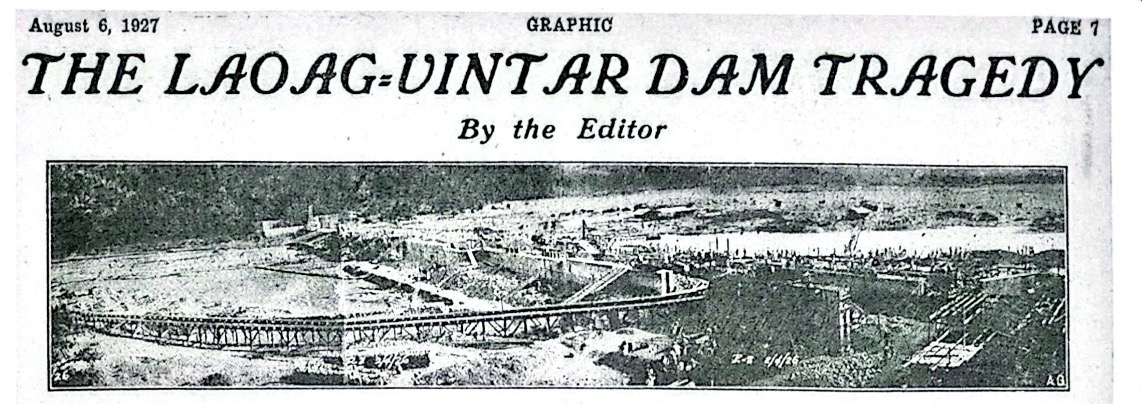
AUGUST 6, 1927 — IF THE Laoag-Vintar irrigation project has proved a disappointment to Representative Confesor and other public officials, it has, so far, proved nothing but a tragedy to the people to whom the government sought to extend a helping hand—the farmers and landowners of Vintar, Bacarra and Laoag, Ilocos Norte.
Long before anybody ever thought of building such a thing as the Laoag-Vintar dam, the farmers of Vintar and Bacarra had their own irrigation systems and were irrigating the larger portions of their tillable land. Happy and contented, they went about their way harvesting crops after crops and happy that after each harvest, they could lay aside a little money which they deposited with the post office or invested in some modest business ventures of their own.
Their old-fashioned rock dams which needed rebuilding after each rainy season, watered fully two-thirds of their rice lands and the bountiful rain in that region enabled them to plant the other third with rice and to reap harvests which were neither too bountiful nor too lean.
Laoag, the capital of the province, is, however, on a higher elevation and although the Laoag river traverses the full length of the municipality, it has too deep a bed that rock makeshifts could never raise its water high enough to be available for irrigation purposes. Of Laoag’s about 2,500 hectares of rice fields, only a little over 300 were under irrigation before 1925.
Laoag Areas
But like the unirrigated, rain-fed fields of Bacarra and Vintar, the entire Laoag area was annually planted to rice and yielded modest and often lean crops. The Laoag rice fields are high in elevation but the source of the Vitar river is even higher. It was therefore conceived that an irrigation system fed by the Vintar river could be extended to Laoag and to its unirrigated areas.
The Laoag-Vintar irrigation project was thus pushed forward, primarily for the benefit of Laoag and incidentally only for Bacarra and Vintar. According to figures from the bureau of public works, more than half of over 600 hectares of Vintar, and about two-thirds of the nearly 3,000 hectares of Bacarra were already under steady irrigation before 1925 and the remaining areas, although dependent on the [rainful], were by no means useless. These unirrigated areas were also yielding crops at a rate of their own.
“There is enough water in the river to irrigate the lands of other municipalities,” the Vintar farmers were told. “It would be plain selfishness not to share this natural gift with Laoag whose rice fields, if irrigated, could make Ilocos Norte a rice exporter over night.”
Where Do We Come In?
But the Vintar farmers were not so altruistic as that and asked, “It is all very well, but where do we come in?”
At which the explanation came: “You will come in this way. Your unirrigated fields will forever be enjoying a steady irrigation which ought to treble your crops. There will be water up to everybody’s neck. Even your old fields which are now irrigated will not be so ungrateful as not to produce more rice and more corn. There will be enough crop to make everybody rich.”
It sounded well. There will no longer be that annual rebuilding of the rock dams and the annual digging of the muddy ditches. Henceforth, these poor farmers will be able to contemplate with pleasure both rain and shine, whereas before, to them, rain meant the blowing off of their rock irrigation makeshifts and shine, the parching of their anemic rice plants in their unirrigated areas. Henceforth or, at least, when the great, big dam is finished, nobody will give a darn. The annual song will be:
Let ‘er rain,
Let ‘er shine,
Let ‘er storm,
Let ‘er parch ‘em
But she can’t parch us no more!
Everybody Happy
One day in 1924, immediately after the dry season set in, the farmers of Vintar and Bacarra set out for a very pleasant job—something next to their heart. The old rock makeshifts were levelled down and the old ditches closed. And they destroyed them and closed them with a feeling of pleasant relief. We can be sure that they did all these with a smile on their lips.
Soon, the big dam began to rise and everyday farmers of the locality were getting happier and happier, not only because of the pleasant expectation of bigger crops in the future but also because they could work as laborers on the rising dam and get ready cash from the government. All was well, indeed!
The rice planting season set in. The dam was almost completed. Water, and plenty of it, was already surging into the vast rice areas of the three municipalities. All available areas were planted to rice. There was water up to everybody’s neck, indeed, and young rice plants in the vigor of their youth were seen in that early season actually trying to crowd out the bamboo and the mango trees from the nearby hills.
And the simple farmers, seeing this unmistakable omen of prosperity, dreamed dreams before they went to bed and woke up with a smile on their lips.
But then, they did not know the half of it!
Good-Bye Dam!
One week early in August, the rain began to pour in earnest. It poured in buckets and it rained cats. But the farmers still dreamed dreams before they went to bed and slept soundly once they got under their blankets. There were no more rock dams to build after the rain and they should worry.
One night, after two weeks of continuous rain and when the farmers were soundly sleeping and the rain actually coming down in torrents, a great sound was heard all over the country side. One half of the big dam gave way and with it the farmer’s predicted prosperity. There was panic, consternation, desolation.
A lull in the rainy season began. The rice fields also began to dry up and the rice plants started to wither. Not only was there practically no crop that year but about a hundred hectares of the Vintar area was turned by the deviated stream into a bed of rocks. With half of the dam blocking the flow of the angry stream, the river naturally jumped off its course and wrought havoc where it pressed. And it passed over some of the richest rice fields in the municipality.
That year, all the rice plants that lived up to harvest time in Vintar and Bacarra, lived on the mercy of the rain and produced a crop that was a poor excuse for harvest time. And the Laoag areas, although untouched by the flood, saw their leanest crop in history.
But where there is a will there is a way, the engineers and contractors told the poor farmers. The plans were altered and rebuilding of the dam followed the following dry season. But the same tragedy was enacted just when the young rice plants were again heralding heavy crop and plenty of cash for all. And to boot, some more fertile areas were either washed out to sea or turned into rocky beds by the raging stream.
Who’s To Blame?
So that the question asked by Mr. Confesor is a question which not only a legislator should ask. It should be asked by every citizen whose money the government expended for building the two dams, and by the Bacarra, Vintar and Laoag landowners and farmers who have been the goats. “Who is responsible for the failure?”
“I believe that each and every member of this house,” said Representative Confesor, “has learned that the dam which has cost the government about P272,000 has been completely demolished by floods and every cent of the P272,000 has gone to waste.”
Yes, and who is responsible for this?
The Bureau’s Part
Either the plans or their execution were defective. Both plans were drawn by the bureau of public works. The first plan was executed by private contractors and the second by the bureau itself. Separate investigations conducted by different committees have since exonerated Gordon and Haley, the private contractors and engineers who build the first dam, so that the responsibility now seems to be entirely that of the bureau.
Emilio Quisumbing, former acting head of the irrigation division of the bureau of public works, and Nicanor Cortes, present head of the division, are engaged in pointing accusing fingers at each other. This is an admission that there is something rotten and that is in the bureau itself.
Mr. Quisumbing alleges that both plans which are now admitted defective, have been drawn by Mr. Cortes. Mr. Quisumbing says:
“It will be noted that both committees (the committees appointed by the director of public works and the governor general which separately conducted investigations to ascertain the causes of the failure of the dam) have separately reached the same conclusion that the construction of the dam in accordance with the plans prepared by Mr. Cortes is not advisable, is hazardous, and its stability and permanence doubtful.”
In regards to the charges of Mr. Quisumbing, Mr. Cortes has submitted the following data to this publication:
“1. Quisumbing was in charge of the irrigation division of the bureau of public works from April 1924 to September 1926 when the Laoag-Vintar dam was being built and when all the unfortunate events connected with that dam occurred.
“2. Quisumbing’s name appears on all the principal plans of the Laoag-Vintar dam.
“3. Construction was done under his supervision.
“4. I received my appointment as chief irrigation engineer only last March, and I became in charge of the irrigation division long after the construction of the dam had been completed, and demolished.
“It is evident, therefore, that Quisumbing wants to pass the buck to me. He seems to insinuate that, as far as the Laoag-Vintar dam was concerned, I, a subordinate of his, could do and did for two years many things which were contrary to his views and methods. And even if this were true, I am at loss to understand how he can absolve himself from something that was going on in his division for a considerable length of time.
“The bold facts are: He was the protagonist in the Laoag-Vintar dam scandal, and he and the project engineer were held by the director of public works responsible for the omission of chains in some of the blocks which resulted in their blowing up in June, July and September 1926 and culminated in the failure of the dam in 1926.
Systematic Attack
“You might have noticed that I have been the object of Quisumbing’s unkind attentions since I have become chief irrigation engineer. He has attacked me in a morning paper several times during the last four months. These repeated jabbings might have shaken the confidence of some people in my fitness to carry on the business of my office. How low down I now stand in the estimation of the public interested in irrigation as a result of the systematic attacks made against me, I cannot tell.
“Nevertheless, I am eager to keep the few remaining shreds of my professional reputation not because I aim to gain social importance and prestige, but because I want to use it as a shield and aid in the uphill fight I am now making for a scheme to rebuild the dam that would redound to the benefit of the people in Ilocos Norte, the country at large and engineering science. I have some new ideas to explain, and I even need in the face of the existing panicky atmosphere, a commanding prestige to obtain a fair hearing.”
There is in this exchange of allegations enough basis for an investigation. Mr. Quisumbing was in charge of the irrigation division and Mr. Cortes was a subordinate engineer when the plans were drawn and executed. Mr. Quisumbing blames a subordinate official for mistakes which happened within his division. There is something rotten in Denmark.
In the face of the Confesor-Quisumbing-Cortes disclosures, the legislature is duty-bound to conduct a thorough inquiry into the matter. And in fixing the responsibility and in righting the wrong committed, the victims, the farmers and landowners, should not be forgotten.
They will pay back to the government for the irrigation dam when finally completed. How much of the money thrown away through defective plans and unfaithful execution as alleged by Mr. Cortes, will these people be required to pay? Will they get fcompensated for the areas which were either washed off to sea or turned into rock beds because the government through its agencies, has been careless and inefficient?
The Confesor investigation, if started, will fall short of its mark if it will not inquire into these rank injustices committed incident to the inefficient and scandalous handling of the Laoag-Vintar project. — Vicente Albano Pacis, Graphic editor
NOTE: This article first appeared in the August 6, 1927 issue of the Graphic magazine.
MORE ARTICLES ABOUT THE LAOAG-VINTAR DAM:
These articles are taken from the archive of the Philippines Graphic.
- ARTICLE: The Laoag-Vintar Dam Tragedy (by Vicente Albano Pacis, published August 6, 1927)
- EDITORIAL: The Laoag-Vintar Dam Scandal (by Vicente Albano Pacis, published July 30, 1927)