
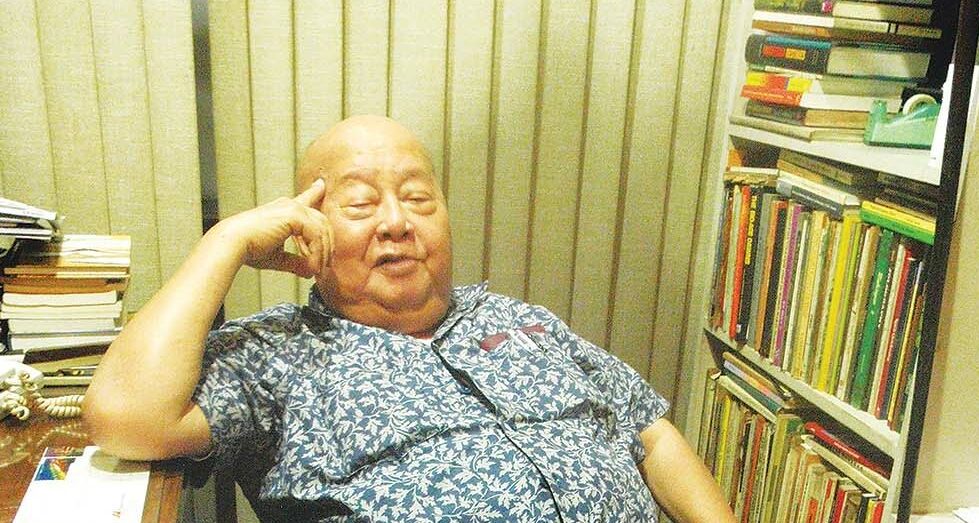
On the last day of his 97-year stay on earth, National Artist Frank Sionil Jose wrote about the Philippines and his hometown of Rosales, Pangasinan in his Hindsight column in the Philippine Star.
In the words of his son: “He did what he loved the most—write about his beloved country and hometown, Rosales. He told us that he wanted his epitaph to simply read: ‘He wrote stories, and he believed in them.’”
The Philippines Graphic is proud to have published some of the original works of F. Sionil Jose or “Manong Frank,” as the Graphic came to fondly call him with the passing of the years.

As recalled by ALC Media Group Chairman D. Edgard A. Cabangon: “My late father, Ambassador Antonio L. Cabangon Chua and the late National Artist Nick Joaquin, both cherished literature. They vowed to nurture excellent literary works in the pages of the magazine.”
This commitment opened the Graphic to the world of Filipino literary writers and Manong Frank—through years-long camaraderie with Graphic editors, its publisher and executive officers—went out to support the magazine by way of his presence in the Nick Joaquin Literary Awards (NJLA).
He was already in his 90s, when the younger staff of the Graphic got to know him. Wearing his signature cap and carrying a wooden cane to steady his measured gait, he’d come to the NJLA together with his beloved wife, Manang Tessie.
And when the pandemic first struck in 2020 and the Philippines Graphic had to go through the most difficult hurdle of sustaining its operations, Manong Frank gamely stood by the Graphic—accepting to be the speaker for its Nov. 30 webinar on Literature, “How’s your soul quotient? The state of Philippine Literature in the time of pandemic.”

in the Arts student, Hermosa National High School in Bataan; Educators Ruzzel Mallari, Secretary of the University & Associate Dean of the University of Nueva Caceres-Bataan; and Nora Babalo, Principal of St. Jerome Emiliani School, Dinalupihan, Bataan
Manong Frank even went out of his way to suggest and thereafter, gain the acceptance of the two reactors to the forum: Multi-awarded poet, fictionist, and academician Jose “Butch” Dalisay and veteran journalist and literary & film critic Lito Zulueta.
Philippines Graphic and BusinessMirror publisher T. Anthony C. Cabangon said that the Graphic made history for being the first magazine to launch a webinar on literature during the pandemic. And this was made possible through meetings and consultations with Manong Frank.
For all the misfortunes emanating from the COVID-19 pandemic, one definite, positive result came out. Suddenly, distance was not an issue, making the webinar an unqualified success.
Senior high school students from schools as far north as Sta. Ana, Cagayan to as far south as Maguindanao in Mindanao watched the webinar.
Among those who registered were students from the Jose Rizal Technological University, University of Nueva Caceres in Bataan, Franciscan College of the Immaculate Conception in Leyte, Holy Spirit Academy of Malolos in Bulacan, Notre Dame of Lambayong, Inc. in Maguindanao, Saint Anthony’s College in Sta. Ana, Cagayan, Saint Joseph College in Southern Leyte, Saint Mary’s College of Quezon City, Saint Thomas Aquinas College in Leyte, San Beda University, St. Bridget School in Quezon City, St. John Paul II College of Davao in Matina, Davao; St. Joseph’s School of Mactan in Cebu, St. Jude Catholic School, St. Mary’s Academy of Carmen in Cagayan De Oro, St. Paul College Seminary in Cavite, St. Paul University in Manila, St. Peter The Apostle School in Manila, St. Peter’s College of Ormoc in Leyte, Sta. Teresa College in Batangas, St. Theresa’s College in Cebu, University of the Philippines, Polytechnic University of The Philippines, and the University of Sto. Tomas.
It was the most successful webinar launched by the Philippines Graphic to date, garnering 8,500 views, 437 likes, and 247 comments. And it was not the last time that Manong Frank would show his support for the Philippines Graphic.
In July 2021, six months before his death, F. Sionil Jose wrote for the Graphic an incisive essay on politics and the presidency—from the time of Emilio Aguinaldo to the time of Pres. Rodrigo Roa Duterte.

The essay, when uploaded, was not boosted by Facebook, perhaps dismissing it as a political endorsement. It was not.
On page after page of the essay, the then 96-year-old National Artist for Literature revealed his thoughts and impressions, with the authority and wisdom of one who had witnessed and lived through 16 presidents, including the last years of Pres. Aguinaldo.
F. Sionil Jose was laid to rest at the Libingan ng mga Bayani on January 18, 2022. As the Graphic bids him adieu, we recall a happier time in 2020, when the organizers, participants, and guests of the Philippines Graphic webinar on Literature greeted him “Happy Birthday” in advance, singing a rousing “Happy Birthday” to our Manong Frank, on National Heroes Day, Nov. 30, 2020.