

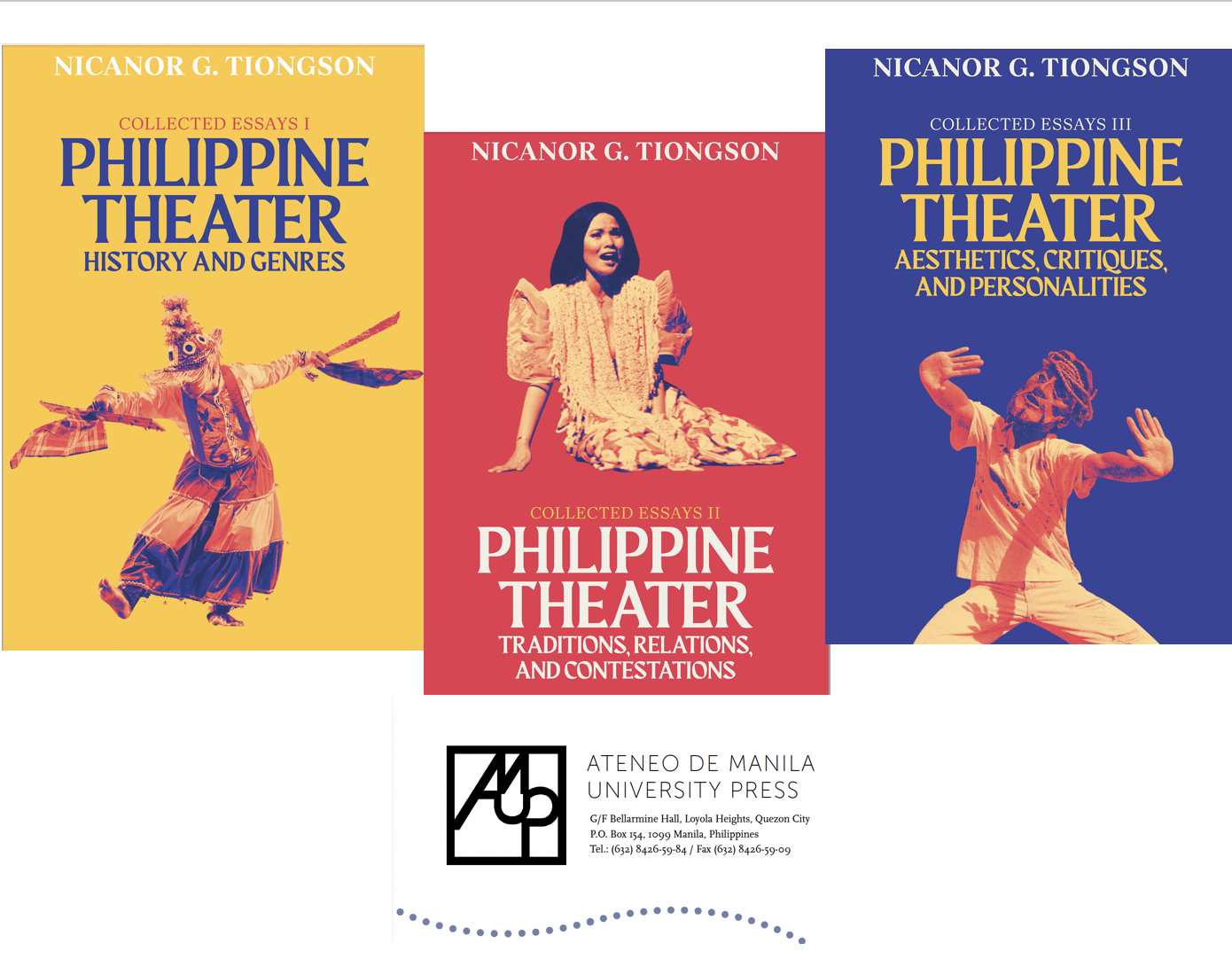
A book launch will be held at Gimenez Gallery, University of the Philippines-Diliman on June 17, 2024, from 3 p.m. to 7 p.m. The event will be hosted by Missy Maramara and Anril Tiatco, and will include speeches from notable individuals in the fields of theater and literature. All theater lovers are welcome to attend this momentous occasion.
Nicanor G. Tiongson’s Collected Essays Volume I, II, and III are ground-breaking contributions to our understanding of Philippine theater.
A theater scholar and critic and playwright, Tiongson is professor emeritus at the UP Film Institute, College of Mass Communication, University of the Philippines, Diliman.
Coming out this June, his Collected Essays are an astonishingly comprehensive collection of writings on Philippine theater—unraveling in three volumes its history, genres, traditions, relations, contestations, aesthetics, critiques, and personalities.
These forthcoming titles from the Ateneo University Press are the culmination of decades of research and practice. The books delve deeply into the threads that bind the theater of the past to the present, as well as the immense potential and irrepressible hopes for the theater in the future.
HISTORICAL APPROACH

Collected Essays I: Philippine Theater History and Genres compiles essays devoted to the exploration of Philippine theater genres that have been performed and transformed numerous times for centuries. When society changes so does theater.
As such, Tiongson uses a historical approach to explain the development of each genre as it is influenced by shifts in the sociopolitical atmosphere, emphasizing how they became avenues for the expression of agency across the ages.

Collected Essays II: Philippine Theater Traditions, Relations, and Contestations is composed of essays discussing plays and productions that indigenized foreign genres and contemporized historical narratives, thereby revitalizing them for a modern Filipino audience. It draws focus to the progressive messages imbued within many of these works as they artistically mirror current national realities and tragedies.

Collected Essays III: Philippine Theater Aesthetics, Critiques, and Personalities begins with essays that propose four different approaches to the analysis of theater performances, with “Kamalayang Pilipino na maka-TAO” deemed as the most
important as it evaluates whether a work advocates for the holistic growth and protection of human rights. The second section assembles decades’ worth of reviews on theater performances and books. The last section spotlights certain people and groups, and the indispensable role they played in the cultivation of Philippine theater.
PRIMACY OF RESEARCH
Virgilio S. Almario, Pambansang Alagad ng Sining sa Panitikan praises the author for the tireless efforts toward the greater understanding and appreciation of Philippine theater: “Narito ang isang iskolar na matiyagang maghalungkat sa mga aklatan at artsibo ng mga maaalikabok na libro at dokumento; narito ang iskolar na handang lumabas ng akademya para tuklasin ang mga bakas ng lumipas sa mga lalawigan [Here is a scholar who patiently researches in libraries and archives, in dusty books and documents; here is a scholar ready to leave the halls of the academe to trace the past in the provinces].”
The sentiment is echoed by Apolonio B. Chua, Professor Emeritus at the College of Arts and Letters in the University of the Philippines Diliman, who states that “the essays in this trilogy illustrate the primacy of research as the scholar’s contribution and participation in laying the foundation for the full development of our national culture and, with it, the full flowering of our people’s humanity.”
These books offer an exceptionally rich and in-depth view into the inner workings of Philippine theater—how it can be studied, how it can be more profoundly enjoyed, and how it can be employed for the amplification of marginalized voices and forgotten stories. The Collected Essays are crucial reading materials for theater enthusiasts, theater professionals, theater scholars, and anyone who, in the words of Ramon P. Santos, the National Artist for Music, is “seriously interested in Philippine theater—and culture.”
Collected Essays Volume I, II and III are now available for pre-order, and will be available for purchase on Ateneo de Manila University Press’s official website, Lazada, and Shopee stores on June 18, 2024.