

There was pain, lots of it. And it seared. It felt like fire, or like being eaten alive. Vincent screamed, using that one scrap of energy he had left to aim the dartgun at the sheath of Pretenders making their way up his leg. They had mimicked the form of the bluespheres from the dartgun, and had weakened as a result of it, but still they were dangerous. His leg could fizzle into dust anytime. And so he pulled the trigger. The bluespheres dispersed again, light blue orbs chasing the clumps of originally invisible beings that had been threatening and killing them on this sandy planet for years. The bluespheres pierced through that same leg, like bullets, pain over pain. Then he blacked out.
When he woke up, he was at the infirmary of the Bathala Station. His leg was wrapped in a tight bandage, but the pain was gone, replaced by an unnatural numbness. Hovering over Vincent’s bed were Doctor Nilda, two nurses, and Captain Patrick San Jose, whom Vince fondly called “Pat” when they were out of duty. Otherwise, he called him “Sir Pat.” Nobody else was allowed to.
“So, Nilda, I believe this means he’ll be alright?” Sir Pat was saying now, and beside him, the head doctor nodded.
“His leg took a bad hit,” said Dr. Nilda. “But he’ll be fine, Sir Patrick. We managed to regenerate his nerves and muscles. The bluespheres were found almost all the way down to the bone, though, so it took us quite some time to extract them – even the dead Pretenders.”
“But they worked against the Pretenders, and that’s the main thing,” replied Sir Pat. “You may be excused, Nilda, and the rest. I’d like to talk to Vince, alone.”
They nodded. No one dared to question Sir Patrick in this station. As soon as the others had left, he drew the curtains around Vince’s cot and pulled a chair next to his bed. Vince opened his mouth to say something, to tell him about how he could improve the weapon he had devised, the latest of his inventions in their fight against the Pretenders—but his throat was dry, and no words came out. One thing was for sure, though. He had failed yet again. But they were almost there. Getting closer. Nearer to their goal of defeating the Pretenders—if only by an inch.
“You’re getting closer,” Sir Pat beat him to it, as he always did. “I saw everything. A few seconds faster, and we’d have the ideal weapon we’d been dreaming of the past five years.”
“We’re still dreaming,” muttered Vince, but as he tried to push himself up into a sitting position, he winced at the pain. He fell back on his pillows. “It wasn’t enough. Let me go try again.”
“No,” said Sir Pat, stopping him with his hand. “Rest. This is an order.”
“Guess I’ll use all this time in bed coming up with ideas on how to make the dartguns faster,” said Vince. “But how’s everyone? Was anybody else injured?”
“Everyone in the Defense Department is accounted for,” replied his superior. “We didn’t even have to call for back-up from the other departments. And you were the only one who was seriously injured.” He smiled broadly. “This ingenuity—this ability to make quick decisions— this is why I chose you to be second-in-command of this ship.”
The ship, now a station stranded on a strange planet in space, once housed two hundred people, all Filipinos. But thanks to the Pretenders – the invisible, shape-shifting alien predators who could mimic both organic and inorganic materials – the population of this maiden mission had dwindled into eighty-eight. The worst part of all was that the Warp they had traveled through from Earth had disappeared, and for almost a decade, there was no communication from other human beings within the vast reaches of the universe. This led to the horrifying realization that they might be what was left of an entire species, the remaining vestige of humanity.
Not everyone believed that, though.
“Any news from Comms?” Vince asked.
“None,” Sir Pat replied grimly. “Radio silence, as always. But again…we’ve survived by not straying from the safe side.”
Every day and night—for they still used Earthling calendars despite the eternal darkness—the Communications Technology Department searched the skies for any sign of life, preferably human. They kept observing signals and patterns and sending out distress messages with the help of an advanced and highly-protected telescope that also defended them from the Pretenders. Vince was close friends with many from this department. He didn’t believe that the Warp had disappeared, or that the energy used to travel through it had destroyed Earth and all the human settlements in its solar system. That was the main difference between CommTech and Defense and Order—most people from either department could not see eye to eye.
Sir Patrick was different. Vince knew him enough to tell when what he meant didn’t really match the facade he showed to his subordinates. “We must exert all of our efforts and forces in defeating the Pretenders, and preserving humanity,” he would tell the eighty-seven others to prep them up; but deep inside, Vince could tell that he was dying to convert the Bathala station into a ship once more and take them elsewhere—a safer planet, another warp, or even back to Earth, once they got a signal. Sir Pat wasn’t entirely sure that they were the last of the human race. Nobody was.
“Do you need anything else, Vince?” Sir Pat went on. He was gazing right at Vince with deep, steely eyes, but underneath the severity of his gaze there was the glistening of tenderness. He cared. A surge of warmth filled Vince’s heart. “No. None at all, Sir Pat.”
The tenderness stayed. “Alright. Just use your hand-monitor to ring for the med people if you need them.” Sir Pat started walking towards the door.
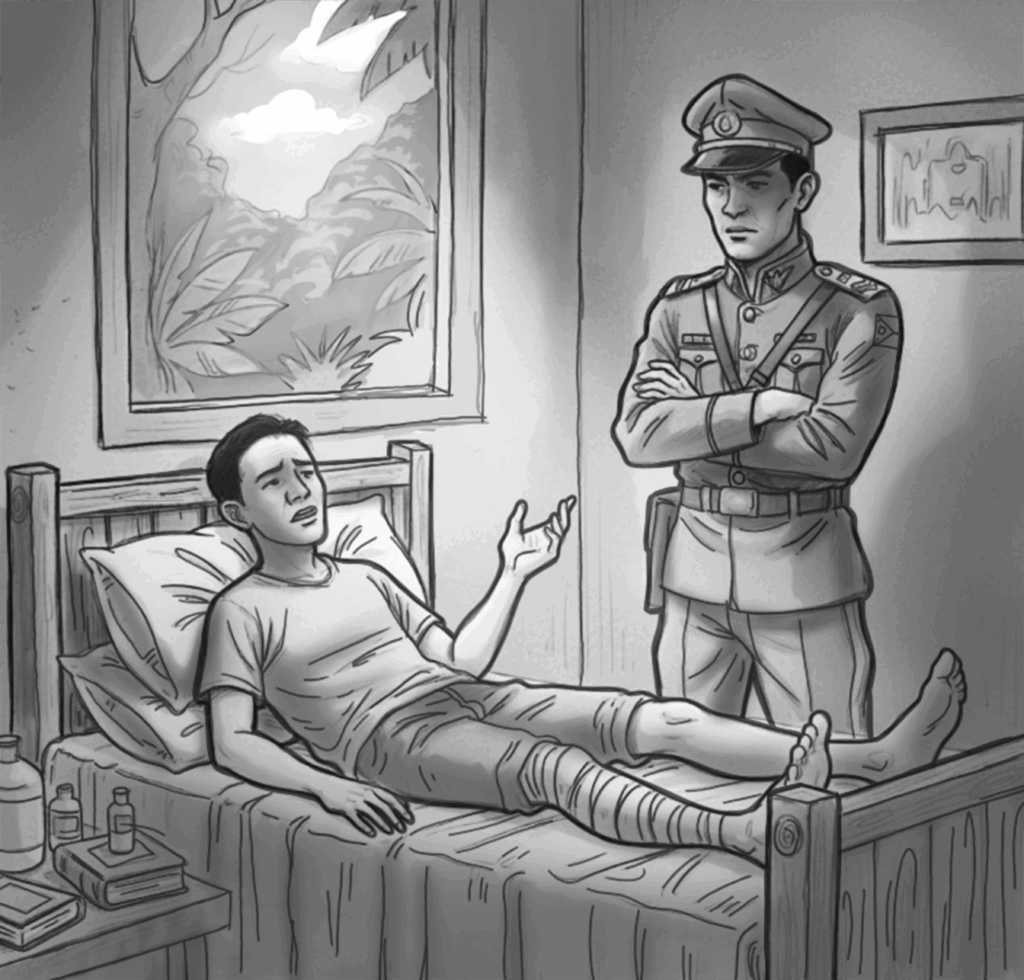
“Wait!” Vince reached out his hand to stop him. A huge mistake. The pain shot through him from his fingertips to his left shoulder, and he sank in his covers again. “That, too?” he groaned. “I need to work. I need to get well and work now.”
“You are going to rest, and that is an order!” Sir Pat’s voice was severe, the same tone he used to other subordinates, the ones who were not as intimate with him as Vince was. The latter went silent. He didn’t want it—the silence, the solitude. The ugly memories and intense loneliness that came with total darkness or the stark whiteness of the walls.
“Just sit next to me,” Vince said. “Everything hurts. It hurts worse when I’m alone.”
Sir Pat sighed, and it was a tone he used for the younger ones—the trainees, the children. “Do you want me to stay with you here for a while?” he asked. “Take note, you’re not the only one who needs me. The moment I’m called for something urgent, I’ll leave you behind—with the door open and all.”
Under his blanket, Vince was wearing nothing but his underwear and a thin hospital gown. His left leg was wrapped in bandages and propped up on a stiff pillow. He realized that the pain coming from down there was because of a catheter—meaning that he couldn’t even go to the bathroom on his own. He hated it, feeling so exposed, even though he had experienced much worse injuries in the 3rd World War years and years ago, before they all left Earth.
“Well,” Sir Pat said, with another sigh, “I might as well hit two birds with one stone since you don’t want to rest. Or, rather, two Pretenders with one bluesphere. What was it like? Do you have any suggestions, as early as now, on how to make it better?”
“I thought you wanted me to rest!”
“I thought you didn’t want to rest!”
“Maybe, maybe not. Either way, I wouldn’t be able to think clearly in complete loneliness. You’re right, though…” Vince thought for a moment, his voice dropping to a sad whisper. “The slingshots. The arrows. The darts and guns, before we combined them. All of these failed because the Pretenders were able to imitate their forms and use them against us before we could make a strike. Until, during that Great Battle, we realized…”
His voice trailed off, and his thoughts were reflected in the sadness in Sir Pat’s eyes, as he sat on the stool beside his bed. That “Great Battle” was when most of the Defense and Internal Order, along with reserves from the four other departments, died. Even one teenager, 17-year-old Julian—a trainee at the Defense Department—died from a Pretender mimicking a bomb. He was the youngest victim in the history of their eight-year stay on the planet. They all sacrificed themselves to protect their home base and everyone who lived in it.
“Blue,” Vince said. “Until we realized the weakness of the Pretenders. Light blue. The same hue of a daytime sky back on Earth.”
This led to the invention of the bluespheres. The Pretenders would morph into bluespheres upon making contact, then die. On the spot, as imitation bluespheres. Then the survivors would use the former Pretenders-turned-bluespheres as extra ammunition against their kind.
“You know, whenever I see a bluesphere,” Vince continued, “I think of Earth. I can’t help it. We had everything but we ruined it.” He paused. “We were supposed to be here for only five years.”
Sir Pat nodded in agreement. “And we accidentally killed everybody else in the process.”
“Do you really believe that? That everyone on Earth, the settlements on the moon and on Mars are gone because we went through the Warp?”
“That again?”
“Isn’t it worth looking into? Or at the very least, trying? We’re not welcome here, Sir Pat. No number of bluespheres can make the Pretenders go away. We can keep them under control but we’ll always be in survival mode! I don’t want the juniors and the kids at the Station to inherit this kind of life! If humanity has to go extinct, I want us to at least spend our last years in peace.”
Sir Pat closed his eyes. “Not again, Vince. This is why you keep on getting hurt.”
“In the Pretenders’ eyes, Sir Pat,” went on Vince, without fear, “we are the Pretenders. Us. Humans. We’re the ones who came to their home planet and built a base. Yes, we did it for research. No, we had no idea they were here. But at the end of the day, this is not our home. It’s theirs.”
“How were we supposed to know that they even existed?” Sir Pat said. The Philippine Space Authority, years and years ago, sent rovers in and out of the warp to collect data and ensure that future missions would be safe. It wasn’t until the Bathala crew landed that they came across their invisible enemies.
“We are a bigger shock to them than they are to us,” Vince said. “I guess, more than anything else, that’s why I want to go away.”
“You always want to go away,” said Sir Pat. “Always. You’re on the move, like you’re looking for a very specific place that doesn’t exist. You were like that in our military days. On Earth. Even here.”
“It’s the loneliness I want to escape,” Vince replied. He turned to Sir Pat, who was looking at a porthole that showed the vast agricultural land encircling the base, and the protective paneled dome that showed a clear night sky. “The loneliness in my mind.” He put his hand on Sir Pat’s, which was holding the bar beside his infirmary bed, and the latter looked at him in surprise.
“I forget that I’m lonely when I’m around you,” Vince confessed, and then waited. Sir Pat, despite his deep empathy and concern, was a man of steel, always hiding his emotions under a shield of strict orders. And although everybody knew what was going on between him and Vince, nobody dared to say it out loud. Not even the two.
But that was starting to change.
A flicker of tenderness passed through Sir Pat’s eyes, then it disappeared. He coughed, then straightened up. He had once again assumed the air of a captain, with his shoulders broad and his jaw set. “All of us are lonely,” he said, his voice grim. “Until we realize that we have to make do with what we have. It’s trying that’s making us lonelier than ever. Believing in what isn’t there.” He glanced again at Vince. “We need to see what is here, what is here right now.”
“I see you,” Vince said. “And the pain in your eyes that you insist on hiding.”
There was an awkward moment of silence. Then, quite unexpectedly, Sir Pat laughed. “I keep on thinking how funny and strange it is,” he said. “That the loneliest day—the worst moment I survived in World War 3 was nothing compared to an ordinary day out here, on this planet, all alone in the universe. But then I realized something.”
“What?”
“We were always alone,” he went on. “Always have been, even on Earth. For millennia, we wandered our home planet searching the skies for any companions out there. Is that any different from anything we’re doing now?”
“Well, the Pretenders –”
“They’re pests, so they don’t count. My point is: There’s no change. On Earth, we’d been struggling to survive, thinking that our numbers might help us from hostile forces—our climate, for instance. The Cold War that was still going on when we left. And yes, as you mentioned, the Pretenders now. So, there’s no use, really, searching for allies from different planets. For what our planet once was. Our numbers won’t help. They’ll just aggravate the problem.” He sighed. “But, yes, of course it hurts. All the people we’ve lost. And the history.”
Vince slowly nodded, trying to understand even if he didn’t really agree.
Then, after another silence, Sir Pat said, “Do you regret it?”
“Regret what?”
“Your being here was my fault, at the end of the day. You didn’t have to be part of this mission at all.”
“Maybe, maybe not,” Vince said, surprised at how bold he was. He paused. “I was younger than most in my rank, and you chose me to be your second-in-command.”
“True.”
“You never told me why.”
“You had everything that I needed—intelligence, quick-thinking, compassion, and above all—” He smiled, placing his hand on top of Vince’s. “And above all, honesty.”
Vince did not squirm away. “It was an honor then, as it is now.”
“But you do have regrets.” Sir Pat was looking at him closely, unquestioningly. Vince said nothing, but neither did he pull his hand away from Pat’s. He simply blinked back tears and turned his gaze to the other side. The porthole was the only window in the room and it showed the farm and a bit of their station’s dome under the sky.
How far away they were from everything and everyone else! How small they were on this strange, cold, dust-filled planet and dark, mostly unexplored universe. “Is it all gone, everything and everyone we ever loved?” he murmured to himself.
“Come again?” Sir Pat asked.
Vince refused to look at him. Instead, he shook his head. “It’s useless to regret,” he said, in a much clearer voice.
“I have my regrets,” said Sir Pat. “All of them have led me to where I am right now.”
Vince looked at him. “What?”
“Oh, don’t get me wrong. It wasn’t a mistake, choosing to lead this mission.” Sir Pat’s smile had a sad tinge, and his eyes were suddenly soft and distant.
“Even if you believe that we’re the only humans left out there?”
Sir Pat shrugged. “That’s what I believe right now,” he said. “Never said that I won’t change my mind upon presentation of evidence.” He sighed, then got up from his stool. “Alright, that’s enough chit chat. I have to check on everyone else in this station.”
Vince nodded. “I understand. Thanks for taking the time, anyway.”
Sir Pat waved his hand in dismissal and exited the room. He walked down the hallway, greeting those who passed him by, and then stepped out of the station, into the agricultural fields, under the translucent dome that showed the bright dots of galaxies that they might never be able to reach. Maybe one of those was their original home, the Milky Way. And Earth.
Nobody else was out as it was past curfew. Some of them were assigned to do night duties inside the station, but everyone knew that their captain liked walking alone in the dark as a way to cope with stress. Nobody questioned him on it. And now, he slowly walked along the circumference of the dome, just thinking and remembering.
In particular, he remembered the first time that he thought he was going to die.
That was decades ago, 2095 to be exact, and at that time the third World War still had one year left to go supernova. For five years it raged on in four different areas– land, water, air, and space – and it was, as usual, about borders. Who claimed what and where, although it was clear, to the soldiers and their families at least, that the only things truly being claimed were human lives.
Patrick, then 26 and a newly-promoted senior lieutenant, was surveying a portion of the Philippine territory on their Martian base. It was a routine inspection, just to ensure the higher-ups that their security systems were still up to shape. Patrick remembered settling back on the seat of his jet as it whirred through the deserts and valleys, dodging sharp peaks and jagged mountaintops. Behind him were several other jets, four on each side, forming a V-formation. A few other squads surveyed the area.
A message from their Colonel broke the routine, alerting everyone through their monitors. A portion of the area that was normally sealed off had a torn fence. Can one of the squads give it a look? Patrick checked the dashboard. Three top squads were chosen for this particular task, but theirs was the ones closest in proximity to the area in question. As the squad head, Patrick was used to thinking quickly. “We’re going there,” he told his squad mates, repeating the coordinates.
“Roger,” they all obeyed through their microphones, and their jets followed his.
They dispersed from the other squads and flew to where they were directed. More unevenly-spaced valleys and mountain tops jutting from a barren, red wasteland. Mars hadn’t even been fully terraformed, and people were already fighting over it.
A notification alerted Patrick, taking him off his thoughts. It’s from his second-in-command, Devon, who also happens to be his boyfriend. (Every night, Patrick thanked God that the government had abolished the laws on military fraternalization by the time he entered.) “Yes, Devon?”
On the other end was cacophony, the sound of wind whipping from all directions, unusual for inside a protected cockpit. And static. Then Devon’s voice, eerily calm, as he was trained to be for situations like this. “Sir Pat,” he began. He was the only one allowed to call him that. “Sir Pat, may I–may I eject?”
“What’s the matter? What’s going on?”
“I—one of my engines lost power.”
“Use the reserve.”
A pause. A beep. “It’s not working, Sir Pat. I’ve been trying to activate it even before I called. I really have to eject.”
“Devon, really, now? We’re so close to enemy territory.” Patrick clicked his tongue in annoyance. Squad mates did not leave each other. If Devon had to eject, then Patrick would have to call off the mission and ask the higher-ups to send another squad to the compromised border.
“Alright,” Devon said. “I’ll eject, but you guys can go ahead to the border.”
“Are you giving me orders, Devon? And this is a surprisingly stupid one, especially from you!”
“Pat, listen. I’ve been noticing strange lights. Behind me, to my right.” His voice was still choppy, the wind hadn’t tamed down the slightest bit. Patrick could hear Devon strapping on his parachute, preparing for ejection. “This is no routine inspection. Now let me go before I endanger the rest of you.”
“What?” Patrick had not detected any lights, nor any other suspicious activity, in the skies around him, but then again, he’d been too focused on his monitor. He turned to his right. Barely visible from his windshield, through the rust-colored haze were rows and rows of round-shaped white lights, far too bright to be organic.
Patrick tried to keep calm. He pushed a button on his monitor that would alert the higher-ups to send back-up. Then he returned to Devon. “Are you still there?” he asked. “Devon? Devon?”
After what seemed like forever, Devon replied. “About to eject.”
“We’ll tail you.” Patrick then ordered the other squad mates to surround Devon in a diamond formation. Patrick knew that they’d be a dead giveaway to the enemies, but that would also buy Devon enough time for back-up to arrive. All the other squads had to do was arrive on time before a dogfight ensued—
The lights were coming closer.
And now, in the present day, in the calmness under the stars, Patrick closed his eyes. He did not want to remember anymore. Even though he always did.
Devon, you saved us all that day, he told the stars, his mind taking him to other thoughts.
Years and years later, when a 27-year-old lieutenant Vincent Ong was assigned to his squad, Lieutenant General Patrick San Jose would look at him and freeze in shock, as if he’d seen Devon’s ghost in this petite young man with serious, deep eyes. But this was ages after the war. During the war, Patrick was just a colonel, and in love with another young man who would always look up at the stars. The same young man who would always tell him, in those rare, quiet, and lull moments between battles, that should they ever be parted, they would still be connected in a way by looking at the night sky. Patrick was looking at the sky now, still talking to Devon. “You went too far, my love,” he whispered. “That’s what got you in the end. If we win this battle, it will all be because of you again. You, in the form of another equally reckless person. But if we lose…” He sighed. He had now stopped in his tracks, arms crossed. “If we lose…no, we won’t. We won’t. I won’t fail you again.”