

If Moudifa stands as a possible indication of what might come to Philippine theater, then the future of Filipino artistry will be as stale as this AI-generated musical
What is true artistry? Ever since the boom of generative artificial intelligence (AI) a couple of years ago when DALL-E and ChatGPT made it easier to be an “artist,” the debate over the use of AI in the arts has never stopped. Many lambasted generative AI for touching the sacred arts, while some are jubilant and unapologetic about using it.
It would seem that Margarita Marquis, the composer and author upon which the musical Moudifa the Musical: A Filipina’s Journey Beyond Borders is based upon, falls on the latter category.
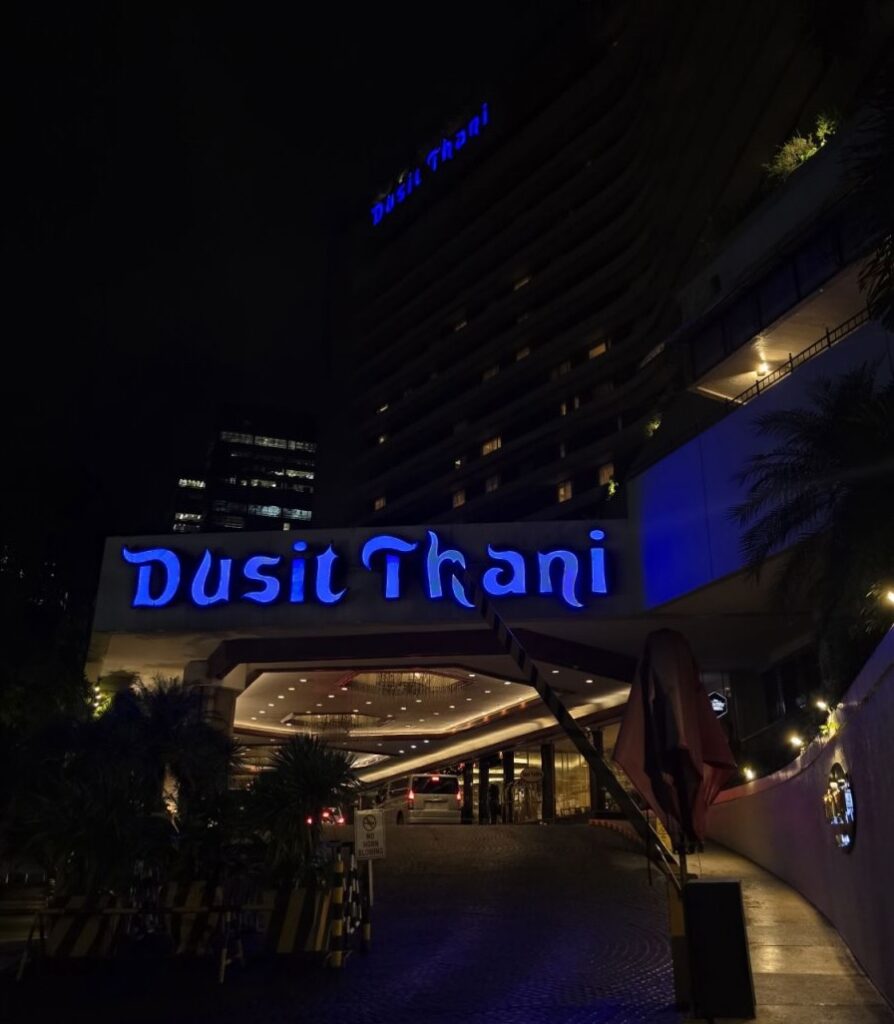
Moudifa held a press preview for select guests and publications on Nov. 4 at the RJ Bistro in Dusit Thani Hotel, Makati.
Based on Marquis’s 2007 book Moudifa!:Culture Shock from the Top, the story is set in the 1980s and follows the titular Moudifa, a Filipina flight attendant working in Saudi Arabia, whose life over the years will be shaped by her romances with four different men: the pilot, the prince, the French man, and the football player. It will be directed by renowned filmmaker Jag Cruz.

Angie Bonnevie as the older Moudifa
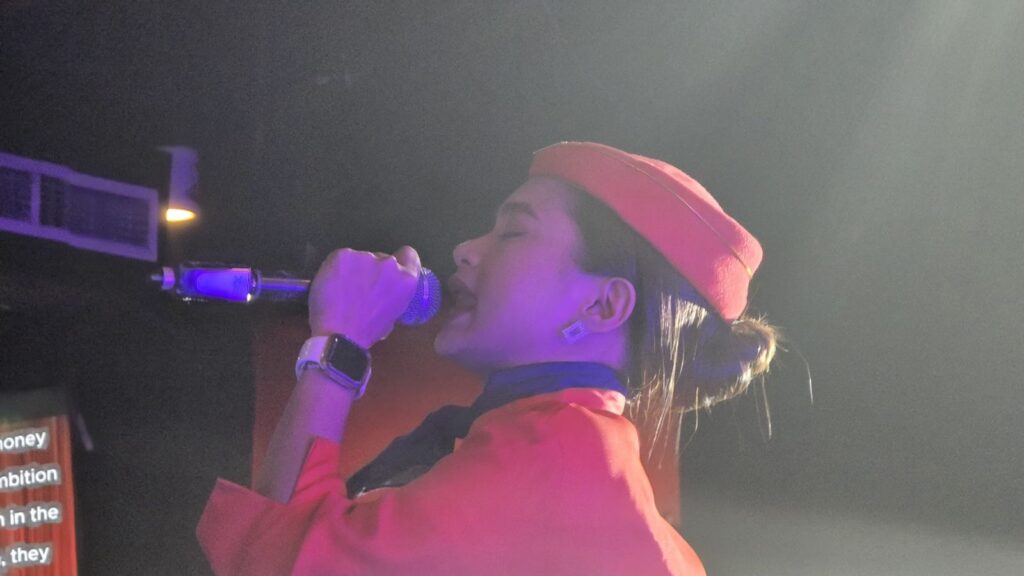
Jassy Calupitan as the younger Moudifa
The younger Moudifa is played by VIVA artist Jassy Calupitan, while the older Moudifa is played by long-time theater actress Angie Bonnevie, who had worked for the Philippine Educational Theater Association (PETA). Ryle Mendez plays as the pilot, while Ferdie Petrasanta plays the French Man. The Prince, and the Football Player, meanwhile, are portrayed by Yuan Fuerte and Genesis delos Santos, respectively.
I initially expected a full-blown musical production. Though the location did give me some doubts about the production quality, I nonetheless thought that it will be a well-oiled performance.
But it was barely passable as a musical.
They previewed some of the songs, all of which were forgettable and plain. Except for the chorus of one song, which I only partly remembered because it sounded quite similar to Let It Go from the 2013 Disney movie Frozen.
Most of the actors’ performance were poorly-done lip syncs, and every now and then they would forget a dance step or where they should stand.
It was, for the lack of a better term, a scattered performance, comparable to a high school group project.
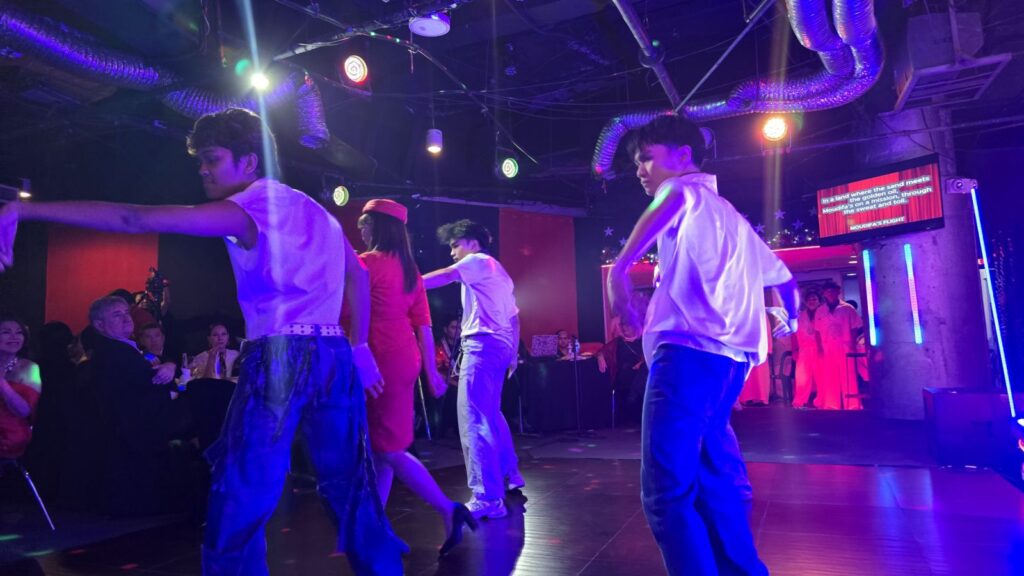
The older Moudifa performs with a dance crew
It was not entirely the cast’s fault. During a short press conference, the cast revealed that they rehearsed the performance for only a week.
Out of the six actors, three of them said that this was their first time performing in theater.
Based on their performance alone, it was obvious that they lacked experience, but kudos to them for giving a hundred percent effort to make up for it. The fact that they were able to make it passable speaks highly of their effort and respect for their craft.
“MODERN AND AI”
Margarita Marquis says of the musical: “Moudifa is not just my story — it’s every Filipina’s story. It’s a tribute to all women who have sacrificed comfort for family, love, and purpose. Through music and art, we remind them of their worth.”
A great and worthwhile aspiration, no doubt. Cruz mentioned of their dream for Moudifa to become the Philippines’ very own Miss Saigon, the internationally renowned 1989 musical by Claude-Michel Schöenberg and Alain Boublil, whose story seems to have inspired Moudifa in some ways.
This is also where the praise starts to falter, because that is as far as the Moudifa musical had any respect for its medium.
During the press conference, Marquis revealed that she had, by her own admission, “created” more than a hundred songs, but selected only 14 songs for Moudifa.
“I get the idea from my heart, and the music and the song from my heart,” Marquis said.
The music was bland and lacked any interesting flavor. I initially attributed it to poor music production. The lyrics were no consolation, either, as it was on par with a Grade 10 English assignment. I had seen more language skill in street vandals than I did in Moudifa. Not a single lyric line was remarkable and none bears any depth or human truth.
The only breath of humanity there was in these songs were the actors performing them.
When a reporter asked about her creative process for making the songs, Marquis paused and said: “Modern… and AI.”
They briefly laughed at her joke. Marquis was dead serious.
She continued: “[AI is] The future of music. Do you know that? Mawawala lahatng singers [All singers will be gone]. I’m sorry. AI will take over. That is for sure… That’s reality. I think you know that.”
By then, the air had thickened. In a couple of tables, small conversations brewed over her statements.
After a short while, Marquis followed it up: “But the lyrics are my lyrics. AI will never say, ‘I will do it for you.’ You let AI follow you, not you follow AI. You let AI follow the human.”
I wish to remind the reader that she said these things in front of her cast—all of whom are artists in their own right—who worked their heart out for their craft and for this production.
What makes the wound even more searing is the fact that before this question was posed, the cast was introduced and all of them had been striving for their craft out of love and passion.
No wonder the music sounded soulless and lacking any genuine depth: the music was made with prompts and a steal machine.
[AI is] the future of music. Do you know that? Mawawala lahat ng singers. I’m sorry. AI will take over. That is for sure… That’s reality. I think you know that.
Margarita Marquis, composer and author
More than that, the composer had not enough respect for the craft that she resorted to asking a machine to make something human for humans.
In their press release, the Moudifa production mentioned that one of their objectives is “to celebrate Filipino creativity, bringing together talented local artists and musicians who make the country proud on global stages.”
But is this not the perfect insult to the artistry of those who put in the effort to make music to use generative AI, and further claim that all singers in the future will be gone? Had we reached a new low for Philippine music, if ‘musicals’ like this one takes the stage?
AI, FILIPINO CREATIVITY
To guide the uninformed, generative AI models need huge amounts of data to work properly and showcase any semblance of intelligence.
Major AI companies scraped data off the internet without anyone’s consent and trained their models on data that had been stolen from real people—artists of all kinds included—right under their noses.
In 2024, giant music labels such as Sony Music, Warner Music Group, and Universal Music Group sued various online music AI generators for copyright infringement.
Is AI-generated music then the appropriate way to celebrate “Filipino creativity”?
Marquis had more or less argued that AI is comparable to human because it has, according to her, has a soul.
She said: “At the beginning, hundred songs I created with AI… Sabi nilang lahat, walang soul daw siAI, di’ba? [They all said that AI has no soul, right?] After 50 songs, AI is following my feelings, my soul! I said, okay, ‘AI, can you cry?’ AI can cry!”
Yet even after claiming this, she seems insistent of her ownership of the lyrics, as she said later on: “But did you hear the lyrics? It’s not AI—it is from my soul.”
Moudifa is the perfect example of a work that had been blindsided by ambition, where respect for the arts has become optional.
Why not hire a Filipino composer or work one’s butt off and compose if we are to celebrate Filipino creativity? It is not as if we humans are incapable of doing so.
DANGEROUS TOOL
Marquis said: “Sa future, wala nang singers. Marami na mawawalan ng trabaho. [In the future, there will be no singers. Many will lose their jobs.] I’m sorry for that. But you have to take care of it. Irerespeto ninyo ang paggamit ngAI[Respect the use of AI because] it’s a very, very dangerous tool.”
Indeed it is a very dangerous tool; dangerous enough to defile the arts we once deemed as sacred. If AI will cause the death of many careers, as Marquis had claimed, let alone lead to the degradation of human artistry, then why champion the use of it?
Marquis repeatedly paints a bleak future for the arts, and at the same time, contributes to the future’s ever growing darkness. If this is a preview of what is about to come in our stages, then it should definitely worry us.
Moudifa contributed, even if in a small way, to the perversion of Philippine musicals. Should it rise to a bigger stage, Moudifa should be remembered for what it had done to the medium with disdain.
So what is true artistry? Certainly Miss Saigon, and certainly not Moudifa.