

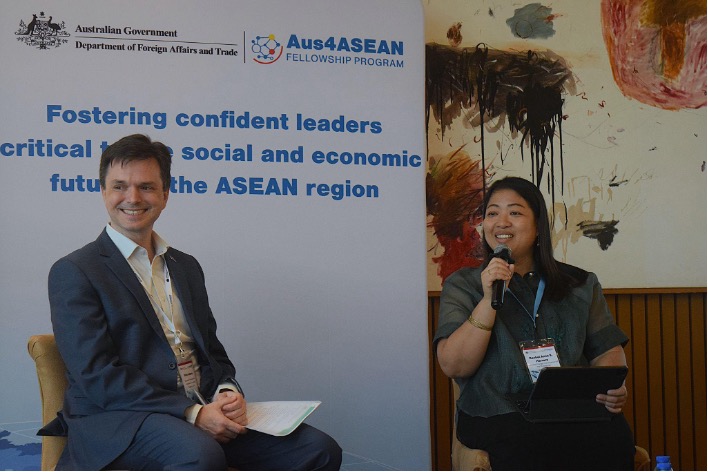
via Graphic Plus — The Climate Change Commission (CCC) called for deeper regional cooperation on shared policy standards, harmonized green jobs data, technology transfer, cross-border energy integration, and joint financing mechanisms to de-risk renewable energy projects at the Aus4ASEAN Sustainable Energy Transition and Green Skills Fellowship Regional Immersion.
CCC Commissioner Rachel Anne S. Herrera, in her keynote address, noted that according to the 2024 Asia Pacific Climate Report, the energy sector—responsible for 77.6% of greenhouse gas emissions in developing Asia—is both the region’s most critical challenge and its most powerful opportunity. She stressed that while renewable energy investments are rising, a truly resilient transition requires systems that are “just, inclusive, and grounded in people’s lived realities.”
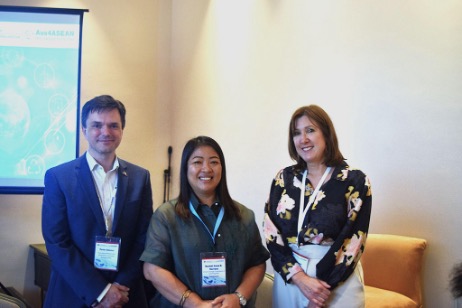
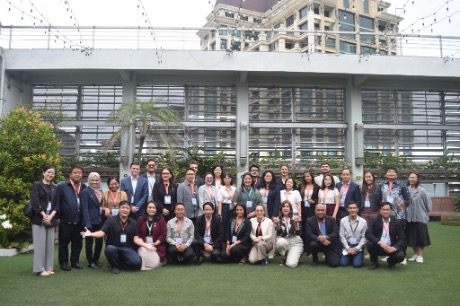
Commissioner Rachel Anne Herrera of the Climate Change Commission with the organizers and participants of theAus4ASEAN Sustainable Energy Transition and Green Skills Fellowship Regional Immersion.
Herrera highlighted the Philippines’ coherent energy transition framework anchored in the Nationally Determined Contributions (NDC) and the NDC Implementation Plan (NDCIP). She outlined concrete energy-sector policies and measures, including expanding the share of renewables, strengthening energy efficiency and conservation, promoting low-carbon transport, and advancing the creation of smart grids and ensuring continuous power supply for remote and climate-vulnerable communities.
These measures are supported by long-term strategies under the National Climate Change Action Plan (NCCAP), National Adaptation Plan (NAP), and Philippine Energy Plan (PEP) 2020–2040, which targets 35% renewable energy by 2030 and 50% by 2040.
Herrera also underscored the growing momentum among Philippine companies transitioning to low-carbon operations—highlighting geothermal leadership, reforestation partnerships, solar PV deployment, and industrial decarbonization efforts. She cited Ormoc City’s geothermal-powered development and solar-powered irrigation, as well as Marikina City’s low-emission strategy pursued through efficient public buildings and protected bicycle lanes, as examples of how national energy policy becomes meaningful at the community level.
Central to her message was the principle of inclusion. Herrera emphasized that a just transition must support workers; micro, small, and medium enterprises (MSMEs) women; youth; and vulnerable sectors. She also noted that consultations for the updated NDC ensure that youth, women’s groups, farmers, and indigenous communities help shape the Philippines’ future energy pathway.
She reaffirmed the Philippines’ strong commitment to the UNFCCC Just Transition Work Programme, stating that climate change requires solutions built on solidarity and shared responsibility. “You are not just participants—you are partners in shaping our region’s future,” Herrera said. “Let us lead this transition together—with purpose, with community, and with each other.”
Organized by the Australian Government’s Department of Foreign Affairs and Trade (DFAT), the program convened youth energy and climate leaders from across ASEAN to explore regional leadership, policy pathways, and practical examples of low-carbon transformation.


 called for deeper regional cooperation on shared policy standards, harmonized green jobs data, technology transfer, cross-border energy integration, and joint financing mechanisms to de-risk renewable energy projects at the Aus4ASEAN Sustainable Energy Transition and Green Skills Fellowship Regional Immersion.)