

A book smaller than your thumb, Roman coins before Christ’s time, priceless Ming jars, and all kinds of oddities—you’ll find them in PI’s oldest and largest museum.
Where in the Philippines can one find a book which is smaller than a ten-centavo coin? Or a 200-million-year-old fossilized piece of wood dug in Mandaluyong, Rizal? Or coins circulated at the time of Christ?
The answer, of course, is the University of Santo Tomas Museum of Arts and Sciences, considered by many as the oldest, biggest and most complete in the country today.
BEGINNINGS
When the authorities of the University of Santo Tomas obtained royal sanction to open a medical school in 1682, the school’s museum of arts and sciences was already a well-developed institution. However, it was not till 1865 that museum work officially figured in the regular curriculum and the collection and the classification of specimens began in earnest.
“The museum was founded as an adjunct to teaching especially of the natural sciences,” says Prof. Vicente Padilla, the present curator of the museum. “That is why the doors of the museum are open to anybody, regardless of age, religion or nationality.”
The museum has its quarters on the second floor of the UST main building. It is open to visitors daily from 8 a.m. to 12 noon and from 2:00 to 5:00 p.m.
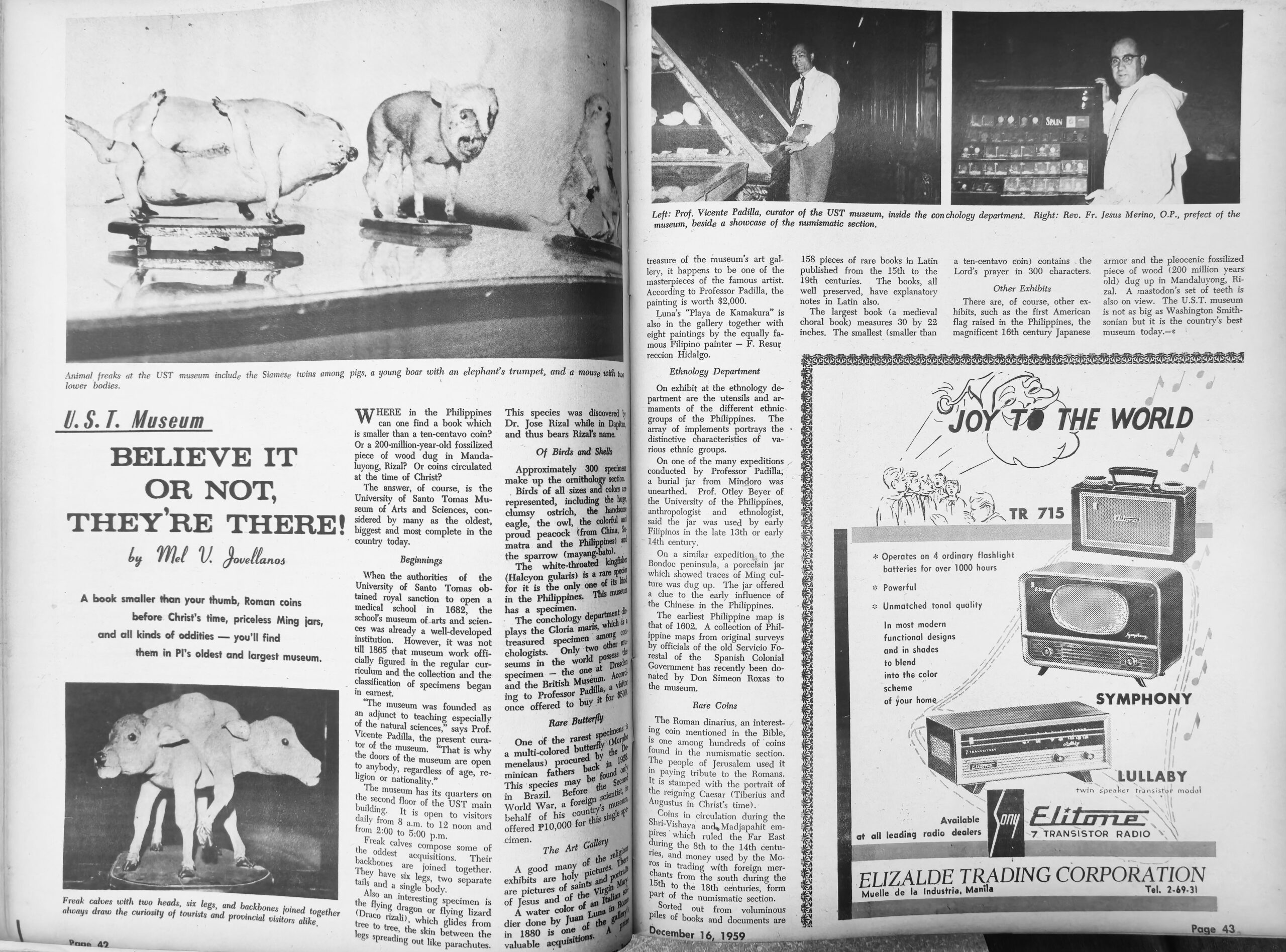
Freak calves compose some of the oddest acquisitions. Their backbones are joined together. They have six legs, two separate tails and a single body.
Also an interesting specimen is the flying dragon or flying lizard (Draco rizali), which glides from tree to tree, the skin between the legs spreading out like parachutes. This species was discovered by Dr. Jose Rizal while in Dapitan, and thus bears Rizal’s name.
OF BIRDS AND SHELLS
Approximately 300 specimens make up the ornithology section.
Birds of all sizes and colors are represented, including the huge, clumsy ostrich, the handsome eagle, the owl, the colorful and proud peacock (from China, Sumatra and the Philippines) and the sparrow (mayang-bato).
The white-throated kingfisher (Halcyon gularis) is a rare species for it is the only one of its kind in the Philippines. This museum has a specimen.
The conchology department displays the Gloria Maris, which is a treasured specimen among conchologists. Only two other museums in the world possess the specimen — the one at Dresden and the British Museum. According to Professor Padilla, a visitor once offered to buy it for $500.
RARE BUTTERFLY
One of the rarest specimens is a multi-colored butterfly (Morpho menelaus) procured by the Dominican fathers back in 1928. This species may be found only in Brazil. Before the Second World War, a foreign scientist, in behalf of his country’s museum, offered P10,000 for this single specimen.
THE ART GALLERY
A good many of the religious exhibits are holy pictures. There are pictures of saints and portraits of Jesus and of the Virgin Mary.
A water color of an Italian soldier done by Juan Luna in Rome in 1880 is one of the gallery’s valuable acquisitions. A prize treasure of the museum’s art gallery, it happens to be one of the masterpieces of the famous artist. According to Professor Padilla, the painting is worth $2,000.
Luna’s “Playa de Kamakura” is also in the gallery together with eight paintings by the equally famous Filipino painter — F. Resurreccion Hidalgo.
ETHNOLOGY DEPARTMENT
On exhibit at the ethnology department are the utensils and armaments of the different ethnic groups of the Philippines. The array of implements portrays the distinctive characteristics of various ethnic groups.
On one of the many expeditions conducted by Professor Padilla, a burial jar from Mindoro was unearther. Prof. Otley Beyer of the University of the Philippines, anthropologist and ethnologist, said the jar was used by early Filipinos in the late 13th or early 14th century.
On a similar expedition to the Bondoc peninsula, a porcelain jar which showed traces of Ming culture was dug up. The jar offered a clue to the early influence of the Chinese in the Philippines.
The earliest Philippine map is that of 1602. A collection of Philippine maps from original surveys by officials of the old Servicio Forestal of the Spanish Colonial Government has recently been donated by Don Simeon Roxas to the museum.
RARE COINS
The Roman dinarius, an interesting coin mentioned in the Bible, is one among hundreds of coins found in the numismatic section. The people of Jerusalem used it in paying tribute to the Romans. It is stamped with the portrait of the reigning Caesar (Tiberius and Augustus in Christ’s time).
Coins in circulation during the Shri-Vishaya and Madjapahit empires which ruled the far East during the 8th to the 14th centuries, and money used by the Moros in trading with foreign merchants from the south during the 15th to the 18th centuries, form part of the numismatic section.
Sorted out from voluminous piles of books and documents are 158 pieces of rare books in Latin published from the 15th to the 19th centuries. The books, all well preserved, have explanatory notes in Latin also.
The largest book (a medieval choral book) measures 30 by 22 inches. The smallest (smaller than a ten-centavo coin) contains the Lord’s prayer in 300 characters.
OTHER EXHIBITS
There are, of course, other exhibits, such as the first American flag raised in the Philippines, the magnificent 16th century Japanese armor and the pleocenic fossilized piece of wood (200 million years old) dug up in Mandaluyong, Rizal. A mastodon’s set of teeth is also on view. The U.S.T. museum is not as big as Washington Smithsonian but it is the country’s best museum today. — Mel V. Jovellanos (December 16, 1959)
Written by Mel V. Jovellanos, this article first appeared in the Kislap-GRAPHIC, Vol. XXVI, No. 25, published on December 16, 1959.