

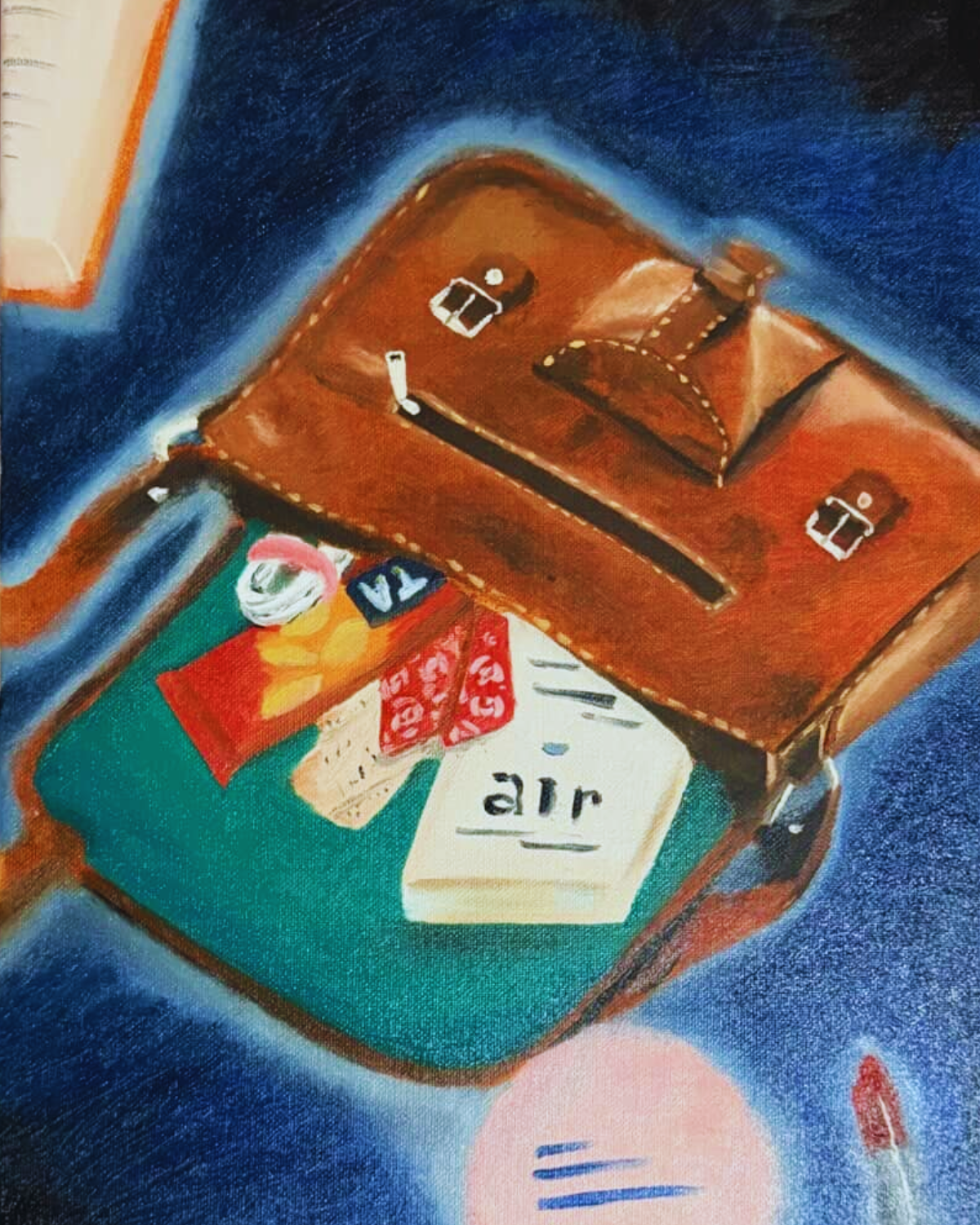
As the first episode of the Philippines Graphic Literary Workshop (PGLW) slowly came to its conclusion on February 28, we knew that we had one more thing that we can offer our bright young fellows: a starting platform for their creative endeavors. Here, we present one of their final outputs from the workshop. We also asked them to provide an artwork that they think best represents their stories. Read on.
“What the—?” Sky’s hand stalled inside the bag, fingers grazing the lining like it might bite.
The leather was a tired brown, the kind that had once been pretty in store lighting and then surrendered to real life—edges blunted, corners darkened by touch. It smelled faintly of powder and something citrusy. It had never softened under her grip, never learned the shape of her shoulder. And yet it had been under her bed.
She pulled out the first thing her fingers snagged on. A head scarf—floral and folded into a neat square. Sky hated anything that clung to her forehead, anything that made her sweat. The cloth was softer than she expected, worn thin in the middle. Under it: a compact of Hello Beauty face powder. Sky made a face. That stuff made her itch. Her skin would bloom with tiny red constellations by noon. Her sister liked that brand anyway, patting it on in the rearview mirror at stoplights. Sky snapped it shut too hard.
There were too few pens. No paper. No journal. No half-finished poems crammed into margins. No angry, slanted handwriting. Where was her journal—the one she swore she had in this very bag? Instead, there was a jacketless copy of Mirror Marked, spine cracked cleanly in half, and a dog-eared When Breath Becomes Air. Sky didn’t read memoirs about dying neurosurgeons. No, Sky wasn’t the type to underline books about dying. She preferred fantasy—worlds where the dead stayed dead or came back with rules.
Star, though—her sister highlighted lines and read them aloud at dinner. “I’m preparing for something,” she’d joked once, tapping a paragraph about borrowed time.
She shuffled through the clutter before lifting a tube of liquid lipstick between two fingers, turning it so the color caught the light. The shade was a violent, unapologetic crimson.
Red was loud. Red was look-at-me. Red was what her sister wore when she wanted to win a room. Red was her sister’s color. Red heels. Red nails. Sky preferred muted tones—dusty pinks, softened browns, shades that knew how to fold themselves into corners and stay there.
Reaching back into the bag, heart beating too hard now, her fingers found a cord. An Android charger. She almost laughed. The charger cord was wound carefully, secured with a tiny pink hair tie. Too many hair ties, actually—looped around the strap, tucked into corners, clinging to receipts. She had mocked Androids for years, had sworn allegiance to crisp iPhone photos and seamless syncing. Her sister rolled her eyes at brand loyalty, said a phone was a phone as long as it called home.
A crumpled pack of Fita crackers surfaced next. The plastic looked old, air puffed strangely inside. Sky stared at it. Her sister used to keep snacks in her bag for long drives. “In case traffic gets bad,” she’d say. “In case I forget to eat.” In case—
Sky turned the packet over. No expiry date in sight. The print had been rubbed off. The crackers inside had probably softened into dust. She set it aside carefully.
Under my bed.
The thought sat on her tongue like something metallic.
But that wasn’t right. She had cleaned under there. After. Especially after. She had knelt on the floor and vacuumed until her back hurt, until dust coated her palms and her eyes burned. She had shoved out dust bunnies and old slippers and a single earring she’d thought she’d lost in college. She would have seen this. She would have—
Sky tugged the strap gently, peering inside again. Receipts fluttered out—gas stations, convenience stores near highways. A tiny bottle of PhCare rolled across the mattress. No, Lactacyd in a PhCare container.She pulled something out slowly this time. Faux leather, peeling at the edges. A clear plastic sleeve on the front. She had found the wallet. The name tag stared up at Sky. Not her name. Star. The letters were slightly smudged at the edges. Sky felt the room tilt. She could see it now—the red lipstick. The scarves for hurried mornings. The charger for a phone that had rung and rung and rung that night, unanswered. The crackers for traffic that never cleared.
“Of course you’d forget your wallet,” Sky’s shoulders shook. “Always on-the-go.”
Always rushing. Always out the door before sunrise. Always forgetting something, doubling back, laughing. Always promising she’d be home before midnight. Sky nodded because that was easier than explaining the sound of metal folding in on itself. Easier than remembering the call from an unfamiliar number. Easier than the way her sister’s Android had been returned to them, screen spiderwebbed, still smelling faintly of citrus sanitizer.
They had never found a bag. The bag. Until now.
Sky sat slowly on the edge of her bed, the wallet heavy in her hands. None of it was hers. Not the red scarf. Not the charger with its bitten cord. She tries to reconstruct the day of the funeral—the choreography of grief. Who packed which drawers. Who cleared which shelf. Who decided what was too painful to keep and what was too ordinary to matter. She remembers her mother folding clothes with mechanical care, as if neat stacks could hold the world together. Maybe it would make the ache go away.
Her fingers trembled as she opened the wallet. Inside is a tiny, rumpled square of paper, folded and refolded until the creases have nearly torn through. She pries it open carefully. The ink is hurried, slightly smudged, the letters leaning forward like they’re still in motion: Buy groceries. Replace Mom’s tupperwares. Return Sky’s bag.
Her name sat there so simply it felt like a bruise. Return Sky’s bag.She didn’t own anything in this bag. Her dead sister did. And somehow, impossibly, it had been sleeping under her bed.
Grief is an odd thing—it steals your belongings and waits for you to notice.
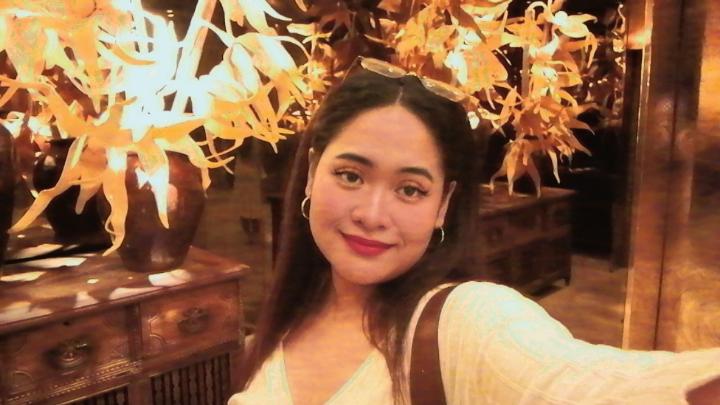
Angela Maria Tabios, also known as Blythe, is a senior Creative Writing major at the University of Santo Tomas. A multidisciplinary writer, she works across fiction, poetry, essays, plays, and film, centering feminist perspectives and the intersections of gender, memory, trauma, and sexuality. Her work earned 3rd Place for One-Act Play (Choke) at the 40th Gawad Ustetika (2025) and publication in Dapitan 2023: Panopticon for her story, The Song of the Tides. A spoken word performer and critic, she writes on translation and gender, with reviews in Halo-Halo Review, and publishes more work on her Substack, Magnolia By The Margins.