
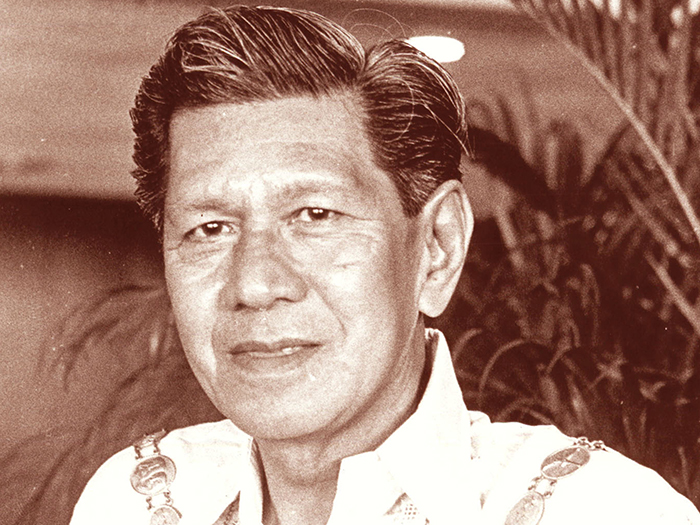
But Jaime Cardinal Sin says we are already into Kingdom Come.
DECEMBER 24, 1990 — Christmas is like that “fabulous invalid,” the theater—always rumored to be in a bad way but always bouncing back amaranth.
Since October yet, the news columnists have been keening in chorus how dismal this year’s Christmas is bound to be; and one and all cited the non-visibility of Christmas tokens. One wonders from what underground cloister these people pen their “observations.” In the matter of trimming and dress, this year’s Yule is, if anything, precipitate.
The banks we deal with didn’t use to decorate until mid-December but this year they put up wreath and ribbon and lantern right after All Souls. That giant tree at the Araneta Coliseum got lighted this year in mid-November, or a full month before its usual debut. And since October yet, mall and mart have been announcing “ang Pasko ay sumapit” and catching mommy kissing Santa Claus.
In fact, this year’s Christmas is the earliest of all to make an appearance.
Then why are the scribes so set on shooting down Santa?
Political malice aside, what’s being enacted—or, rather, reenacted—is an old Philippine tradition. Search the memory as we will, we can’t recall a Filipino, when asked about a coming Christmas, predicting anything but: “Aie, Paskong tuyo!” Man and boy, we have awaited no Christmas foreseen as terrific: it was always going to be dry, dry, dry. But when the Feast did arrive, it would be found satisfactory as usual. No, not because of the bonus, or the chill in the air, or the kids with their toys, or the family reuniting. The eternal surprise is what happens to us come Christmas Eve, when suddenly the carols we have been cursing since October bring us close to tears.
Christmas is always such an event in the heart that it doesn’t really matter if it’s calm or tumultuous, abundant or bare. It’s the Feast itself, and by itself, that satisfies. A merry Christmas is the sheerest lagniappe. None will admit this, of course. The post-Yule shrug is a wry: “Nakaraos.”
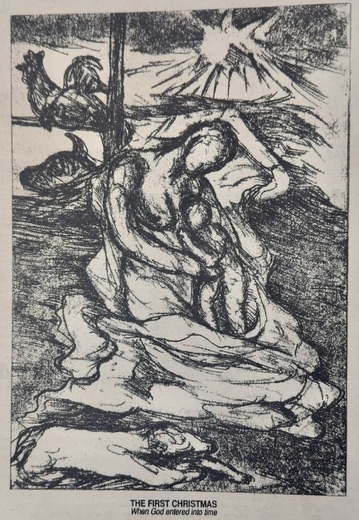
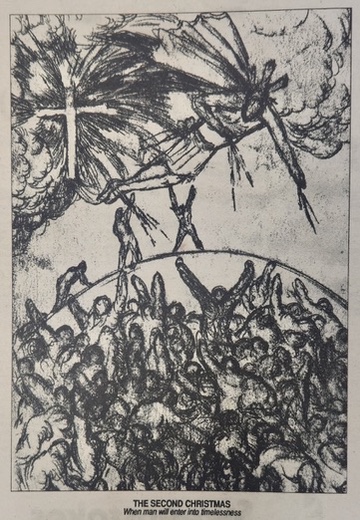
Yule this year has a special portentousness: it’s only nine years to the end of the second Christian millenium. The popular belief is that the world will end at the turn of a millennium. Are we on the verge of the “Second Christmas”?
The First Christmas had Christ coming to earth as a child, as a scion of David, as teacher and savior. The Second Christmas will have him coming as judge and king: he will reign on earth for a thousand years. Then time will cease, the universe will dissolve, and those he has picked will follow Christ to heaven.
Christ has described his Second Coming into the world:
“The sun shall be darkened and the moon will not give its light: the stars shall fall from heaven, and the powers of the heavens shall be shaken. And then shall appear the sign of the Son of man in heaven. Then shall all the tribes of the earth mourn, and they shall see the Son of man coming in the clouds of heaven with power and great glory.”
But today’s faithful wonder if certain signs of our time augur the second advent of Christ. The collapse of communism in Europe has been dubbed the “end of history.” The renascence of religion in Russia (old churches being reopened for worship and new ones being built) has also been read as augury. Is this the “conversion of Russia” that certain mystics say will precede the finale? Does it portend the end of the world and the coming of the Millenium?
Is the Second Christmas at hand?
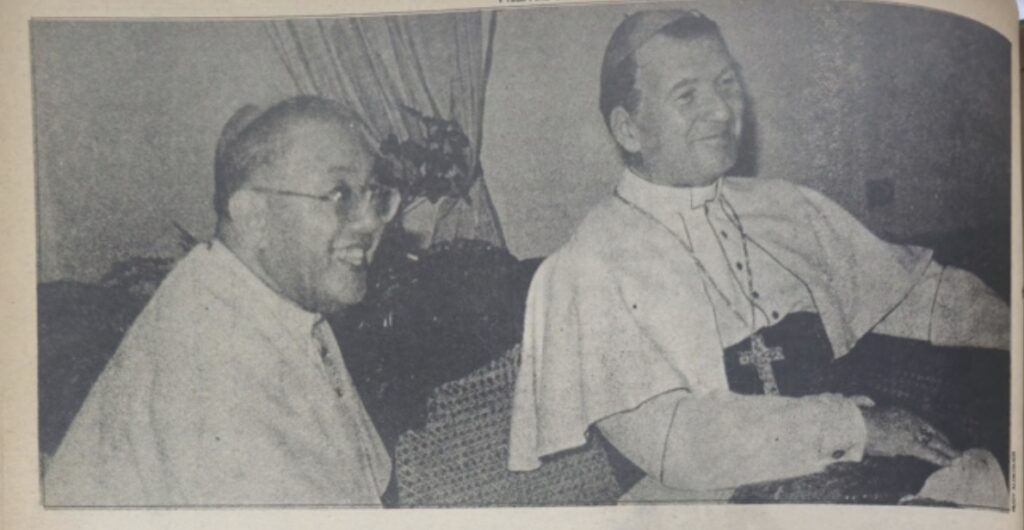
His eminence, Jaime Cardinal Sin, views from a different angle this belief in the return of Christ to the world and the establishment of a reign, the Millenium, that will fulfill his promise of a Kingdom Come. But the Cardinal prefers to believe that the promise is already being fulfilled and that we are already into Kingdom Come.
“My interpretation is rather that the 1,000 years referred to in the Apocalypse are symbolic of the entire reign of Christ, coterminous with the entire life span of the Church on earth. Baptism is ‘the first resurrection’ by which we benefit from and participate in Christ’s own resurrection and reign.”
What we await now is the Last Judgment that will complete the thousand years of the reign of God.
“The ‘millenium’ therefore has already come. We are in it. The question ‘Will Christ stay on earth again?’ is wrongheaded. Christ has already come to earth. He has already taken on our flesh, eaten our food, walked our land. This is the good news that we celebrate year after year on Christmas. And part of that good news is the fact that he is still present among us. ‘Whatever you have done—or not done—to one of these least of my brothers, that you have done to me.’ There is no need to ask, therefore: ‘Will Christ stay on earth again?’ He is already here—in our brothers and sisters, especially the poor.”
In other words, the so-called Millennium began with the birth in Bethlehem, is currently in progress as the presence of Christ binds as ever closer to one another, and will conclude with the Last Judgment: the full visibility of the Son of man.
This happening in progress is the true history of the Christian and Cardinal Sin doubts that its end is signified by the decline of communism.
“Even with the ideological upheaval in the Soviet Union and the Soviet Bloc, history continues, as it does here in the Philippines. As Filipinos and Christians, we are still called to take responsibility for our history. The central event for us is that God mysteriously, but nonetheless irrevocably, entered our history as God-made-man and thereby wonderfully sanctified all time and space. Facile interpretations of events in the Soviet Union as portending the Millenium or the end of the world tend to distract us from our historical responsibilities as Christians: to establish God’s reign more fully in our history.”
If the communist failed to make the world more human, neither can the Christian gloat that he has succeeded in that respect.
“Do we not in our own history still see so much gruelling poverty, so much oppression, so much lack of true fraternal concern for one another? Our view of history, however, is precisely that our world is still unfinished, has to be changed, there being so much human suffering in it. Ours is the land of the rising sun. For us, the sun of history is not setting.”
The Cardinal sees the light on the horizon as the dawn.
EXCESSIVELY literal interpretations of the Apocalypse result in an obsession to divine when the world will end. Cardinal Sin points out that the Apocalypse, having being written in a time of persecution, used a “coded language” that can mislead.
“An over-literal interpretation asserts that before the Last Judgment Christ will return to establish a kingdom that will last a thousand years. Those who held this view were called millennarists, from the Latin world mille, meaning 1,000. They taught that during those thousand years Satan would be chained and the saintly would come to life in a ‘first resurrection’ and would share the royal priesthood of Christ in a messianic kingdom. Towards the end of this Millennium, however, Satan would be allowed to resume his diabolical activities but Christ would vanquish him and triumph in the Last Judgment. The dead will then rise in a ‘second resurrection’: sinners to damnation; the just to eternal rewards. This interpretation was however never accepted universally by the faithful.”
Over-literal as well may be the interpretations of communist happenings, like the “conversion” of Russia. Wonders the Cardinal: can abolishing a state policy of religious suppression be referred to as “a revival of religion”? Or is it fruitless mystification to hail it as “the prophesied conversion of Russia”?
“I believe that there is in man a special type of experiencing, a unique way of reaching out to an Ultimate or an Absolute that we call religious, and which does not die no matter how thoroughly or violently traditional religious expressions are suppressed. If today there is happily a liberalization of religious expressions in the Soviet Union, this does not mean that Christian conversion has already taken place. Freedom of religion does not necessarily mean a baptism in Christ.”
And the Cardinal observes that even those baptized in Christ may still be wanting in authentic Christianity. If we allow the needy to go hungry or naked, ours is a faith without works.
“How much is Christ incarnated in the values and decisions that spawn the misery of our slum areas and the utter poverty of those who till our land? We may discover that as Christians we ourselves are very much in need of conversion.”
Still, it cannot be denied that Christianity is stirring again in Russia. And the superstitious ask: Is this part of the coming end of the world?
“Everything,” smiles Cardinal Sin, “is part of the coming end of the world! All that we do—or do not do! But the end of the world is not just a cataclysmic explosion. The end of the world is Our Lord coming in glory as triumphant Judge of heaven and earth. Then, what we have done or not done now will have irretrievable bearing on our future. Hence, the end has long begun!”
The “conversion” of Russia may presage a similar shift in China and Cuba.
“I had the opportunity recently to visit China, which is theoretically atheistic. But everywhere I went I was overwhelmed by the fervor of the Chinese Christians I encountered and the vibrancy of the Church I experienced. Violent and thorough in the past was the religious suppression in China, and the faithful suffered dearly for their fidelity. They are the Church’s true martyrs in Asia. But even the so-called Patriotic Church, I am convinced, could not have emerged outside the promptings of the Holy Spirit. In China, therefore, the Church is very much alive. Cuba, too, had its era of religious suppression. It needed, however, the type of social conversion we need here in the Philippines. I’m sure the Church there is still very much alive.”
Is communism to collapse in Asia too as in Europe?
“There is hubris in a state that undertakes to meet all the needs of its society. Planning is important (and we could use more of it in our own economy, as we can see from the Pajeros and Mercedes Benzes clogging our streets as we bewail our gasoline shortage!) but planning should be an activity which everyone, not just an elite few, participates in and takes responsibility for. Communism will collapse because ultimately it misunderstands man. It rightly sees as man’s problem his alienation from himself in his work and production, an alienation that spawns class conflict. But it assumes that man himself can remove this alienation by mandating change! You cannot mandate man to free himself from his selfishness, his self-division, his rebellion against what’s ultimately Absolute. You may think you can, but you err. Communism is shot through with this kind of misunderstanding. Its promises are based on this misunderstanding. So it over-promises. But it cannot deliver.”
The Christian is franker in recognizing man’s selfishness, his self-division, his rebelliousness all of which we call sin. And we admit that not we ourselves but God only who frees us from sin.
“That’s why communists can’t celebrate Christmas. They cannot believe that we need any messiah beyond ourselves.”
But the grand politico-revolutionary schemes have only brought nations to global war. It is not ideology, as the ex-commies have learned, that saves.
“Rather is it a babe in a manger: Emmanuel: God with us!”
Are there signs that communism is actually on the decline in the Philippines? The Cardinal says yes.
“The communists and their allies, as I see it, have, with their over-simplistic world-view, ceased to capture the imagination of our people. The killings, the forced taxation, the perpetually rehashed sloganeering, only show that communism is not being accepted by the masses. Our people want change. But they don’t believe the communists can bring about the change they want. And what they want is a change into genuine democracy. A change into real peace. A change into a truly Christian society. As for the Huks—or, for that matter, all former communists—the Church is always ready to welcome them home.”
A strong contrast to communist wane is the renewed vigor of Philippine Christianity, as manifested by the popularity of the Bible, the Born-Again phenomenon, and the charismatic movements. But Cardinal Sin warns against a misuse of these phenomena.
“The Bible is God’s word, not a fad. We should not pit Scripture versus Catholic tradition; or Scripture versus Holy Mass and our devotion to Mary.”
All Catholics, says the Cardinal, are already “born again.”
“They were born again in baptism. All should be made aware of this rebirth and of the imperatives this rebirth imposes on us, individually and communally. Being born again is a challenge to achieve an integral Christian life; it is not an abstract assertion of the Word of God divorced from the community to whom the Word was revealed.”
Likewise, the gifts of the Holy Spirit are not just “emotional highs” for the corybantic devotee.
“It’s good that today we can sing and dance and shout out our praise of the Lord. But in the spirit we are still called to the depths of quiet prayer and the silence of selfless service. The joys of the Spirit must animate our commitment to a true responsibility for one another. The Lord may be pleased every time we yell Praise the Lord! But the Lord is actually praised when we bend down to serve a fellow creature in need.”
The health of the Faith shows in the state of the Church.
“The Church in the Philippines is alive and well, and growing. Since 1953, when the first national council was held, the number of the Catholic faithful has grown from 15.8 million to 46.7 million; the number of dioceses, from 26 to 77; the number of bishops, from 28 to 119. In 1953, there were 1,288 Filipino diocesan priests and 1,204 Filipino priests in religious orders. Today there are 3,408 of the former and 2,165 of the latter. There were 2,808 religious sisters in 1953; today there are 9,231!”
Contrary to popular belief, and unlike in the countries of the West, religious vocations in the Philippines are on the rise. However, the Cardinal hesitates to compare the devotion of the faithful today with the religiosity of the Filipinos of yesterday.
“How can one make comparative judgments on the interior state of soul of believers? Impossible! But, as Archbishop of Manila, I am often impressed and edified by the earnest commitment to God and Church that I find in laymen and clerics alike. The Vatican Council, I think, did much to put our Catholic life in step with the demands and challenges of modern-day living.”
In religion, the modern demands and challenges are to establish a personal relationship with God; for the Christian, to achieve a personal relationship with Christ. Don’t such native cults as the devotion to the Santo Niño, to the Nazareno, and to the Sacred Heart, by being so institutionalized and conventional, hinder rather than help the seeker of a closer communion with Christ?
Cardinal Sin objects that such questions imply that, to find a deeper relationship with Christ, we should do away with traditional devotions.
“I find the implication funny—since whom really do we worship in the devotion of the Santo Niño, the Nazareno and the Sacred Heart? Growth in a personal relationship with Christ implies growth in personal devotion to him. But who is Christ? Christ is he who on the first Christmas became a child among us (the Santo Niño); he who redeemed us through his passion (the Nazareno); and he who loves us and will ever continue to love us personally (the Sacred Heart). There may be those who can relate to Christ more abstractly, but most Filipinos are helped to grow in their personal relationship with him through such devotions. Why shouldn’t we use all the aids given us to come closer to Christ? Devotion to the Santo Niño may help use find Christ in the children of the slum areas. Devotion to the Nazareno may spur us to lessen suffering and injustice in our society. And devotion to the Sacred Heart may make us more loving.”
Is it “more loving” to take an acrimonious stand against Christian fundamentalist sects and the Masonic Order? Isn’t such a stand in conflict with the ecumenical movement? The Cardinal points out that the ecumenical movement posits mutual respect and goodwill among the various denominations involved, having gone beyond the old type of polemical debating, where the aim is to prove the opponent wrong. But it’s with this outmoded bludgeon that certain foes continue to hit the Church.
“When, despite the ecumenical movement, Catholics, especially the poor ones, are subjected to facile attacks by Bible-thumping preachers who fall short of respecting our goodwill and traditions, as bishops and shepherds we are bound to champion our beliefs and protect our people from being led astray. This should not be taken as acrimony but as a vigorous effort to fulfill our pastoral duty in the idiom called for.”
Nor is there any acrimony towards the Masonic Order when it operates in the civic spirit of Rotary or the Lions Club.
“But the Church must obviously object against a type of Masonry whose understanding of humanism excludes the possible knowledge of God or affirmation of the truth of Christ’s Church on earth. Such humanism is really no different from that of the communists.”
Cardinal Sin is quite aware that the Philippines is more and more becoming a pluralistic society where the Church must co-exist with unbelief and heresy.
“For that reason, even in an age of ecumenism, it is all the more urgent that we understand what it is that makes us what we are, and how we are to live it. Ecumenism mandates unity from multiplicity. It is not license for wishy-washiness.”
Of two projects that the Philippine Church has ongoing, the first must expect to snail it in the long run, since the movement to have Sor Ignacia del Espiritu Santo of Binondo (she founded the Religious of the Virgin Mary) elevated to the altar as a saint, must contend with the holy red tape of the Vatican. “Pray the Lord to work miracles through her intercession!” says Cardinal Sin. Only authenticated miracles can speed up the process of canonization.
The other project is the Plenary Council in January 1991, which will involve the entire Church in the Philippines: clergy, laity and the entire gamut of Philippine life. “Catholics, speak up!” command the initial ads. And expected is a battle royal between pro-lifers and birth-controllers.
National councils (the first one in the Philippines was held in 1953) are supposed to bring the laity into the decision-making processes of the Church; but whatever the timidities of our 1953 council they got overwhelmed by the total revolution that was Vatican II. Cardinal Sin believes that Philippine Council 1991 may be more epochal: “Its decisions may affect our lives well into the 21st century!”
Expected to be affected are our political and economic culture, and most especially, for sure, our sexual conventions, besides what’s really the chief, but not the only, business of the council: our religious style. Should the style be reformed?
Cardinal Sin prefers to say that our religiosity needs to be updated, or “inculturated.”
“We inherited the Spanish type of religiosity from the missionaries who evangelized us and their methodology included processions, holy images and fiestas. All this was a kind of catechism, a form of evangelization.”
Procession, holy image and fiesta make vividly graphic the events in the life of Christ and the doctrines of the Faith. They are a way of teaching, not an idolatry.
“Like, for example, I go to the plaza and contemplate the statue of Rizal. This doesn’t mean I am adoring Rizal. The statue bids me think of Rizal and, as we were told in grade school, lives of great men all remind us we can make our lives sublime. Or like my looking at a picture of my mother when I feel depressed. I’m not worshiping the picture: I’m just allowing it to gladden and inspire me. Popular religiosity in the Philippines has so many ways and means of remind us of the life of Christ. Like the Simbang Gabi, so beautiful a custom. The missionaries introduced it, to attract people to church and to indoctrinate them in a pleasant manner. That was also why the Church turned a pagan holiday in Rome into the celebration of the birth of Jesus that has become Christmas. Here in the Philippines, the pagan harvest festival of thanksgiving was transformed into the town fiesta, which is really our thanksgiving day. At the same time we are reminded of the life of our patron saint and urged to imitate it. Of course, this cult of saint and fiesta can be abused. You hear people attributing wonders to the image of this or that saint. I’m not saying the wonders can’t happen. Remember how Balaam was converted when his ass began to talk? God can use anything to bring us to him.”
The Cardinal sees us making progress as Christians.
“A priest now spends double the time preparing a sermon. The congregation knows the Bible very well: he must show he knows it better. In the days when there was no freedom and we were what we might be called ignorant, religion was perhaps merely imposed on us. But now we have become enlightened. We have to know why we must do this or why we should not do that.”
And religion must be related to, must be relevant to, our life, our times, our particular culture.
“So, after Vatican II came what we call the inculturation program” the inculturating of religion. Here in the Philippines we developed the liturgy of the Misa ng Bayan, very beautiful, approved by Rome, and celebrated in Tagalog, Cebuano, Ilongo, etc. Even the songs are Filipino. This does not mean that we should not adopt the practices of other countries; isolation would make us deteriorate. Tribal drums were used at Mass in Africa during their Holy Father’s visit. The Igorots could use their tribal drums in the same manner. But actually such things as drums are accidentals, not essentials. The essence of the Mass is the formula of consecration—‘This is my body… This is my blood’—whether said in Spanish, Latin, or Ilocano. This is one of the mysteries of our Faith that can never be completely explained or understood. That’s why St. Augustine said: ‘Believe first in order to understand; do not ask to understand first in order to believe.’ And that’s why St. Teresa prayed: ‘Lord, do not appear to because the moment you appear I lose my faith, since faith is believing in the unseen.’ Still, we should gradually eliminate superstition through explanation, understanding and inculturation.”
At a time when we despair of the Filipino because he hasn’t made it industrially like the Korean, the Taiwanese and the Singaporean, Cardinal Sin begs to differ.
“The Filipino is naturally a good person. I’ll tell you one thing: we now complain that Filipinos work abroad as servants, the role of the Chinese before. But maybe God allowed this.. Once upon a time the Irish were slaves in their own country under English domination, and servants in America as immigrants—but they are the ones who christianized the United States. Similar may be the role of the Filipino today: the Filipino in Alaska, in Russia, in Europe.”
While in Italy one time, the Cardinal was astonished by the generosity of an Italian multi-millionaire, who explained that he and his wife were fallen-away Catholics until they hired a Filipina as nanny for their four kids. She was a teacher hiring out as servant but she nursed those four children better than a mother: taking them to hear Mass every Sunday, teaching them their catechism, making them pray the rosary every day. The youngest, a girl, approached her father on the eve of her birthday: “Daddy, the birthday gift I want is you and Mommy hearing Mass with us every Sunday and praying the rosary with us every day.” How could he refuse his youngest and his favorite?
“But for that countrywoman of yours, Cardinal,” said the Italian multimillionaire, “I and my wife would still be lost sheep.”
Which explained his prodigal benefactions to the Filipino prelate.
Would the Pinoy diaspora as christianizer of the Old World that christianized him be another sign of the approaching Second Christmas?
The Pinoy Christian wasn’t much of a “millennarist”—except towards the end of the 19th century, simultaneous with the Revolution, when the Ilocanos began selling or giving away their fields and fleeing in ox-wagon caravans to Pangasinan, to join a miracle man there in awaiting the Second Coming and the global dissolution.
What arrived was not Christ but the Gringo.
Nevertheless, in the current panic among mystics foreseeing the coming end of the 20th century as the general finale of creation, the wise word to skeptics is an old one:
“It may be later than you think.”
Being Christian, his eminence, Jaime Cardinal Sin, prefers to believe that the Second Christmas will be as merry as the first. Wherefore the jollity of his message:
“In this perspective of great hope for the future, I wish you all the special joys and graces of Christmas!” —Quijano de Manila
This article was written by Quijano de Manila, Nick Joaquin’s pseudonym, and was published in the Philippines Graphic magazine on December 24, 1990. Nick Joaquin also served as the Philippines Graphic’s editor-in-chief when the magazine was revived in 1990.