


In addition to being an agricultural haven, the City of Sto. Tomas is also known as home to two of the most successful business hubs in the country.
The First Philippine Industrial Park (FPIP) is located in Barangay Sta. Anastacia and the Light Industry and Science Park of the Philippines III (LISP) is situated in Brangay San Rafael.
Companies operating in ecozones like FPIP and LISP are entitled to benefits, including a tax incentive package accorded by the Philippine Economic Zone Authority (PEZA) to qualified export-oriented companies.
But more than the government-provided incentives, the FPIP and LISP III provide highly reliable and world class infrastructure, utilities and services that allow locators to focus on growing their businesses.
These parks, described as “the best place for the best business,” continue to attract a significant number of foreign investors.
DEDICATED MERALCO SUBSTATION
FPIP provides a first world manufacturing environment that promotes stability and growth, allowing businesses to thrive.
It is the industrial park of choice for a growing number of world-class, high-growth companies and their supplier partners. It is home to 84 locators that employ a total of 63,605 personnel.
The industrial park offers its locators a dedicated Meralco substation which is connected to three separate circuits in Canlubang, Los Banos and Mak-Ban, all in Laguna. This assures the park of a reliable and stable power supply. It also provides industrial water to its locators from the 15 deep wells and above-ground reservoirs strategically located within the park. It also has a modern water treatment and centralized sewerage collection and treatment facility.
The FPIP has a wide concrete road system and best-in-class underground telecom cables and multiple telecommunications partnerships. It also has the Oasis Commercial Center, hotels, specialty restaurants, sports and recreational facilities as well as Eco-Pars with trekking trails.
DISTINCT PARK MANAGEMENT

The LISP III, on the other hand, is a 107-hectare world class, master-planned industrial estate. It is part of the Investment & Capital Corporation of the Philippines (ICCP) Group, one of the foremost developers of private industrial parks through Science Park of the Philippines Inc. (SPPI) which has almost 800 hectares of industrial estates or being development.
In addition to ICCP, the other stockholders of SPPI include Philippine American Life and General Insurance Company, Fremont Group which is the investment arm of the Bechtel Family and the National Development Company, the investment arm of the Philippine government.
It is the fourth of a series of industrial estate projects of SPPI, one of the country’s pioneers and leaders in industrial estate development.
The distinct method of park management and community relations that SPPI strongly imposes on all its projects is what truly sets it apart from the others. Its dedicated team carries proven competence and experience in managing industrial parks.
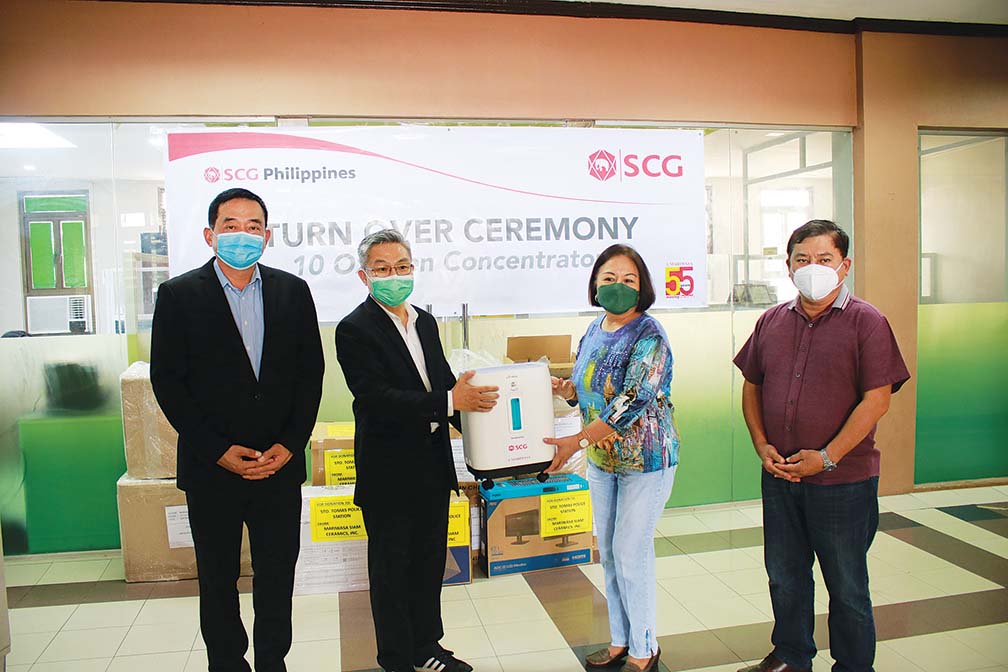
One company that has found its home in Sto. Tomas City is Mariwasa Siam Company. Founded in March 1966, Mariwasa is one of the pioneers in the Philippine ceramic tile industry.
Established by the brothers Emerson and Edison Co Seteng, the company was founded on a vision of producing ceramic products that would meet world standards for beauty and durability.
As part of their corporate social responsibility programs, Jakkirt Suwansilp, Mariwasa President and VP for Sales and Marketing accompanied H.E. Vasin Ruangprateepsaeng, Ambassador of the Royal Thai Embassy for a courtesy call on Sto. Tomas City Mayor Edna P. Sanchez.
During that visit, Suwansilp turned over a number of oxygen concentrators and other appliances that would be used to ease the plight of those who were suffering from breathing problems brought about by COVID-19.
“Sto. Tomas is an agro-industrial city and we expect more investors to come in now that we are a city,” Sanchez said.
Anne Ruth Dela Cruz
Anne is a seasoned journalist and corporate communications specialist. After 13 years in the health care industry, she is back to where she started—print media.