
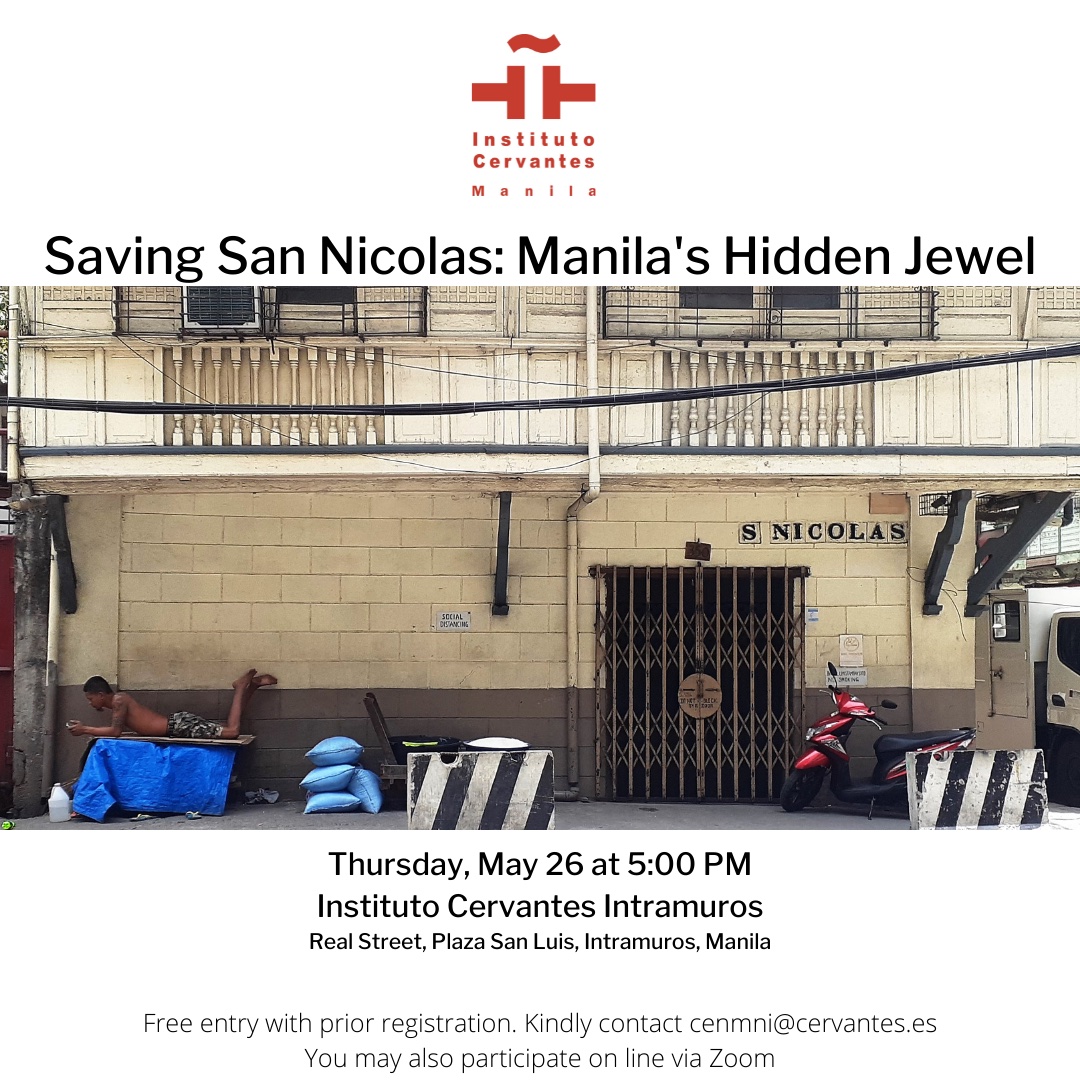
Let’s Save San Nicolas (Manila)

Share

The district of San Nicolas has great historical value. The interaction of Spanish and
Chinese influences that largely contributed to the Filipino identity took place in
Chinatown, which San Nicolas is part of. Here you can find buildings from the 19th century, some dating about 150 years ago.

These are the last vestiges of a previous era, of which not many people know about. Unfortunately though, not much value has been placed on this area which resulted in the loss of its heritage value.

As a first step towards raising awareness about the historical and heritage value of
San Nicolas, Instituto Cervantes de Manila, is organizing a round table discussion
for historians, architects, urban planners, businessmen, residents of the area and
the general public to reflect on the value of the San Nicolas district, explore its
potential as an historical site, and brainstorm for ideas on how to conserve it.

This encounter, titled “San Nicolas (Manila): The Forgotten Treasure” will be held on
May 26, Thursday at 5 p.m. in Instituto Cervantes’ Intramuros branch (Calle
Real, Plaza San Luis, Intramuros, Manila).

The event will follow a hybrid format in which people can view the discussion and participate online, via Zoom. The link is https://us06web.zoom.us/j/86201518785.

Admission is FREE but if you will be attending in Intramuros, prior registration is
required by sending an email to cenmni@cervantes.es. For more information,
please visit our website at http://manila.cervantes.es or our Facebook page at
www.facebook.com/InstitutoCervantesManila. You may also contact us at 8526-
1482.

Philippines Graphic
Philippines Graphichttps://philippinesgraphic.com.ph/
Started in 1927, the Philippines Graphic is the longest-running printed magazine of national circulation that provides relevant news and features and promotes Philippine literature.

Read More

Missiles maim the undead, too: Kyiv’s cathedral, the Battle of Manila, and why war erases culture

In the history of mankind, wars have taken away far more than it created anything. The 1945 Battle of Manila and the recent attacks in Ukraine's capital of Kyiv have shown us what we lose as a species when a war—and the people behind them—threatens culture. IT IS MOST OFTEN in times of war that entire evenings could become as bright as summer noon. Flashes from missile explosions would light up the sky just as well as the morning sun, long enough to see the before-and-after silhouettes of buildings.  Ukraine has known for four years now that no relief could...

Looking back at the future of Filipino writers

One day, toward the end of 1967, National Artist for Literature Bienvenido Lumbera sat down to look critically at the state of Philippine literature and what sorts of styles and literary figures have come to the scene.  Lumbera’s particular interest was with the outputs that came out in the decade between 1955 and 1965 to help “see where Philippine writing seems to be going,” as that time period “saw intensive literary activity which resulted in the development of the novel in English and the rise of new writing in Pilipino.” The result was Lumbera’s “Looking Back at the Future of...

LOOKING BACK AT THE FUTURE OF PHILIPPINE WRITING

ONLY the very naive or the very cynical would try to predict the future course of Philippine literature. There are only the weekly magazines or the occasional books as signposts to indicate trends, and these signposts do not give very coherent directions.

THE PETRON SELLOUT

The sale of the national oil company to a foreign corporation betrays the national interest, endangers the country’s security, and sticks of graft and corruption. Petron Corporation is unquestionably the most valuable corporate asset of the Philippine government—the most precious gem in the country’s dwindling collection of public corporations. Yet it has been sold to a foreign corporation controlled by Arab businessmen. The price of the sale is allegedly much lower than its actual worth. At the same time, the sale endangers the national security and national economy because it places the country’s oil supply totally in the hands of...