

Taking advantage of the worldwide shutdown of human activity during the COVID-19 pandemic, a new study co-authored by Ateneo de Manila University – Manila Observatory and University of Arizona researchers revealed surprising insights into how the naturally-occurring components of sea salt—sodium and chloride—combine with Metro Manila air and contribute to the city’s pollution.
This new research points to sea salt particles in the air (aerosols) as an important, chemically-reactive contributor to air quality when their components interact with the already polluted city air, particularly in Metro Manila. The researchers showed that sea salt particles and urban pollution do not simply mix when they meet in the atmosphere; pollutants chemically react with and transform the sea salt particles, with potentially negative effects on the air we breathe.
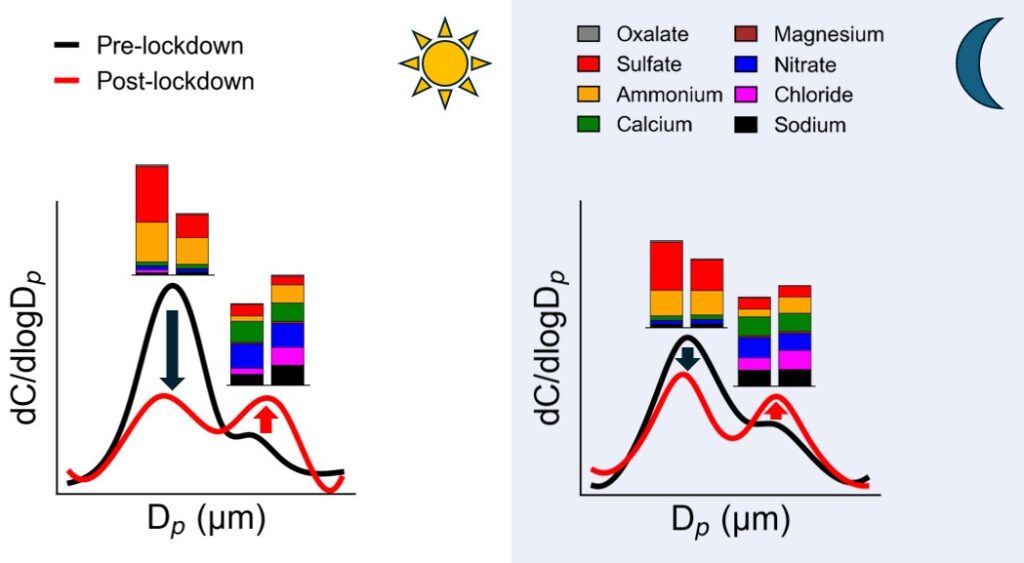
The researchers examined the chemical composition of city air in both daytime and nighttime, pre-lockdown and post-lockdown. They gathered aerosol samples over continuous 48-hour intervals and found that the concentrations of chloride and sodium actually increased post-lockdown. Metro Manila’s heavy pollution before the lockdown was found to be very potent at stripping away the chloride component of sea salt in the air–a process called “chloride depletion.” After lockdown, the reduced pollution allowed more naturally-occurring sea salt components to persist: when emissions from vehicles and industries dropped, the air became less acidic and therefore less able to deplete airborne chloride.
The researchers’ findings offer potential implications for human health, climate, and urban policymaking by highlighting the complicated dynamics of urban pollution. They recommend further studies to measure gas emissions and weather conditions together, and in greater detail, towards more effective, evidence-based government interventions.
Grace Betito, Paola Angela Bañaga, Rachel A. Braun, Maria Obiminda Cambaliza, Melliza Templonuevo Cruz, Alexander B. MacDonald, James Bernard Simpas, Connor Stahl, and Armin Sorooshian published their study, Day-Night Shifts in Water-Soluble Ions of Size-Resolved Aerosols before and after the COVID-19 Lockdown in a Coastal Megacity: Metro Manila, Philippines, in ACS Earth and Space Chemistry in October 2025. — Danika Geronimo, Ateneo de Manila University Research Communications