

According to the International Agency for Research on Cancer (IARC), the Philippines recorded nearly 189,000 new cancer cases and more than 113,000 cancer-related deaths in 2022. Globally, IARC also projects that the number of new cases will rise to over 35 million by 2050, which is a 77% increase from 2022 figures. Meanwhile, the 2025 Philippine National Cancer Summit reports that more than 180,000 new cases are diagnosed each year and cancer is estimated to cause over 300 Filipino deaths daily. These alarming statistics highlight the urgent need for continued research and innovation in cancer treatment.
In response to this growing health burden, chemists Christian Angelo Concio and Dr. Susan Arco of the University of the Philippines – Diliman College of Science’s Institute of Chemistry (UPD-CS IC), in collaboration with Dr. Wen-Shan Li’s group in Taiwan, are exploring innovative ways to fight cancer at the molecular level. Their study introduced new compounds designed to inhibit the activity of a cancer-related enzyme and prevent the spread of breast cancer cells.
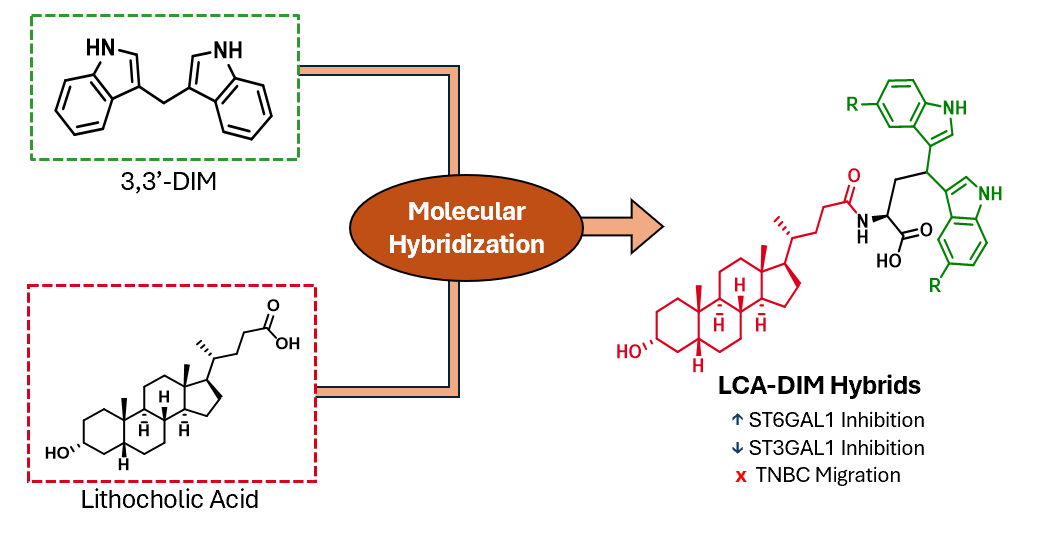
“These compounds, which we call lithocholic acid-3,3′-diindolylmethane (LCA-DIM) hybrids, work by stopping the enzyme known as sialyltransferase (ST), the key enzyme for this sialylation process,” Concio explained. The LCA-DIM hybrids can inhibit hypersialylation—a process in which cancer cells coat their surface with excessive sialic acid to hide from the immune system and promote cancer progression.
In the study, the chemists focused on two ST enzymes, ST6GAL1 and ST3GAL1, which both add sialic acids to glycoconjugates but in slightly different ways. Although both enzymes are involved in cancer, different STs tend to be overexpressed in specific cancer types, meaning that selectively targeting the appropriate enzyme could help improve therapeutic precision and minimize potential side effects. “Interestingly, we observed that these new types of ST inhibitors presented selectivity towards ST6GAL1 in comparison to ST3GAL1, which is ideal for next generation ST inhibitors,” Concio shared.
The LCA-DIM hybrids were also found to inhibit the spread of different triple-negative breast cancer (TNBC) cell lines, highlighting their potential as a treatment for this aggressive and hard-to-treat cancer type.
The team of scientists was inspired by previous studies, including their own earlier work, where they observed that indoles—compounds known for their chemical stability and potential anticancer properties—play a vital role in ST inhibition. They hypothesized that combining the “indole-rich” DIM compound with LCA, a known ST inhibitor scaffold, could enhance its inhibition. The resulting hybrids not only proved more effective but also showed high selectivity toward ST6GAL1.
“Unlike traditional anticancer drugs such as doxorubicin, which directly kill cancer cells but often cause severe side effects and develop resistance, our ST inhibitor works through a different mechanism,” he said. “It targets cancer metastasis, aiming to block the spread of cancer cells rather than just destroy them, thereby helping to slow disease progression and make cancer treatment more manageable.”
While their study focused on breast cancer cells, Concio said that they intend to explore this approach in other cancer types that also exhibit high levels of the ST6GAL1 enzyme, such as pancreatic and ovarian cancers. To bring the research closer to real-world applications, he added that the next steps include testing the hybrids for their safety, stability, and effectiveness in animal models.
Their research paper, titled “Novel lithocholic acid-diindolylmethane hybrids as potent sialyltransferase inhibitors targeting triple-negative breast cancer: a molecular hybridization approach,” is included in RSC Medicinal Chemistry, a journal publishing research and review articles in medicinal chemistry and related drug discovery science. — Eunice Jean C. Patron
References:
Concio, C. A., Perez, S. J., Chang, T., Chen, C., He, Y., Arco, S. D., & Li, W. (2025). Novel lithocholic acid-diindolylmethane hybrids as potent sialyltransferase inhibitors targeting triple-negative breast cancer: A molecular hybridization approach. RSC Medicinal Chemistry, 16(10), 5070-5083. https://doi.org/10.1039/d5md00390c
Ferlay, J., Ervik, M., Lam, F., Laversanne, M., Colombet, M., Mery, L., Piñeros, M., Znaor, A., Soerjomataram, I., & Bray, F. (2024). Global Cancer Observatory: Cancer Today. Lyon, France: International Agency for Research on Cancer. Retrieved from https://gco.iarc.who.int/today
International Agency for Research on Cancer. (2024). Global cancer burden growing, amidst mounting need for services [Press release No. 345]. World Health Organization. Retrieved from https://www.iarc.who.int/wp-content/uploads/2024/02/pr345_E.pdf
Philippine National Cancer Summit 2025. (n.d.). Philippine National Cancer Summit 2025 Calls for Urgent Action to Strengthen Cancer Care in the Country. Philippine National Cancer Summit. Retrieved from https://cancersummit.pcscancom.org/


, the Philippines recorded nearly 189,000 new cancer cases and more than 113,000 cancer-related deaths in 2022. Globally, IARC also projects that the number of new cases will rise to over 35 million by 2050, which is a 77% increase from 2022 figures.)