

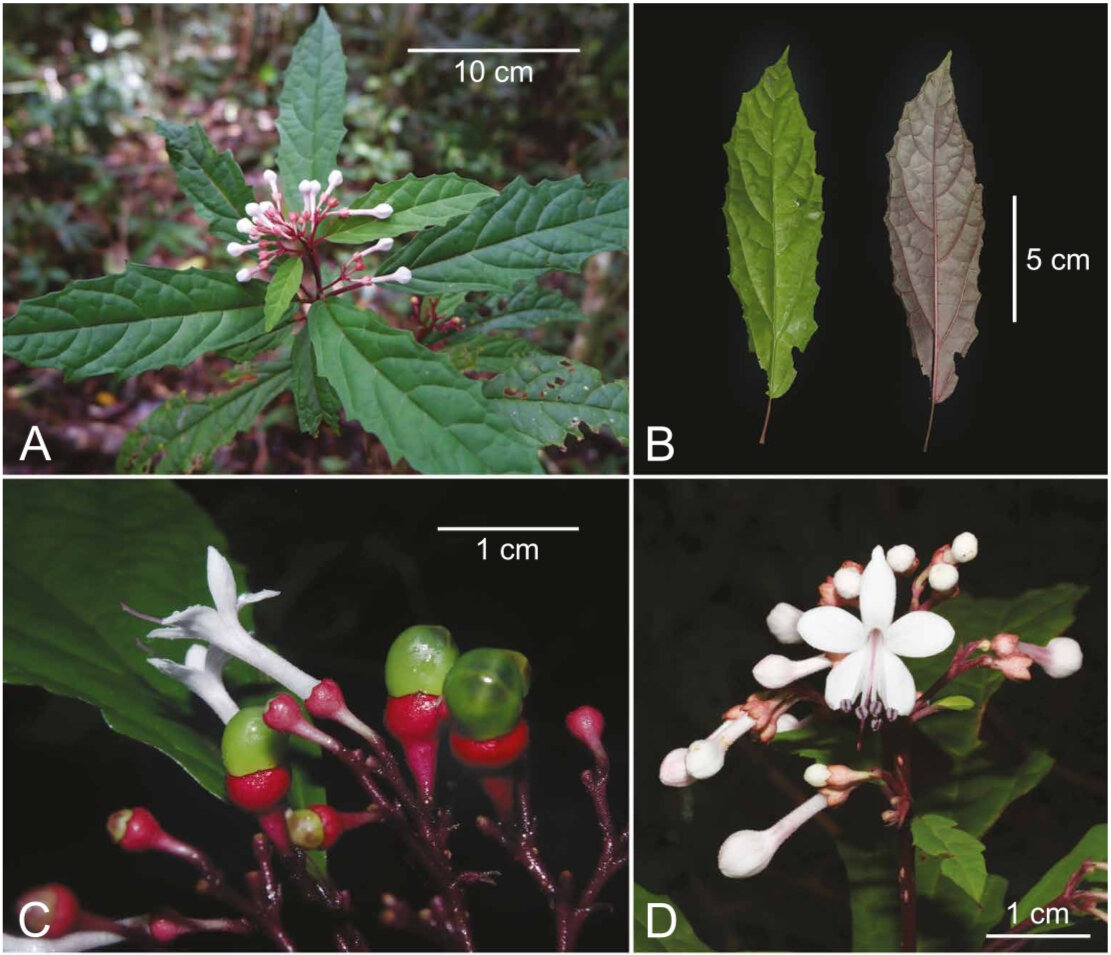
The indigenous Bugkalot people of Nueva Ecija call it “kelli”: a plant with white, starburst-like flowers and oval-shaped leaves that are traditionally mashed and mixed with food to treat ailing dogs. But despite this local familiarity, science has only now been able to identify it as a distinct species and given it a formal scientific name.
Clerodendrum kelli is a small shrub that grows in the humid montane rainforests of the Caraballo Mountain Range, specifically in two localities—Mt. Meddengen and Sitio Binbin. Nestled within the Pantabangan-Carrangalan Watershed Forest Reserve (PCWFR), this rare species is a subtle presence in the landscape, never appearing abundant nor easily encountered.
Reaching about a meter in height, the plant stands out with its green leaves accented by pale purple undersides. Its white, tube-shaped flowers bloom from reddish-pink bases and are arranged in loose, open clusters, unlike the dense groupings of some Clerodendrum species.
The documented medicinal use of the plant reflects the Bugkalot’s deep understanding of the species and its habitat. Importantly, there is no indication that their traditional use has led to the plant’s scarcity. Rather, habitat loss from land conversion and natural landslides poses the greatest known threat to its survival.
Despite formal protection, this ongoing habitat degradation has reduced C. kelli’s range. This shrinkage is especially severe along the steep ridges where the species grows. As forest clearing and slope failures continue, C. kelli is now assessed as Critically Endangered and is known to exist in a total area of just 8 square kilometers. Researchers warn that, without stronger protection, the species could vanish.
The underscores how the discovery of C. kelli is more than a scientific milestone; it highlights how Indigenous knowledge and science can overlap—bridging traditional and formal understanding of biodiversity.
David Justin R. Ples, John Patykowski, Leonardo C. Udasco, John Charles A. Altomonte, Adriane B. Tobias, and Rene Alfred Anton Bustamante published their study, Clerodendrum kelli (Lamiaceae), a new species from Carranglan, Nueva Ecija, Philippines, and lectotypification of Clerodendrum mindorense in December 2025 in the Gardens’ Bulletin Singapore. — Danika Geronimo, Ateneo de Manila University Research Communications
SOURCE: https://archium.ateneo.edu/biology-faculty-pubs/190/

Started in 1927, the Philippines Graphic is the longest-running printed magazine of national circulation that provides relevant news and features and promotes Philippine literature.