

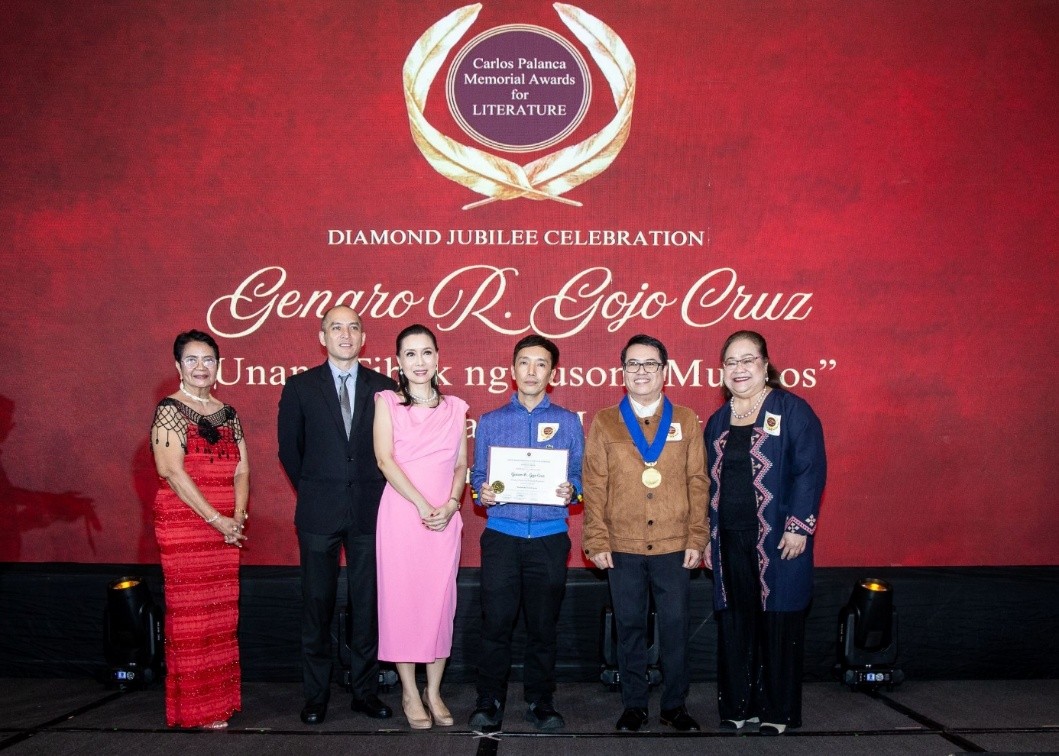
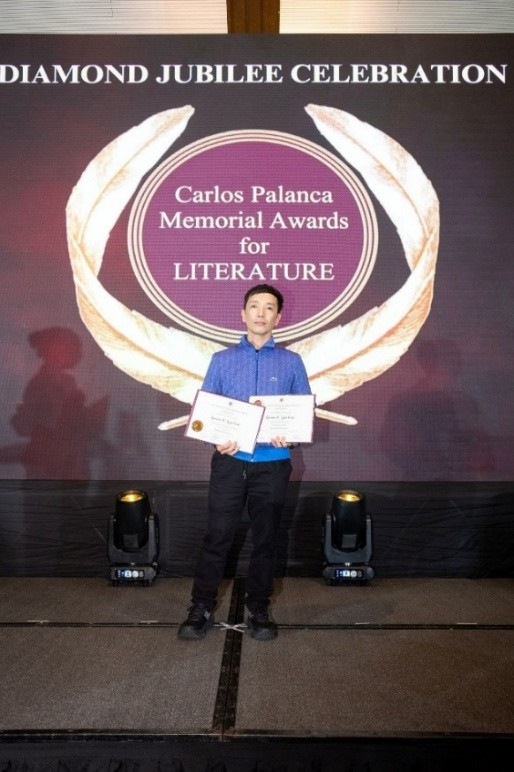
The first time a child saw him—the children’s author—in person, they blurted out, “Buhay ka pa pala, Sir.” Genaro Gojo Cruz, or “Sir Gene” as his students called him, laughs every time he tells that story. For many young readers, authors exist only as names on book covers—distant, almost mythical, and sometimes assumed to be long gone. But Sir Gene is very much present, and, 25 years into his career, he’s more devoted than ever in telling Filipino children’s stories. This year, that commitment earned him two wins in the Palanca Awards, both Second Prize in Maikling Kuwentong Pambata and Tula Para sa mga Bata.
When the Palanca emails landed, his first thought wasn’t trophies or glory. “Ang una pumasok sa isip ko, buti sinali ko,” he said. Submitting is never just clicking “Upload.” There are forms to fill out, notarizations to chase, classes and meetings to attend in between, and the constant tug of everyday life that makes it so easy to say, “Next year na lang.” Any of those could’ve stopped him. Instead, the risk paid off with two wins in one year—less a peak than silent proof that years of writing in an often-underrated genre were worth every delay, every form, every deadline he pushed through.
Small Sacrifices, Big Feelings
His award-winning short story, “Problema Ko Si Nanay,” sounds playful at first glance, but the “problem” it tackles is serious and very real. It’s about a child whose mother is a teacher. To outsiders, that might sound convenient. But for the child in the story, it means sacrifices.
“Mahirap din na titser ang nanay. Hindi puwedeng hindi siya kilala ng titser ko… Kaya hindi puwedeng maging maingay ako sa klase. Hindi puwedeng hindi ako makinig sa aralin. Hindi puwedeng hindi ko gawin ang assignment. Hindi puwedeng magkaroon ako ng kaaway,” goes the story.
When your Nanay is a teacher, Sir Gene pointed out, there are many things you quietly give up: time, attention, and the small freedoms other kids enjoy. The mother’s love is there, but it’s shared with lesson plans, classroom tasks, and other children.
In the story, he wanted to show that invisible cost, to give words to feelings many children of teachers might not know how to name.
On the other hand, his winning poetry collection, “Unang Tibok ng Pusong Musmos,” doesn’t just talk about crushes or romantic love. “Tinalakay ko ‘yung iba’t ibang anyo ng unang pag-ibig ng bata,” he explained.
First love can be a favorite plant, a beloved pet, a childhood experience, a trusted playmate, or a treasured toy. In the collection, he plays with all these forms of affection—how a child can fall in love with a memory, a moment, or something as simple as a kalaro.
“Laro lang ang laro, pero may ibig sana akong sabihin sa iyo. Bukod-tangi ang laro, Bukod-tangi ka sa mga kalaro. Makuha mo sana ang ibig kong sabihin,” he wrote.
Each poem tries to capture that first “tibok” of the heart, the early attachments that shape how children see the world and themselves.
Read Like a Child, Write Like One
Ask Sir Gene what matters in writing for children and he’s blunt: don’t underestimate them. “Mahalaga na hindi mo sila minamaliit bilang batang mambabasa,” he said. Assume a child is “too young to understand,” and the story turns to spoon-feeding, everything explained, nothing discovered. His pages leave space for young readers to think, use understatement instead of preaching, and trust that kids can decode metaphors and connect the dots. The moral shouldn’t land like worksheet; it should be found.
After decades of writing for children, he solved most technical hurdles, but the early challenge was learning to find the child’s voice. “Hindi dapat magtunog professor, hindi dapat maging tunog teacher sa kolehiyo yung kwento, dapat yung boses ng bata yung maririnig.” A children’s story must sound like a child could say it. His technique: listen, observe, and read mountains of children’s books.
He also researches like a reporter. If he’s writing about pigeons, he studies how they’re cared for, their habits, and uniqueness. “Bago ko pa isulat, well-informed na ako sa topic,” he explained. To Sir Gene, writing for children isn’t simplification; it’s accuracy, respect, and being deeply informed about the world his readers live in.
Keep Writing, Keep Going
In a world of phones, tablets, and endless scrolling, some fear children’s books are fading. Sir Gene, however, sees the opposite. A good kids’ book does what no gadget can do. It strengthens a child’s sense of culture and language, sharpens feeling and imagination, and connects young readers to history. Only Filipino writers, he said, can truly capture Filipino children, their streets and games, food, fears, and small joys. Foreign shows may entertain, but local stories help kids recognize themselves and believe their lives are worth telling.
That belief keeps him steady. 25 years in, and not new to Palanca, his first win felt like acceptance into the writing world; the second felt like proof; the next, quiet reminder to continue. “Ang pagiging writer, ‘yung pinaka-challenge… ‘yung pagpapatuloy. What is one win worth if you stop after it,” he said. The real work is to keep going, with or without awards. Trophies are a nudge, not the destination, to keep telling our children’s stories, and tell them well.
Truth on the Page
With so many children’s books under his name, does he have a favorite? Yes, and he even answered it without hesitation: “Ako ay May Tite.” It opened a conversation many adults avoid, giving classrooms and families clear, respectful words for body parts, honest and age-appropriate language kids deserve.
As a teacher and storyteller, he often road-tests drafts with kids, reading aloud and watching where they laugh or drift. When one student said, “Buhay ka pa pala, Sir,” it felt funny and tender, a reminder that beloved stories come from real people who sit at desks, make mistakes, revise, and care. That’s his aim: books that tell the truth, invite brave talk, and keep kids close to the living hands that write for them.
Sir Gene’s message to young readers is simple and hopeful. Keep reading local books. In Filipino children’s stories, you are the main character; seeing yourselves on the page builds confidence, and sharpens the sense of being Filipino. To those dreaming of writing for children, he points to the same doorway he walked through: read children’s books. Techniques can be learned and the work of earlier writers can be studied and adapted. “Ang pagbasa ang magtuturo sa ‘yo magsulat.”
After 25 years, countless titles, and two Palanca wins in a single year, Sir Gene still writes with childhood intact—curious, brave, and full of firsts. For a new generation growing up in a digital age, that may be exactly the writer they need, someone who keeps insisting their stories matter and keeps finding fresh ways to tell them. —Seymour Barros Sanchez