

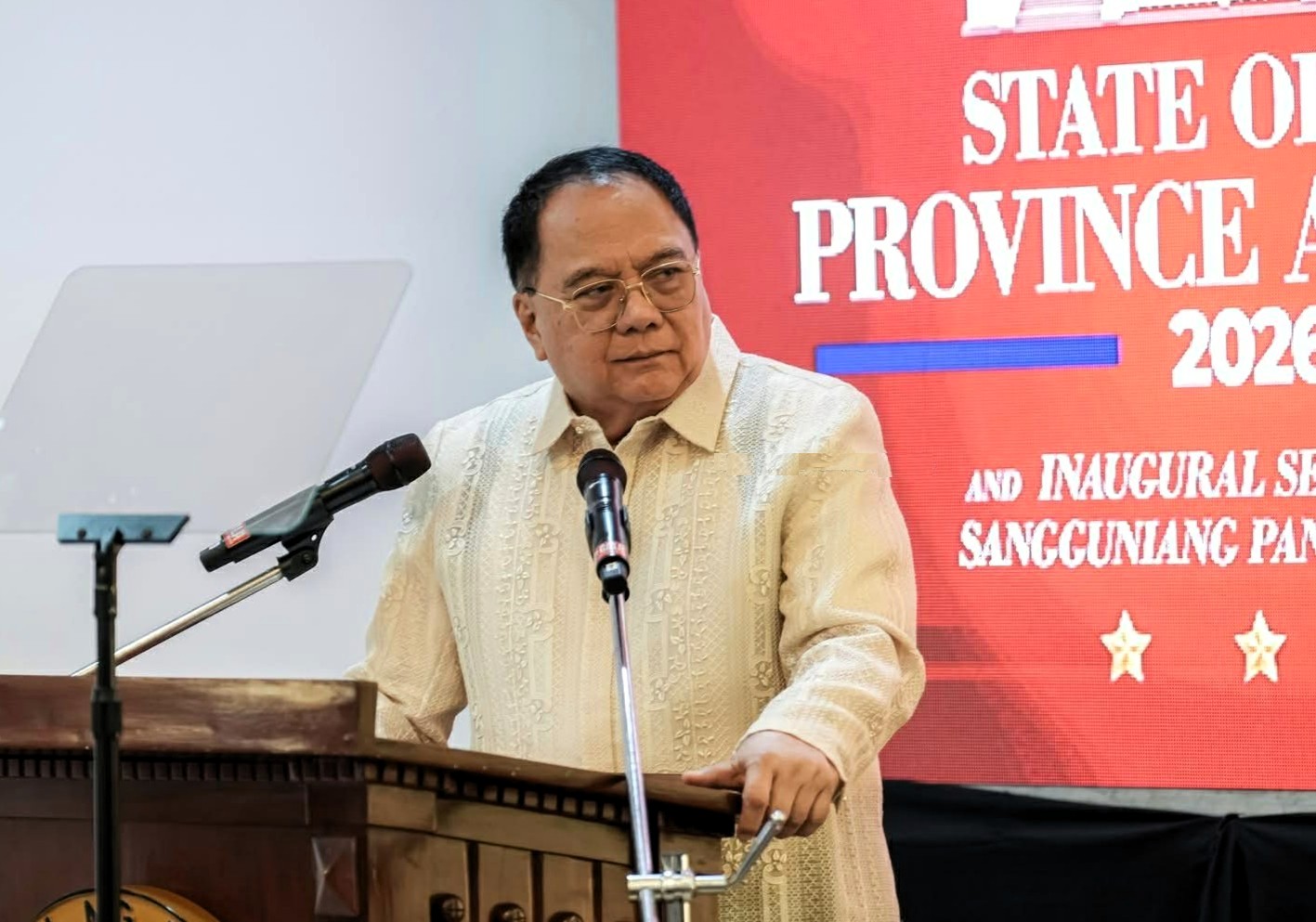
IBA, Zambales (Jan. 20, 2026) — Sound fiscal management and strong revenue generation have propelled Zambales forward to bring about continuing inclusive development and social transformation in the province, Gov. Hermogenes Ebdane Jr. said on Monday.
In his State of the Province Address (SOPA) at the inaugural session of the Sangguniang Panlalawigan, Ebdane said his administration has leveraged fiscal discipline and increased revenue collection into better public services, more roads, bridges and schoolhouses, and programs to empower local farmers, fisherfolk, and entrepreneurs.
“Today marks the unfolding of a new chapter, one that builds upon fifteen years of legacy with a simple yet bold vision: a Zambales that truly works for every Zambaleño,” Gov. Ebdane said. “Today, Zambales stands tall—economically, socially, and culturally. Our province has regained and sustained its first-class province status, fueled by strengthened fiscal discipline and revitalized revenue generation,” he added.
The governor said that under his helm, Zambales regained and maintained its status as a first-class province because of strengthened fiscal discipline and revitalized revenue generation.
Last year, Zambales mustered a 32.50 percent ratio of locally sourced revenue (LSR) to total current operating income (TCOI), a slight improvement over its LSR to TCOI ratio of 32.74 percent for the fiscal year 2023-2024.
This ratio, which measures an LGU’s fiscal self-reliance, and indicates strong local tax and non-tax collection compared to external funding like the National Tax Allotment (NTA), earned Zambales recognition from the Department of Finance as Top 8 among the 82 provinces in the country for 2024.
Zambales also placed Top 2 in 2022 and Top 6 in 2023 for year-on-year LSR growth under Ebdane.
Aside from increased revenue generation, Ebdane also pointed out the positive outcome of government efforts to promote transparent governance, and equipping communities with tools and guidance that empowered people and encouraged them to participate in the enhancement of services in key sectors.
He cited as an example the establishment of the Zambales Mango Industry Council to improve mango farming, for which the government allocated P5.3 million to revitalize mango farms in the towns of Palauig and Masinloc, as well as P1.6 million for technical training for mango growers in Castillejos, San Felipe, Botolan, and Iba.
For the fisherfolk, meanwhile, Ebdane said the government has developed a program to develop the local fishing industry through equipment assistance, technical training, and the organization of local fisherfolk into cooperatives. Under this, two 45-footer lightboats will be turned over to local fishers groups this month as initial inputs, he also said.
The governor likewise cited the distribution of agricultural machinery, improvement of farm-to-market roads, and procurement of modern equipment like CT-scan, ultrasound and radiology machines for the four government hospitals in the province, as initiatives to boost livelihood opportunities and government benefits.
Under infrastructure development, Ebdane said the Zambales LGU has embarked in the construction of a new Capitol building worth P499.6-million; a P499-million sports complex track and stadium; P399.7-million provincial hospital annex; and the P213.2-milion Capitol multi-purpose building on top of other community facilities like roads, water systems, barangay halls and covered courts.
Significant progress was also made on behalf of students and the youth through the Capitol’s “Handog Edukasyon” program, sports training and facilities improvement; for the elderly and disadvantaged through the “Hatid Serbisyo” and “Tulong Kapitolyo” projects; and for the environment through strategic interventions in watershed management, resource recovery and waste management, and climate resilience.
In his SOPA, Ebdane also urged public officials and residents to prepare for and help mitigate challenges from climate risks, infrastructure gaps, health system pressures, and poverty in vulnerable communities in the future.
“We must embrace emerging tools and new approaches—not for trend, but for better service. We must ensure that governance remains responsive, relevant, and worthy of the people’s trust,” Ebdane said. – Taktikom News & Features