
I used to bite my tongue a lot. I hated facing things head on. My emotions feel like they have all risen to the surface from years of being anchored down to the sea bed, barnacled and all. I’ve become a lot more tearful when I watch movies. I no longer hold myself back from sniping back at rude customers. I fear the dark more than I used to. I can’t walk at night without fearing a man might try to take hold of me. Other things have changed, too. I have developed a taste for watermelon seeds and eating kiwi like apples. I am no longer allergic to cats and pollen. My feet used to be two sizes smaller, and my leg hair three centimeters shorter. I can no longer touch my toes. I can fit four whole lanzones into my mouth now. My hair used to grow curlier, but now it comes out of the shower pin-straight. I like to braid my hair in three parts. I wake up every morning nauseous and craving mango pits.
A lot has changed since last August, the wet season. Summer is warm and dry. My bed is like an ocean in a storm. The white cotton sheets are buckled, and the striped pillows rest on the foot of the bed, mapping the twists and turns of the night. I bring my hand to my belly and feel the fullness of it beneath my palms. When I breathe in, I can feel my hand curving over the roundness of it. It’s already been nine months. I’m afraid it will come as it pleases. I feel it kicking, pounding, using all of its strength to poke a hole in my belly to get out of my body. At night, I lie awake dreaming up scenarios in which I’m doing something menial in my everyday life, like doing the groceries or lining up at the bank, and suddenly it will decide it is ready to enter the world. I have a feeling that it will be strong. When I lie down in bed, and my dog Kelly comes to cuddle me, it will kick from inside, and Kelly will look at me, confused, as if I pushed him away. Kelly will readjust and go back to sleep.
I try to call my father. My mouth makes the sound of each letter of his name. He has been staying with me since the pregnancy. He likes to come into my room at 7:00 am to tell me there is warm pandesal in the kitchen. My father does not know how to care for a pregnant woman, which I do not blame him for. When my mother was pregnant with me, she had a team of mothers behind her. Her mother, my grandmother, had six sisters who all grew up together and had three children each. Back in Silay, where the land was fertile, so were the women. My father was able to work tirelessly while my mother was being pampered and taken care of. Now that I’m big-bellied and almost ready to pop, my father only knows how to do so much. So he brings me bread, helps me down the stairs, and drives me to my doctor’s appointments.
My father does not approve of the pregnancy. I told him three months after I found out; he had just returned from Makati, where he works in operations. I had been covering my stomach by wearing large, thick sweaters to hide my belly, but it was getting harder and harder to do so with the sweltering heat, and I knew I had to tell him at some point. I was a gymnast for a good ten years of my life, and I had just won a competition and was going to pursue a scholarship in Los Angeles to play for a college team, compete, and travel to all sorts of places I could only dream of. When I showed him my belly, all he did was put his head in his hands and said nothing. Of course, there was a boy, yes, he knows about the baby, and yes, he is an asshole. We didn’t need to discuss the change of plans — I told my team I was injured and had to take a break, unpacked all my packed bags, and found a remote job in customer service.
Recently, I’ve been wanting to play around with names, but I do not want to know the sex. I have the envelope tucked in the desk drawer, but I haven’t opened it since I received it last September. If the baby is a boy, perhaps “Leo,” named after my father, or “Carol,” after my mother. Clearly, I do not give much thought to these things, though I should. There are a multitude of things that I should or shouldn’t care about anymore as a woman—a mother, I mean. Life has become a complete calculation of numbers. Doctor says I need 9 hours of sleep plus a 2-hour nap in the afternoons. I was 90/60 mmHg yesterday. 110/70 mmHg a month ago. There are 402 calories in 80 grams of Chocnuts. 67kg when I stepped on the scale this morning. The 3% decline in my muscle mass from last week. The baby’s body is roughly the length of a zucchini: 38–40 cm in length. 1.4kg, about the weight of a cauliflower. 12 distinct kicks in the last 90 minutes.
We grew up in a big house in Silay, where the sugarcane fields stretch for miles, and the wind kindly delivers a fresh breeze from the sea. It was a two-story home with large window panes and a big balcony that looked over the garden. My mother loved to collect all kinds of birds. We had large enclosures around the house, and every morning I would hear them singing and chirping. I would know when to get up and ready to leave for school; when I’d get back home, the parrots would signal my arrival, and my mother would hurry out the door and greet me at the gate. I grew up in tune with their language. It was only the three of us in that big, old house for seven whole years until my mother got pregnant again. A baby girl. She was three months pregnant when she began to bleed. We moved to Manila to find an answer to her complications. We sold the house and all the birds, all the enclosures and the songs. She couldn’t stop bleeding, and my mother died in the hospital a short while after. My father and I stayed in Manila to forget our old life. To leave the sadness where it was, in Silay.
I’m twenty-five this year, the age of change. Since being in the last term of my pregnancy, I have been working at home, answering phone calls from people who complain about their phone service and bills. In between the hours of nine and five, I sit on my office chair in front of my window that faces the corner of our house, and the street that goes down to the bakery. I do a lot of bird watching. My father bought me binoculars and a journal on my last birthday. Last Friday, I saw a spotted wood kingfisher taking shelter in one of the trees across from our home. It had a heavy, red bill and a brown crown. I wrote it down in my journal and drew a quick sketch of it to keep track of my findings.
My dog Kelly likes to sit beside me, right by the office chair, and in places around the house where he isn’t meant to sit. He likes to lie down where the castors or the wheels of the chair are. While I work, I have always been careful not to roll over his thin, floppy ears. And I always tell him not to sleep there because he could get hurt, but he just likes to look at me with his big eyes, sideways, lying on the floor. Clueless of what dangers I speak of, he can’t comprehend the pain because he has never felt it yet. I can only give warnings and provide signals. This is what it’s like to be a mother, I think. Ever since my pregnancy, Kelly has been more protective of me. He has made it a job for himself to guard the bathroom door while I’m inside. This also includes smothering me with kisses when I start uncontrollably sobbing while watching something on my phone.
We found Kelly on the street near our house two years ago, when he was a little puppy – about five months old. He was all skin and bones. His white fur had practically looked gray. Sometimes strays find their way into subdivisions; no one can control the population. We figured that he might be a mix of a chihuahua and a poodle because of his tall, pointed ears, and his long legs and curly fur. He had big, black eyes like tapioca, and he had a perfectly straight tail, like an antenna. He was helpless and hungry on the street, just barely able to walk. He looked at me with his large eyes, rolled over to show his belly, and I instantly took him home.
Kelly is emotionally intelligent, but not very sharp when it comes to picking up things that should and should not be done in the house. He likes to chew on things that aren’t meant to be chewed on, like phone chargers and throw pillows. There was one time he came into my room, holding a dead rat between his teeth. I screamed so loud it woke my father from his slumber. He was wagging his tail, his eyes wide and bright. When I started yelling at him, he cowered away, slowly scooting away from me and my towering voice. When I saw him like that, his ears lowered, his tail soft, I couldn’t help but think what kind of unrecognizable person I might be to him. I remind myself that he is a dog. I say Kelly, it’s okay, and I open my arms out to invite him into an embrace, and he’d slowly crawl toward me; let himself melt in the warmth of my forgiveness. I didn’t realize how much I projected this motherly instinct onto Kelly, and how often I expected him to learn and change, as if he were a person with intrinsic values and the ability to decipher right from wrong.
Kelly also likes to search for birds; this is one hobby we like to share. He can easily spot one flying in and out of the trees. He barks in excitement and jumps up as if he could actually go fifty feet in the air and reach to bite their little wings. There is a little cavity nestled between the roof of our house and the window to our guest bedroom. I always see it directly from my bed – that small cave of darkness. I like to look at it and try to imagine what sort of residence they’ve built in there. I sometimes see lizards, moths, and flies popping in and out of that small hole.
Yesterday, I saw a maya bird move in there. She had streaks of black on her wings and a full, soft, white chest. She flies lightly and quickly, fluttering in short bursts, and waits patiently perched on the brim of the little cave for her partner to bring home small insects. When she flies, she darts over and under the trees and lampposts in the surrounding area. Kelly sees her, too, and he signals her arrival by barking and circling one spot excitedly. Today, she is collecting twigs and dried leaves and bringing them to the little cave. I spot her closer with my binoculars. She is making a nest. A mother-to-be.
While my father used to work at a sugarcane plantation as the operations staff, he and my mother loved to learn about birds. They studied them together and built a whole world for it at home. He kept a book of the different birds to spot in Silay. Different birds build their nests in different ways. The maya, or the Eurasian Tree Sparrow, is a city bird. They adapt to the rigidity, the unyielding nature of the city, so they nest in the cavities of buildings and roofs. Because of the lack of greenery, they also make use of the objects littered around the city: paper, string, and bits of plastic. I had never seen one building a nest; it was amazing to see one up close.
Doctors use the same term for pregnant women with an instinctive urge to create a space for their baby prior to their birth. Nesting. I look around my room; I remember I still have to pick up the crib at the mall this week, and that I need to baby-proof the sockets. On my desk, there is an unchecked notepad of to-do lists for the baby. Schedule 3 prenatal visits before delivery, stock up on 10 packs of diapers, 12 packs of wipes, purchase at least 1 nursing bra, 2 baby monitors, and submit my work leave. My father told me that I don’t seem like a pregnant woman – just a regular woman with a really large belly. I’m afraid these are signs from the universe telling me something important. I feel like there is a timer built into me, slowly counting down to the moment this body will suddenly decide to give up on me and the baby. Will just collapse and shrivel in defeat, no longer willing to take on the toil. It’s not good to moon over these thoughts, my doctor always says. What else is there to think of, apart from this giant thing inside me, I want to say.
The mother bird is darting back and forth from the ground and back up to her new home. I watch her gathering materials, and I don’t realize that an hour has passed. It’s already 5:43 pm, almost time for dinner. I push the windows open to let some air in. My father should be home in a few minutes. I go downstairs in careful, heavy steps. The fridge is stocked with Tupperware of food from last week as well as a huge pot of rice. I like to cook large amounts of ulam for me and my father. Recently, my favorite activity has been making new recipes from the overripe vegetables in the fridge. I boil sweet potatoes and carrots together to form a hearty soup or bake bell peppers and ground beef, then top them with cottage cheese. While I am chopping and stirring in the kitchen, my father sticks to watching me from behind the counter, tasting sauces, and taking bites of the scraps of ingredients on the side.
I decide to reheat the chicken sopas—a creamy chicken soup with macaroni and chopped carrots. I have been wrestling with the changes that came with the baby. There are certain things that I prefer to eat. I have developed an unusual liking for dairy and all kinds of nuts and seeds, which have made my skin perpetually erupt in breakouts, and led me to pick my face in the dead of night and make incisions, or craters, around my face. I do not understand this maternal “glow” that everyone seems to gloat about. More than ever, I have been concerned about my appearance and how I may look to those around me at the grocery store or on Zoom calls for work. I have been buying more makeup, caking layers of concealer on my red, puffy face, and eating more chocolate, indulging always.
In moments like these, shoveling cheese and pasta into my mouth, I feel like a caricature of a person, a shell of a woman. I’m constantly thinking about myself and what might be good or bad for my body to consume. I avoid processed meats, like Tender Juicy hot dogs. I always have to be wary of unpasteurized dairy, and I only drink coffee once a week. My father checks my blood pressure every day, fearful that I might be experiencing preeclampsia without us knowing. Hence the constant numbers. I used to be one force of a woman. All muscle and strength. I feel deflated, like I stepped out of my old body and entered a new one. I used to be able to balance my entire bodyweight on my palms. To leap into the air, weightless, and land back onto the ground almost soundlessly.
There are other fears, like who the baby might grow up to be. Now that I am this different person – all chub and red-faced – would they want to be my friend? Would they learn good things from me or would they have to unlearn everything I taught them at the end of it all? I feel them kicking, but I want them to stay there. How do I tell them I’m afraid? Selfishly, I think about getting my body back. If that is a privilege motherhood offers. Then I feel a wave of guilt wash over me to think what better thing my body could do. To run with full force on the sand. To lift a bookcase with one hand. To sleep on my stomach. To take up less space. To create life. And more life.
When I finished dinner and came back upstairs, my feathered pen was gone from my desk, as well as my popsicle sticks. I look around at my stationery; there are objects misplaced and gone: 1 ruler, 3 black ballpoint pens, and 2 bookmarks. My window is still open, the wind softly blowing the curtain. I look at Kelly, already curled up in my bed, falling fast asleep. I’m constantly forgetting things these days. I shower with scalding hot water and brush my teeth in front of the fogged-up mirror, sure not to get a glimpse of myself.
Tomorrow, I am determined to work on the baby’s room. There are lots of things to consider: the color of the wallpaper, the type of wood for the bedframe, and the number of sockets for baby-proofing. I list down everything in my head that I need to prepare, and I fall asleep dreaming of building a crib, piece by piece. I dream of my baby, a smaller, perfect version of me. A small girl is running towards me, holding out a bird between her hands, but when I look at it closely, its body has completely hardened, the legs shattered, its eye sockets empty. The girl is crying, pleading for me to take the thing out of her hands, but I’m running too slowly, and I can’t get to her fast enough.
When I wake up, there’s a ticking sound coming from the wooden floor. I wake up to it once; maybe it’s just Kelly and his rough paws stepping around the room. I hear it again, and I gently rub my eyes open. The sun is streaming through the curtains, warm and still. The mother bird is inside my room, pecking away at the floor. Beside her, a pile of stuff: pens, jewelry, and bookmarks. She spots me spotting her, and she quickly picks up a black pen from the pile, flies through the open window, and goes into the little cave across my room. Kelly is outside my door, scratching, barking, asking to be let inside. When I open the door, he sprints inside and starts jumping and barking at the window. I tell him to hush, relax, the bird has gone.
I close the windows this time, turn the knobs to lock them shut. I didn’t have any food in my room – why was the bird inside? Why did it want my things? I try to remember what my mother told me about the maya’s behavior, but I can’t seem to recall them being intrusive and territorial. I remember she used to leave sunflower seeds for the maya birds, but I didn’t have those anywhere. Slowly kneeling down on the floor, I pick up each item and return it to my work desk, where they belong. I go downstairs, one foot after the other, my hands gripping the railing. There is pain in my left ankle. There has always been something painful and unexplainable recently.
No kicks from the baby this morning. It is quiet again. My stomach is growling, however, from starvation. Outside the kitchen window, I spot my father harvesting the small patch of tomatoes he grew in our backyard. He’s wearing his work pants with a white linen shirt and soft red gloves on his hands. I knock on the window to let him know I’m there, and when he sees me, he mouths the word pandesal, and I laugh. I concoct a breakfast made up of fried eggs, leftover tapa and monggo, and pandesal with peanut butter, and I eat it all together in big bites.
I’m eager to check something off my list: choose a color for the baby’s room. When I’m done eating, I go upstairs to the empty room beside mine. I had some color samples from the architect, months ago. A soft, ballerina pink, maybe? Or a buttery yellow for something more neutral? I hold the cards up to the wall, but I’m not satisfied with either one. The sunlight is streaming in the room beautifully, and I try to imagine what it would be like filled with furniture, paintings on the walls, and a child playing on the floor. What games would we play, and where would the baby hide if we did hide and seek? I sit in the corner of the room, holding my belly, and I feel a kick. As if being in this room suddenly awakened the baby.
I write it down in my journal. 3 kicks in the last minute. That’s more than yesterday. The baby is talking to me, slowly inching its way into this room. Reaching, pushing, kicking. The numbers are getting bigger every day, the days to the delivery smaller. I think about the person who will grow in this room, a little thing standing 3 feet tall, with two large growing teeth, 10 fingers and toes, with a love for the color blue. Tears suddenly burst from my eyes, and I miss my mother. I want her to tell me what to do – how to arrange the room and what wallpaper color to paint it. I want her to tell me I will be a good mother and that my child will grow up just fine.
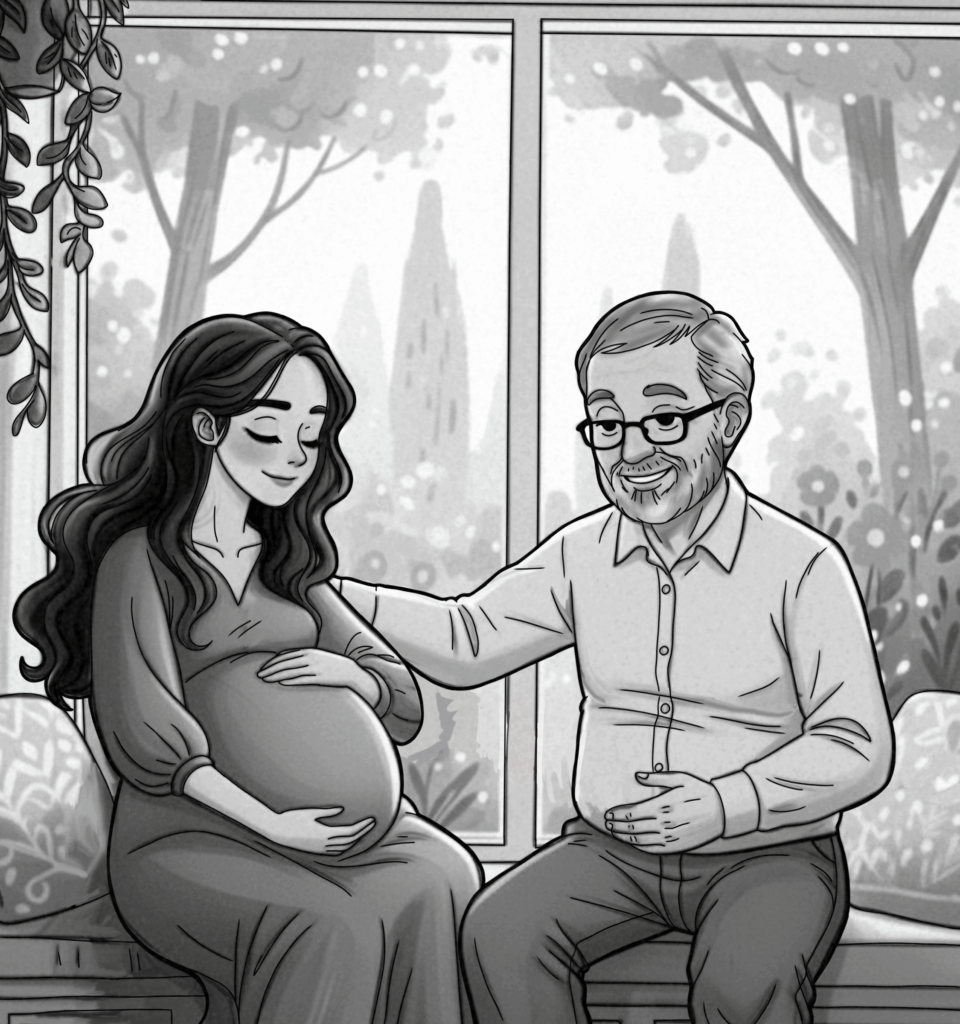
I wipe the wetness from my eyes and nose. I hear heavy steps from the bottom of the staircase. My father slowly pokes his head to peek into the room; he finds me like this, disheveled and sweaty, on the floor. I know that he will help me up and tell me to shower, try not to press or ask more about the mess that I am. Instead, he sits beside me and lets me rest my head on his shoulders, and I completely crumble. You’re okay, he says. My back is all damp from the heat, but he still holds me in his arms. When your mother was pregnant, he starts, she was like a storm. She loved to run, even though she was told never to do so. That’s probably why you’re so athletic. She hated crying, though, and always tried to resist her tears even when she was so obviously upset. I couldn’t see his face, but I could hear him smiling as he was speaking. The crackle of his lips, slowly drawing his gummy smile open. But more than anything, she was afraid, he continues.
Before you, she was always guarded. She liked to keep things to herself—just like you, I guess. She whispered her secrets to the birds. To be honest, I wish we had stayed there. I wish we could still hear their songs. I look up at him, and a tear falls on his cheek. I had never seen him cry. My father helps me up from the floor. It is time for him to go to work, he declares. I check the time on his watch, and it’s already 7:32 am. He’s already late. He reaches for something behind him and hands it to me. It’s a large, heavy roll of paper. I unwrap the edge, and I see that it is cornflower blue wallpaper with a pattern of little illustrations of flying birds. I embrace him, my large belly in between us, my tears on his crisp white shirt.
I’m standing in the room that will soon be my child’s; the floor is still unswept and surrounded by boxes of unopened furniture. In a matter of years, someone’s life will shape up here. They will learn how to change the light bulbs when they start to flicker; they will discover something about themselves that will conjure the desire to change the wallpaper to a different pattern. But for now, the house is still and silent; all I can hear is the sound of the birds chirping outside. I walk to my room and grab my binoculars. The mother bird is finished with her nest – I see my pens, some of my popsicle sticks mixed in with twigs and feathers. Now I see – this is what she has been making. She has laid her three eggs and is sleeping right next to them. She is there every day and night, quickly finding food and returning to keep them warm, and after two weeks, I heard a choir of chirping. They all hatched perfectly. The mother feeds them worms and insects as they all widen their mouths in hunger.
What might it be like to be on the side of giving? All of my life, I have been receiving. From my mother’s breast to my father’s roof. When the baby comes, mouth open and asking, maybe I will be ready to surrender. I have been feeling more and more pain in my lower back and abdomen, and I know for sure that I’m nearing the delivery. There are fewer hours of sleep at night, and more of thinking, worrying, and pacing. I think about how different my life will be in a matter of weeks. Maybe the birds would have learned how to take flight.
Suddenly, I hear a faint, high-pitched sound coming from outside. It sounds like crying or wailing. I walk outside to find the sound getting louder and louder – and there it was, nestled in the soft green grass, the tiniest baby bird. It is chirping and yelling with all of its power, fearful of the world outside its nest. I pick it up with my hands, carrying it gently to the table on our porch. It has brown feathers with a white chest and black speckled wings. A maya bird. I look around for any sign of the mother, but she is gone.
There is a soft white blanket in the linen closet, which I quickly get. I wrap the baby maya in the blanket, softly petting its head to make sure it knows it’s safe. Back in our home in Silay, my mother used to take care of helpless birds like this one—baby birds that fell from their nests or were abandoned by their mothers. I used to watch her hold them and feed them through a dropper. Some of them lived, but most of them died. There was a little pigeon that found its way into our garden one afternoon. The nest was perched upon a nearby tree, but it was completely abandoned. The mother must have been teaching her young how to fly. We taped toothpicks to its wings and pushed it off from low heights, teaching it how to fly on its own, but it never did. We kept it in a cage, all its life, safe from the dangers of the world without flight. My mother always said she could only help so much; she wasn’t their mother after all.
I try to feed the baby maya small pieces of a hard-boiled egg, but it wouldn’t open its mouth, instead just crying and wailing even more. A website on Google suggested trying to keep the baby bird warm. I position a pot of boiling water underneath its makeshift container, but it is still shaking. I try to look for the nest in the nearby trees or lampposts, even in the cave across from my room. I’m trying to sleep, but I keep hearing the little bird chirping and crying. I wonder if its mother is looking for it or if she has completely abandoned it. I feel a pit of guilt in my stomach for possibly taking this mother’s baby from its family – what if she was going to go back for it? Does she hear its cries now, but can’t figure out a way to get her baby back? My lower back has succumbed to the sensation of being stabbed, and I feel like I have been peeing two liters of water each time I go to the bathroom. My father has readied the pack for the hospital, but I can’t leave the bird. I fall asleep dreaming of the baby maya flying away into the sky, my belly flat and my ankles less swollen.
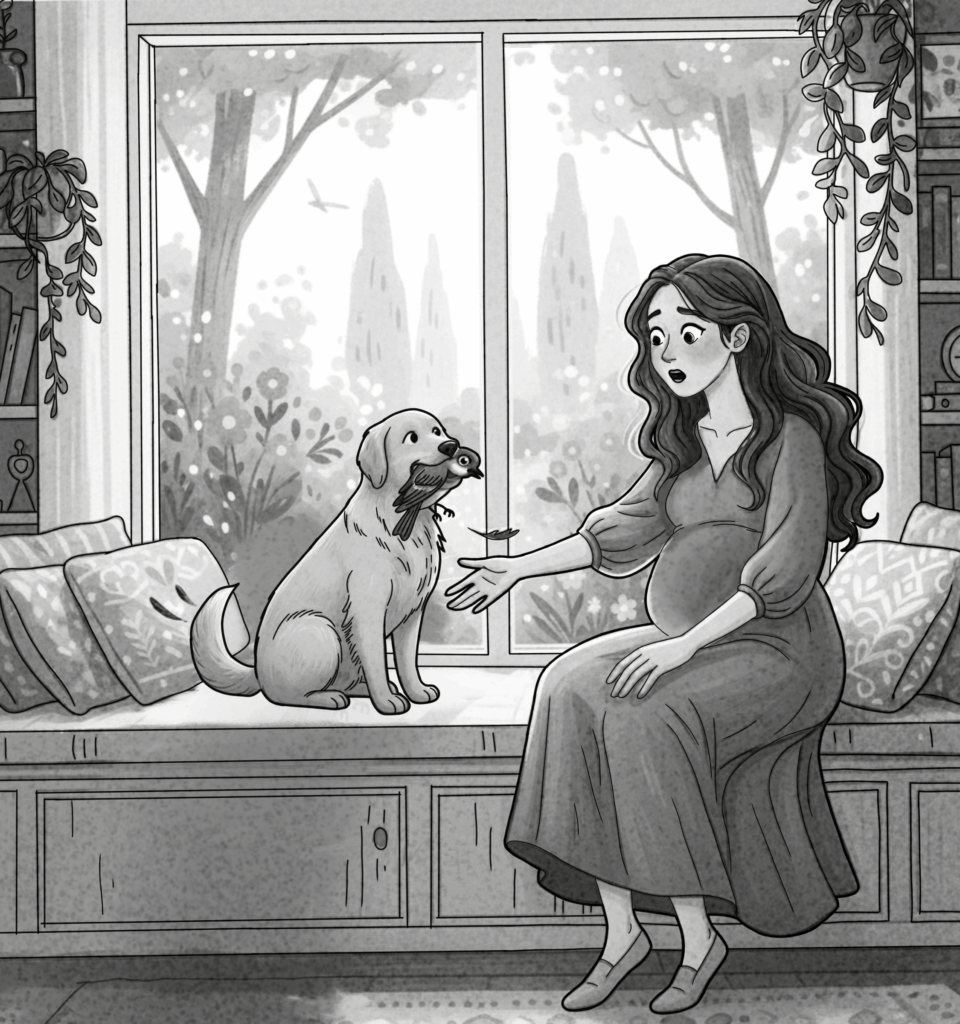
I wake up with my bed wet. I yell for my father, and he enters the room in a split second. He helps me up and brings me to the car. The baby maya is silent, and I wonder if it has finally fallen asleep. I tell my father I need to bring Kelly, and as he runs in, there is something between his teeth. He is wagging his tail, the dog that he is, happy to bring me something that he found. When he comes closer, there are feathers hanging from his snout, a wing over his front teeth. I scream when I realize it was the little bird. Kelly is holding the bird in his mouth. It’s slightly twitching, trying to fight its way out of Kelly’s mouth. Kelly, put that down! I cry out to him, and he obeys. The baby bird is flapping its wings, trying to fly away, but the wings are damaged and broken.
He does not know what he has done. I do not blame Kelly, as I always do. He will lower his head, and I will let him into my arms, and he will melt in my forgiveness. This is what it’s like to be a mother. My father has picked me up and is dragging me to the car, and in this moment, I am more fearful than ever. I am not its mother. I am going to be a mother. I am going to be a mother.