

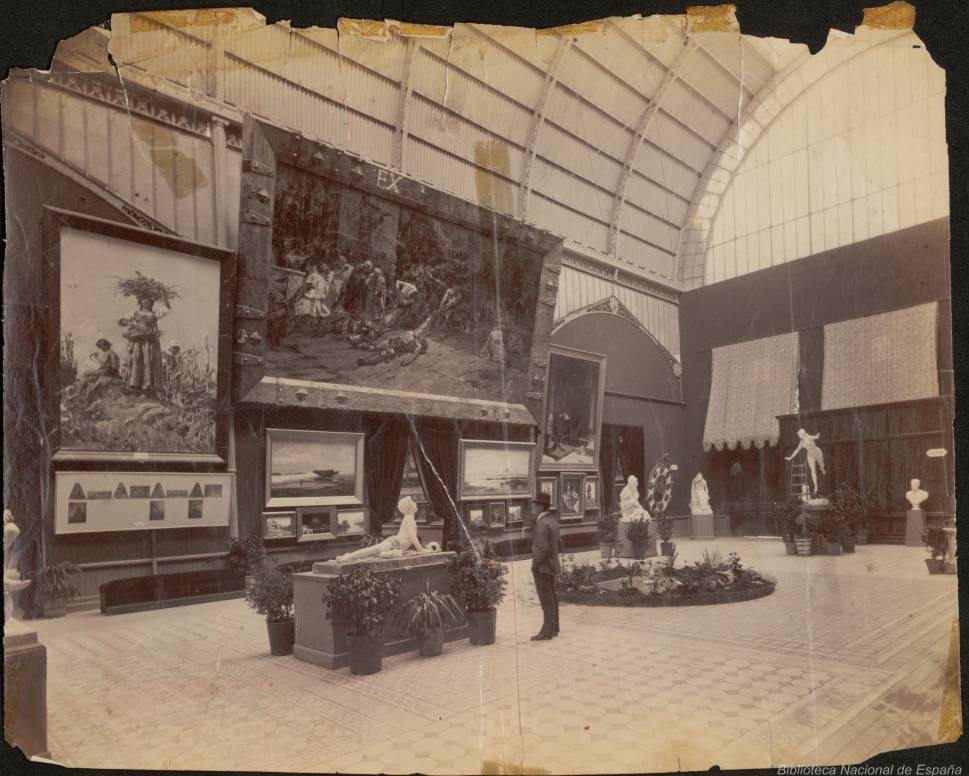
While examining the archives of the Biblioteca Nacional de España, I encountered an albumen photograph labelled “Sala de pintura y escultura at the Exposition Universelle of 1889 in Paris.”
The image is attributed to Juan Laurent—one of the most important photographers working in late 19th-century Spain.
Laurent created a visual record of Spain’s cultural life at a moment when photography was becoming central to the circulation of art. His photograph shows the Spoliarium installed in the hall alongside a sculpture titled “Ismael en el desierto (Ismael in the Desert).” The library label is incorrect.
Comparison with published sources confirms that the image depicts the Sala of the Crystal Palace during the Exposición General de Bellas Artes of 1884 in Madrid.
The photograph explicitly names Luna, while the other artists remain unidentified—a sign of the painter’s prominence. To identify the sculpture placed before Spoliarium, I examined the digitized image and consulted 19th-century newspaper reports.
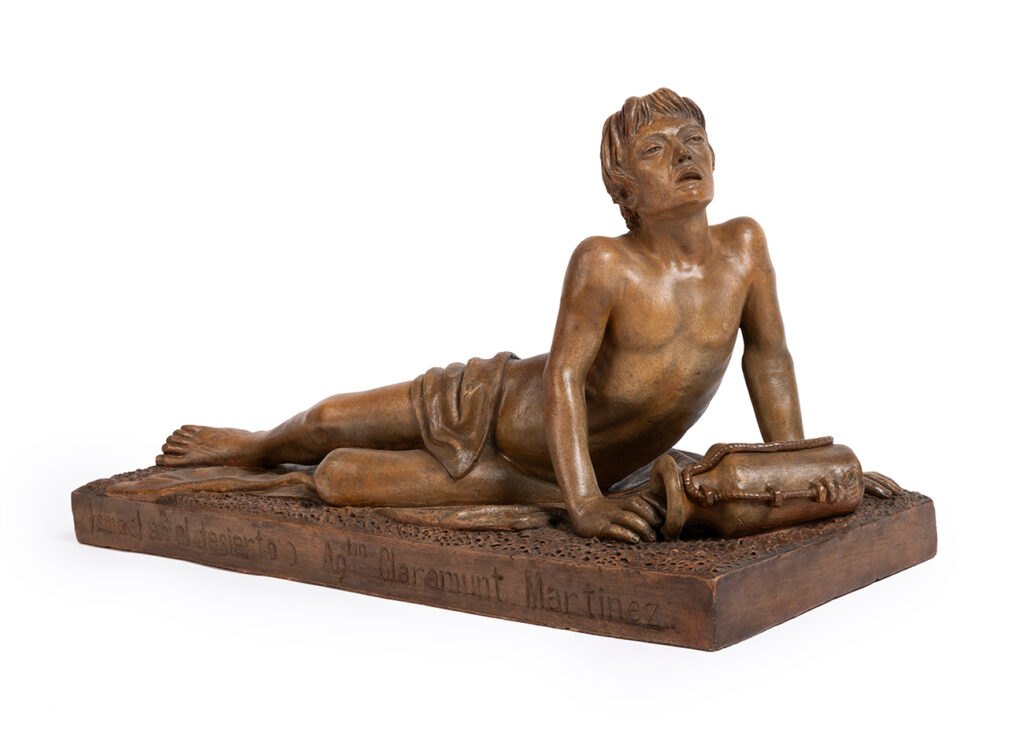
A closer view of the plinth reveals the partially legible name: “A. Claramu[…]”. I identified the work as a piece by Agustí Claramunt i Martínez (1846–1905), a plaster sculpture whose editions sold for 1,000 pesetas. A terracotta cast from this mold is now in the collection of the Biblioteca-Museu Balaguer.
DREAM DISPLAY
I considered how compelling it would be to display Claramunt’s “Ismael” near Spoliarium at the National Museum of Fine Arts in Manila. The Madrid installation staged a dialogue between artists at the margins of the Spanish Empire.
Ishmael’s biblical exile—placed before Luna’s monumental scene of gladiators dragged into the Colosseum’s dungeons—captured how both artists positioned themselves in relation to Madre España, which often claimed the heritage of the Roman Empire and its Christian identity.
Luna partly drew the scene from Rome in the Time of Augustus (1835) by Charles Louis Dezobry—a widely read four-volume work illustrated with engravings and descriptions of everyday life in antiquity that served as models for academic painters. The composition also reflects the painter’s exposure to French Orientalist painting. He moved in the same artistic circles as Jean-Léon Gérôme, who was a leading exemplar of this current in French academic art, and likewise drew from Dezobry’s volumes.
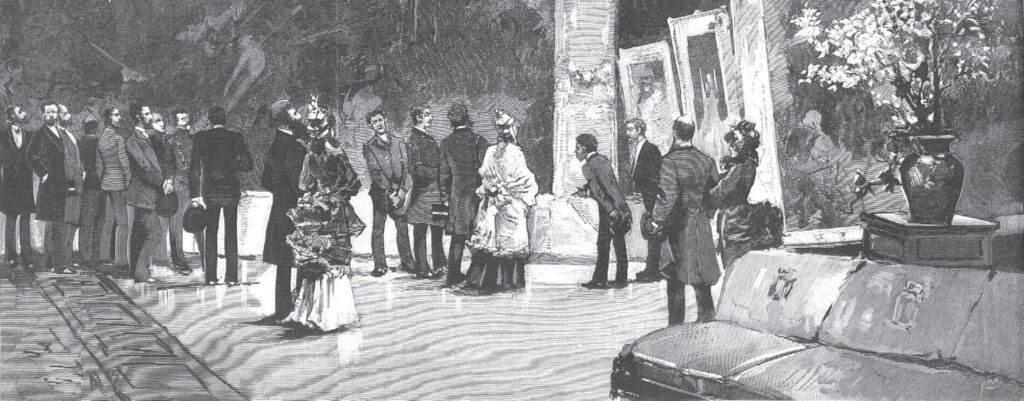
Luna first exhibited the Spoliarium at the Palazzo delle Esposizioni in Rome on March 30, 1884 for five days. There, King Umberto I and Queen Margherita expressed their intention to purchase the painting.
Their offer, however, prompted the intervention of the Spanish envoy (Felipe Méndez de Vigo) who redirected the work to Madrid so that it could be entered into the Exposición Nacional de Bellas Artes. Once in Madrid, Luna’s masterpiece was awarded a gold medal.
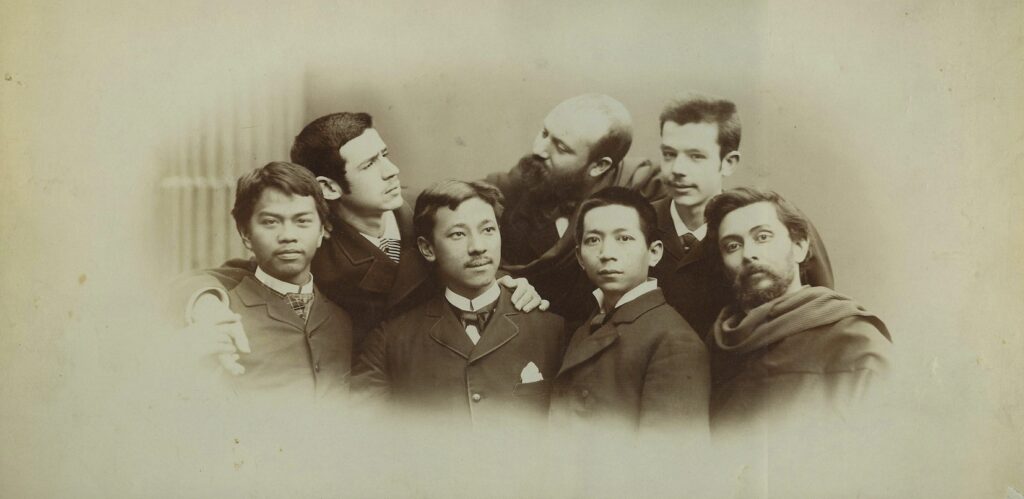
The distinction became a source of pride for the Filipino community in Spain and emboldened calls for political reform. In June 1884, Pedro Paterno organized a banquet at the Hotel Inglés in Madrid to honor Luna and Félix Resurrección Hidalgo.
At that gathering, José Rizal delivered his celebrated brindis (toast) declaring that “genius knows no country.” The prestige gained from the Madrid award also led to Luna receiving a commission from the Spanish Senate to paint for its Salon de Conferencias, further consolidating his position within official Spanish cultural institutions.
In October 1884, Luna moved his studio to Paris.
THE ‘EX’
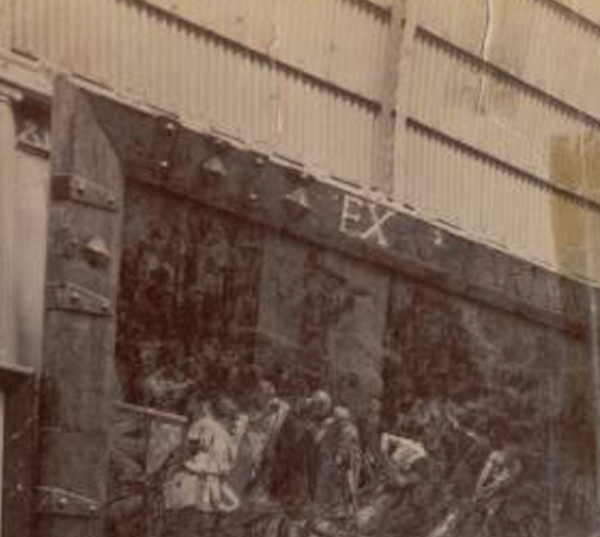
The recreated frame of Spoliarium at the National Museum in Manila resembles the one visible in the 1884 exhibition photograph, with two notable differences.
The frame is rough, made of pockmarked timber, and the title appears as EXPOLIARIVM, with the added “EX” unevenly carved across the top beam. The alteration suggests a possible reference to the original sense of the Latin spoliarium (to strip).
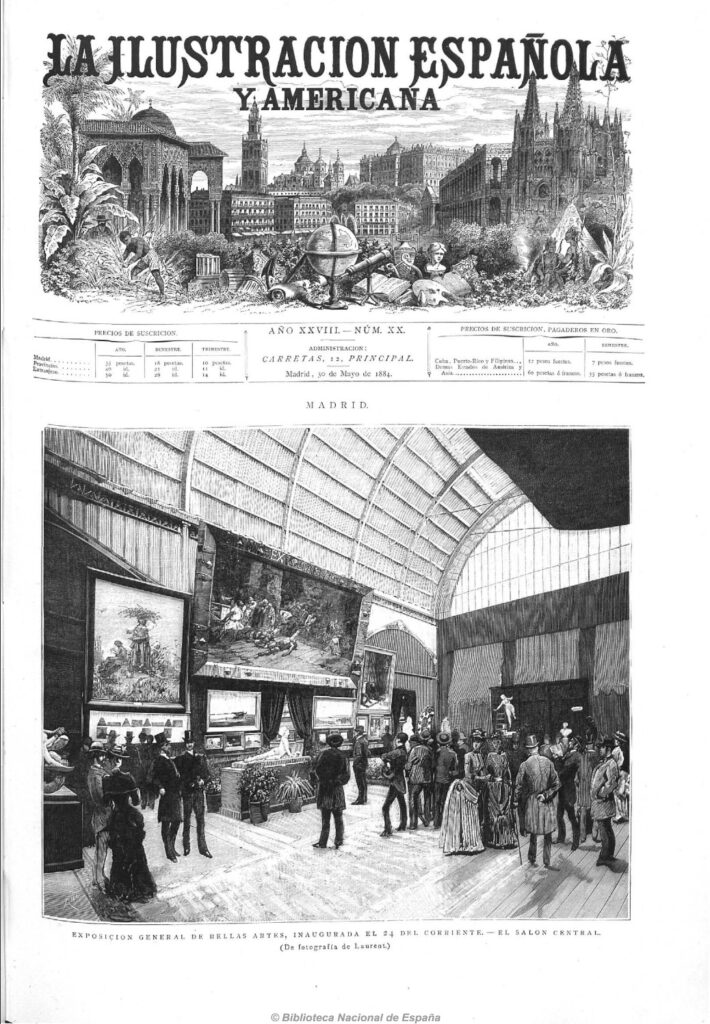
The painting was likely selected to align with the exhibition’s broader theme of works commemorating the restoration of the Spanish monarchy. This context explains why Catalan artists were shown alongside Filipinos in the same display.
At the time, both Philippine nationalism and Catalanism had emerged as strong movements seeking greater autonomy, though they had not yet called explicitly for independence. Catalanism’s coherent political program, the Bases de Manresa, would appear only in 1892.
This also explains why in 1885, Spoliarium was purchased by the provincial government of Barcelona—the capital of the Catalan region, and remained in Barcelona for decades. The painting drew praise from the Spanish novelist Benito Pérez Galdós, whose admiration for its stark realism helped strengthen Luna’s reputation. Spoliarium was exhibited at Barcelona’s Sala Parés from January to February 1886, attracting large crowds and wide press coverage. Its popularity led the organizers to grant free admission so that workers and day laborers could also see the celebrated painting, as noted by the Catalan magazine La Renaixença.
It survived the burning and looting of the museum during the Spanish Civil War in 1937, and was later sent to Madrid for restoration under the orders of the dictator Francisco Franco. It stayed in Madrid for the next 18 years.
In the 1950s, Filipinos and sympathetic Spaniards called for its transfer to Manila. Franco eventually ordered the completion of its restoration and approved its donation to the Philippines.
A REPATRIATION
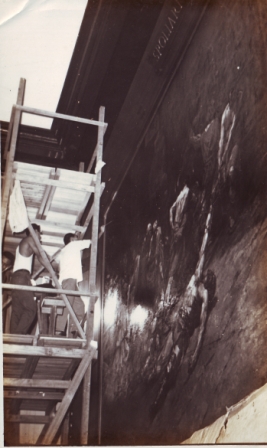
In 1958, Spoliarium was handed to the Philippine ambassador and shipped to Manila in three crates. It was restored, mounted, and unveiled in 1962 at the offices of the Department of Foreign Affairs in Manila. The event was celebrated as a symbolic homecoming, even though the painting had never previously been in the city.
Scholarship often narrows its focus when reclaiming Luna as a Philippine national hero. The painting’s ties to the liberal and anticlerical currents shaping 19th-century Spain and Catalonia are largely forgotten. Re-nationalizing Luna also detached Spoliarium from the European exhibition circuits that first established its prestige and later enabled the Philippine Propaganda Movement to mobilize it symbolically.
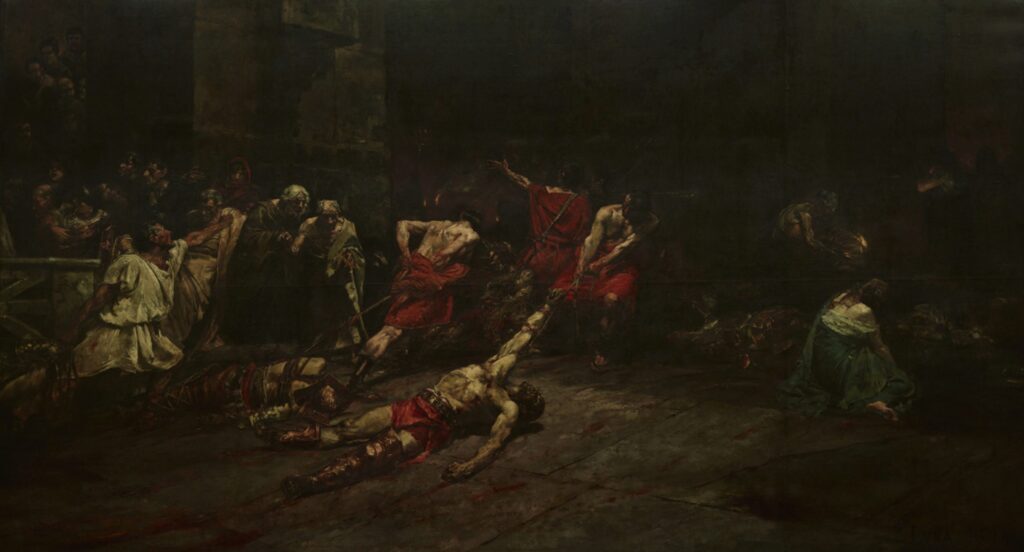
Fortunately, Laurent’s photograph of the 1884 exhibition hall preserves this wider context. It shows that Spoliarium was embedded in the transnational artistic arena of late 19th-century Europe, where debates over revolution and regional autonomy shaped both artistic production and reception.

Geronimo Cristóbal
Geronimo Cristóbal is a lecturer in Art History at Ateneo de Manila University, and a PhD candidate in the History of Art and Archaeology at Cornell University. He serves as an international correspondent for the Philippines Graphic. He can be reached at gc448@cornell.edu.