

The sale of the national oil company to a foreign corporation betrays the national interest, endangers the country’s security, and sticks of graft and corruption.
Petron Corporation is unquestionably the most valuable corporate asset of the Philippine government—the most precious gem in the country’s dwindling collection of public corporations.
Yet it has been sold to a foreign corporation controlled by Arab businessmen. The price of the sale is allegedly much lower than its actual worth. At the same time, the sale endangers the national security and national economy because it places the country’s oil supply totally in the hands of foreign-owned companies.

Petron has been consistently listed as the nation’s top corporation in terms of both asset and income. As of September 1993, it had a net income of P2.7 billion which also replenished the government coffers, substantially reducing the government deficit.
Petron is definitely not a non-performing asset. It is a performing asset. It earns big money for both government and people.
Moreover, it protects the national interest and enhances national security by assuring that the supply to the Philippines of crude oil shall not be left alone in the hands of non-citizens. Crude oil is our country’s main source of energy for transport and industrial needs.
Cut off that supply then you throttle the country’s economy. Increase unconscionably the cost of crude oil and its main derivative—gasoline—and you cause widespread misery among the people.
Yet, early this year, 40 percent of the shares of Petron were sold to a foreign corporation– the Aramco Overseas Company B. V. (Aramco)—”for a song,” according to a petition filed with the Supreme Court by four senators, two congressmen and an ex-senator.
Not only were the shares sold at much less than their actual value, but the manner in which it was sold violated both the law and regulations, the petitioners declared.
Moreover, Filipino citizens who, by law, ought to have been allowed to purchase ten percent of the shares of the company ahead of the foreign firm were denied that opportunity. Consequently, they will have to purchase shares at a cost higher than that paid by the foreign company.
In the words of the petitioners, the “conduct of public bidding [which resulted in the sale of Petron to Aramco] was tainted with haste and arbitrariness.” Consequently, they claimed, there was a “failed bidding.”
Under the agreement, 20 percent of the shares of Petron were offered for sale to the public last July 18, after which Aramco would own the controlling stock of Petron, thus assuring it full management control of the corporation.
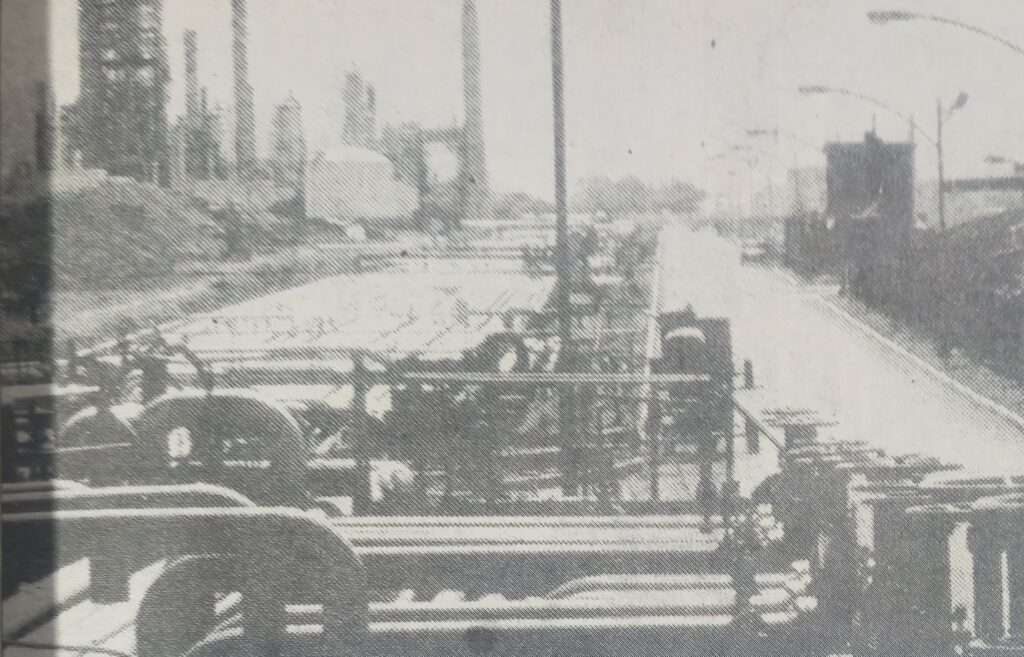
When this happens, the entire crude oil supply of the Philippines will depend upon the goodwill and reliability of three foreign-controlled corporations–Caltex (Philippines) Inc., Pilipinas Shell Petroleum Co. (Shell), and Petron. The local price of gasoline and other oil products will also be fully dictated by these corporations.
Petron, which was originally formed to serve as buffer or countervailing power against the two other foreign-owned companies, would lose its position to bargain on behalf of the Filipino people. It would instead act on behalf of its foreign owners. Should another oil crisis occur, the Philippines would be once more totally helpless and at the mercy of foreign companies. In other countries, the opposite trend has happened.
More than fifty years ago, Winston Churchill, the great British statesman, caused the purchase by the British government of the Anglo-Persian Oil Co., later renamed British Petroleum (BP). Recalling this historic event, Anthony Sampson wrote in the Seven Sisters, a book about the world’s great oil companies:
“The Government state [51 percent in BP] … not only … insure[d] the Navy’s [oil] supply, but it provided a competitor to the international cartel of Standard Oil and Shell. Churchill was undoubtedly influenced by Teddy Roosevelt’s trust-busting zeal, and the formula of half-nationalisation was in some respects the British equivalent of the anti-trust movement, to limit the power of big business: a policy which other nations were later to imitate. By buying-in to OP the British government proclaimed that oil was too important to be left to the oil companies–an awareness that was to recur periodically over the next decade.”
Clearly, President Ramos is no Churchill since he was allowed the opposite to happen in the Philippines.
The “Magnificent Seven” who filed the petition in the Supreme Court to void the sale of Petron to Aramco, a wholly-owned subsidiary of the Saudi Arabian Oil Company, were Senators Neptali A. Gonzales, Ernesto M. Maceda, John H. Osmeña, Wigberto E. Tañada, Congressmen Joker P. Arroyo and Amado D. Bagatsing and former Senator Rene A. Saguisag.
Named respondents were Energy Secretary Delfin Lazaro in his capacity as chairman of the Philippine National Oil Co. (PNOC), Monico Jacob, in his capacity as president of PNOC, the Committee on Privatization, PNOC, Petron Corporation and Aramco Overseas Company.
The Supreme Court did not act on the petitioners’ plea that a temporary restraining order be issued to stop the public offer of 20 percent of the shares of Petron. Instead, the Court required the respondents to answer the petition within 10 days from its filing. As of press time, no answer has yet been filed with the high tribunal.
In asking the Court to void the sale to Aramco, the petitioners claimed that there was a “failure of bidding.” Moreover, the price at which the Petron shares were sold to Aramco were allegedly very much lower than their true value. In addition, the bidding was allegedly “tainted with haste and arbitrariness” with important decisions made in one day and the procedure followed was contrary to law.
The PNOC Board of Directors accepted the bid of Aramco for 40 percent of the shares of Petron in the amount of $502 million. On the other hand, Salomon Bros., an international accounting firm, had valued Petron at $600 million and its 40 percent equity at $240 million. PNOC chairman Lazaro proposed a valuation of $1.4 billion, while the Petron board recommended $857 million. Francisco Oñate, a member of the Petron Privatization working committee, placed the value from $743 million to $1 billion. The PNOC board, however, fixed the floor price at $440.
A bid higher than Aramco’s was submitted by Westmont Holdings, a Malaysian firm, according to the petitioners. However, Westmont was disqualified from participating in the bidding because it purportedly did not meet the pre-qualification requirements. Its bid was returned unopened. Another bidder, Petronas, submitted a bid lower than the floor price. Its bid was rejected.
In effect, argued the petitioners, Aramco was the only qualified bidder. Because there was only one bidder, the PNOC should have declared a “failure of bidding.”
Worse, claimed the petitioners, the respondents “flagrantly violated” Republic Act No. 7181 and its implementing guidelines in conducting the sale. These provided that in “the sale of assets in corporate form” by the Committee on Privatization “at least 10 percent of total shares shall first be offered to local investors.”
This was not done. “What the PNOC actually did was to sell lock, stock and barrel the 40 percent block of Petron to Aramco without first offering at least 10 percent shares thereof to small local investors,” decried the petitioners. “Clearly but quite sadly, this is another abhorrent example of a government agency violating the very law it is charged to implement and the implementing guidelines it itself issued to carry out and implement said law.”
Consequently, Aramco paid only P6.70 per share for its 40 percent block, while even Jollibee sold its shares at P22.50 each.
Even more dismaying was that when Petron offered 20 percent of its shares to the public last July 18, out of sequence as mandated by law, the initial price was pegged at P9.00 per share. Eduardo de los Angeles, president of the Philippine Stock Exchange, said the price of the Petron shares was expected to rise to P12.50 or as high as P14.00 per share.
Clearly this is a case of the government favoring a foreign entity over and above its own citizens.
As the petitioners pointed out, “at P9.00 per share, Aramco will already earn P2.30 per share or at least 35 percent of its capital per share and only in a span of seven months from December 15, 1994.” And if the original proposal of fixing the price of the sale to the public at P16.00 per share was adopted, Aramco would not only have recovered its capital but would have also earned by as much as 120 percent of net profit.
R.A. 7181 precisely provided that before the sale of a corporation, at least 10 percent of its shares of stock should be offered to the general public for sale. Its purposes were to diffuse ownership and thus prevent monopoly control, and also to determine the actual value of the stocks in the market. Instead, this procedure was ignored.
Are the Filipinos again being boiled in their own fat?
In selling Petron to a private corporation, the Committee of Privatization also violated an established national policy, added the petitioners. They pointed out that Proclamation No. 50, which launched the program for the “privatization” of government corporations, declares as a national policy:
“To promote privatization through an orderly, coordinated and efficient program for the prompt disposition of the large number of non-performing assets of the government financial institutions and certain government-owned or controlled corporations which have been found unnecessary or inappropriate for the government sector to maintain.”
The petitioners stressed that Petron is certainly far from a non-performing asset. It owns the largest, most modern oil refinery complex in the Philippines. It is the country’s biggest combined retailer and wholesaler of refined petroleum products. In 1992, it commanded 398 percent share of all domestic oil products sold. “Needless to state, Petron is the most profitable of all government corporations and one of the largest in Asia.”
Neither is Petron an “unnecessary or inappropriate corporation for the government to maintain,” asserted the petitioners. In support, they cited the PNOC charter which states: “It is imperative for the government to take a more active role in assuring adequate supply of oil by reducing the lament of uncertainty on sources of crude oil supply.”
The petitioners continued: “Oil and petroleum products are the lifeblood of our country’s economy and are essential components to a better quality of life. Petron likewise serves as a stabilizer or counter-balance to profit motivated foreign-owned oil firms. It was established precisely to protect the nation’s interests against the cartelized operations of these alien-dominated oil companies. Petron’s strategic and far-reaching value to the survival and progress of our country makes it highly necessary and appropriate for the government to maintain and not privatize it.”
Indeed, Petron was established at the height of the oil crisis in the 1970s when the Philippines found itself at the mercy of foreign oil corporations that had no stake in the country’s survival and progress. We were then in a similar situation as Great Britain before the World War II when Churchill noted the danger of being dependant on private oil corporations–Dutch Shell and Aramco (then owned by Arabs and Americans). Today British Petroleum remains a stable government corporation which earns money for its government.
Petron is a victim of privatization gone mad. Hypnotized by the advice from the International Monetary Fund and World Bank, and other foreign economic circles, to “liberalize” and “privatize” our economy, our policymakers are in a hurry to get rid of even profitable and necessary government corporations. Some critics suggest that behind this madness is a pecuniary logic—somebody is bound to make money from such irrational sales.
On the road to the bidding block is Manila Hotel, a historic and profitable possession of the Philippine government. Already privatized is the country’s flag carrier the Philippine Airlines, which had made profits for many years in the past.
Possession by the government of an airline is also a national security requirement. Most governments in the world operate national airlines. Now PAL is in trouble, and the foreign airlines are poaching into its traditional domestic market.
The Philippine National Bank, abettor of the nation’s agricultural and industrial progress since the time of President Quezon, has also been privatized. Now it is trying to con the government in selling the PNB building to Congress even though the PNB building on Roxas Boulevard was originally paid for by the government.
The privatization program rests on the theory that progress would be faster if government got out of economic enterprises. This is not borne out by practice and experience.
British researcher Nigel Harris wrote in The End of the Third World—Newly Industrializing Countries and the Decline of Ideology:
“The process of accelerated economic growth in the newly industrializing countries appears to be everywhere associated with the expansion of the public sector and the role of the state. It has not been ‘free enterprise’ nor multinational capital which has led the process, but the deliberate and persistent efforts of government… There is only one tiny monument of the ancient virtues of laissez faire: Hong Kong. In its very marginality, it confirms the general thesis: in the period since the Second World War, sustained economic development has been part and parcel of the drive of the state to develop national power.”
If Harris, who wrote his book based on direct observation of the practices and policies of the Asian NICs, is correct, then the Philippines is adopting the wrong strategy in its frenzied drive toward NIC status.
More to the point is the observation of Anthony Sampson who wrote in The Seven Sisters (Esso, Gulf, Texaco, Mobil, Chevron, BP and Shell):
“The need both to supervise the [oil] companies and to widen their representation goes far beyond questions of foreign policy and commitments abroad. For the West’s dependence on energy is now fundamental and so expensive in terms of investment, that the planning and forecasting cannot be left primarily in the hands of private corporations.”
Sampson speaks of the West, a strong industrialized power bloc. The Philippines is a weak state. Therefore it is more in need of protection against foreign cartels especially in regard to such an essential item as oil.
The sale of Petron to a foreign oil corporation, leaving the supply and distribution of petroleum in our country entirely in the hands of foreigners, is a betrayal of the national interest, aside from being a possible case of graft as suggested by Senator Maceda who has filed a graft case against the officials involved in the sale. —G
Written by Manuel F. Almario. July 29, 1994. Philippine Graphic.

Graphic Archive
The Graphic Archive contains the articles and literature published in the Philippines Graphic since it was first established in 1927.