

Now and in the foreseeable future, all that the Filipino doing literature should aim for is to create in the context of the multicultural reality around him.
When recently, a Philippine Daily Inquirer correspondent wrote from Davao about a novel in Cebuano just issued there, I felt as though the book was none other than the long lost Albert Camus that New York has been excited about.
“But you don’t read Cebuano, do you?” protested the friend who dispatched me a copy. “Worse, this is in the Cebuano dialect spoken here only in Davao.”
I knew that all along, but it occurred to me that it should be about time something happened on the cultural scene. The emergence of serious regional writing seems to have been too long delayed. Haven’t we come a ways since Urbana at Felisa (1864) and Ang Bantay Sang Patyo (1925)? Our capabilities have in no way been stunted by The Child of Sorrow (1930), which, if we are to believe some encyclopedia writers, had had some influence in its time.
If the current upsurge in publishing in English suggests what half-a-century can do for the Filipino imagination’s ability to accommodate a literary form much favored by the West, the Philippine novel invites celebration. Scene for scene, our writers in English—a number of them, anyway!—could match any of Rizal’s in Noli Me Tangere. If only his mantle could drape comfort upon our sweaty, T-shirted follower of the New Criticism and Postmodernism. In the Thirties and even years later we heard the tambuli sounding loud. The intermittent call was and has been for the author of the Great Filipino Novel, and this we may well understand, in this context, as simply a deep-seated yearning for a generous illumination upon our uniqueness as Filipinos. Or some such notion, in any case. Every generation invents its own requirements. Of late, two kinds of writers appear to have attracted notice: the entertainers and the serious ones. Neither kind, of course, is easy to described.
Did my Davao friend figure out that in a month I could probably pick up the Davao Cebuano dialect and derive entertainment or seriousness of some kind? Just give me a month, I might have told him, and let’s wait for results. A perverse exaggeration? But I love Bisayan; the late Estrella Alfon, when saying anything to me, almost always dropped her English and switched to her native Cebuano. She wrote her last poem in Cebuano. It was about her feeling of approaching death. I understood it perfectly. A more beautiful poem on the same subject, in our literature, could be difficult to find.
As to managing a Davao dialect of Cebuano, why shouldn’t that be a breeze? You do not have to be Nabokov, a polyglot and all that! He once said that the difficulty with being polyglot is that you can’t always be up-to-date with your idioms. Well said. Let’s better be happy being only tri- or quadri-lingual.
Language-wise, the Philippines is like Europe. And the true European knows his German, French, English, Italian or Spanish. The Filipino has necessarily to be multilingual. As a long-oppressed people, we had to have a language our masters couldn’t understand. We could have had many secrets, as a people. But we fell for our master’s rhetoric. How admirable the Hanunoo of southern Mindoro, for having been able to keep over the years a language and a script all to himself. To this day, his brother in the lowlands has not bother to learn the mountain speech—which is a loss.
Instead, he takes pride in being multilingual. And the ability to palaver in several dialects is a secret that only a politician appreciates. The man knows that the half-a-dozen or so ways of saying “I need your vote!” takes him places. While batting for Filipino as the national language, there’s that standby, Taglish. Something handy to most of us, anyway. For Taglish is well on its way to becoming a dialect of Tagalog as well as a variant of English. Only you probably can not depend on it when writing a formal essay or a report to the Anti-Logging National Association.
For now, the reality about our multilingual environment, and, hence, our multiculturalism, is that diversity obtains everywhere you turn. You receive letters from friends with addresses that announce this condition out loud. How else can you regard the address which says
No. 775 España del
Norte Avenue
Barangay Kawalhatian,
Panglantaw District
Iloilo
with its strong appeals to your Tagalog, Cebuano, English and Spanish? And your sensibilities that an organic combination of all these?
To be a Filipino writer—say, a novelist—means, among other things, and quite simply, to face the promptings of an imagination aware of this diversity, this wealth. What lies ahead for such a person? How can he view things round and about and not be overwhelmed? What he probably needs to realize is that now and in the foreseeable future, working in the context of this reality about him is about all he can do.
All to the good, then, is that he start somewhere. Davao, for example. “Usa kini ka true-to-life story, kung sa ininglis pa…” it says on the publisher of Basin Ugma Puhon, Junjun (Davao: Mayukmok Publications, 1994) and that should suffice for an invitation. “Kilom-kilom na ang panahon sa kalangitan,” is how the novel opens. “Bisan sa akong pagkaanaa sulod sa opisina, diin and mga bintana sirado kay gi-aircon man, madunggan ang haguros sa hangin sa gawas.” Which, for what I can gather, seems straight, honest writing to me.
The syntax is efficient, and except for pagkaanaa, madunggan, hanguros, and gawas, I am not thrown off, although not really. Somewhere in my past I had known dungga, and should be able to make out madunggan; and as to haguros and gawas, what’s stopping me from recalling hagushus and luwas?
If all this effort is nothing but sheer foolhardiness, is there anything really wrong in that? I should be able to do better next time. Tomorrow, maybe. But let it be known that I tried. In any event, I rather feel comfortable with these words—from Bisayan, Cebuano, or Davao dialect though they may be. That’s what is important, it seems to me. Doesn’t every other word in English make you remember you are a stranger to that language? Try—
“My father has asked me to be the fourth corner at the Joy Luck Club. I am to replace my mother, whose seat at the mah jong table has been empty since she died two months ago. My father thinks she was killed by her own thoughts.”
Wonderful! But what a demand it makes. And to enter this world of Amy Tan’s I must first sign up as a stranger, an alien—and at once surrender my pretensions to my own order of reality and give in wholeheartedly to hers.
Let us likewise try the beginning of The Satanic Verses (1989):
“Gibreel, the tuneless soloist, had been cavorting in the moonlight as he sang his impromptu gazal, swimming in air, butterfly-stroke, breast-stroke, bunching himself into a ball, spreadeagling himself against the almost-infinirt of the almost-dawn, adopting heraldic postures, rampant, couchant, pitting lefvity against gravity.”
The challenge is clear, and to a reader, it is satisfying to be so engaged. Salman Rushdie is generous, and he honors me with this kind of writing. But I strain and will wear myself down in half an hour. I am and will never be at home here, though. Nor in Faulkner, with his “Was,” in Go Down, Moses (1940), which leaves me holding onto a sliver of a spider’s web:
“Isaac McCaslin, ‘Uncle Ike’, past seventy and nearer eighty than he ever corroborated any more, a widower now and uncle to half a country and father to no one…”
And of course, that’s the point. Reading is work, man. But although there is Fr. Miguel Bernad, perhapos our first literary critic among many to help us boost our self-esteem, how are we to truly feel at home in a cosmopolitan setting?
To fellow critic Roger J. Bresnahan he once spoke of “the danger of islanding ourselves. We are islanded by geography. Our danger is also that we should be islanded or, if you will, isolated culturally.”
And farther along in this conversation, “…I wish our writers were given the opportunity to be at home in a culture that is worldwide in its horizons. “
But that at-home-ness, should we ever attain it—won’t that be a self-induced deception? We are the words we know—or claim to know. We work hard at them, at knowing them, at being masters of them and at the same time servants to them. They eventually become our reality, and the reality about outselves that we hope others to see, if they should care.
Neither Stephen Crane’s salutation, “None of them knew the color of the sky…” in “The Open Boat”, or Tolstoy’s opening in Anna Karenina, though in translation (hence already that much removed from the reality as the author, through language), he might have truly meant it—no, in neither case do you get to those worlds and feel particularly and incontrovertibly and instantly at home.
Those are wonderful invitations to the domain we call Literature; but alas, we are the words we speak. The sounds of Bisayan are simply closer, and warmer, as they reach the listening heart of this reader, and doubtless, the hearts of many more. Let us leave to their devices those boys who aspire to power by spoiling the peace and quiet of the neighborhood, having discovered your mango trees in fruit. As the Tagalogs say of guava trees, Binabato lamang kung sila ay may bunga.
Looking about a crystal ball for Philippine literature has quite a history. Pleased with their installation in the country of the English language, the American educators on the crew at the beginning of this century were very upbeat about the opportunity. They called it a mission, and had held out the hope that some introduction to Shakespeare would improve the tao. The Juliets and Portias in today’s classrooms are evidence of that thinking.
Long deprived public school instruction, the Filipino took to the classroom with a vengeance that upsets even now; to be in attendance at some school or other has acquired as strong an appeal as that elicited by religion. Schooling has become form; whatever conveniently namable has served for substance. Our youth population could at least have reflected the phenomenon in a love for books and the substantial possession of them; but this is scarcely the case. What with the endless tinkering with the school curriculum, we have created out of the American model, if indeed it was such, a system of education that has been continually unstable and ever in flux.
Only in recent years has the movement for and on behalf of Filipino as a national language made a headway, and even this is remarkably hobbled by other advocacies, for other languages. A current thinking favors training the young and employable for overseas labor,with a smattering of English for prop. Thus the position of English remains preeminent.
But there is an aspect of the issue which is not readily recognized, and this besides the accessibility of world readership, actually a will-‘o-the-wispy sort of notion and typically Filipino perhaps. The fantasies generated by colonialism are difficult to erase in a culture with a distended and denatured dreamtime.
The Filipino lusts for recognition almost to a point of exacerbation. Hence, we look forward to acquiring things not quite our own, to cite an instance, a place in the global village. English would be in our view its working language. Won’t that be great indeed? Haven’t we got a headstart already? We forgot that Anglo-Saxon imperialism has been thorough and penetrating. Never mind what empires really mean when they bring down upon a people the full weight of their cultures.
In fine, what works is the thirst for the metropolis, the global village envisioned being the new reality of it. Thus, the street signs there would be in English of some dominant language? But whose English, in any case? How about the millions of users of English in Africa, India, Autralia, New Zealand and elsewhere? The millions with their linguistic idiosyncracies?
Every village, as our history tells us, has its own principalia, the folks that live near around, if not right by, the plaza? Who would such personages be in your global village? And why do we ask this? Because it’s their hemming and hawing that will matter; that will clatter,if not adorn, the pages of the global media, and its literature, were that to evolve—the spread, as a matter of fact, of the one currently available. And how, moreover, are we to be sure that there will be books to read instead of screens to view? The media shall have induced in us new habits of absorbing information and/or enjoying thought.
Prayerbooks may still be around, but these in fact could probably have no more readers. Already my local parish church has moved into this new age; it gives away four-page leaflets to help out parishioners understand that prayerbooks are things of the past. Even the Bible shall have been transformed into bytes of sounds and pixels of images. Your true books could be mostly computer manuals.
There is a good chance then that we Filipinos could return to orality. It is a cultural tool which after all we have not really exploited. Imagine the incalculable savings in imports of paper and printing ink, money which we would have invest elsewhere. Easily twenty percent of the teaching conducted in Filipino these days is oral anyway; the lack of texts, say in elementary science classrooms makes this technique profitable. The observed reluctance of our pupils to read, indeed their aversion to reading itself, invites orality and the exploration of its joys most tempting.
Even now students prefer classes that are fun. Why strive to be a reading people when we are so efficient with tsismis? We can advance in intelligence without resort to print, pen, or paper—a nativist approach to life, and this could be true progress. Even some professors have begun to cultivate a new style; instead of nurturing creativity and scholarship, they demand nothing less than adoration and conformity to theory and practice. In defeat, students have considered suicide!
The inspired worker at making Literature has other alternatives. Given the fact that the culture needs it, writers these days, and possibly the next decades—when the world shall have settled down from the upheavals brought on by disenchantments with isms and technicology—will be discovering their craft and art.
Consider a seafront scene, the tide rather out. In the water might be seen the local community of fishermen at their various tasks. Far in the distance is leaf-net fishing in progress. How productive has this been? While allowing for its primitiveness, you have to give these folk credit, for their resourcefulness is abiding and abundant. Turning coconut fronds into a large fishing net simply by stringing them out there in the shallows—why, how truly Southeast Asian, or South Pacific! THe method has survived for centuries, in any case, and works splendidly even today.
Close by are a couple of fishermen who happen to be devotees of the cast-nets; and farther out, although not as far as where the seafloor dips to a man’s height, are people working the gill net. It’s capital for mullets, gar, pampanos—fishes not too prone to scrounge about the coral reefs or sandy floor. Will these people have baskets of catch enough for the market?
You could go and look. But, wait, a one-man outrigger has just come in. With a swagger and a tune to match his stride our hero displays a twenty-kilo albacore. Or, maybe, that’s a tuna that he’s got. How ignorant can you get, city slicker that you are!
So which type of fishing now appeals to you?
The worker at Literature, though, has very little choice in the matter. Readership, audience, mentoring and like concerns do not, in fact, bother him as much as what he feels he has to say, and the means he finds comfortable with. And given the opportunity of publishing only a few hundred copies makes very little difference.
He has his own seafront. That’s his secret. For now, and as always, he has to make do with the reality that is there. Provincial or cosmopolitan, there’s the wealth of his seafront somewhere. And, perhaps, that seascape could be somewhere in Davao, where the sun dips quietly in the long twilight. -G
Written by N.V.M. Gonzalez. June 10, 1994. Philippine Graphic.
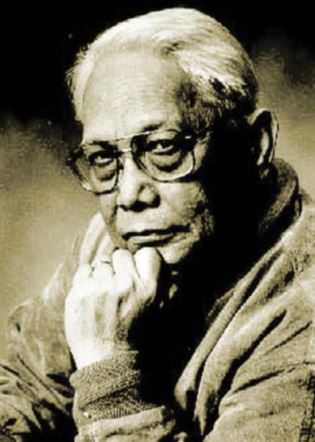
N.V.M. Gonzalez is international writer-in-residence at the University of the Philippines and emeritus professor of English literature at California State University in Hayward, California. He is the author of A Season of Grace, The Bamboo Dancers, The Bread of salt and other novels and collections of short stories.

Graphic Archive
The Graphic Archive contains the articles and literature published in the Philippines Graphic since it was first established in 1927.