
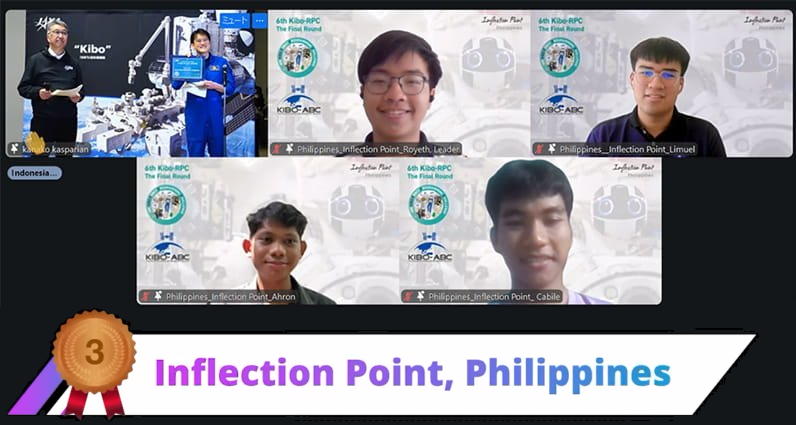
Team Inflection Point of the Batangas State University (BatStateU) has won again in the international Kibo Robot Programming Challenge (Kibo-RPC), securing 3rd place in the final round, the Philippine Space Agency (PhilSA) has announced. Team Inflection Point commanded NASA’s Astrobee robot aboard the Japanese “Kibo” module of the International Space Station (ISS) with their own program, competing against teams all over the world in image recognition accuracy and mission speed.
The team is composed of third-year aerospace engineering students from BatStateU, namely: Howell Dela Cruz, John Royeth Samson, Ahron Martinez, Benedict Lontok, Andrew Cabile, and Amer Panganiban. Their 3rd place win marks another achievement for the Philippines, following its successful debut into the Kibo-RPC last 2024 where the same team secured 2nd place and became the first-ever Philippine team to join and win at the Kibo-RPC.
A total of 738 teams from 37 countries/regions—including 25 countries from the international slot of the United Nations Office for Outer Space Affairs (UNOOSA)—joined this year’s Kibo-RPC. Team Inflection Point scored the highest in the preliminary round amongst the 27 Philippine team applicants and, thus, qualified to represent the country once more in the in-orbit finals.
Watch Inflection Point’s program run here: https://youtu.be/1T3ktCcb28I
Organized by the Japan Aerospace Exploration Agency (JAXA) in cooperation with the National Aeronautics and Space Administration (NASA), the Kibo-RPC is open to student teams across the Asia-Pacific Region. Robots are being developed to support astronauts and potentially assist in case of emergencies in space. The Kibo-RPC aims to train the next generation in programming robots in space for precise and swift operation, testing their teamwork and skill in predicting motion under microgravity conditions.
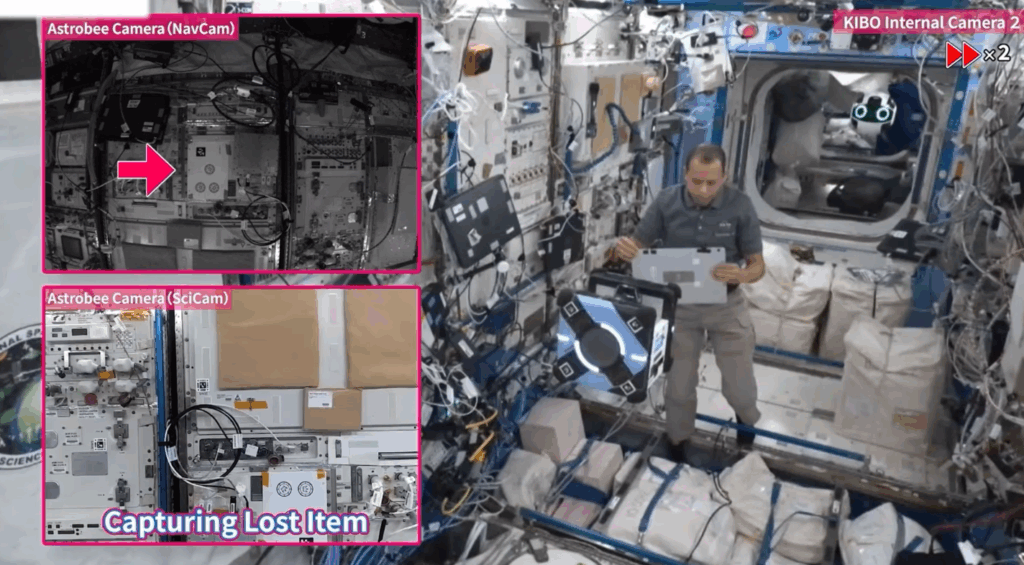
National Aeronautics and Space Administration (NASA) astronaut Christopher Williams executed programs by the student-teams using Astrobee during the 6th Kibo-RPC Final Round held in orbit aboard the ISS on 28 February 2026, evaluating the task completion rate, accuracy, and speed.
Team Inflection Point successfully completed 4 out of 5 tasks during the live test run, earning a total score of 216.8 out of 300 points. Their performance in the “Oasis Zone” contributed significantly to their result, as the new feature introduced this year offered bonus points while challenging teams to balance speed and strategy since certain routes carried additional time penalties. Their score only has a 1.6-point difference from the second-place winner, team Automen of Malaysia (218.4), while Team iTron of Taiwan won first-place (269.9).
Watch the full recording of the finals here: https://youtu.be/fVhdATbsMJk
About the Kibo-ABC program
The Kibo-ABC program or Asian Beneficial Collaboration through Kibo Utilization was established by the Space Frontier Working Group (SFWG) of the Asia-Pacific Regional Space Agency Forum (APRSAF) to promote the utilization and share the value of the Japanese Experiment Module “Kibo,” enhance the capacity of participating organizations, and foster collaborative projects between Japan and Kibo-ABC member countries.
The Kibo-RPC, through its member organizations, is one of the activities under the Kibo-ABC program that aims to expand the use of the Kibo module on ISS and develop the youth’s understanding of space environments.
As the central government agency addressing all national issues and activities related to SSTAs and as a member of the Kibo-ABC program, PhilSA spearheaded the local call for the 6th Kibo-RPC applications. 27 team applications were received nationwide from 12 March to 26 May 2025, and 7 teams successfully submitted their program entries.
The 7th Kibo-RPC is scheduled to begin in July 2026. For more information on the challenge, visit: https://jaxa.krpc.jp
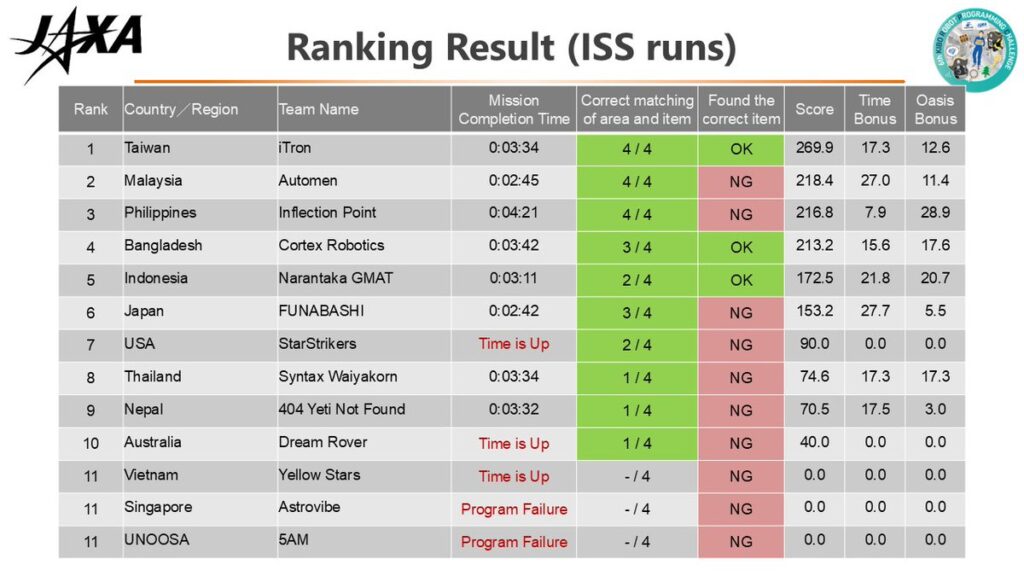
Team Rankings of the 6th Kibo-RPC Finals. Screenshot from JAXA’s recording of the live demonstration “6th Kibo-RPC Final Round in Orbit & Simulation Award”
Started in 1927, the Philippines Graphic is the longest-running printed magazine of national circulation that provides relevant news and features and promotes Philippine literature.

 has won again in the international Kibo Robot Programming Challenge (Kibo-RPC), securing 3rd place in the final round, the Philippine Space Agency (PhilSA) has announced. Team Inflection Point commanded NASA’s Astrobee robot aboard the Japanese “Kibo” module of the International Space Station (ISS) with their own program, competing against teams all over the world in image recognition accuracy and mission speed.)