

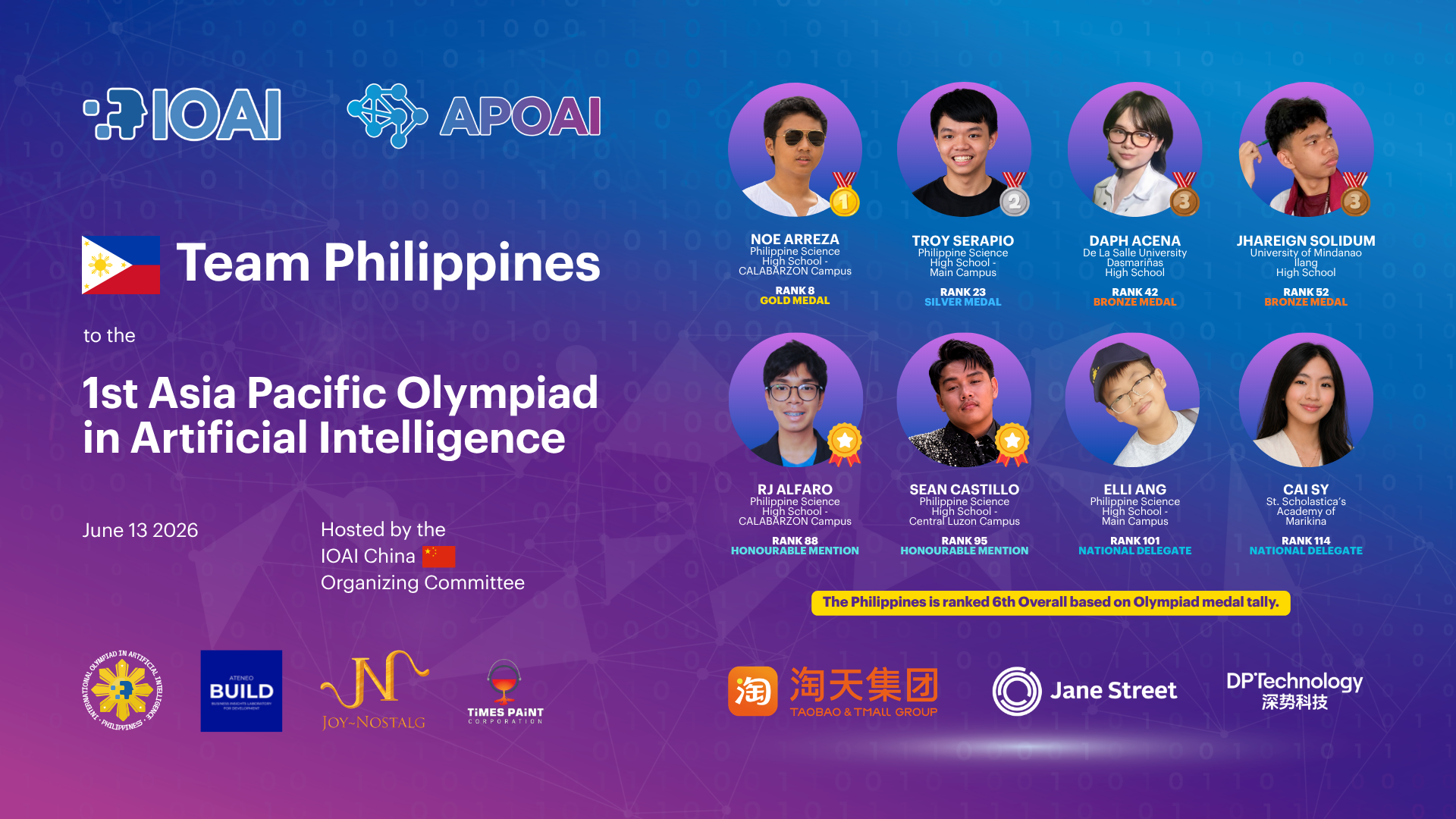
The eight-member Philippine national team won one gold, one silver, and two bronze medals at the first Asia-Pacific Olympiad in Artificial Intelligence (APOAI 2026), securing a historic tie for 6th place versus over a hundred of the best secondary school students from across 18 countries.
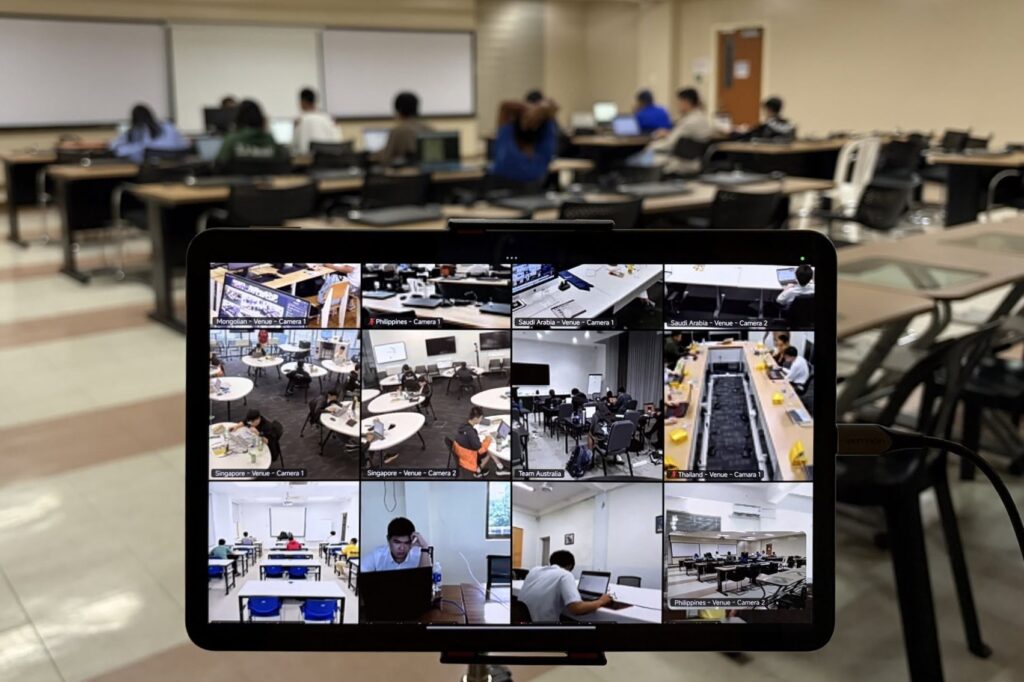
Locally hosted at the Ateneo Business Insights Laboratory for Development (BUILD) of the John Gokongwei School of Management, Ateneo de Manila University, the grueling six-hour examination tested the kids’ skills in machine learning, mathematical modeling, and algorithmic problem-solving.
Leading Team Philippines was Noe Nathan Y. Arreza of Philippine Science High School–CALABARZON Campus, who ranked 8th overall and won the country’s gold medal. Troy Dylan T. Serapio of Philippine Science High School–Main Campus ranked 23rd and won silver. Daphne Eunice U. Acena of De La Salle University Dasmariñas High School ranked 42nd, while Jhareign S. Solidum of the University of Mindanao Ilang High School ranked 52nd. Both received bronze medals.
Ryan James L. Alfaro of Philippine Science High School–CALABARZON Campus ranked 88th, while Sean Marcus N. Castillo of Philippine Science High School–Central Luzon Campus ranked 95th. Both received Honourable Mentions. Completing the Philippine delegation were Ellison Matthew S. Ang of Philippine Science High School–Main Campus, who ranked 101st, and Aretha Cai Faustine M. Sy of St. Scholastica’s Academy of Marikina, who ranked 114th.
The Philippine team was selected through a rigorous, merit-based national screening process organized by the International Olympiad in Artificial Intelligence Philippines (IOAI PH). Participation in IOAI PH is free for students, in keeping with the program’s goal of making national representation dependent on talent, preparation, and performance rather than financial capacity.
“This historic performance establishes a powerful baseline for the country,” said IOAI PH Executive Director Martin Gomez. “This result belongs to far more than the students who sat the exam. It is a testament to the coaches who trained this team, the local staff who maintained competition integrity, and the families, schools, and communities who championed these students every step of the way.”
For the Philippines, the result marks a strong opening performance in the region’s first AI Olympiad. It also points to the growing depth of Filipino youth talent in artificial intelligence, a field that is increasingly shaping science, industry, education, and daily life. With the right support, these students show that Filipino talent can stand with the best in the region.
The Philippine participation in APOAI 2026 was supported locally by Joy-Nostalg, Times Paint Corporation, and the Tiu Family, with testing operations hosted by Ateneo BUILD. Globally, the Olympiad was supported by Taobao of Alibaba Group, Jane Street, and DP Technology.

Started in 1927, the Philippines Graphic is the longest-running printed magazine of national circulation that provides relevant news and features and promotes Philippine literature.

, securing a historic tie for 6th place versus over a hundred of the best secondary school students from across 18 countries.)