

As PhilHealth recalibrates its role under universal health care, leadership and culture converge to make prevention practical, accessible, and trusted.
Universal health care has long been framed as a matter of access and financing—who gets covered, what services are included, and how much protection citizens receive against catastrophic health spending.
In practice, however, its success hinges on something far more basic: whether people actually seek care early enough for the system to make a difference.
In the Philippines, this has been a persistent challenge: Care is often sought only when symptoms become severe, often after weeks or months of delay. Preventive checkups are frequently postponed, while self-medication and “waiting it out” remain common responses to early signs of illness. The result is a cycle in which conditions that could have been addressed at the primary-care level escalate into hospital admissions—costly for families and burdensome for the health system.
Established to provide financial risk protection, PhilHealth carries the mandate of supporting the country’s Universal Health Care (UHC) law. Yet for many members, its relevance has been felt only at hospitalization—when bills arrive and claims are processed. The challenge has been how to make the institution matter earlier in the health journey.
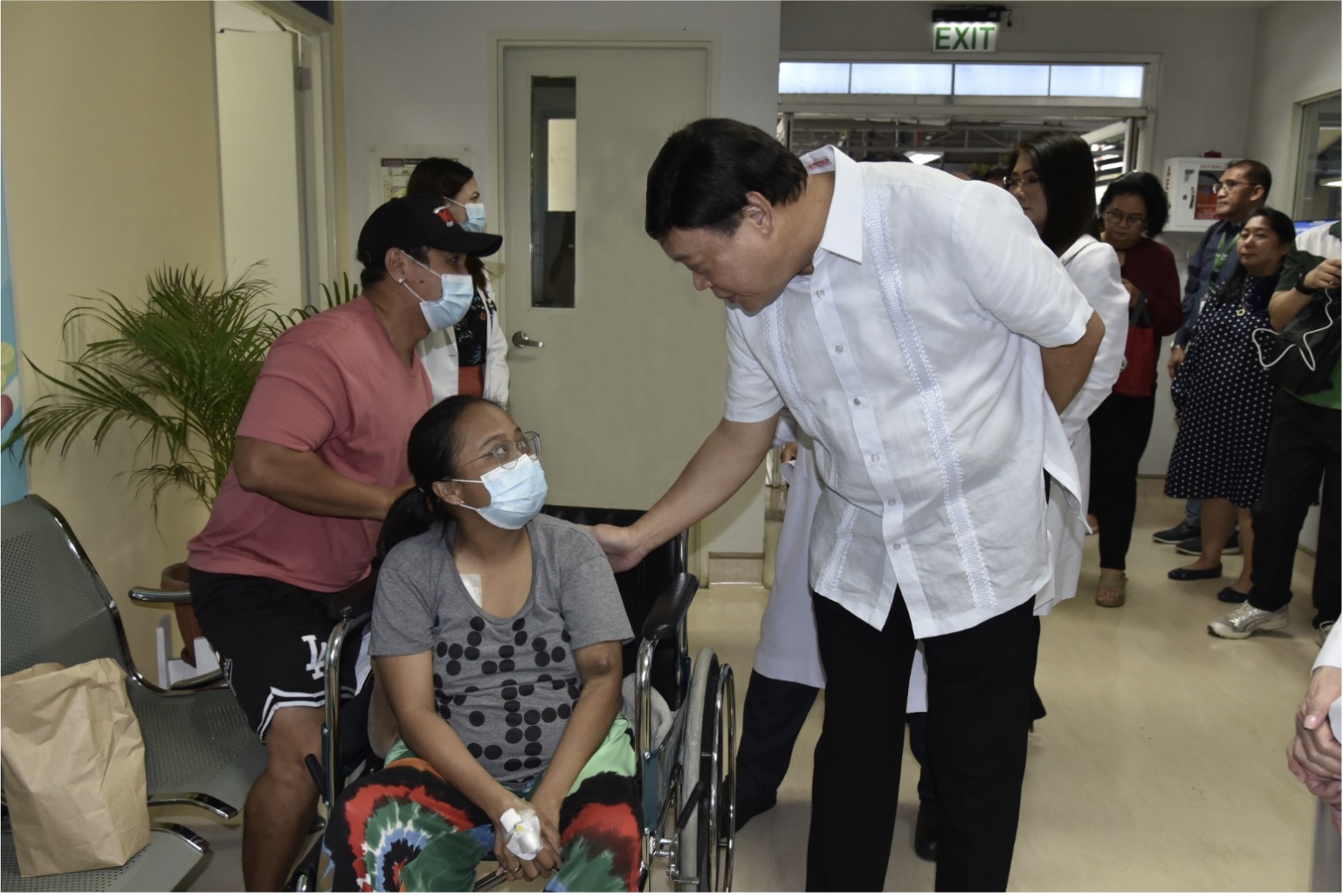
That challenge sits at the center of the leadership agenda of Dr. Edwin M. Mercado, the president and CEO of PhilHealth. The emphasis, he has stressed, is not on individual leadership alone, but on institutional posture—how PhilHealth positions itself in relation to members, providers, and the broader health system.
For Dr. Mercado, universal health care cannot succeed if PhilHealth steps in only when people are already sick. The institution, he has pointed out, is the largest purchaser of healthcare in the country, and that position brings with it both responsibility and leverage.
“The way we design benefits influences how the entire system behaves,” Dr. Mercado told the Graphic. “That is why we have been very deliberate in aligning our benefits with the diseases that Filipinos fear the most—heart disease, stroke, cancer, and other major conditions that can easily lead to catastrophic spending.”
This perspective reflects a broader understanding of UHC not merely as coverage, but as guidance. Insurance, in this view, influences behavior. When benefits are concentrated at the hospital level, people tend to delay care. When pathways are clearer and support is available earlier, prevention becomes more realistic.
Public reporting reinforces this logic. In an October 2025 article from the Philippine Information Agency (PIA) (“PhilHealth outlines RISE 30 mission to improve services, public trust”), Dr. Mercado emphasized the need to rebuild trust and improve service delivery as part of the state insurer’s modernization. The report situated these reforms within the broader UHC mandate, noting that institutional credibility is essential if members are to engage more consistently with care.
Trust, in fact, has emerged as a recurring theme in discussions about PhilHealth’s evolving role. Years of delayed reimbursements, inconsistent application of rules, and operational bottlenecks have shaped perceptions—among both members and providers—that dealing with the institution could be unpredictable. Addressing these issues, Dr. Mercado has argued, is inseparable from encouraging earlier and more regular engagement with health services.
Access also remains uneven. Geographic disparities, differences in provider availability, and varying levels of health literacy all affect how Filipinos navigate the system. Dr. Mercado has acknowledged that no single institution can address these challenges alone, underscoring the need for coordination with the Department of Health and other partners. Still, he has been clear that PhilHealth must do its part by ensuring that its policies and processes support, rather than hinder, timely care.
From an institutional standpoint, this has meant rethinking what success looks like. Rather than measuring success solely by claims paid, PhilHealth has increasingly focused on whether its systems are predictable, fair, and responsive. These qualities, Dr. Mercado has said, are what ultimately make members comfortable enough to seek care before illness worsens.
The emphasis on internal discipline and clarity has been reflected in how PhilHealth communicates its direction. Internally, the institution adopted the tagline “Isang PhilHealth na umuusad, nagtutulungan at kinikilala”—a PhilHealth in motion, helpful, and recognizable—signaling a push toward cohesion and accountability.
A NEW MISSION RISES
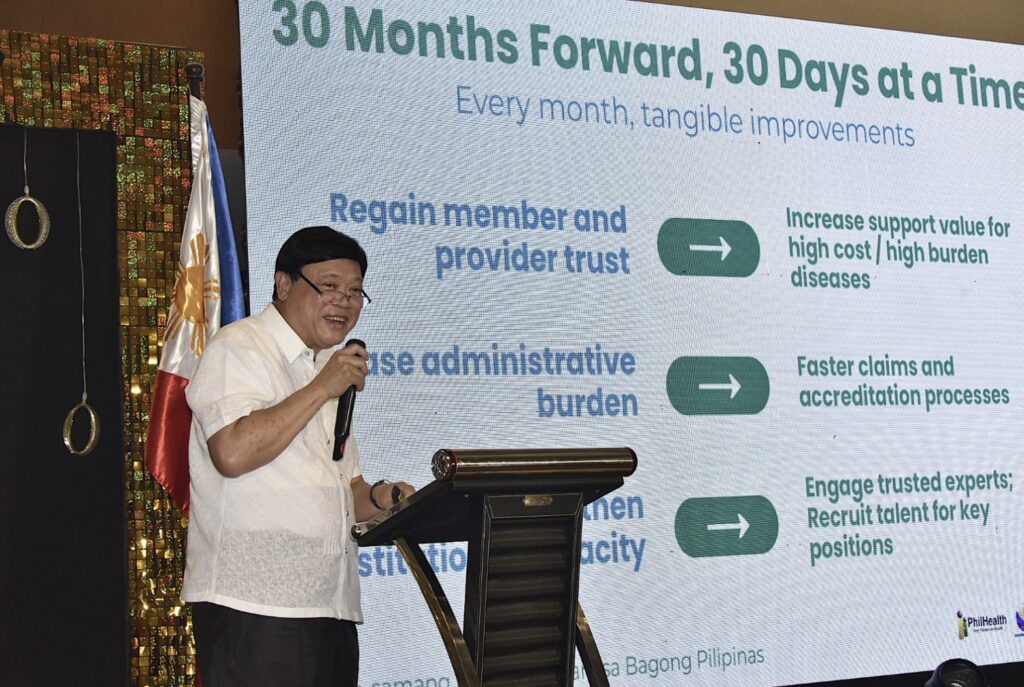
Conceived as a 30-month reform roadmap parallel with PhilHealth’s 30th anniversary, the RISE 30 Mission sets out concrete targets for improving internal discipline, streamlining workflows, and reinforcing accountability.
Under RISE 30, claims processing timelines were shortened, performance indicators were monitored more closely, and monthly reporting became standard practice.
For Dr. Mercado, these operational gains were inseparable from reconnection. Providers who received payments on time were better positioned to serve patients. Members who experienced fewer delays were more likely to trust the system.
Over time, these improvements were meant to signal a shift through consistent service. RISE 30 was framed as a foundation. Institutional credibility had to be restored before PhilHealth could meaningfully influence how people approached their own health.
When Dr. Mercado assumed office, claims turnaround times could stretch to 40 or even 60 days. These have since been reduced to an average of about 22 days, with a target of 15 days.
“Faster payments reduce the cost of money for hospitals,” the PhilHealth chief said. “That allows them to negotiate better prices, plan better, and focus more on patient care. When providers see PhilHealth as reasonable and predictable, the entire system functions more smoothly.”
“For me, that is what institutional momentum looks like—not just numbers improving on paper, but relationships stabilizing and confidence returning across the health sector,” he added.
WITH ARMS WIDE OPEN
These shifts in language mirror deeper changes in organizational mindset. The aim has been to move beyond the image of PhilHealth as a back-end processor of claims and toward a more visible, engaged presence in the health system.
That presence, Dr. Mercado has stressed, must be felt not only in hospitals but also in clinics, pharmacies, and consultation rooms—places where preventive care begins and happens.
Coverage patterns provide further context for why this shift matters. According to a February 18, 2026 PIA report: “PhilHealth shifts from emergency coverage to preventive care,” health officials have repeatedly flagged delayed consultations and self-medication as contributors to avoidable hospitalizations. The article noted that encouraging early checkups and routine screenings is essential if UHC is to deliver on its promise of better outcomes at lower cost.
For PhilHealth, aligning with this goal has required balancing ambition with realism. Changing how people approach their health is not something that can be achieved through policy pronouncements alone. It depends on whether systems work as intended, whether providers are supported, and whether members feel that seeking care early will actually help them.
In this sense, leadership has been more about consistency. Dr. Mercado has described the task as restoring confidence—inside the institution and beyond it—so that early engagement with care becomes a rational choice, rather than a leap of faith. When members trust that benefits are accessible and providers trust that reimbursements are timely, the conditions for prevention begin to take shape.
Taken together, these developments point to a common thread: UHC, as envisioned under Philippine law, requires more than coverage at moments of crisis. It requires institutions that are prepared to engage people before illness escalates, and systems that reward early action rather than late intervention.
The emphasis on leadership, trust, and institutional readiness sets the stage for what comes next: translating these principles into concrete programs that meet Filipinos where they are and encourage them to take their first steps into care earlier.
This article appeared in the February 2026 Special Issue.

Started in 1927, the Philippines Graphic is the longest-running printed magazine of national circulation that provides relevant news and features and promotes Philippine literature.