

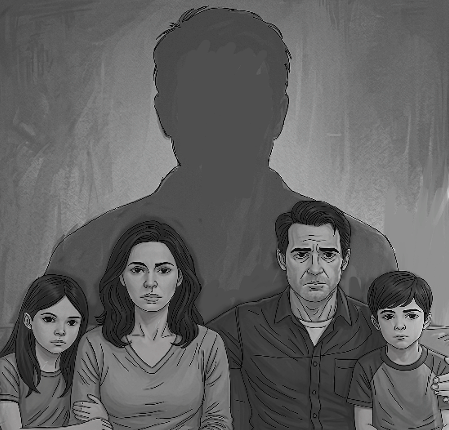
My phone slipped from her grasp, clattering against the tiled floor. The impact was a muted thud, not strong enough to shatter what had already fallen.
Not the screen. Our silence.
We were standing in the kitchen in a classic FPJ cinematic standoff, where I was the villain—sweaty, clumsy and desperate—cornered by my wife’s stoic “look,” bracing myself for that one, devastating line that would seal my fate.
“Since when?” The question landed harder than the phone on the floor. Her face was as impassive as stone while her piercing eyes probed over my face. Perhaps mentally carving CHEATER all over it.
My nerves jangled, the shame slithered through me like a sinister snake. And as if to punctuate that thought, the oil in the pan erupted in a loud hiss as the bangus cooked on the stove.
Since when? Did she mean since when had I been careless? When had I been putting things where they didn’t belong? That damn phone was on the kitchen counter all night before it conveniently fell into her hands. Punyeta.
I picked up the phone from the floor and saw how my reflection on the screen mirrored the guilt that readily popped there.
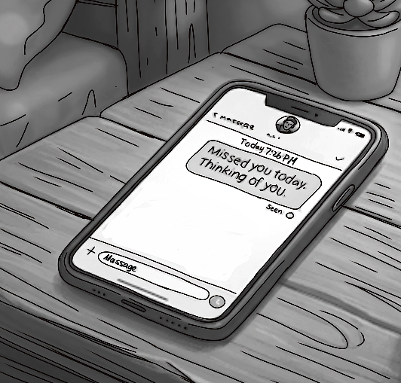
Missed you today. Simple. Innocent, even. Except it wasn’t. There was: Thinking of you.
I repositioned my phone face up on the narrow counter, screen lit, as if being transparent could still save me. It was clearly as wasted as our two mugs of cold 3-in-1 kape that sat next to it.
Step away, Rick. Run, my konsensiya whispered. But I don’t. Not when that long train ride to forever with Jen had suddenly crashed to a halt.
The bangus began to burn. Neither of us moved to save it. A thin ribbon of smoke curled upward between us, lazy and accusing.
“How long?” she asked. There it was again. Not what. Not who. How long.
I drew close, like approaching a wild animal. “You’re reading too much into it, Jen. Wala ’yon.” The words were laden with insincerity even in my own ears. I don’t know if I was reassuring her or myself.
Jen nodded slowly, as if she expected that. “Right, of course,” she mumbled, sarcasm at its helm. “It’s nothing.”
“I am so, so sorry, Jen. But it wasn’t like that.” My response had been automatic. I know for certain that anything I say from this point forward would now be a potential piece of incriminating evidence being weighed against my innocence.
“Then what was it like?” she asked, her voice whisper soft. No tremor. No theatrics. Somehow, I wished she would just scream, letting her mouth pop open in outrage. Or perhaps, burst into tears and wail as loud as the next ambulance siren. Her blank, unblinking stare told me the thoughts flickering underneath that surface were too deep to fathom. It was supposed to scare me away.
“Jen, please, it’s not what you think,” I groaned. Difficult does not mean impossible. If I could just maintain control over my temper and speech. Maybe employ a little lambing, though at forty-two, I am now a little rusty in that department.
“Tell me what to believe.” She watched me. Waiting.
In court, my goal had always been to win. But never with Jen. Not here. Not now. Not ever. “We’re really just friends, and that was years ago.”
“Seventeen, Rick.” she snorted, unimpressed.
She did the math. I hadn’t. Suddenly, it hit me. She knew. She had always known. My whole body tightened.
“You think I don’t remember?” She asked incredulously. “You two spoke your own language. I was in the room, until I felt I wasn’t.”
I pressed my lips shut to suppress an urge to argue. I can’t risk it. Because she wasn’t wrong.
“Anton,” she breathed. “That is his name, isn’t it?”
That’s the thing. She knew him. Jen met him once or twice when we were still dating—back when he and I shared that cramped Cubao apartment. She would bring pancit when she came over. She saw how close we were.
“Iba kayong magtinginan, ha,” she had said in a casual, almost laughing tone. We would laugh it off. I would kiss her on the forehead and quickly change the subject. Not once did she ever make me any less a man, even when she had been overly suspicious. I felt understood, accepted without judgment. I loved her for that.
I was too young and careless at the time to even think it was safe to let her in. I figured she just felt a bit awkward, going quiet when we were all together. Now, standing in our kitchen with burnt bangus in the air, I realized she had been observing. She kept a detailed account of every joke only Anton and I got, every significant look we shared, and how he and I always seemed to finish one another’s sentences.
“If I told you then that I was uncomfortable,” she went on, “you would have said I was imagining things.”
I would have. Hell-bent, yes. Just to keep her.
Seventeen, Jen said. I lost track.
That’s how long Anton and I were able to stay out of each other’s lives. We’re not friends on Facebook. No images with tags. No post likes. Not even the occasional “Congrats” for milestones in our lives. You simply bury truths because they don’t fit the life you want to build.
And so, we married and had kids. He has two. I have three. All five were of the same ages—as if we followed a matching family plan. We led parallel lives, parallel secrets. It had been easier to escape labels. Because we wanted normal. The thing about burying a part of life, though, is it doesn’t decompose. It is determined to resurface, one way or the other.
It appeared to me as a message, lighting up my phone at 1:08 a.m. a week ago, while Jen slept next to me with one arm over a pillow that has kept us apart like a polite border. Jen was funny that way. I stroked her hair by chance once and she jumped awake, looking alarmed and not pleased, as if I had done something horrible.
But this isn’t about her, though. It’s an entirely different person. Another individual who had a blank profile on Facebook. No picture. Just a name. A profile deliberately created for one purpose: to reconnect. With me.
He messaged me a picture on Messenger of a narrow hallway with a wooden door ajar, and it left me feeling confused. That door concealed all the versions of myself I’d never shown anyone. Except for this one person. Anton.
His name often takes me back to that apartment where I was almost always twenty-five and the nights lasted longer than they should have. We were two probinsyanos trying to survive Manila, sharing rent, tinapa and Lucky Me. We shared stories about the futures we swore we would build. We’d sit knee to knee, throw arms around each other’s shoulders, or sleep side by side.
It was easy—until it wasn’t.
“Hey. Long time.”
I stared at his message for five full minutes, my thumb hovering over the screen. Typed. Deleted. Typed again.
My brain short-circuited as I looked at Jen’s sleeping form. I did my damnedest to avoid waking her. My body moved on cue, acting before my mind could stop it. I slipped out of bed, crept downstairs, and hid in the kitchen. It was, without a doubt, the most damaging choice I’d ever made.
Anton and I caught up. We talked about work, our aging parents back home, and the kids.
Then he asked, “Do you ever think about us?”
That was the initial spark. What happened in that apartment was not a mistake born out of loneliness. It had been mutual. Wanted.
“Sometimes,” I said. What I really meant was: More than I want to admit to myself.
These late-night ping-pong chats escalated gently. All the sneaking around was wild, and I was completely and totally hooked. It allowed me to act more freely rather than the “should” in some strange way.
“I miss you,” he typed one night. “I still fantasize about you, about us.”
The word us hit harder than it should have. It carried the weight of the label that we never put a name to. Never dared. There had been no big confessions. No “I’m gay.” No “I’m bi.” Just hunger dressed in denial. It was complicated and tied to parts of me I had trained into silence.
“I miss you, too,” I wrote back, my world shrinking to the glow of my screen.
I blinked and I was back in our sweltering kitchen. I was covered in sweat, and the last thing I wanted to think about was that my reliable barong was probably now ruined, and I may have to call in sick today.
“Why now?” Jen asked. Not angry. Just invasive. “Why reconnect after all this time?”
I tried not to react to every word she said.
“Was it curiosity, Rick?” she pressed. “Were you exploring something?”
“I’m not exploring anything,” I held up my hands in surrender. “I was just—”
“Lonely?” she cut in. That landed too close to home.
“We’ve been busy,” I say. “Work. Kids. We hardly ever talk about anything other than logistics.”
She turned around slowly. “So, you went looking for something that felt familiar.”
I made no response. No nod of acknowledgment.
Jen let out a shaky breath—the first crack in her composure. She walked past me, picked up the pan and the burnt bangus, and dropped it into the sink harder than necessary. The clang of metal echoed.
“Was it about him?” she asked. “Or was it about who you were when you were with him?”
More than anything else, that question hit me square in the face. Because when Anton messaged me, I didn’t just remember him. I remembered myself. The reckless, desired, uncomplicated me.
“You don’t understand,” I said, but I didn’t even know what I meant. I was quickly losing control of this conversation, and I needed to iron this out before either one of us said something we would regret
I reached for her to cover the space between us. I squeezed her shoulder lightly, and she didn’t back away. I had to count that as a good sign.
“I wasn’t trying to leave you, Jen,” I let out a breath. “I wasn’t planning an affair.”
“But did it cross your mind?” she shot back.
I shook my head no.
“Then why him?” Jen asks. “Why reopen that door, Rick?”
Because Anton knew me before I chose this life. Because he represented a version of me I buried. Because sometimes, in the middle of routine, I want to know if I still could be that person. I was pretty sure none of these were answers she would like to hear.
“I don’t know,” I puffed between each word, which was the truth. “I don’t know,” I repeated helplessly. I needed to breathe. I peeled off my barong in haste, and the buttons darted in a thousand directions before the flimsy cloth joined them on the floor.
“So, what am I, then? Your backup plan?”
“No!” I said it too fast. “I love you.”
“Do you?”
She stepped back and unintentionally knocked one of the mugs off the counter, breaking it into pieces and spilling coffee on the floor. We both look down at it. The broken shards spread across the floor like the irreversible crack in our marriage.
Jen stalked out of the kitchen. We no longer run after each other anymore. We were at an age where our happiness was no longer a priority. There was always something we had to place first. Mortgage. Tuition. The kids. Their needs had to come before our own—even sleep had taken a back seat. We were a unit, Jen and I, instead of two separate people.
Until this morning.
We spent the rest of the day avoiding each other. She escaped to her laptop and turned the sound up. Despite our apologetic conversation, she avoided me, and when forced into my presence, she barely talked. All of this had made my life a muddle.
She saw it all. I sent Anton a message later that night while temporarily confined to the couch.
There was a moment of hesitation before an answer came.
We can’t go on like this. There’s so much to lose.
He was right. We both have families. The cost of exposure would ripple outward into every aspect of our lives.
I deleted the chat thread right there and then, as if pressing that button could seal a version of myself as quickly as it had been awakened. Maybe I was expecting that by erasing it, the past would magically be shoved back into some obscure corner of my mind.
Anton stopped replying. My relief outweighed any disappointment. Silence, in that moment, was a shield. It allowed Jen and me to settle back into our nice normal routine.
Three days passed. Then a week. Two. Three weeks.
A low hum of worry persisted. “Are you alright?” I typed, hoping for a reassuring response. No answer.
I remembered the last message he had sent before it was deleted: We can’t go on like this. There’s so much to lose. It sounded rational. Measured. But something about it felt off. Anton had never sounded that cautious before. He had always been impulsive. Emotional. Brave in ways I wasn’t. I told myself to let it go.
But curiosity ate me.
One night, unable to sleep, I searched for Anton’s name online, assuming he had more than one profile. I hadn’t stalked him in years. We weren’t connected on social media. We had made sure of that long ago—an unspoken agreement.
His profile appeared. The information available was a bit too thin. Not much going on, really. Something had piqued my interest, though. His last public activity was two years ago. Two years. That didn’t add up. He had been sending messages for a few weeks.
I kept scrolling. Old posts. Old photos. Nothing new. Hardly any tagged events to speak of. No comments. It was as if his digital life was nonexistent.
For several days, I continued my search. His wife’s profile, family, friends. Then I saw it.
An offer of sympathy from almost two years ago. I looked at the date. Two years before the first message. My mouth went dry. No. It can’t be. I looked again. Different profile. Same day. Anton had been dead long before the photo of the hallway appeared on my phone.
Pu******na.
Who had I been talking to if Anton was already gone?
I remembered the hallway photo that was included in the first message. I thought about the angle, the framing. It looked familiar in a way that unnerved me.
That night, while Jen was out for groceries, I checked all my email accounts, one after another. It took time. Password resets. Security codes. And then I found it. The same hallway picture. It was an attachment to the email I sent to myself, seventeen years ago. My breath caught. Anton couldn’t have sent it. He never had access to my email.
Unless—no, that wasn’t possible. I scrolled through the sent folder. No one had ever opened, downloaded or saved the file. It had just been sitting there in my inbox. Until a few weeks ago.
I checked recent login activity. There it was. An access from an unknown device one month ago. The exact week the first message came. I stared at the download timestamp. It was late afternoon. I tried to remember where I had been that day. Court. Traffic.
Jen had been home. Chills went up my spine. No, this couldn’t be happening. It was so ridiculous! Yet, the thought refused to leave. Our message exchanges had always been careful. Suggestive but never went into detail about what I offered.
Do you ever think about us? That question was a bait. I shouldn’t have fallen for it, but I did. I had given every detail. The person who sent it had merely goaded me into action.
I replayed Jen’s face when she confronted me. Not hysterical. Not surprised.
I lay next to her in bed that night and listened to her breathing. Our marriage was caving in, and it scared me to think that we may have taken serious steps to jeopardize it.
“Did you ever go back there?” she asked all of a sudden. Out of the blue.
My heart raced.
“No,” I said.
A pause.
“I went once,” she said quietly. Seventeen years ago, after he left, before we were married.
The air left my lungs. She hadn’t always been this person when she was with me, with this ability to pull something from me, so easily.
“I didn’t tell you,” she continued, still facing away from me. “I wasn’t sure what I wanted to find.”
I lay there in silence, faking a snore. Because how do you respond to that?
I checked the login location again the next day. It wasn’t by chance. It traced back to our internet provider. Our house. Ice wormed into my veins. I tried to make sense of it. Someone might just have hacked into our Wi-Fi. But deep down, the shape of the truth was forming.
That blank profile. I also looked it up. It was registered and activated only a month ago. I sat in my car outside the house for a long time that afternoon before going in, processing what I now knew.
When I walked through the door, Jen was at the dining table helping our youngest with homework. She looked up at me. There was something steady in her gaze. Not guilt. Not fear. It was a test.
I suddenly understood something devastating: If she had engineered it, she would have never lied in the messages. She had simply let me speak. She had given me the stage. And I delivered.
That night, I communicated again.
I know you’re not him. Message sent. Seconds passed.
You do? The answer came too soon. It seemed like it had been waiting all this time.
Halfway up the stairs, I paused. I craned my neck, trying to see the bedroom door from my perch. It was slightly open. Jen was inside. My pulse roared in my ears.
I typed: You used my photo. A long pause. Long enough to feel deliberate.
You’re the one who remembered everything. The words cut like a knife.
I walked up slowly toward the bedroom. Each step felt calculated, unreal. Jen sat on the edge of the bed when I came in. Her phone was in her hand. The screen dimmed as I entered.
She stared at me for a full beat. No confession. No apology. Just a quiet, unwavering gaze. And in that look was the answer. I didn’t ask. She didn’t explain. She didn’t need to. She had, after all, been in the “detective mode” longer than I did.
The damage wasn’t because she had tested me. It was that she wanted answers herself.
We sat side by side in silence for long minutes before she slid a postcard over the sheets toward me. The only one Anton ever sent a year after he left for Germany. It had a picture of him with his wife and first child.
I averted my eyes. An awkward pause ensued then, she asked, “Was it real?”
I nodded. “Yes.” That was the first time I had spoken honestly without making excuses. We lay down that night with a narrow strip of space between us. Small. But deliberate. I stared into the dark and understood something with brutal clarity. The messages had been a trap. But the feelings were not. And now the only question left was not whether I had betrayed her—but whether a marriage can survive when both people finally see the truth at the same time.

Therese Q. Yaptenco-Loyloy
Freelance writer and literary contributor