

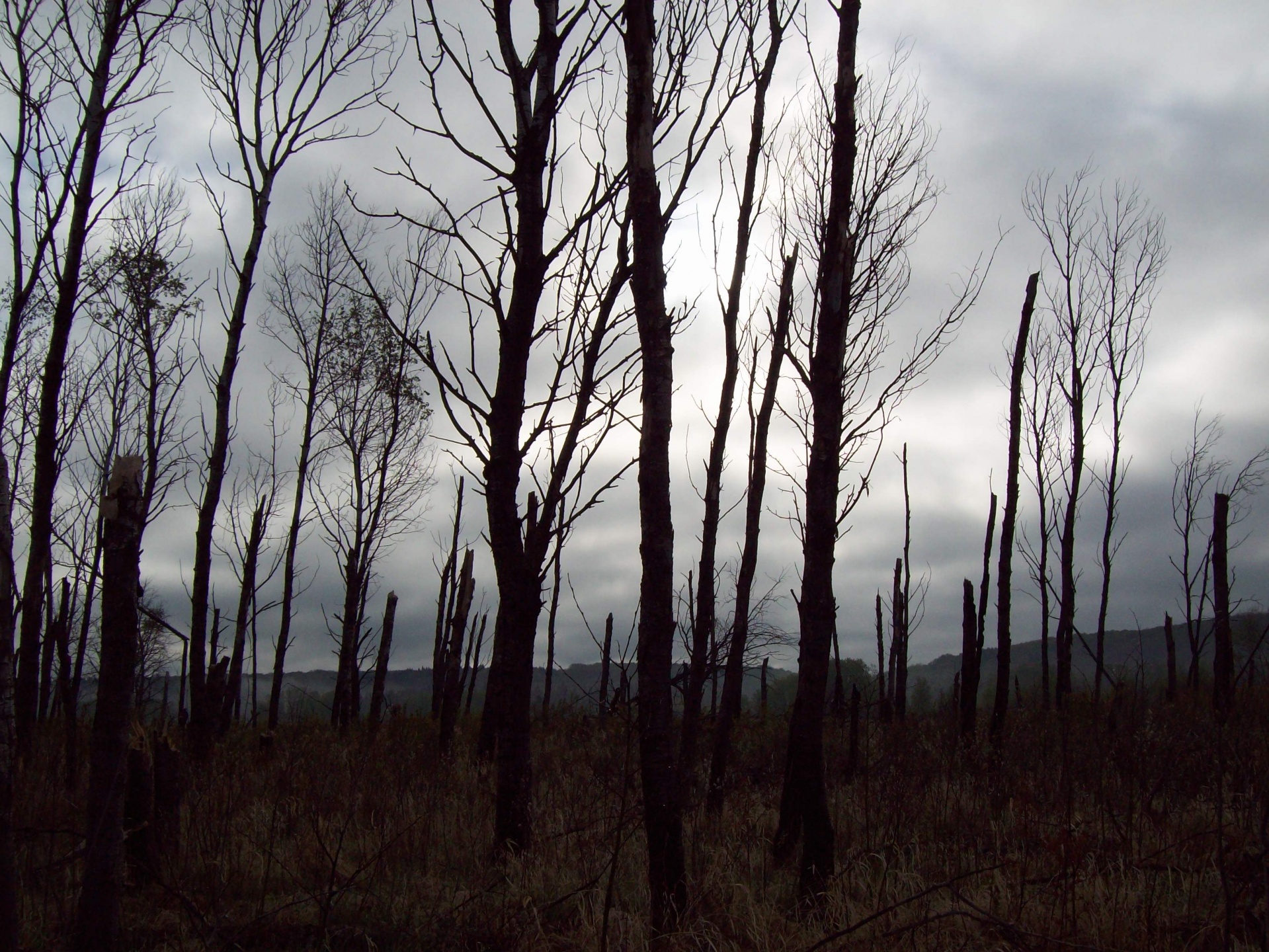
Before the third episode of the Philippines Graphic Literary Workshop (PGLW) concluded on April 18, we knew that we had one more thing that we can offer our bright young fellows: a starting platform for their creative endeavors. Here, we present one of their final outputs from the workshop. We also asked them to provide an artwork that they think best represents their stories. Read on.
There was once a lush forest that was a refuge for many in the village during the hottest days of the dry season. The river just a few miles away used to be a favorite recreational spot for this season as families gather to swim or to spearfish along the gentle currents.
But, as years passed, as peddlers and politicians bought out parts of the land and exhausted the bountiful number of raw materials, the forest was no more. It was a desolate land with only a few signs of life.
Last month, a record-breaking flash flood happened, nearly wiping out the villages nearby. Alon remembered clinging to her mother as the cold and hard rain was beating on her skin and the wind screaming into her ears. The flood just wouldn’t stop rising. It almost reached the roof where they were forced to climb on. It was slippery, wet, full of people crying and praying for rescuers. She remembered a little girl who slipped and fell, and her mother slipped after her as well. Both mother and child were swept by the merciless current of flood.
Now, the village still needed rebuilding, and Alon was assigned to send a letter to the regional office for aid. Usually, it was the chieftain who would go back and forth from the village to the city to coordinate aid for the village but a few days ago many villagers fell ill. Halia, a lucky child who managed to go to college, said that it was due to malaria and leptospirosis. Manong Lito’s and Manang Lucita’s five-year-old son died from malaria a few weeks after the flood, and more young children and elderly people died afterward. The local spirit healer could only recommend herbal tea that only alleviated some of the symptoms, in which the herb itself was becoming scarcer day by day. Halia proposed a volunteer camp from her college, to which the college had been delaying for a few weeks due to the limited rides to the village’s location. Both healers tried their best to help the sick, but one by one familiar faces kept getting buried underneath the muddy soil.
Thus, as one of the few men left not riddled with sickness, the chieftain decided to stay in the village. He wanted Marco, his nephew, to be the one to deliver the letter to the regional office in the city, but Alon immediately volunteered. She reasoned that Marco was busy helping his family and his neighbors while her elder sister, Maya, was usually the one to help her mother and grandmother.
“Let me be of use, sir. I have already been to the city thrice. Just tell what to do and what to say.”
The old chieftain hesitated but relented when he looked around and saw many of his villagers were busy, hungry and sick. She was the one right in front of him, ready to do anything to save the village.
He gave her an envelope and instructed her what to do and what to say when she would arrive at the office. He emphasized that if she needed help, simply ask the workers over there, although he had a weird expression on his face when he said it.
Then, a familiar warning followed suit after his instructions, “Go down the long stairs to the main road. Remember, do not go to the naked forest.”
…
Her lola also warned her the day before her departure, “Little tubod, do not, I repeat, do NOT go there to cross the city! Understood?”
But when Alon had awoken before the sun, cleaned herself to look presentable in front of the city people, the main road was under construction once again. The third time this month, and it wasn’t even broken in the first place. She could walk further to where the road was still intact, and most of the villagers who also came down to the main road walked toward there as well with heavy baskets either balanced over their shoulders or on their head. But she couldn’t be bothered at all, for the road ahead was full of debris and dirt, making it hard to walk through and around. How did the others manage to get past that?
She looked at the sky and saw the sun rising between the mountains. She planned to be there by eight, but it seemed like she would get there by nine instead. She sighed deeply, knowing that going home before the afternoon heat was a long-gone schedule.
She looked away and her gaze landed on the naked forest. A thought passed by her mind: she could go through there to find the other jeepney stop on the other side. But then she remembered the chieftain’s and her lola’s warnings.
Do not go to the naked forest.
Ever since the disaster last month, that warning came to light. It began when the chieftain held a search for the mother and child that was swept away from the roof. They found bodies for those who didn’t make it, buried beneath the mud, except those two. The husband wanted to at least see their bodies so that he would stop hoping they lived. The woman thankfully was alive, but the little girl… she was still missing. The search party kept looking and looking, but no body was ever found— until one day, two members of the search party disappeared.
The surviving members dared to not speak of what happened, and if they did all they said repeatedly, with wide eyes and trembling hands, “Do not go to the naked forest.”
One of the surviving members was the chieftain, and he made it a decree to never go through the forest to reach any place outside the village ever again. The people must always take the long way down to the main road, even though it was a hassle. Many protested against this decree, vying it unfair for the elderly villagers who still had to sell goods and wares to the city, and the forest track was the least trouble for their aching joints. That was until old Rosita, who brought a wagon and her son to cross the forest, did not come back. They held a search for her as well and only found her wagon of goods by the river. A few days later, her son miraculously showed up, naked and wet, his skin pale and his eyes wide. His father, old Carlito, ran to him by the edge of the forest and hugged him tight. Again, like the previous survivors, the mantra was said again: Do not go to the naked forest.
Alon probably shouldn’t go there, but she went back up to the long winding stairs, to the entrance of the village, snuck pass workers and neighbors, and stopped to read the sign perched beside the path before her:
Do not enter here.
The wind picked up. She felt the cool breeze of the morning dew, and she tightened the scarves around her neck as she entered the naked forest.
…
It’s been so long since Alon walked on this route. She used to remember the stones and the weeds as her mother and father guided her and elder sister to pick some of the fruits growing within the forest. Now it’s dead grass, mud, old stumps, and a few trees. A young ipil-ipil had some of its bark stripped, and a small, yellow-breasted bird was on top of one of its leafless branches. It sang a hopeful trill, waiting for a song back, but she heard no bird reply to his calls. When she stepped on a twig, the songbird flew away.
Another path opened to her left, and she knew it was the path going down to the river. There were streaks of mud on the path, like something had slipped on its track. She shook her head, shaking off the thoughts of what it could be.
As she passed by a row of dead shrubs, a snake hissed at her from the dried grass. She jumped and backed away. The snake curled up and continued to hiss at her. It has slit pupils, narrow and menacing along with its red irises. She went around the snake and quickly took off before it could have a chance to strike.
…
At last, she was heading down to where the other jeepney stop was located. She sat on the old waiting shed, the rust eating away the metal of the bench and the roof. A woman was already sitting there, although she didn’t look well. The woman was pale and kept on shivering. She offered her one of her hinablon scarves, which was woven by her grandmother, but the woman simply ignored her. Finally, a jeepney was coming. She stood up and flagged it down. She climbed up and told the driver that her stop would be by the plaza. After she gave him the money, she looked back to see if the woman would ride the jeepney as well but was surprised to see no one sitting in the waiting shed.
…
Alon walked toward the giant building across the statue of Jose Rizal, his eyes toward the Philippine flag and his hands occupied by pen and paper. The building was gorgeous but worn down. The coral stone walls were slightly chipped, its crevices was full of soot and dirt, and the white painting on the columns was faded and full of soot. There were a few missing tiles on the roof, leaving it bald on some spots. She had heard from one of the city people that this building was built during the rule of the Spaniards. A guard was standing beside the large arch doorway that opened to a hallway of patterned tiles, walls of pictures, and rows of ornate doors with people sitting outside. She was stopped by the guard and asked her what her purpose was.
“I’m here to deliver a letter to the mayor’s office.”
The guard paused, looked at her up and down, before he pointed inside.
“Head over there. On the right. You need to fill up a form there.”
She recognized the instruction; the chieftain had already said that to her. She nodded and thanked the guard before she went inside the regional office. There were people sitting on benches and walking around the hallway, some of them wore uniforms, and some only wore casual but modest clothes. She turned to the right and found herself in a line.
…
Time flew by, and when it was finally her turn, she immediately presented the letter to the receptionist, to which the woman then asked if she had a referral from the barangay office.
“He should know then that we need a referral before we can proceed with any transactions in this office. No referral, no process.”
Alon bit the inside of her cheek. “The guard said I must fill up a form. Can I still do that even without a referral?”
The receptionist shook her head, then shifted her gaze away to look at the small rectangular thing that flashed moving pictures.
“Is there any easier way, miss? My village still needs aid from the disaster last month. We need the regional office’s support.”
The receptionist doubled down because it was simply what the policies said. She cannot make exceptions.
Alon wanted to press further; she even contemplated her dignity by lowering herself down to her knees because her village needed this. But then she was shoved away from the desk that she almost fell to the floor. She looked up, about to berate such rude behavior, only to see a clean-looking man with fancy clothes. He simply placed his papers on the desk and told the receptionist that he needed them done right now. The receptionist suddenly became more attentive compared to when she was speaking with her and immediately reviewed the papers.
She left the building feeling guilty and furious. Guilty, for she failed to deliver the letter and furious about the whole interaction with the receptionist. Perhaps her anger was more intense than she thought because her clothes felt warm and her forehead began to sweat like a downpour. She stared at the sky, and her vision was blinded by the sun right above her. The shift from the air-conditioned office to the sweltering heat of noon made her sneeze. The guard asked her if she was alright. She ignored him as she made her way back to the road.
…
The sun was flaunting above its afternoon glory — blinding, burning, and producing sweltering heat she swore it would melt her to a puddle of guts right then and there. Her clothes were wet from sweat as each garment clung to her skin. The makeshift neck gaiter she made from her grandmother’s old scarves were protecting her face and neck from the burning rays of the sun, but her baby hair was sticking to her forehead and her neck was hot. The heat was unbearable that she could hardly breathe! Each step was grueling and miserable as the afternoon heat made her sweaty and exhausted. Alon finally reached the row of dead shrubs, and the snake was nowhere to be found. She swallowed her saliva to quench the thirst, regretting not buying a bottle water sold by the street vendor in the plaza.
But she had to carry on — she had to — for he saw the woman once again, standing and shivering underneath the leafless branches of a mango tree.
She picked up her pace, avoiding her gaze at her intense stare. Her eyes felt dry, her throat felt dry, her body was sweating all over. It was so hot, so damn hot, she needed to cool down!
The woman appeared again. This time, she was by the path going down to the river. Her vision was becoming blurry, but she swore the woman lifted her arm and pointed down to the muddy trail.
“The river should help you. It should cool you down,” a meek voice echoed within her head. Repeatedly. She squinted her eyes, to see if the woman’s lips were moving. No. Her lips were still a thin line.
Alon wiped the sweat off her face. She swallowed her saliva again. She needed water.
She swerved from the path home and headed down to the river. When she walked past the woman, she didn’t see her thin lips curled up into a smile.
…
She heard the soft trickles of the river’s current, a loud splash and a low gurgle. She ran. Water! Water! God, she needed water.
The water was murky, full of floating branches and litter, but that didn’t matter. On her knees by the bank, she gathered her a handful of water and greedily drank. She drank more. And more. The water tasted like dirt. She scooped up some more and drank. Her body felt cooler as she sighed in relief.
There was something floating in the river. Not a branch. It was something white. Flowy and wide. But her throat was still dry, so she didn’t care to observe. She drank once more.
The water tasted like metal. Alon opened her eyes, and the water was red. She gasped as the smell of iron and rot permeated her nose. The red water seeped through her fingers, and she quickly stood up. But before she could stand, a pale hand emerged from the murky waters and grabbed her arm. She screamed. She pulled herself back, putting all the strength in her exhausted body to get away. A lock of black hair appeared as well, floating alongside the white garment, before it turned into the shape of a head. A familiar face greeted her. Her long, wet hair clinging to her round cheeks and forehead — just like the day she was swept by the flood. Her eyes were bloodshot, and her skin was deathly pale. The young girl was shivering. And the girl’s small fingers and soft palm continued to tighten around her forearm.
“It’s colder down here, ate.”
She resisted the girl’s call and once again tried to back away. “Please! Let me go home. Let me go home!”
The young girl’s gaze was empty, but she saw her reflection in her red eyes — her reflection was upside down.
She didn’t know these creatures thrived here after the disaster. Now she understood why no one should have entered here. God. Dear God! A shiver went down her spine and wailed aloud, calling for help, for someone to save her from the monster.
When she tried to pull away, the ball of her foot stepped on mud. She slipped and lost her balance. The young girl’s impossible strength immediately pulled her down, down into the murky river, deep into the riverbed. She felt her body cool down as she gasped for air. She sank, deeper and deeper, until she saw sunlight no more.
…
The village chieftain called for a search party again, because another villager went missing. It has been three days since the youngest daughter of the Buhain family left for the city and never came back. Marco rode his motorcycle to the city and asked around if they saw a young lady about his age. The guard from the regional office admitted he last saw her walking away from the office and rode a jeepney.
The chieftain felt dread as he rerouted the search to the naked forest.
The matriarch of the Buhain family cried out that her granddaughter, her little tubod, wouldn’t dare cross the forest. Her granddaughter was an obedient girl. She wouldn’t risk her life! But the search party ignored her cries and entered the naked forest to find the missing young lady. And they indeed found her — naked, pale and as still as a broken branch floating along the soft currents of the river.
Louise Katrina C. Ybañez