Before the third episode of the Philippines Graphic Literary Workshop (PGLW) concluded on April 18, we knew that we had one more thing that we can offer our bright young fellows: a starting platform for their creative endeavors. Here, we present one of their final outputs from the workshop. We also asked them to provide an artwork that they think best represents their stories. Read on.
That morning, Lenn woke up at the sound of her roommates leaving their room. By the time she climbed down from the upper bunk, half-asleep, she was conscious enough to recognize something was different—perhaps wrong. Since they were in different grade levels, the times they needed to be at school varied, though the difference was a mere thirty minutes or so. They had an entire system that determined who would wake up first and where each of them needed to be, vital for order in such a small space. Sara, the tenth grader who occupied the bottom bunk, always accompanied Lenn on the way to school. Today, however, she left without even so much as a goodbye.
The alarm rang. Lenn turned it off and crouched to find her underwear and toiletries in her box underneath their bed. Back was the mechanical drive of routine, and she readied herself like any other day, assuming that the other three may have mentioned something about an event for the grade-schoolers she did not care enough about to remember. A few minutes later, she was dressed, standing before the mirror with her towel in her hand, rubbing the last of the excess moisture from her hair. Then, she saw it.
The person reflected in the mirror wasn’t her at all, but a foreign woman with white skin and a knowing, sharp gaze that Lenn had only ever seen within the confines of her cards. The High Priestess. Lenn did not startle—she continued to dry her hair as the reflection mirrored her movements and rubbed a towel against her own brown, dry hair.
When Lenn moved to put the slightest bit of makeup on her face, it was a different woman reflected in the mirror. Unlike the High Priestess, the Empress’ expression was soft and kind, like a well of tenderness and patience, even as Lenn pulled taut on the dark circles beneath her eyes to put on mascara. When she finished and looked away to rummage through more of her tools, Lenn wanted to ask why they were there. And for a moment, the Empress looked like she was about to answer her unspoken question as Lenn applied color to her lips, but she did not. Instead, the woman sighed as Lenn took one good look at herself, satisfied with her work. They smiled at one another.
“You have something to tell me. Urgently,” Lenn said to the mirror. She nodded, and the Empress did, too.
This was not the first time this had happened, and the other times proved to be very eventful. Her deck was tucked away in the folds of her bag, but she yearned for answers and wanted clarity, as already she was wrought with scenarios that could befall her on the street, disrupt her classes, or interrupt the evening reading session she was going to host downstairs. Was it something about her? Someone she knew? Someone she was about to know?
A man stared at her through the mirror whose gaze silenced the trembling of her fingers and the questions in her mind. The Hierophant, unlike the women, was a domineering presence, intimidating and cold, reminding her of the air-conditioned faculty rooms and the calculating gazes that fell upon each student brave enough to open the door. As a reflection, he was equal parts quiet and firm, holding with both hands the rough fabric of a lanyard. He crowned the base of his nape and turned it over, Lenn’s face, name, and school plastered on its front. Only then did she realize, as she stared at her own face in the reflection of the I.D., what he was there to tell her: Go.
She was running late. She was never late. Lenn left the boarding house in a hurry, refusing the breakfast a college student from the lower floors offered her, struggling all the while to open the zipper of her bag to pull out her deck. Once she managed to unfurl it from her makeshift holder made out of scrapped cloth and yarn, her mind whirred in anticipation. There in her hands were the answers to all her questions—the very voice of the universe.
Carefully, she shuffled the cards as she walked, her pace brisk yet calculated, expertly navigating the uneven terrain through the street, lingering just at the edges of other properties: small stores, informal businesses, and stalls. She stopped shuffling and turned over the card closest to her. At the same time, her steps faltered as a group of rowdy children nearly collided with her, shouting profanities that made no heads turn.
Five of wands—conflict. A hundred scenarios played in her mind, but one stood out. Sophie. The name was foreign, almost, but the association felt… right. And if Lenn trusted anything just as much as her cards, it was her intuition.
Lenn and Sophie used to be inseparable. Having grown up in the same province, they considered themselves sisters in every aspect. And although they fought about the littlest things—as siblings often did—they did not stay so little.
One fight of significance took place many years ago, when they were barely old enough to be in school. Lenn was visiting Sophie’s home, and they fought over the last remnants of a jar of chocolate. As she was their guest, Sophie’s mother offered the jar to Lenn. Sophie was so furious, enough to condemn her with screams that her mother later apologized for to their neighbors.
Another instance was when they were in fifth grade and quarreled over claims of a boy’s affections that were neither reciprocated nor acknowledged. The fight was hardly a secret, though they tried to make it so. After all, two bodies that normally orbited one another would send things into disarray once they ceased to function. Their families—the ones who cared, anyway—were quick to act. It pained them to see the children torture one another with their silences.
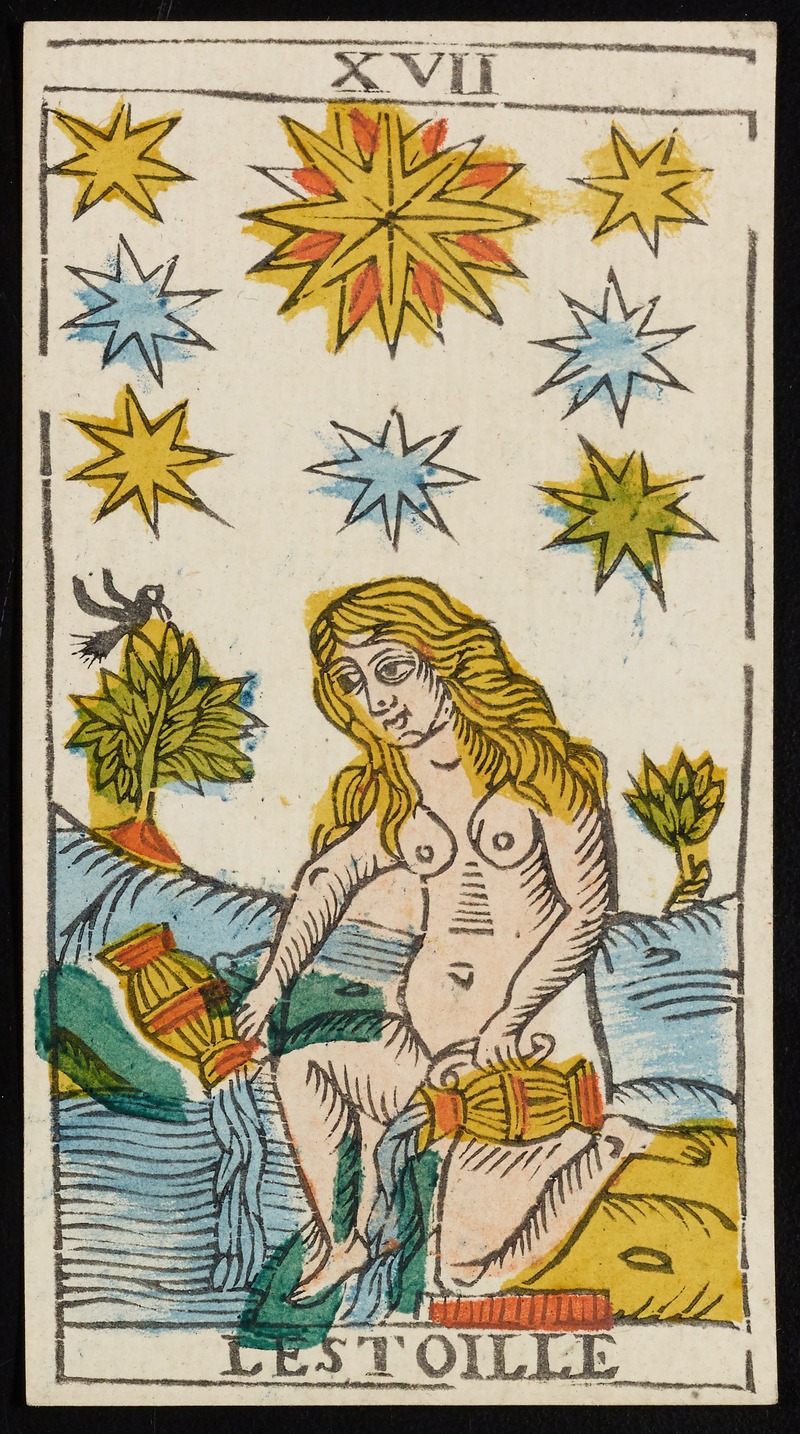
Lenn cut the deck, turned over the topmost card again, revealing a woman seated upon a bank with her feet dangling into a steady stream of water. Above her, a single star shone like the very center of the universe. Lenn looked up into the distant sky, suddenly hyperaware of the sun’s heat, the cool morning breeze, the smell of fruit juice and homemade dishes as she passed the last of the remaining shops before the stretch of an unmanned field, owned by a wealthy man she had never met. Normally, she would endure the heat with annoyed sighs over her forgetfulness when it came to bringing an umbrella and the lack of trees on the stretch, but today, she found herself willfully bathing in it like the woman in her hand as she whispered to her: The universe is on your side today.
The Star was favored by Lenn’s aunt. Each card represents a portion of a story, occurring one after another. The Star is the one that follows The Tower—a card of devastation, destruction, and trauma.
“We all have problems to face, Lenn. We cope with them in our own way,” her tita Nora said as she braided Lenn’s hair with long, manicured fingers. Lenn had just been told by her parents that she was to be sent away to study far from home. She understood that her current school only offered classes up to a certain grade level, and that the distance between their house and the high school was too great, but it seemed to Lenn more like an excuse to get rid of her. She was upset how everyone else continued acting as normal while she toiled over the thought of being sent to a place where she would be alone.
Even after such news, the house was alight with games of bingo, cards, and bets, as it often was a den of gamblers. Nora was a neighbor, both the barangay’s manghuhula and manghihilot, the ale who kept to herself within shadows and lit candles. She was also Lenn’s closest family, much preferring the quiet and privacy she brought to her life. At the news, Nora braved Lenn’s family’s home and sought her niece, comforted her the only way she knew how.
“You asked me before why I am like this,” Nora continued. “It is because I chose this life. It is how I survive day after day. It gives me reason to keep going, just as it does for those who come to me for help. The troubled and restless will do anything to find reprieve. To some, the guidance of divination is just the thing.”
Lenn, then, realized that Nora’s lifestyle was what her tita was to her—a comfort, a place of rest amidst the loud noise of numbered chips, dealt cards, booming laughter, and coins. A place of ease and companionship.
When she finished braiding Lenn’s hair, Nora took her niece’s hands and squeezed them tightly, the ridges of her rings digging into Lenn’s skin. “Do not worry. You will not be alone.”
Eventually, Lenn learned this was true in two ways. One, a similar circumstance that led to Sophie’s enrolment in the same school. Two, Nora’s gift—an heirloom tarot deck, yellowed with age, its box in tatters, but functional nonetheless.
Lenn only ever saw Nora use them once or twice before, as she much preferred other methods of divination, but she knew how important the deck was to her aunt.
“They call for you,” Nora said when Lenn vehemently refused to take such a gift the day she was set to leave. “At the very least, they will make sure you are not lonely.”
Lenn would be lying if she said divination did not intrigue her, but to say that she was meant to have such a treasure? Alas, she became homesick so easily that she could not let the cards go, could not avoid touching them, or calling Nora every night to ask for brief lessons on reading. In one way or another, it was an inevitable connection, and it was strong.
Some ways past the pasture was a tricycle terminal where she could get a ride that would take her straight to the school gates. She walked faster, but not without turning over the topmost card after cutting the deck once again. The image was that of a hand extending upwards from a coalescing mass of clouds at the bottom of the card.
Of all the cards, Lenn loved the aces most, which signified different beginnings based on their suit. “Swords,” she mumbled to herself, caressing the image with her finger. The domain of intellect and communication—just what she needed. She tucked the card back into her deck. “I know, I know. Today it is.”
Sophie knew about Nora and how much Lenn adored her and missed her. As her best friend, she also witnessed Lenn’s growing obsession with the cards. It was harmless enough—if anything, it gave them something new to talk about, and Sophie loved hearing Lenn gush about the accuracy of her own readings, the passion that consumed her whenever the cards flew as she shuffled them.
That was until the visions. When Lenn asked Nora about them, she said she’d never experienced such a thing before while using tarot, and it was unlike her visions when she would use other forms of divination. Lenn was quick to be convinced she was special. Nora did not disagree. Sophie did not know what to think.
Lenn’s efforts to study the cards doubled, and once she was confident enough, she offered free readings to her classmates and friends. She built a reputation and even started accepting small exchanges like snacks, gossip, and pocket money in return for guidance.
Sophie was supportive in the beginning. “They say too much,” she said one afternoon as they sat across from one another on their school’s cafeteria table.
“That’s what they do,” Lenn said with a laugh.
Sophie sighed, put her food down, and placed a hand on top of Lenn’s, effectively putting a stop to her shuffling. “They blabber because you let them. Try shutting up.”
Lenn could not remember how she reacted then, but she did remember how Sophie’s visits to her boarding house increased, as if in apology. She observed the reading sessions Lenn hosted in the shared living room. She listened to her divine others’ feelings, careers, academics, finances, and health.
It did not last long. Lenn remembered the first excuses, too—homework to be done, headaches to sleep off, siblings to put to bed, lingering guilt from what she had said. A distance that was all too convenient to blame on “growing up.”
The Hierophant walked a few steps ahead of Lenn when she disembarked the tricycle and entered through the school gates. He was clad in a dark robe, and his white hair, aged with knowledge, was still despite the morning breeze. Even as Lenn ran to catch her morning class, the Hierophant maintained the same distance despite only walking.
He stopped at a point in one of the hallways, and Lenn did, too, having reached her classroom. They entered, and she was relieved to see the room was full of noise and activity. When Lenn turned to look at the Hierophant, he was nowhere to be seen.
“Ma’am Sydney is sick,” the student seated behind her said as she lowered her bag to the back of her chair.
“What about the sub?”
The girl shrugged.
To Lenn, there was no use questioning it. After all, the cards would not have pushed her all morning if the conditions were not ideal. She was convinced—and the cards assured her—that nothing would stop her now.
The next moment, she was in front of Sophie, who was seated in the middle of the classroom. Lenn took the empty seat in front of her and turned it around. Sophie’s gaze lowered from the phone in her hands onto the deck in Lenn’s.
“I don’t remember buying a reading,” Sophie said as Lenn shuffled. When a card flew out, she placed it neatly to the side.
It wasn’t as though they hadn’t spoken to one another in the past few weeks. They had stopped hanging out as friends months ago, but they spoke when necessary and remained civil. Still, Lenn always felt there was something more there. More than asking what, she was afraid to ask her cards anything, for fear of being told otherwise.
“This one’s free,” Lenn said. Her shuffling hastened, and another card flew out.
This time, Sophie was the one to fix the card on her table. Lenn watched, wondering about the implication of that small movement, the lack of clear animosity or bitterness in her gaze.
“I know why you’re here.”
“Do you?” Lenn asked.
“You want something from me. Obviously.”
“You could say that,” Lenn replied, and the final card flew out.
Lenn wasted no time. In the next moment, she’d flipped all the cards over. She gave them a brief look-over before settling her eyes on Sophie, who was staring straight at her with an unreadable expression on her face.
“You’re hiding something from me.”
Sophie lowered her gaze and picked up the first card. “What could I be hiding from you?”
Lenn pointed to the last two cards. “You’re being naive. You’re keeping quiet to protect yourself.”
“So you think I’m being selfish?”
“I think you’re being immature,” Lenn replied. “This… distance you’ve created between us could have been resolved if you had just opened up and talked to me.”
For a moment, Sophie was quiet, her brows furrowed, her expression no longer unreadable but openly bewildered. Then, slowly, it melted away from her face. Bitterness replaced it. “…That is the cards’ advice?”
Lenn nodded as she put the cards back together. She tried not to show it, but she was elated to have been right, to have been assured that there was a chance to fix things. If only she’d trusted herself more to seek answers from the deck months prior.
Sophie sighed. “They told you to come to me.” Lenn did not confirm. “All this time, you waited for them to tell you to come, didn’t you? And now that they have, this is the message you bring to me?”
“I only impart what the cards say.”
“To you?”
Lenn furrowed her brows. “To you.”
Sophie shook her head. “You’ve got this all wrong.”
“How? What do you know about reading cards?”
“I learn enough from your blabber,” Sophie chided. “And what I know is its message applies to you as much as you say it does for me.”
If she asked, Lenn was certain she’d be able to see Sophie’s every movement in the spreads, her future with every upturned card. And yet, even as the very person sat in front of her now, she could not be certain about anything. Just how much had her best friend changed in a mere few months?
Preoccupied with her thoughts, Lenn did not realize she was shuffling the cards in her hands. Muscle memory failed, and the cards unraveled and fell. She gasped and crouched quickly to gather them. Other students put their hands on the cards, too, eager to help, and when she looked up to thank them, all she saw were faces of familiar people who did not belong in the classroom. They handed her small, rectangular mirrors that felt impossibly thin between her trembling fingers, and she stared at her own reflection, the terrified look on her face, the heavy rise and fall of her chest as the mirrors continued to pile up, up, upwards, until—
The Hierophant entered the room. Lenn got to her feet and breathed a sigh of relief, but in the next moment, his visage blurred, and in place of him, a teacher crossed the front of the room and called for order. Everyone quieted, everyone sat. They called for Lenn to do the same.
Marielle G. Tolentino
Started in 1927, the Philippines Graphic is the longest-running printed magazine of national circulation that provides relevant news and features and promotes Philippine literature.