

BUILDING A SITE
Manila took a long time to make. What is now its ground used to be sea. The sea reached as far as the present towns of Mandaluyong (“a place of waves”) and Makati (a place of tides”).
It is said that diggers in Makati often find seashells. This could mean that once upon a time Makati was seashore or seabed. The line of the shore may have been along Guadalupe, under the cliffs. So, at that time, the highway called EDSA would have been a beach!
All the land north of this, up to what’s now Quezon City, was underwater. Then, through hundreds and hundreds of years, this foreshore began to fill up until a triangle of ground appeared.
This became the site of the City of Manila.
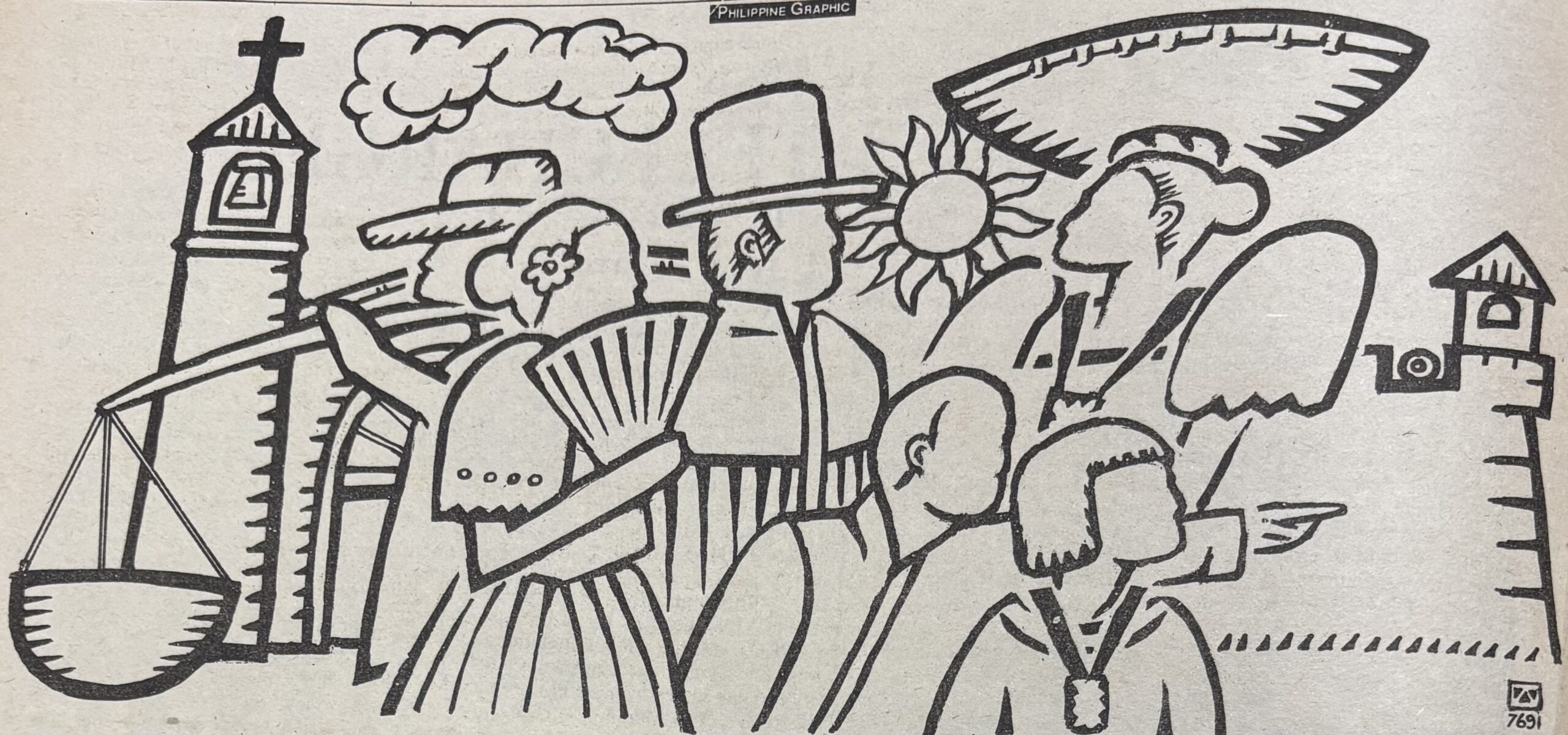
The triangle can be imagined as a fan: the handle is Pasig town; the rim of the fan is the arc between Pasay and North Harbor.
No one knows how long it took to turn sea into land. But we do know who built a site for Manila.
The builder was the Pasig River.
The present Pasig is a stream 23 kilometers long. It rises from the north side of Laguna de Bai and flows westward into Manila Bay. The mouth of the river was at first somewhere near Pasig town.
Into the bay there the river carried its load of mud and sand. After hundreds of years these deposits of soil had piled up to form ground. THrough this triangle of ground that it had formed, the river forced a new channel, with many loops, to reach the bay now farther off.
The river thus divided the triangle into an upper side and a lower side, or into north and south. And the mouth of the river was now almost exactly in the middle between these two halves.
The ground thus formed at the mouth of a rivver is called a delta.
The delta of the Pasig River is almost entirely occupied by the City of Manila. In the beginning this delta was not a solid hunk of ground. Instead it was a jumble of small islands between which ran the rivulets that we call esteros.
It must have been a long time before anybody inhabited these islands. Being barely above sea level, they would go under water during high tide or the monsoon rains. Floods are still a problem in modern Manila because the land level has not risen much since the days when the Pasig delta was a jigsaw of tiny isles.
The site of Manila was reclaimed from the sea—and the sea is still trying to get it back!
The higher ground beyond the delta was already inhabited. In the dense forests of what are now Kalookan, Quezon City and San Juan roamed the aboriginal tribes. Their tools, weapons and other goods (Which are called artifacts) have been unearthed. But no artifacts have been found in the ground of Manila, a sign that the delta islands began to be lived in only recently.
Perhaps the first to inhabit the delta isles were the barangay folk who began to arrive in the Philippines around the tenth century. They came in the large rowboards called barangay. A group of families related to one another is called a clan; and each barangay expedition carried a clan from the nearby Malay world to a new home in the Philippines, then still the virgin wilderness of Aeta and Negrito.
Certain barangay expeditions sailing up from the south and cruising the western coast of Luzon came upon an opening in the shoreline. This entrance was partly blocked by an island that rose high like a rock. Rowing past this “door,” the migrants found themselves inside a big and beautiful bay, almost perfectly round and almost totally enclosed. Here the water was calm and the breeze was gentle, for this was hjhaven shut off from the storminess of the China Sea outside. Down to the waters of the bay grew the forest primeval, so that everywhere you looked you saw a world of blue and green.
With what awe must our forefathers have gazed on all that purity and silence and loveliness!
They had discovered Manila Bay.
One of the world’s best natural harbors, the bay is 56 kilometers at its broadest. The entrance is about 18 kilometers wide and is divided by the Rock of Corregidor into two passages: a northern and a southern channel.
If our forefathers entered through the upper channel, which is only some three kilometers wide, they rounded the tip of the Bataan peninsula and saw its deep jungles. If they sailed in through the lower passage, they beheld the “hook” of Cavite and the green hills rising from a narrow curving shore. From a distance, the hills look like a Sleeping Woman.
Ahead, on the east point of the bay, was the fairest marvel of all: a cluster of islands sparkling in the sunshine like emeralds.
Oh, how the hearts of our forefathers must have leapt with joy upon seeing that mini archipelago tucked so safely deep inside the bay!
Our ancestors must have known they had found the new home they sought, especially when, sailing into that flowery maze, they found that all these gardens afloat were vacant.
No roof, no trail, interrupted weed and foliage. Water and soil and light and the very air had the cleanliness of a new creation. The islands were bare of life, except the life of leaf and bough, of bird and insect, of snake and fish. Everything was morning-fresh because so unseen, so unbreathed, so unpeopled!
Oh, what a vision you must have been to my sires when first you enthralled them in the dew of your dawn: Manila, my Manila!
Having occupied the delta isles, the newcomers gave each island a name that fitted it. Two islands were what’s called a headland, meaning a large bulk of ground jutting out to sea. So one of these islands was called Tondo; and the other Binondo. Both names refer to tallness.
Another island that was swampy got called Sapa. When the Spanish came, they renamed the place Santa Ana de Sapa.
Also swampu was this very small isle that may have been used as a burial place for chieftains and tribal heroes, and was therefore referred to as Malacañang: “There are great ones there.” That name survived as the name of a street—and of a palace—on the isle that was renamed San Miguel.
A kind of water cabbage called cuyapo was plentiful on the banks of an island that naturally became known as Quiapo.
The island next to it had the more mysterious name of Mayhaligue. Did this refer to a sacred pillar, or to a great house with mighty posts? We now know that island as the district of Santa Cruz.
Where now stand City Hall and the Normal College was an island called Dilao, named after a herb that yielded a yellow dye. The name became even more apt when Dilao became a village of Japanese migrants. Spanish times knew it as San Fernando de Dilao. From it sprang the parish that we now know as Paco.
At the very mouth of the river, on the southern bank, was a tongue of land on which grew in abundance the plant called nilad. So that isle was referred to as May-Nilad, or Maynila, although some people insist that the original term was May-Dila (meaning “with a tongue”) and others think that the tagalog term for the indigo plant, anil, a plant which may also have been abundant in pagan Manila, may account for the island’s name.
At any rate, this isle of Maynila, which must have been the very last to be formed by the Pasig (since it is at the very mouth of the river), has given its name to the entire delta.
Extra-delta places like Kalookan, Quezon City, San Juan del Monte, Mandaluyong, Makati and Pasay owe their glory to the fact that they are beside Manila, the Metropolis of the Philippines.
When the pilgrims from the south stumbled upon that entrance to Manila Bay, what came about was the history not just of a city but of a nation.
Manila happenings have a national effect.
When Manila sneezes, the Philippines catches cold.
OUR PILGRIM ANCESTORS
Malay is our breed. The breed is said to have come from the south of continental Asia. The Malay belongs to the Mongolian race, along with the Chinese, Japanese, Eskimo and American Indian. We share with them brunette features, slanting eyes, and a skin color that ranges from yellow to tan to red.
The Malay began as a nomad. He had an itchy foot. His has been a history of restless wandering. From southern Asia he wandered down to the Malay Peninsula and from there to the archipelagos of the South Pacific that are now Indonesia, the Marianas and Polynesia.
And from the South Pacific he moved north to the Philippines, which is maybe the last land he reached and occupied.
What’s amazing is that these voyages of his were made not on ships but on flimsy rowboats. His heart was as bold as his craft was frail.
The Malays who came to Manila were part of a twin migration. This migration was of two tribes who may have been neighbors in the land they came from (Java? Sumatra?) and were thus closely allied. The Tagalog (“of the River”) was related not only by culture but by blood to the Pampango (“of the riverbank”) and their rulers came from a royal house that was of Pampango-Tagalog lineage.
So when members of these two tribes decided to emigrate to the Philippines, they did so together. Thus, they were neighbors again, as in the old country.
From Manila Bay, the Pampango pilgrims sailed up the Pampanga River to the plain dominated by Mount Arayat. There they founded the communities that would make all this realm they occupied famous as Pampanga.
As for the Tagalog pilgrims, some of them stayed on Manila Bay and built the communities that would become Cavite and Bataan. Of course their greatest labor was occupying and developing the delta isles at the mouth of the Pasig.
Later Tagalog arrivals would sail up the Pasig to Laguna de Bai, on whose shores would rise their bailiwicks and colonies. Their capital was the town of Bai; and so all this lake country—and the lake itself—became known as Bai.
When Chinese traders came to Manila Bay, they contacted some local king for help. The king took care of sending the Chinese goods upriver to the communities of Bai and of bringing down what products the Bai folk wanted to trade with the Chinese. That’s how Tondo and Sapa became great ports, by being the trading centers between the lake and the bay.
Native trade items were mostly forest products. There was hardly any commerce in grain or manufacture because each barangay produced only just enough for its own needs.
Agriculture was still either slash-and-burn (the kaingin method) or stick-and-mat: stirring the soil with a stick before planting in it seedlings grown on a mat. Farming was mostly women’s work; the job of the men was hunting and fishing.
Religion was also in the hands of the women. The priest was female, or sometimes a man who dressed and acted like a woman. There were no permanent places of worship. The basic belief was that everything in this world—a tree, a river, a roof, a room, a season, a feeling, an industry, etc.—had its own anito, or spirit. This is like the classic Greek religion, though it produced no dazzling Olympus.
Our forefathers believed in a benign God the Father called Bathala but he and the other “good” deities hardly got any attention. Everyone was too busy trying to bribe the “bad” spirits into relaxing their malice to ward oneself.
It used to be claimed that, before the coming of the Spanish, the culture of Manila was a Muslim culture. The opinion today would be that the Manila culture of the 1560s was still pagan Malay. The headman was Muslim, and so, more or less, were the elite: the datu class and maharlika. But the mass of the population, though they might circumcize and avoid pork, were still of the old anito religion. Most of them had never even heard of “Mahoma.”
In Manila (as in Cebu) the prehispanic Filipino was certainly not “Islamic.” His culture stayed Malay and pagan. Culture means the behavior in general of a society.
Barangay culture respected the rights of private property. In fact, it was usually the datu with the largest land and the richest house who became headman.
However, barangay society also believed in communal property. In every barangay was a tract of land that was owned in common—that is, by the community as a whole—and every member had the right to use it.
The barangay community was divided into social classes. At the top were the datus, or royalty. Next came the maharlika, or nobles. Very much below were the commoners, or freemen. And at the bottom were the slaves: prisoners of war, or debtors unable to pay their debts, or wretches who for some reason had to sell themselves into bondage.
Barangays were very small. The usual size would be a community of 30 familities. A barangay of a hundred households would be considered very big.
Especially on the delta isles, where the “streets” were the Esteros, houses were built on riverbanks. Those early Manileños lived very simply. Their bamboo-and-nipa huts rose on posts above water or ground; the interior was a single room that served as living room, dining room, kitchen and dormitory.
The men wore a short shirt over a G-string, or bahag. The shirt, without sleeves or collar, was blue or black for commoners; red for the upper classes. Women wore a cloth wrapped around the body, sarong-style. For dressing up, they wore a blouse over a skirt.
Footwear was unknown but both men and women wore a lot of jewelry: bead necklaces and shell bracelets and golden anklets. Teeth were filed and usually blackened. There was much chewing of betel nut, or buyo.
Manileño warriors carried spear and shield. Tucked into the shield was a sword wavy like a kris. Tucked at the waist were daggers about a foot long. The Manileños had already advanced to artillery. On their ramparts—usually a palisade of logs or mounds of earth—bristled their cannon, or lantakas, some of which were 17 feet long. Every barangay was fortified because of the endless power struggles among the datus.
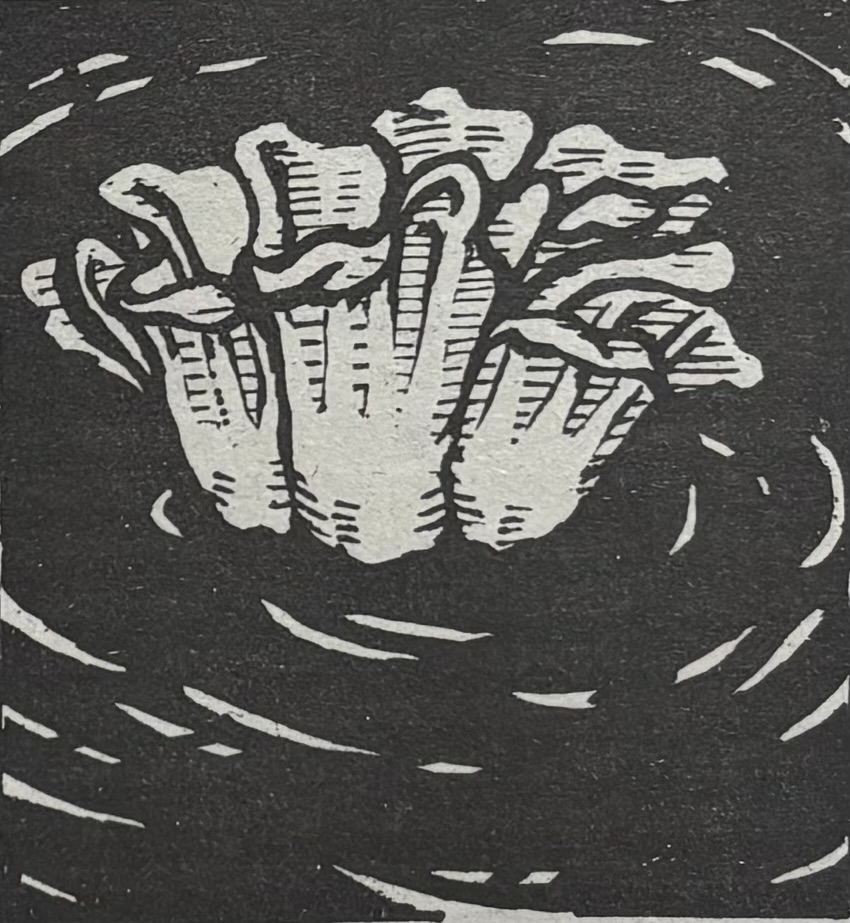
Manileños had a system of writing called alibata. But an early missionary who declared that everybody in Manila could read and write is now believed to have been exagerrating for the sake of kindness. If there was such a high degree of literacy, it’s strange that he failed to mention or quote from any famous literary work: a book of chronicles, say, or a book of laws.
The truth seems to be that the craft of writing was still so new among us it was used only to keep accounts, not yet for literary creation.
Government was mostly informal, meaning you did not have to accept it. If you didn’t like how your barangay was run, you were free to join another barangay. But around the middle of the 16th century, a leader had risen in the delta who might have united all the little kingdoms there into a state strong enough to turn the surrounding country into its empire.
THRONES & DOMINATIONS
There were efforts before to unite the barangay colonies into a larger whole. One was the effort of the Kingdom of Namayan, which succeeded in bringing under its rule a large part of the delta.
The Kingdom of Namayan had its royal capital in Sapa, which is today known as Santa Ana. This may be the oldest inhabited section of Manila. Ancient graves in Santa Ana have yielded artifacts indicating that this ground was already inhabited in the 12th century.
From Sapa, the kings of Namayan extended their power until their dominions included what are now the territories of Quiapo, San Miguel, Sampaloc, Santa Mesa, Paco, Pandacan, Mandaluyong, San Juan, Makati, Pasay, Pateros, Taguig and Parañaque.
In other words, the empire of Namayan stretched from Manila Bay (Pasay) to Laguna de Bai (Taguig). That’s quite a lot of turf.
Namayan organized the barangays on its turf into a number of states. These United States were known as Maykatmon, Kalantogan, Dongas, Dibak, Pinakawasan, Yamagtogon and Maysapan. The state of
Maysapan was on the lakeside and included what’s now the town of Taguig. As late as the middle of the 19th century, a sitio in Taguig still bore the name Maysapan—a relic of the first Metro Manila: the Empire of Namayan.
The high point of Namayan history was the marriage, sometime in the 13th century, of a Namayan princess, the Lady Sasaban, to the heir of the Madjapahit Empire: the Prince Soledan.
On succeeding to the imperial throne, they reigned as the Emperor Soledan (or Anka Widyaya) and the Empress Sasaban over the realm that’s now Indonesia. A Manileña had become an empress!
Among the children of the imperial couple was a son, the Prince Balagtas. He was born around the year 1300 and to him was destined as heritage his mother’s old realm: the Kingdom of Namayan. Since his future was as a Tagalog king, his education was oriented to the Philippines. In fact, he was given a Filipino bride: the Lady Banginoan of the Philippine nobility. Her father was the Lord Lontok, son of the Archduke Araw. And her mother was the Lady Kalangitan, princess of Pasig.
Sometime between 1335 and 1380, Prince Balagtas migrated to the Philippines and tried to fuse into one empire the Pampanga colonies then occupying an area that stretched from Manila Bay to the wilds of Cagayan.
Prince Balagtas could dare try to unite and lead the Pampangos because Pampango blood ran in his veins. The royal house of Namayan was a Tagalog-Pampango family. If he had won in his try, the Pampango-Tagalog heartland of Luzon might have become a United Kingdom, with the city on the delta as its royal capital.
Unhappily, Prince Balagtas could not overcome the tendency of both the Tagalog and the Pampango to divide instead of uniting. Not he but the Spanish would know how to turn the two tribes into a single effective coalition.
Prince Balagtas gave up on his Pampango scheme and retired to his Tagalog heritage. He became king of Namayan who had dreamed of creating a Pampango-Tagalog empire.
But from the seed of King Balagtas of Namayan sprang such Tagalog-Pampango dynasties as the Soliman, the Lakandola, the Gatbonton, the Gatchalian, the Gatmaitan, the Gatdula, the Malang and the Kapulong—families in whose veins ran a mixture of Pampango and Tagalog blood as in their brawn throbbed the marriage of Tagalog and Pampango power.
One descendant of King Balagtas occupied the throne of Sapa in 1470 and gained fame as the Lakan Takhan. (Lakan was the native term for king.) Lakan Takhan had five children by his wife Buan. He also had a son named Pasay by a slave woman from Borneo. To his bastard Pasay, Lakan Takhan bequeathed the seaside property now known as Pasay City.
Lakan Takhan was succeeded on the throne by his son Palaba. King Palaba’s heir was the Prince Laboy, who ruled after him and was in turn succeeded by his heir: the Prince Kalamayin. It was when Kalamayin was king of Namayan and had just been blessed with a firstborn male child that whiteskin strangers from another world appeared on Manila Bay.
The first local preachers of the whiteskin’s religion were allowed to baptize King Kalamayin’s baby heir, who was given the Christian name Martin. With Prince Martin ended the Kingdom of Namayan.
Panday Pira was then in Namayan, casting artifacts of brass, silver and iron in his foundry. Famous for his cannon, he saw his foundry burned down by the palefaces in 1571. A decade later, in his rebuilt foundry, Panday Pira was making cannon again, this time for the palefaces and their war against the Moros.
When the whiteskins arrived, the Kingdom of Namayan was on the decline. It was being outshone by two other towns on the delta.
The first of these towns was Tondo, which had replaced Namayan as the chief port of entry on Manila Bay. Tondo was right on the seaside. This was the advantage it had over Namayan, which was upriver inland. So the merchant ships that came into the bay preferred to unload their goods into the bay preferred to unload their goods at the port of Tondo. And it was now the king of Tondo who was responsible for sending the merchandise upriver to the lakeside communities there to be traded for local products. Tondo was thus the first distributing center, or entrepot, on the delta.
In the 1560s Tondo was ruled by Lakan Dula. He is said to be a descendant of King Balagtas. Many of the kingdoms along the Pasig River and on the Lake of Bai were ruled by Bornean princes, possibly the younger sons of marriages between the daughters of Tagalog kings and scions of Bornean royalty. Since the Bornean princes were Muslim, there was an impulse, at least among the Tagalog upper classes, to embrace the religion of Islam.
Tondo’s Lakan Dula may have been unusual in being neither foreign nor Muslim. This is indicated by his use of the native term Lakan instead of the foreign title Rajah.
Lakan Dula can be presumed to be of native birth and to have reared in the anito cults. One guess is that he converted to Islam, then changed his mind again and returned to his native faith.
In the time of Lakan Dula, Tondo was at the height of its career as entrepot, but another town was rising that could gain supremacy as a port because it enjoyed an even better location than Tondo.
At the very mouth of the river was the island called Maynila. As a town, it was just becoming well-known. In fact, it may have founded only a couple of generations earlier. In the 1520s it was unknown in the Visayas (or Magellan would have been told about it) but by the 1560s the Visayans had already heard of the Kingdom of Maynila.
On its throne say a young king: Rajah Soliman, who was Muslim and Bornean. His wife was Bornean too and so were his palace guards. Soliman was a warrior. The petty kingdoms along the river and on the lake lived in mortal terror of him. They cried that he was forever swooping down on them, to raid and plunder.
What Soliman may have been doing was what Prince Balagtas tried to do in Pampanga in the 14th century: organize the barangay colonies into a nation. With his raids on the petty kingdoms of river and lake, Soliman may have thought to reduce them into a single commonwealth: a unit, a union, a unity welded under his government.
If unification was indeed his dream, he would see it fulfilled—but not under his government.
SOLIMAN VERSUS THE PALEFACE
At the tip of the tongue of land that was Maynila, Rajah Soliman had built a fort facing the mouth of the river and the sea. A palisade of logs (the trunks of coconut trees) was meant more to deflect gunfire than to enclose, since it was easy to pass between the logs, planted in the ground about a foot from each other. The fortification proper consisted of narrow mud walls mounted with a dozen pieces of artillery, mostly small-caliber cannon.
The town itself was a mass of nipa huts huddled around Soliman’s palace. There is no mention of a mosque. The palace was a big house with a lot of porcelain and blankets; a number of wooden tanks filled with water; and rich stores of copper, iron, wax, and cotton. Beside the palace was an arsenal. Nearby was a forge where cannon made under the direction of a Portuguese armorer.
Maynila was considered a great city because it had a population of 4,000. Government was in the hands of two men. Apparently the previous king, Rajah Laya, had, because of old age, abdicated in favor of his nephew Soliman. But the young king kept his uncle on as adviser. So the old Laya held the position of elder statesman and was known as Rajah Matanda.
Maynila was not ignorant of white men; the Portuguese were already active in the Philippines. Still, the summer that brought the whites in large numbers to Manila Bay was epochal. With that summer, the history of Manila begins to have dates. We have entered the calendar of the West.
One day early in June, 1570, Soliman heard that a ship of the palefaces had entered the bay at sunset and anchored off Kawit. The palefaces were Kastila, not Portuguese. An evening conference with his uncle, Rajah Matanda, would have enlightened Soliman on the Kastila.
The old king would remember how, some forty years ago, there had been rumors of these palefaces coming to Cebu and converting the court there to their religion. But when their leader was killed on Mactan, the palefaes had fled in terror.

Recently, word had come from Cebu that the Kastila had reappeared there. For sure they had returned to avenge the killing of the leader. But what were they doing so far away from Cebu?
Rajah Matanda would point to the really bad part of the news. The Kastila were said to be accompanied by scores of Bisaya warriors. Now that was the heart of the problem. A handful of white men could be disposed of quite easily. But not if the Bisaya fought on their side.
The Bisaya would fight to the death against anything Muslim (and in their eyes Maynila was Muslim) because ages and ages of being meat for the slave trade had taught the Bisaya who their mortal enemy was.
Rajah Matanda would shake his head in anxiety but young Soliman would beg to disagree. The problem was not the Bisaya. The enemy was the paleface. “Let us sleep on the matter.” Easy to imagine either the young rajah or the old one closing the conference with that remark.
Morning brings a letter from the white men. They are requesting “peace and friendship.” Soliman and Rajah Matanda pore over the missive. They come to a quick decision: no instant answer; let the white devils wait. So three days pass before a reply is sent to Kawit.
Meanwhile, Soliman coaches an envoy on how to take a high tone with the whites. Dispatched to Kawit, the envoy tells the foreigners that this master, a most magnificent lord, is willing to befriend them—but only if they swear to behave.
When the enjoy rows back to Maynila, the alien fleet follows him and thus learns where Maynila is.
Soliman is notified the next morning that the Kastila have landed on the beach. He sends his uncle, the old rajah, to receive them but himself waits until noon to make an appearance. The palefaces are impressed by his entrance. He warns them that he and his people are not painted savages who will tolerate abuse. Rather will they repay with death any affront to their honor.
Then he is introduced to, and is embraced by, the leader of the whiteskin expedition: a chap called Martin de Goiti.
Next day, Soliman is visited in his palace by Goiti, who agrees that no tribute is to be exacted from Maynila. The treaty of peace is sealed with a blood compact: Soliman and Goiti drinking a few drops of each other’s blood.
But Soliman has already made a decision and only awaits a good omen: rain. When the first rain of the season falls, he will wipe out the invaders.
Alas that he waited too long!
The rains were delayed that June. The white devils were nervous. Suddenly, one morning Soliman heard gunfire. He ordered his own fort to commence a bombardment. A Spanish vessel was hit. War had begun.
Presently the white men were crossing the moat around the fort on bancas commandeered from fishermen. As they poured into town they set it ablaze. Under cover of smoke, Soliman managed to lead his people out of fallen Maynila. As the battle ended, the first rain fell—too late to be of good omen!
Upriver fled Soliman and his people.
In the forests upriver they hid until they heard that the white devils had sailed away. Then they came back to the delta to rebuild their town on the island of Maynila.
Such was the first defeat of young King Soliman. Though he resumed the throne, he had lost face.
Subsequently he would have learned that the Goiti expedition was but a feeler. The main body of the Kastila troops were in Panay. And their real dealer was someone called Don Miguel Lopez de Legazpi.
Why had the Kastila wandered north to Maynila.
They had found Cebu a famine spot and had moved to Panay, which also proved to be starved. But there they had heard of the great city of Maynila, where the living was said to be easy. So Martin de Goiti had been sent north to verify if Maynila was indeed a land flowing with milk and honey. And the Goiti report on Maynila was favorable. So Legazpi decreed a transfer of the entire expedition from Panay to Maynila.
That was what Soliman’s spies would have reported to him. And what could the young rajah do but receive it with the shrug of kismet?
The June that would bring the monsoon would also bring north once more the invasion forces of the whites.
Would Maynila, just risen from the ashes, burn down to ashes again?
FROM SANTA POTENCIANA TO PENTECOST
Mid-June it was, of the year 1571, when Maynila aghast saw the foreign sails reappearing on the bay. But this time, not on just one ship (as when Goiti came) but on three big ones arrived the palefaces. And escorting the ships were no fewer than two dozen outriggers, or paraos, loaded with eager Visayan volunteers.
From his fort at the mouth of the river Rajah Soliman could barely discern the fleet that anchored off Kawit. Thirteen moons had passed since his defeat in battle and the torching of his town. Shame was still a bad state in his mouth; his heart craved revenge.
But spies hurrying back from Kawit had fearful information. The Kastila numbered over 200—and uncountable were the Bisaya they had enlisted as allies. And who knew if this was still not the total force of the whites. Perhaps more of their ships were on the way, carrying more soldiers and guns.
The raging Soliman knew that all morning his people had been crowding the beach, staring across the bay, waiting to see what would happen next. Should he sound the war cry?
Then, at past noon, the fleet of the Kastila began to cross the bay towards the delta.
Panic spread among the watchers on the beach. Rushing back to town, they set fire to their houses and fled across the river to Tondo. But the invaders halted in mid-bay; no shot was fired. It was two o’clock in the afternoon.
Abandoned by his own people, what could poor Soliman do but swallow his rage and pride and heed his uncle’s warnings? Rajah Matanda said they must confer with Lakan Dula of Tondo and persuade him to meet with the foreigners and sue for peace.
The following day found Rajah Matanda and Lakan Dula being rowed to the ship of the white commander. Don Miguel Lopez de Legazpi turned out to be a white-bearded grandfather, rather stern of eye, but very cordial and courteous.
No, said he, the Spanish harbored no grudge against Rajah Soliman for taking up arms against them the past year, and sincerely wished to meet him as friend.
This gladdened the two old chiefs, who assured Legazpi that on their next visit Soliman would be with them. Before leaving, the two chiefs ascertained the white commander’s plans. None of his people, said Legazpi, would land in Tondo; they would all disembark in Maynila and occupy that island.
Lakan Dula felt rewarded for not warring on the palefaces. But he would also have seen that Legazpi was being practical. Burned down and emptied, Maynila would be easier for the Spanish to occupy than teeming Tondo. Besides, Maynila would be a better spot to fortify, because more strategic.
True to their word, Lakan Dula and Rajah Matanda had the young Soliman in tow when, the very next day, May 18, they returned to the flagship of the Kastila.
May 18, 1571 is a fateful date in the history not only of Manila but of the Philippines. On that day, Rajah Soliman, Lakan Dula and Rajah Matanda acknowledged the sovereignty of Spain over the islands and procalimed themselves the vassal of the king of Spain.
On the day, the Maynila of Soliman became the Manila of Legazpi. Came the following day, May 19, another epochal date, for on May 19 Legazpi landed in Manila and took ceremonial possession of the place, in the presence of Soliman and the other native chiefs.
In the center of what was to be the central plaza of Manila, a hole had been dug. To this hole the native chiefs aided by Legazpi’s top officers, carried a section of tree trunk, which they planted in the hole, packing the ground close around the tree trunk so that it stood erect.
Legazpi then approached and drove his sword into the tree trunk before addressing the crowd.
Said he: “Gentlemen, soldiers and comrades, and all you who witness this: behold, here have I fixed gallows and sword. And here I establish and locate the City of Manila, which God preserve for long years. And I reserve the right to reestablish it in whatever location may be found better. And this city have I founded in the name of the King: in his name will I defend it, maintaining peace and justice for all Spaniards, citizens, and foreigners, and for all the natives, giving equal protection and justice to the rich and to the poor, to the humble and to the great, and succoring widows and orphans.”
Then, sword in hand, Legazpi yelled in a voice of fury:
“Gentlemen, I have founded the City of Manila in the name of the King. If there be any here who would challenge this, let him come forward and I will measure my sword with his!”
Three times did Legazpi utter this cry and three times did the crowd respond in chorus: “The city is well founded! Long live the King!”
As Legazpi sheathed his sword, a priest came forward bearing a large cross, which he planted in a corner of the clearing, the site selected for a church. An altar was improvised at the foot of the cross and holy mass was said. All through that day the ships on the bay fired salvo after salvo to salute the city, which rang with “the music of trumpets and drums.”
Thus, on May 19, 1571, did Legazpi create the capital of the “New Kingdom of Castile,” which has how he first named the colony.
May 19 is the feast of St. Potenciana, who was therefore proclaimed the patroness of Manila. St. Potenciana was an early Roman Christian who died a virgin. When Legazpi laid out the map of Manila, one of the streets was named after her, a street that still exists.
Another Legazpi proclamation allotted lands to members of the expedition who wished to settle in Manila. The island was therefore subdivided into lots. A new fort was constructed where Soliman’s rampart used to be: what’s now the site of Fort Santiago. Within the fort a chapel was built, and a house for Legazpi and his family.
Outside the fort rose some 150 bamboo-and-nipa houses, which hardly filled the city area. So large was the area that the city planners then believed it would take more than two centuries to cover it fully with edifices. The streets were laid out in a gridiron pattern. Sites were reserved for the cathedral and the principal government buildings. Carefully traced out, all around this new manila, were its boundaries, where the city walls were to rise.
Across the river, in Tondo, as they watched the palefaces building a new town, the former residents of Maynila sighed to each other that they could not go home again. But neither could they stay as refugees in Tondo forever. So what were they to do?
The decision was to build a new town for themselves.
South of the isle of Maynila was a vacant seaside. This was the place to which the old residents of Manila moved. There they built houses and laid out fields, orchards and fishing wharves. Their new town, which became known as Bagumbayan, occupied what is now the Luneta.
Having established himself in Manila, Legazpi sent word to the chieftains of the surrounding country to come and swear allegiance to the king of Spain, as Soliman and Lakan Dula had done.
One Pampango headman, the king of Macabebe, exploded with fury upon being invited to do so. He called on the chieftains of Pampanga to join him in driving the foreign devils away.
A fleet of 40 warboats were assembled, each equipped with cannon. Down the Pampanga River sailed some 2,000 troops, led by Lakan Macabebe himself. On reaching the delta, the Pampango king held a conference with Rajah Soliman, Rajah Matanda and Lakan Dula. He urged them to join the resistance.
While they were conferring, a Spanish officer arrived, sent by Legazpi, to ask if the fleet that had arrived in the bay brought chieftains desiring peace and friendship with the Spaniards.
Up jumped the king of Macebebe, drawing his sword.
“May the sun split my body in half,” cried he, “and may I become shameful and hateful in the eyes of my women, if ever I befriend the Kastila!”
And brandishing his sword at the Spanish officer, he yelled:
“Tell your master we have come to make war, not peace, and are challenging him to meet us in battle on the waters of the bay!”
After which, he jumped out the window and fled to his boat.
Lakan Dula refused to join the coalition, but Soliman did, although Rajah Matanda begged him not to join. Since it was Martin de Goiti who headed the flotilla that was to fight the challengers, the Battle of Bangkusay was a return bout for Soliman and his vanquisher.
The battle was fought off the port of Tondo, in Bangkusay, at high noon. Lakan Macabebe and Soliman made the mistake of trying to crowd the Spaniards. Instead of ambushing them as they entered the port, the native fleet swarmed out to meet the enemy.
Goiti’s troops were on light boats that he had ordered to be fastened together, two by two. This turned them into a solid mass seemingly easy to surround. But once surrounded, the Spanish troops fired all around—and they might as well have been firing their arquebuses at set-up targets.
Soliman and Macabebe saw their fleet being scattered with great loss of life. Among those who died in action was the king of Macabebe himself. Soliman escaped and managed to reach Pampanga.
Among those taken captive by the Spanish were two nephews of Lakan Dula and several of his officers, but they claimed they were on the scene just to watch the battle, not to fight. Legazpi wisely set them free, to show his confidence in Lakan Dula.
The policy paid off. If he had been playing a double game before, Lakan Dula now became earnest in supporting the Spanish. It may be he who persuaded the fugitive Soliman to surrender and return to the good graces of Legazpi. When later that year Martin de Goiti was sent to pacify Pampanga, Lakan Dula and Soliman were with him, urging the Pampangos to accept the rule of Spain.
The Battle of Bangkusay was fought on June 3, 1571. It was a Sunday, a great Sunday, in the religion of the Kastila: the Feast of Pentecost.
For Filipinos, that June 3 is a great day too. On that day fell in battle the nameless king of Macabebe who defied the invader. Among the first of us was he to die for freedom. He should be listed among our heroes as Lakan Macabebe.
Written by Nick Joaquin. Published in the Philippine Graphic on June 17, 1991.
Graphic Archive
The Graphic Archive contains the articles and literature published in the Philippines Graphic since it was first established in 1927.

 and Makati (a place of tides").)