

In support of patient-centered care, Jehovah’s Witnesses are working with healthcare professionals and hospitals throughout the country to provide information about nonblood clinical strategies that are acceptable to the beliefs of their patients.
Also called Hospital Liaison Committees (HLCs), Jehovah’s Witnesses have formed an international network of trained volunteers who offer assistance to Witness patients, their families and physicians for quality healthcare without the use of blood.
Worldwide, there are about 1,700 HLCs in 110 countries who interact and collaborate with physicians, and hospital personnel. In the Philippines, there are 22 HLCs composed of 283 Christian ministers from across the country. In October, the Hospital Information Services of Jehovah’s Witnesses completed virtual training for the six HLCs in the Mindanao region. Prior to the pandemic, training for HLCs in Luzon and the Visayas regions was also held.
The HLC members make full use of their training to support Witness patients who have personally decided to receive medical care that is compatible with their Bible-based belief to avoid blood.—Acts 15:28, 29.
“Jehovah’s Witnesses value life and do whatever is reasonable in order to prolong it. They seek out quality healthcare and accept the vast majority of medical treatments. We highly appreciate countless physicians and medical staffers who understand and respect deeply-held personal beliefs of their patients,” said Leynard Rodulfa, Philippines Spokesman for Jehovah’s Witnesses.
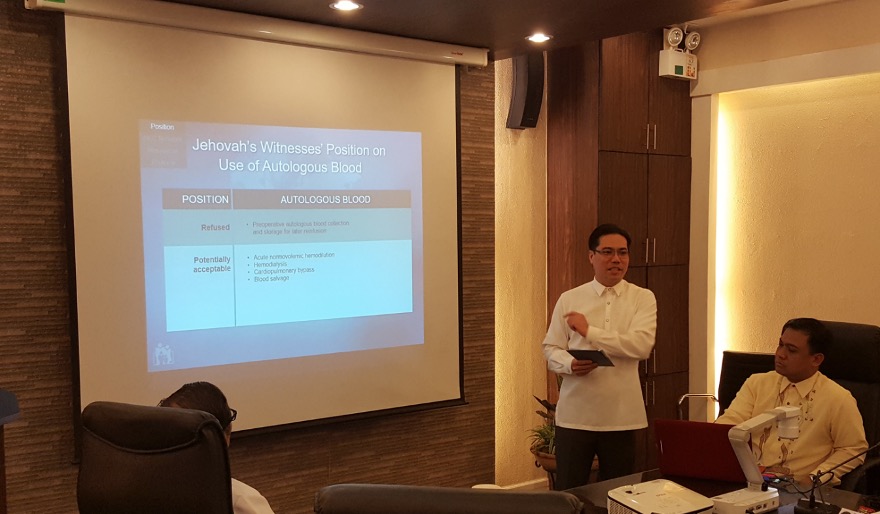
The HLCs also provide access to relevant peer-reviewed medical journals, and facilitate physician-to-physician consultations. Presentations for the medical community are being held to enhance understanding about the religious and ethical beliefs of Witnesses on medical therapy without the use of blood. The presentations also include information on advanced medical procedures based on scientifically accepted alternatives to blood.
Some non-Witness physicians and patients prefer nonblood medical care. Patients who undergo bloodless medical treatment often benefit from fewer infections and faster recovery.
“I would like to learn more about alternatives because we know that the safest transfusion is still the one not given. In our official consent form, we do acknowledge and respect the rights of every patient to receive or refuse blood transfusion,” said Dr. Reynette Christine Ligaray who attended one of the HLC presentations in Cebu City.
The HLCs are available 24 hours a day to healthcare professionals who are treating Witness patients. Medical information for clinicians about complex medical and surgical procedures performed successfully without the use of blood can be found on jw.org/en/medical-library.
For more information, please call the Office of Public Information: 3224-4405

Started in 1927, the Philippines Graphic is the longest-running printed magazine of national circulation that provides relevant news and features and promotes Philippine literature.