
[FIRST OF FOUR PARTS ]
Questions and reflections in a “writing experiment” dealing with language, time, memory, birth, mortality and other human concerns.
Only a writing experiment. Choose at random a future date—don’t even think, Does it fall on a Tuesday?—and resolve to pay close attention, noting whatever small incidents occur or even ordinary things that seem to modulate the day’s hum and drum, but throughout it should just be a kind of calm receptivity without anxiety for words to shape its form; and then, on that night and the days following, in simple words and without fear of unpleasant revelations, to lay the day’s strands like rope to its flickering memory.
What meaning, as far or as deep as words reach, would a day in one’s life bear? As soon as I asked myself, numerous problems arose but I think, most hypothetical, so that they made the trial necessary. The question rose, Would I still be the same person that day, my usual compliant, distracted or uncomprehending self, since the effort at consciousness is fully deliberate and perhaps unnatural? I also asked myself, Must there necessarily be a meaning to be found, and would that meaning have been part of that day, in fact, its whole tenor—or simply an illusion, part of any man’s (or woman’s) secret striving for significance?
No, I was not going to be paralyzed by those abstract reservations. Part of the experiment’s interest lay precisely in that, other than the habitual or routinary (which may be difficult to see), one cannot tell beforehand what will happen; in fact, most wouldn’t really be incidents that naturally form their own meaning, but simple things in the day’s hub and bubble that, because one had determined to be more receptive, call one’s attention to them. Perhaps a face in the crowd stings memory with a strange regret over a past relation; or the taste of atis like summer on the tongue, unravels a buried dream in childhood. Memories could throng any moment on a sudden. Or there could be a flash of premonition from a barefoot woman offering a sick baby in her arms to the compassion of passers-by; or, as one converses with a friend, an obligation is suddenly remembered, perhaps a letter long unanswered.
But the other, more telling part of the experiment will be the writing itself. The words to hand are only the words one knows, and may not be adequate to the day’s experience; so, you struggle with your day and its possible words before their fiction overcomes the clear pattern of your fate. Well, it may not be really such a grand meaning as that; only literature, sprung from myth and creed, seems to have endowed the word “fate” or “chance” with a titanic resonance. Besides, you realize soon enough that the text itself is something porous, whether as written or when read by others, so that many other things seem to escape through it like water through a net. I suspect there is some madness in writing that is part of the meaning it seeks.
In fact, before the experiment itself, I already guessed its outcome because my mind had become curious. Certainly, I thought, any day in one’s life is essentially fragmentary. This is why any day that passes without words to retrieve its parts is forever lost. But perhaps all our words—I mean, our words in daily use—are, unconsciously items of recollection. When we speak and understand each other, we remember our days together as a family, or a circle of friends, or a people even, but are not aware that our words are recoveries of memory.
There was another thing I anticipated. The recollected pieces of any day may all without further inquiry be quite unrelated. That “further inquiry” is the crux: the need for writing. Then it may be found that, on any day, all one’s life is lived. All: that is the mystery to fathom. Any day at all, for its depth in time, is also whole. Its isolation is artificial, only an experiment, say, in consciousness. This requires detachment, as you know, a disinterested stance, but I would avoid irony which may be a form of refuge.
And so the day came, and I was ready. Pay close attention, that is all, I reminder myself again, as I awoke. Consequently, I could not collect, as I sometimes try, the dream-wraiths that swiftly dissolved in our bedroom’s morning disarray of pillows and drowsy bodies and comic bodies and Time on the floor. THere remained only a sense of something like a great swirling sky, and a cloud-woman like perhaps the goddess Kali, and something again like both a chaos and a cosmos being born…
But as I write the day tonight, what was it? It began long ago—not today, on which I write. And it cannot end, it must always be unfinished. The subject, to-day, simply expands in all directions as one writes, and its strands, unraveling from the past and moving toward some future, weave the present but cannot quite give it any definite form. Its shape or structure, which is only what writing must insist on, is one of great tantalizing tentativeness. And to-day of course shall repeat itself many more days, in many more ways… But no matter; I must not lose the experiment.
I take out my watch under my pillow. Five past six; time enough, as usual, to beat the traffic again. Clearly, it is the fiction of time that first decides my day. “C’mon, guys,” I say cheerily, “Let’s go!”
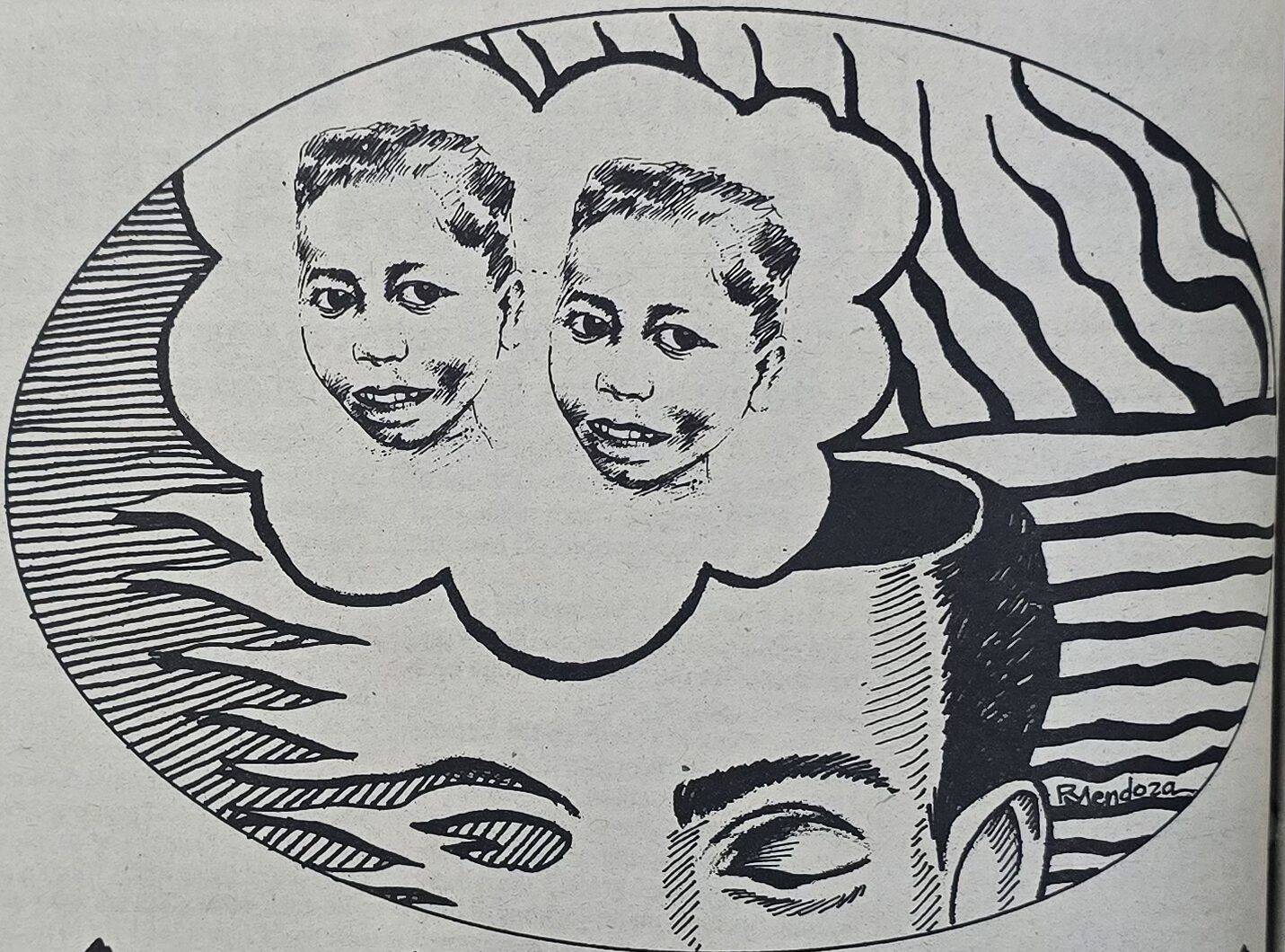
I gently shake our twin boys who sleep with me and my wife on the floor. There, such a picayune detail—how shall I begin to account for just any day at all? Even that matter of sleeping on mattresses on the floor has its little past. When our children were babies, Mercy and I eliminated in that way any anxiety about their falling off from bed. Especially the twins who in sleep pursue their joust with imaginary beings. But one consequence is that, although they’ve tried, David and Diego still can’t sleep in their own room. “Really, Mom,” says Diego one day, “I should give Pop a chance.” He may have inferred that piece of wisdom from the twins’ close friend Paulito who is going on fourteen and talks about circumcision this summer.
The twins too have their story. When they came, I mused upon my own name, often misspelled “Geronimo” or “Genuino,” but which in Latin means “twin,” and yet, there are no twins in my family nor my wife’s. My father, consulting the names of saints on the fifth of February, chose an obscure martyr in Africa; he might have served as a bush tribe’s meal there. Is it mere superstition, even in Plato, that one’s name is a form of predestination? What if I had been called Voltaire or Dagohoy, or, like a particle physicist’s child, Muon?
A day came when Mercy thought we might adopt a son. I wasn’t surprised; it wasn’t only that she missed her babies, our daughters having grown up. We had lost a son… ah, but that is another story again. Yet I thought of Tosi this morning. Mercy had remarked over breakfast, perhaps because she was leaving that afternoon for a conference in Hongkong, that we might set aside a date soon to visit his little plot in Loyola Memorial Park.
More than myself perhaps, Mercy yearned for little boys in our family. It so happened that a couple, Pong and Del, who were very close to us and had themselves already adopted a girl, knew of an obstetrician, the wife of their town’s mayor, who had taken it upon herself to look for foster parents for unwanted children. In this way, she prevented abortion which was not uncommon among families who valued honor more than life itself. At the time when Mercy spoke with Del, there lived with the doctor a girl she called Marie who was hiding from her father because she was with child. Her beauty was her undoing, for on the same night that she was crowned queen at a town fiesta, she was seduced. A nursing student at a private school in Manila, she wrote her father that she had enrolled for summer classes; she found no other way to prevent him from beating her and killing her seducers who, as it turned out, were sons of a prominent family in town. Marie’s misfortune, as Del heard it from the doctor, inspired her to tell my wife in turn, and between her and Del, it was quickly agreed that if the child should be a boy, it would be ours, if a girl, Del’s, but neither thought there may be twins!
Marie’s time came soon enough. I was in Cebu, but when I arrived home one night, Mercy met me at the door, flushed with excitement: “I have a surprise,” she said. I went up the stair with her, and when I saw diapers strung across our bedroom, I laughed for I had always thought that with our son, God played a joke—not cruel, I honestly believe, but beyond comprehension. For I sometimes imagine that the godhead is a center of deep hilarity, and Puck is merely impish when he triumphantly observes: “What fools these mortals be!” WE had a daughter, Cyan, and when Mercy was big with child again, I begged God for a son. A son He gave us alright, but took him away before half a year had passed. So I never asked Him again. He had other plans. Later, He gave us another daughter, Cybele. And now, my wife past childbearing and because I had not asked again, He obliged with more than I could have imagined.
On the night the doctor called, Mercy rushed to the doctor’s town with Sonny, our driver, despite the stormy weather and flooded streets. She took the babies home with her without meeting the mother, nor did Marie, which was not her real name, even held them in her arms (I doubt if she even knew she had twins), for the doctor thought it wiser that no relationship nor identity was established. “Mercy,” the doctor had announced over the phone, “you have your wish, but there’s a small problem.” At that, my wife shivered and thought how it was with our son. But “a small problem?”—perhaps a missing finger, or blind, or a harelip? She couldn’t speak. “Mercy?” the doctor’s voice came on again. “It’s a normal child, but—they’re twins.” I laughed again when Mercy recounted it. “Why, they’re ours,” I said, “we can’t separate twins.” Then Mercy asked me for their names. -G
(to be continued next week)
Written by Gemino H. Abad. August 7, 1995. Philippine Graphic.
Graphic Archive
The Graphic Archive contains the articles and literature published in the Philippines Graphic since it was first established in 1927.