

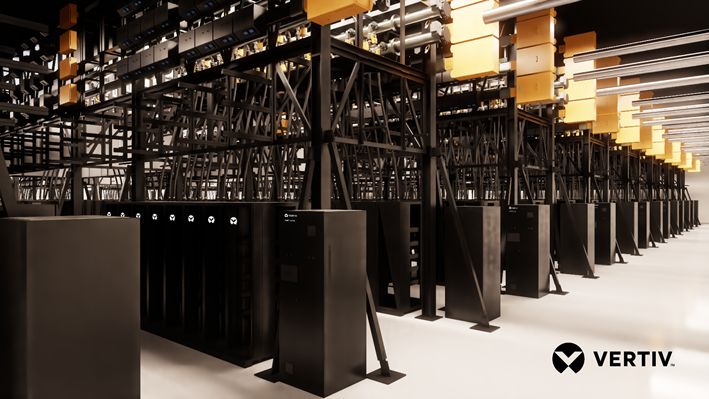
Model-based digital twin capability of Vertiv™ SmartRun helps accelerate AI factory design, simulation and deployment workflows
via GRAPHIC PLUS — Vertiv, a global leader in critical digital infrastructure, today announced progress on a production-grade digital twin capability for Vertiv™ SmartRun integrated in theNVIDIA Omniverse DSX Blueprint, advancing the company’s roadmap to make AI factory infrastructure more configurable, repeatable, and simulation-ready.
As AI deployments scale to higher densities and larger capacities, data centers need a faster, more reliable way to turn each generation of computing into real-world infrastructure. Traditional, document-based processes and siloed handoffs across power, cooling, controls, and deployment teams can’t keep pace. Vertiv SmartRun digital twin shifts planning to a model-based approach, allowing infrastructure to be designed, simulated, and validated as a single system before build-out. By capturing system configurations and dependencies in a virtual environment, it helps reduce late-stage design changes and integration risk, improve confidence through simulation, and accelerate time from planning to operational readiness—while improving coordination across teams.
“AI infrastructure can no longer be planned one compute generation at a time,” said Scott Armul, chief product and technology officer at Vertiv. “To deliver more tokens per second per megawatt, customers need power, cooling, controls, and deployment workflows to be designed as one interdependent system. The Vertiv SmartRun digital twin helps encode Vertiv’s infrastructure expertise into configurable, simulation-ready building blocks that support faster, more confident AI factory planning. As we extend this approach to Vertiv™ OneCore Rubin DSX, Vertiv is helping customers translate future compute requirements into deployable physical infrastructure before those requirements reach full deployment scale.”
The Vertiv SmartRun digital twin is the first phase in Vertiv’s multi-phase AI factory digital twin roadmap. Digital twins are designed to help close the gap between accelerated compute innovation and physical infrastructure readiness, preserving engineering intent from early configuration and simulation through deployment, commissioning, lifecycle assurance, and future optimization.
“AI factories require full-stack co-design across compute and physical infrastructure,” said Vladimir Troy, vice president of AI Infrastructure at NVIDIA. “NVIDIA Omniverse DSX Blueprint helps the ecosystem build, simulate, and optimize gigawatt-scale AI factory digital twins using OpenUSD, SimReady assets, and power, thermal, and operational simulations. Bringing Vertiv SmartRun into this workflow can help customers evaluate infrastructure choices earlier and prepare for multiple generations of accelerated computing.”
At Computex Taipei 2026, Vertiv will demonstrate Vertiv™ SmartRun as both a physical infrastructure system and a configurable digital twin, allowing attendees to explore configuration scenarios and see how model-based design choices can support downstream infrastructure planning, coordination, and simulation workflows. Created using Dassault Systèmes model-based systems engineering capabilities on the 3DEXPERIENCE platform and connected to NVIDIA Omniverse DSX workflows, the demonstrator establishes a shared digital foundation for configuration, simulation, validation, and future optimization across the AI factory infrastructure lifecycle.
“Digital twins allow complex infrastructure systems to be represented with the intelligence of their configuration rules, dependencies, and engineering intent,” said Stéphane Sireau, vice president of high tech industry at Dassault Systèmes.“At Computex, Vertiv, Dassault and NVIDIA demonstrate how Vertiv’s AI factory infrastructure is moving from document-based design workflows toward an industrialized, model-based systems engineering approach optimized for speed, quality, and system-level performance.”

Started in 1927, the Philippines Graphic is the longest-running printed magazine of national circulation that provides relevant news and features and promotes Philippine literature.