

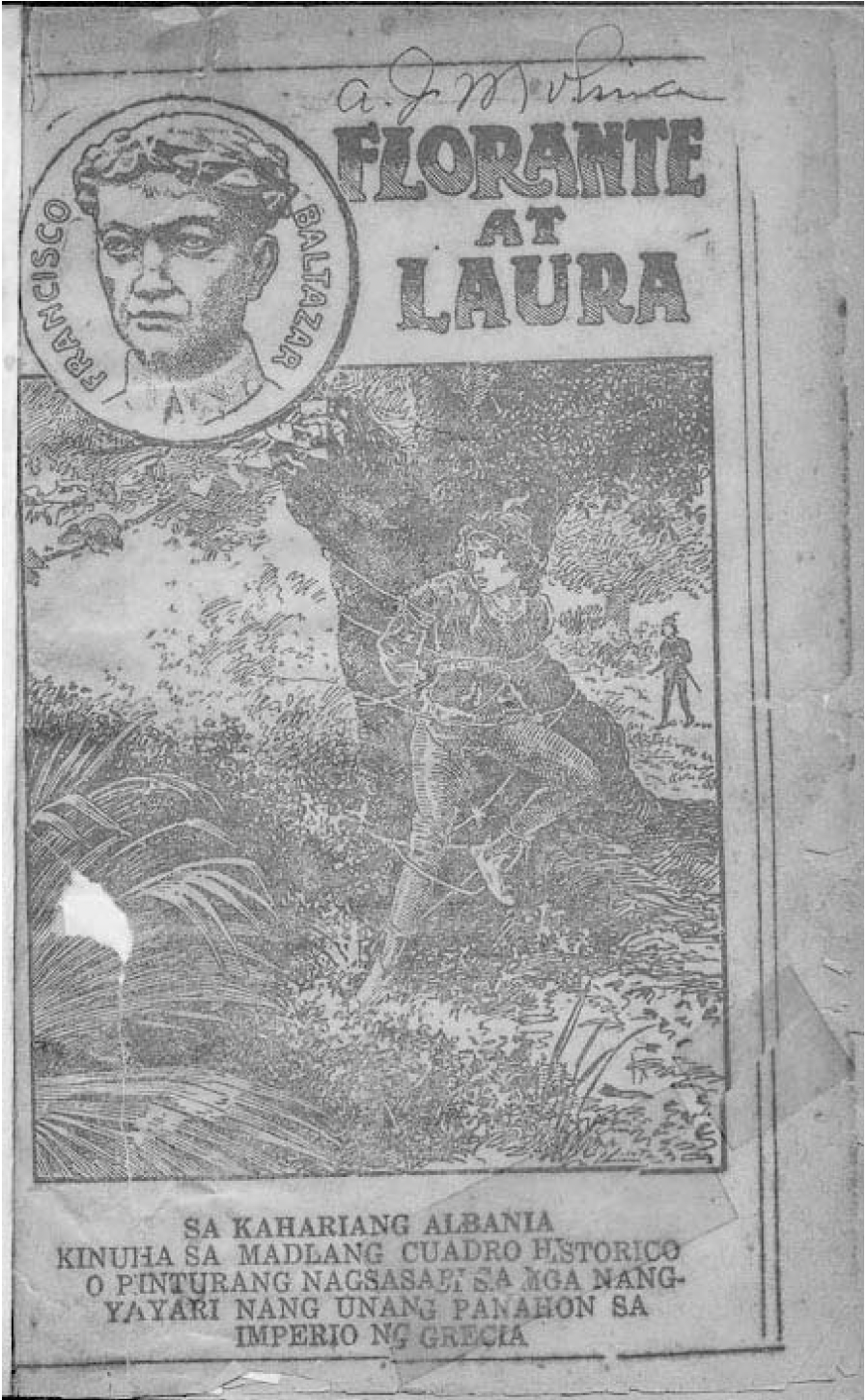
When I gave a lecture on Francisco Balagtas’ (1788–1862) Florante at Laura to graduate students in literature at the University of the Philippines, I opened by asking them to recall its full title.
Only a few could summon its opening lines; fewer still remembered the phrase that directs how the work is meant to be seen: “Pinagdaanang Buhay ni Florante at ni Laura sa Cahariang Albania, quinuha sa cuadro histórico o pinturang nagsasabi sa mga nangyari nang unang panahón sa Imperio nang Grecia.”
The poem has long been studied in literary history, memorized and mined for allegories of colonial oppression. Balagtas’s reference to cuadro histórico, or historical painting, signals that the work is conceived as an ekphrasis: a versification of visual representation.
I followed this painterly ambition further: What kind of historical image-world made such a poem possible?
BORROWED ANTIQUITY
Balagtas wrote Florante at Laura around 1834 when Manila underwent a major economic shift as the Spanish crown opened its port to unrestricted foreign commerce. The influx of capital and cultural influences exposed the city’s limited access to a sanctioned precolonial historical imagination, since its past was largely framed through Christian conversion and imperial administration.
Faced with this constraint, Balagtas turned elsewhere. The kingdoms of Albania, Epirus, and Persia function in the poem as distant terrains capable of bearing political thought without naming the colony directly. It allowed him to speak obliquely about tyranny and justice within the limits of colonial censorship.
From the title’s reference to “mga nangyari nang unang panahón sa Imperio nang Grecia [events in the Ancient Greek Empire],” it is clear that Balagtas was less concerned with empirical accuracy than with drawing from antiquity as a visual and moral archive. As Andreas Zanker argues in José Rizal, the Philippines, and Greco-Roman Antiquity (2026), this turn to antiquity would later echo among the ilustrados, for whom classical education offered a way to situate the Philippines within a broader historical continuum not wholly determined by Spanish conquest.
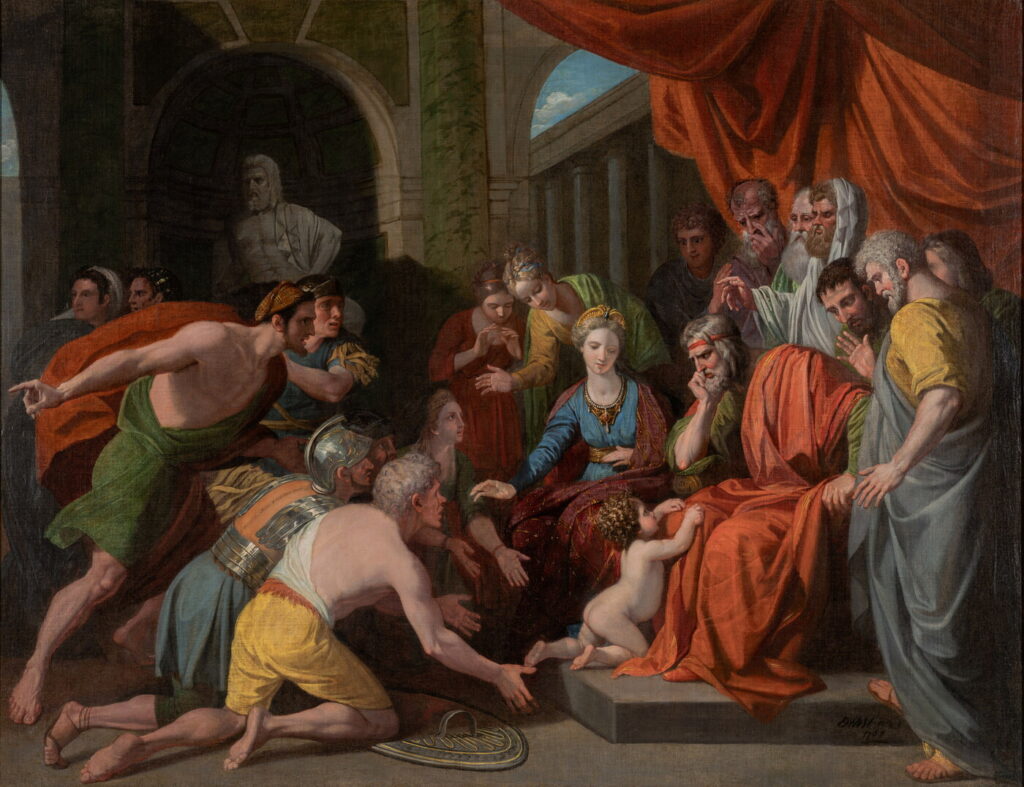
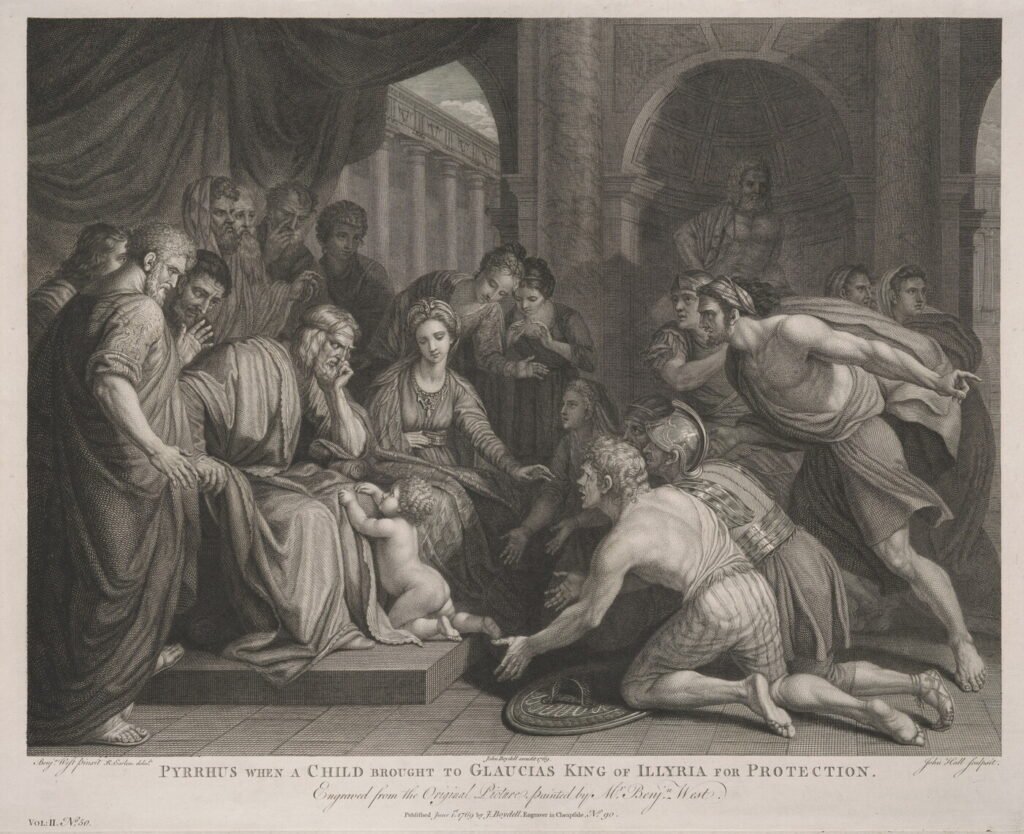
American-born painter Benjamin West’s Pyrrhus when a Child Brought to Glaucias, King of Illyria, for Protection widely circulated through engravings by Richard Earlom (1769), offers a close parallel to Balagtas’s account of Florante’s childhood.
Both figures begin in Epirus as endangered children whose survival depends on intervention: Pyrrhus entrusted to Glaucias, Florante saved by Menalipo and later Menandro. The correspondence extends to description. Pyrrhus, from Greek pyr (fire), evokes a flame-coloured appearance, often linked to light hair, while Florante is described as smooth-skinned, golden-haired, and perfectly proportioned. West presents Pyrrhus as a luminous child at the centre of a royal court.
While the circulation of European and American prints in the 1830s makes this plausible, there is no firm evidence that engravings after West reached Manila. The connection therefore remains my informed speculation.
VISUAL REGIME
The visual motifs of anachronism (out of time) and anatopism (out of place) sharpen when read alongside a contemporary image that illuminates Balagtas’s milieu.
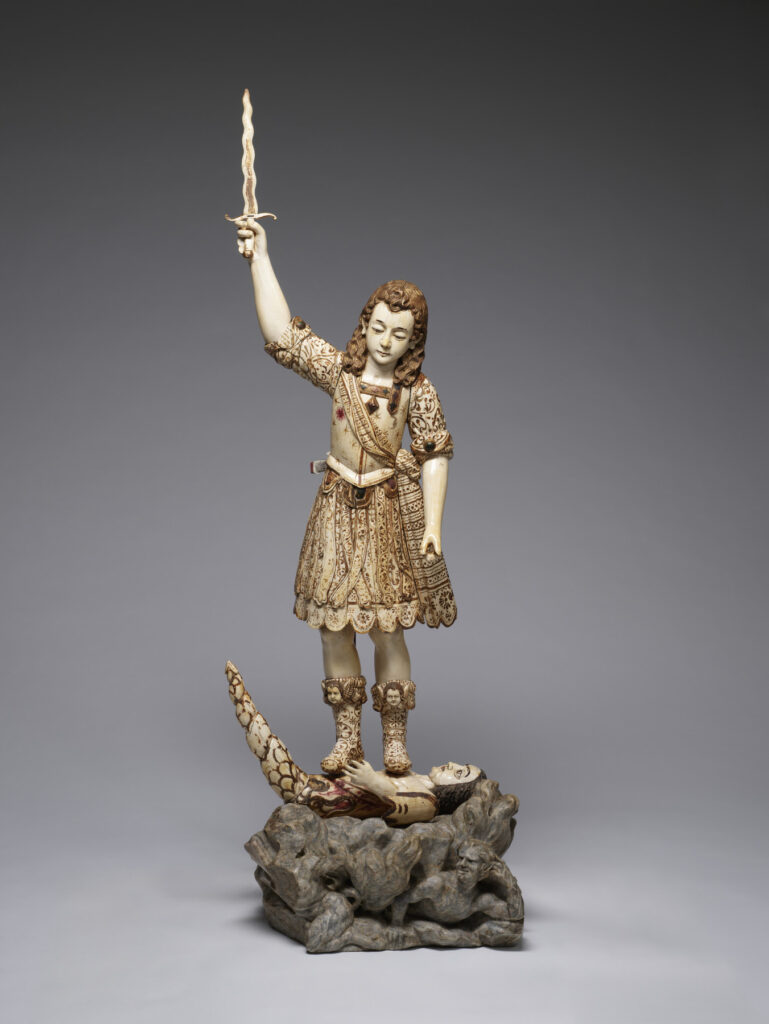
In Stanza 22 of Florante at Laura, this logic condenses in the kalis (or kris): a traditional double-edged sword, where power depends on forces beyond the human hand. Florante calls on a higher authority to set the blade in motion against the wicked:
Your powerful hand, set into motion,
will make the blade of wrath flash;
Into the Kingdom of Albania, of its own force, cast down
Your vengeance upon the wicked.
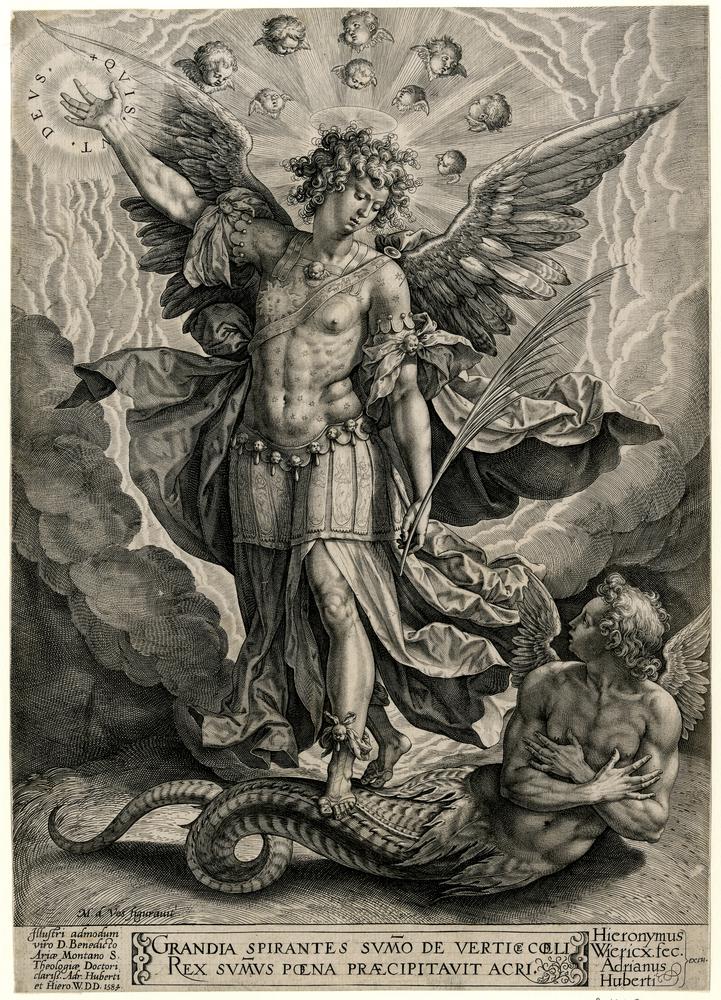
The sword acts only when authorized from above. This recalls early modern images of San Miguel Arcángel, especially the 1584 engraving by Flemish engraver Hieronymus Wierix after painter Maerten de Vos, which, as art historian Stephanie Porras shows in her award-winning book on early modern prints (2023), circulated as a “viral” image across devotional networks.
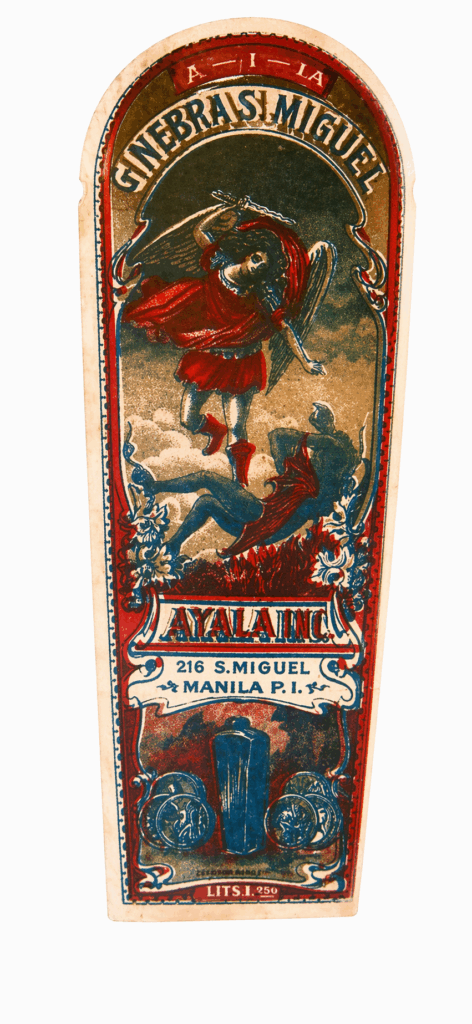
Later depictions arm San Miguel with a wavy-edged kalis in paintings and ivory icons, eventually forming the famous “marca demonio” emblem of Ginebra San Miguel which was founded 1834—the same year Balagtas began writing Florante at Laura.
In these images, the raised sword signifies force exercised under divine command—the core of the poem’s sense of justice.
‘CUADRO HISTORICO’ AND ORIENTALISM
From comparing the verses with contemporary visual material, it becomes clear that while Florante at Laura builds its notion of power through the material world of antiquity, it does not draw directly from Greek or Mediterranean history. It emerges instead from a stock set of scenes shaped by colonial picture-making.
Since Balagtas is not known to have travelled abroad, the settings of Albania and Persia are assembled from fragments into a staged “Orient,” where courts and forests follow a familiar script, treating Greek and Moorish worlds as spectacle and moral testing ground.
The poem works like a neoclassical history painting: clearly composed and morally legible without requiring accuracy. This aligns with what Palestinian literary critic Edward Said later described as Orientalism.
The “Orient” here is not a real place, but a constructed field where difference is made visible through costume, titles, gestures, and setting. Within it, the Moro appears as a type, shaped by a long tradition in which Muslim figures are cast as enemies or, at times, noble exceptions.
These expectations would have been familiar to Balagtas’s audience. As Bienvenido Lumbera and Doreen Fernandez have shown, Florante at Laura belongs to the awit: a metrical romance tied to performative forms such as the comedia and moro-moro. These traditions staged recurring conflicts between Christians and Muslims, training audiences to recognize a fixed moral polarity in which the Moro functions as a conventional antagonist.
Within this generic environment, romance poetry remained acceptable to ecclesiastical authorities precisely because it reproduced an established theatrical convention.
ALADIN
Aladin, a Persian prince who overcomes religious prejudice to become Florante’s rescuer and ally, appears as a disturbance to this convention. He does not conform to the expected role of the Moro as antagonist, instead occupying a position that unsettles the very logic that organizes both the poem’s world and the world that produced it.
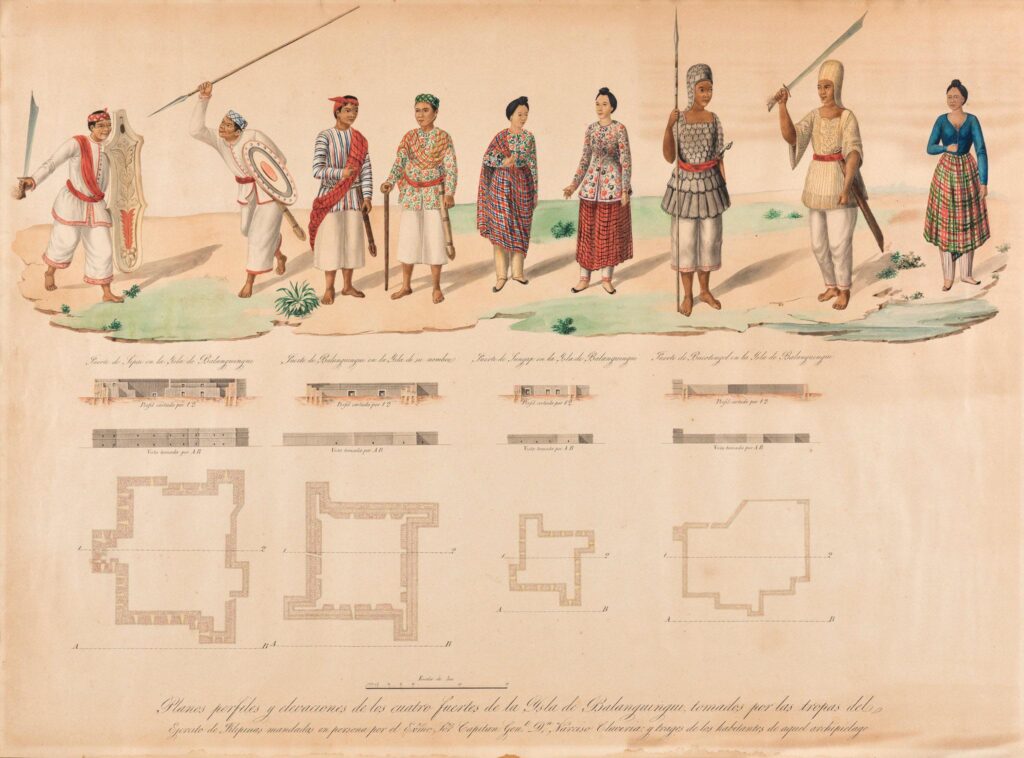
There is no definitive historical painting that can be identified as the source for Balagtas’s Persian characters, but if the Muslims in distant Albania are read as standing in for those in the Philippine south, the closest visual parallel appears in the work of his contemporary: the painter José Honorato Lozano.
Lozano’s Balanguingui paintings (1848), commissioned under Governor-General Narciso Clavería, depict the Spanish campaign against Muslim communities in Sulu about a decade after Florante at Laura was written. Exhibited in Manila, they combine tipos del país of Muslim warriors, datus, and women of rank with drawn plans of captured fortifications. The warriors carry kampilan (single-edged sword) and shields, with one shown in chain-mail, while elite figures are marked by silks, weapons, and staffs of authority—among the earliest detailed images of Muslim subjects in Philippine art, distinct from Lozano’s usual Manila-centred scenes.
The works show how the Moro conflict was visualized in the colony, raising the question of whether Balagtas similarly displaced early 19th-century events in Sulu into a distant setting.
For historian Teodoro Agoncillo, this is not incidental. Aladin is the poem’s moral pivot: the Muslim prince, not the Christian Florante, and performs the decisive act of mercy by rescuing the son of his enemy. In a narrative structured by conflict, he interrupts violence rather than fulfills it, becoming a figure akin to the kalis held in suspension, and released only under moral judgment invoked earlier by Florante. This places Aladin close to the “exceptional” figure within Orientalist representation—a noble Muslim granted interiority and moral force.
EVOLVING INTERPRETATIONS
This shift shaped later readings of Florante at Laura. Twentieth-century audiences began to see, unevenly, the Moro not as an enemy, but as a figure who restores and saves, linking him to a precolonial Filipino past.
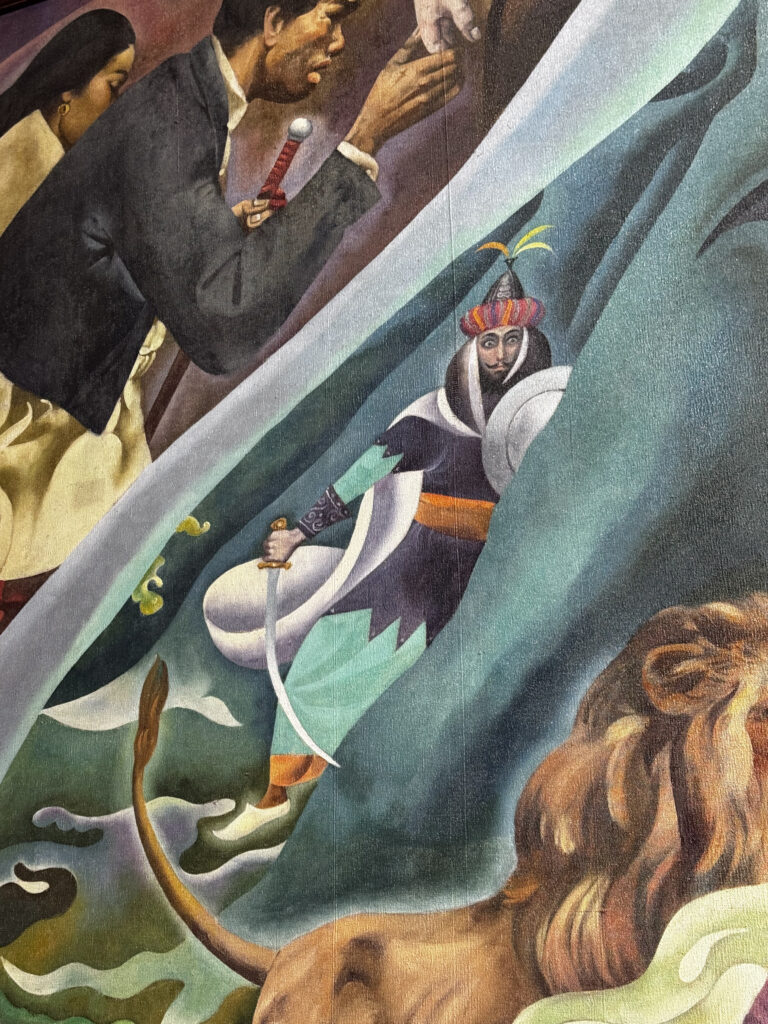
In 1968, when Carlos ‘Botong’ Francisco was working on his epic mural Filipino Struggles Through History (now in the National Museum), he depicted Aladin using a visual vocabulary drawn from Persian illustrated manuscripts. In light of the ongoing oil crisis triggered by Iran’s closure of the Strait of Hormuz and the threat to nearly a fifth of global oil supply, this return to Balagtas’s treatment of Islamic figures invites renewed attention to how such characters helped shape the national narrative.
Botong’s reimagining shows how the epic poem’s distant setting remains legible and rife with metaphors. Nearly 200 years later, this sense of historical displacement continues to resonate in a world where thousands of overseas Filipinos face the dangers of conflict in the Near East.
Balagtas probably did not expect his writing to be prophetic: that our Filipino exiled breadwinners would come to inhabit places he first imagined through the lens of cuadros históricos.
Geronimo Cristóbal
Geronimo Cristóbal is a lecturer in Art History at Ateneo de Manila University, and a PhD candidate in the History of Art and Archaeology at Cornell University. He serves as an international correspondent for the Philippines Graphic. He can be reached at gc448@cornell.edu.