
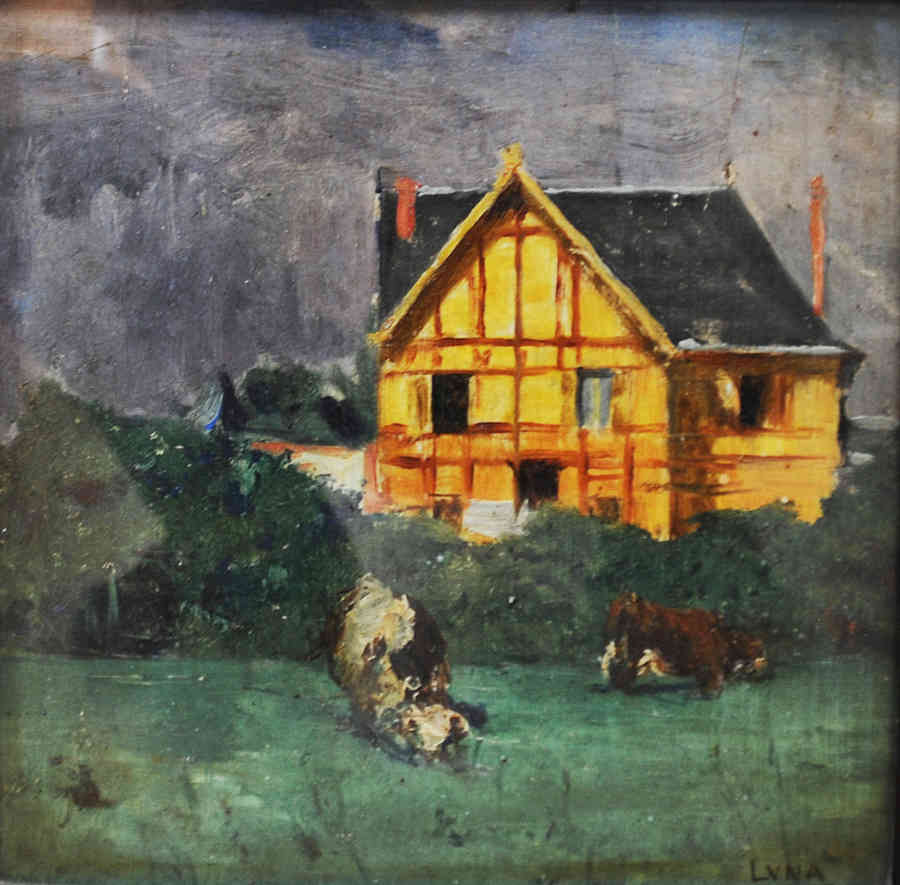
Before the third episode of the Philippines Graphic Literary Workshop (PGLW) concluded on April 18, we knew that we had one more thing that we can offer our bright young fellows: a starting platform for their creative endeavors. Here, we present one of their final outputs from the workshop. We also asked them to provide an artwork that they think best represents their stories. Read on.
In those distant mountains, insects still sang the same song they’ve sung how many centuries over, echoing its screeching noise through forests that had seen much lusher days. Through the fields, farmers still harvested their landlord’s yield under the beating rays of the sun. Just outside, people came and went in the usual rabble of a summer day. In the middle of it all, the house still stood as it stood for years, unchanging, an artifact among its neighbors built upon wood on the verge of rotting and stones that barely hung on, surrounded by a garden that no longer carried any flowers.
Don Yoyong’s face peered through the capiz shell windows. Before, when children would peek outside that gate, they would wave and chuckle and shout Don Yoyong! Don Yoyong! and he would wave and smile in return. Not many children care do that anymore. He wondered if they would even recognize his face. People’s eyes didn’t look up at his windowsill much at all–they only looked straight and moved towards what was in front of them.
“Sit still, mi amor,” Doña Luisita said as she brushed a layer of black dye on his head.
He couldn’t help but jitter as the brush tickled his thinning scalp.
“Bear with me,” Don Yoyong said, “it is too sharp for my skin.”
“You asked for this,” the Doña said. She returned the brush to the can of dye sitting on the mirror, by the window, and started to prepare another round.
His eyes glanced to the mirror. She had only finished the right side of his hair–too much to take it back. But, even incomplete, Don Yoyong already started to see a glimmer of his youth. The black splotch on his head showcased a vigor he hadn’t had since his first term. But It didn’t fit. The illusion was shattered by the thinness of the hair on his left side and the wrinkles that littered the loose skin on his face.
Around his eyes, he only saw two gaping places of flesh hanging barely to his skull.
It only sounded embarrassing now, to ask his wife to dye his hair back. Maybe he always knew it was going to be embarrassing. When he asked Doña Luisita, he was sheepish, his voice barely left his cheeks.
“Dear,” she sighed. “What will the press say? You don’t want them to bash you again, do you?”
“Mi amor, I only ask you of so much,” he said in something akin to a whisper.
Once, when his flesh was still plump, and the wood panels of the room weren’t so rotten, he would sit in that garden out the window, then flush with flowers, alongside Don Pepe and Don Claro in great debate and discussion. That garden had seen many of the party’s darkest days and much of its brightest. He remembered vividly the days of the Pros and the Antis, or those insufficient coups led by those Young Turks, or those horrid hours of his own scuffle with Garcia. Of those memories, he held one most fondly. To let Monching in the party, that was the question then. It was a tumultuous time for them Nacionalistas. Quirino had beaten them how many times over. Don Pepe was at many times on the verge of declaring a revolutionary government. It was much of the public’s, and their own party’s, opinion that the only hope lay in Monching’s, the Guy’s, conversion to the NP.
Don Claro, in his quick wit, spoke for the young man and sang his praises of the then-secretary. Don Pepe was unconvinced, still with his own ambitions intact. Our President should be a Nacionalista, Don Pepe Exclaimed. Then let him be one, Don Claro retorted in an instant. The debate was long, fervid, and stuck at a standstill. Yoyong, what do you think? both turned to him. They were, by no means young then, but at that gazebo table, they were filled with a feeling reserved for fresh graduates. Change. It is very rare that old men let new things happen, very rare indeed. Don Yoyong softly agreed with Don Claro and sealed fate. Monching was in. A few months later, he secured the win, beating Quirino and his Liberals, for a time.
Then he died. Terms came and went. Don Pepe would die next, and Don Claro soon after. They were all loose skin and bones in their caskets. The game has changed very little since their time. New faces entered the ring, old faces phased themselves out until they all blended into one. Don Yoyong remained. Of those old men he found himself come up with, only he lived on. Only his skin continued to cling, albeit loosely, on his bones. But for how much longer?
It had been so long since that rabid pang of change rattled his bod. He wondered if anyone remembered that time. He wondered if it mattered at all.
“What’s wrong?” Doña Luisita asked.
“Am I too old?”
Dona Luisita laughed. “Too old to worry about that, Cariño.” She continued brushing the last coats of the dye.
Too old to worry about that, he repeated to himself. He had been old most of his life. For how much more would he be old? For what purpose did it serve? Who knows. All these years of wasting away, and he didn’t know either.
For a moment, his hair clumped together in the black substance gave the appearance of fullness. Then Doña Luisita brought his head down to the sink and washed the excess dye. As he watched the rest of the black flow down the drain, Don Yoyong looked at himself. His hair loosened and started to unravel, revealing some small spots of balding littered across his scalp.
Outside, the insects continued to sing throughout the mountains. Farmers still tended to their fields. The city moved and rushed along like jittery clockwork. Flowers wilted along. The sun beat on. Somewhere in the distance, a tree was chopped down. That house continued to rot. And the world moved on.
Written by Deniel Basilio
Started in 1927, the Philippines Graphic is the longest-running printed magazine of national circulation that provides relevant news and features and promotes Philippine literature.