

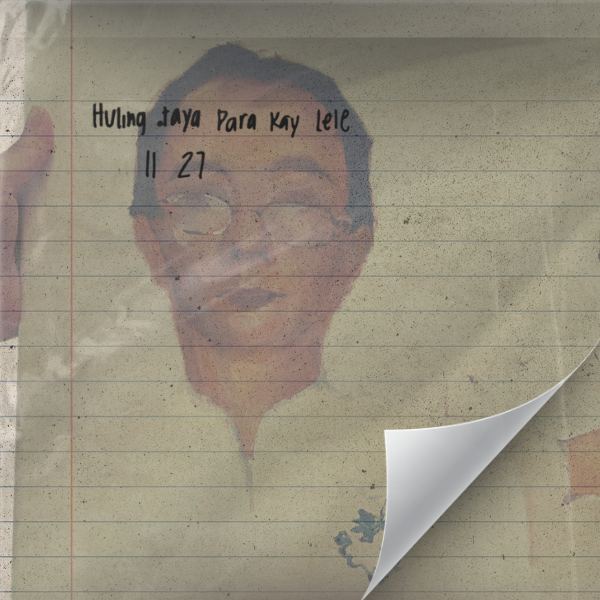
Before the third episode of the Philippines Graphic Literary Workshop (PGLW) concluded on April 18, we knew that we had one more thing that we can offer our bright young fellows: a starting platform for their creative endeavors. Here, we present one of their final outputs from the workshop. We also asked them to provide an artwork that they think best represents their stories. Read on.
Prologue
Here is what I want you to know before I tell you any of this:
The yellow house is still standing. The trees are still there. The cicadas still do what cicadas do… that thin, enormous sound that fills a whole afternoon without asking permission. These things have not changed, and I think it matters that you know this going in, because everything else has, and grief has a way of making you feel like the world changed its whole face when really it only changed one room.
My lolo’s name is Carding. Everyone calls him Toti. He was a kubrador for twenty-three years — a numbers runner, a collector of small hopes and before that he was a young man who painted a house yellow because his wife told him to, and before that he was a boy in this same barangay who once saw something at the edge of a field at dusk and ran home and never entirely stopped looking over his shoulder. He is a man made of attention. He noticed everything… the birds, the rain, even the way a child’s shout could carry a number inside it without the child knowing. He built his whole life on the belief that the world was legible, that if you watched closely enough it would tell you what it meant.
I am telling you this now because later, when his mind begins to scatter — when the lastillas lose their order and the combinations wander the page without partners…I want you to understand what is being lost. Not just a man. A whole way of reading the world.
I went home because I ran out of reasons not to. I want to be honest about that. I did not go home out of some clean, uncomplicated love. I went home guilty and tired…and full of the particular shame of someone who has been absent in ways that cannot be fully repaired. I had been in Manila four years. I had called. I had told myself calling was enough.
It was not enough.
What follows is the day I came back. His version and mine, running alongside each other the way two people can share the same house and the same hour and still be living in entirely different worlds. We never say to each other what I am about to tell you. That is the nature of the thing. Some distances are made entirely of silence. It is merely the failure of language in the presence of too much feeling.
But I am telling you now. So you can hold both of us at once, which is something neither of us could do for the other on that day.
Remember: the house is still yellow. The trees are still there.
Start there.
* * *
I. Morning
LOLO TOTI
I have always been a man who pays attention.
To the birds on the wire. To the way rain begins, which is never the same twice. To the lastillas — those thin slips of paper, smooth on one side and slightly rough on the other, and you have to write on the smooth side or the pencil will not hold. Such a thin thing to carry so much hope on. The bettor’s name. The combination. The amount. Two pesos. Five pesos. The dreams of the barangay, rendered in pencil, organized in the flat tin that used to hold Carmen’s sewing needles.
I was a kubrador for twenty-three years. People trusted me with their numbers, which is to say their hope, which is the most embarrassing and necessary part of themselves. I never lost a lastilla. I never lost a collection.
I have been trying to remember where I put the tin.
It was here. I am certain it was here.
—
LELE
The first thing she remembers about the yellow house is the shade.
Not the house itself… though the color was impossible to ignore, that yellow, the one Lola Carmen chose, which was brighter once, more like a shout. What Lele remembers first is the way the trees had taken over. How the porch always felt underwater, cool and green and slightly removed from the rest of the world. You could sit there in the hottest part of the dry season and feel nothing but shade on your skin.
And the radio. Her lolo kept a transistor on the window ledge — battery-operated, because the extension cord wasn’t long enough and he was not going to run a new one. Practical man. In the mornings it was Pilita Corrales. Later, Basil Valdez. The guitar lines drifting out of the tinny speaker at exactly the hour the light came low through the trees and turned everything briefly gold. Music and light arriving together, every morning.
She thought about the watering can on the six-hour bus ride home. The old green one, the spout repaired twice with wire. The way her lolo tilted it so the water came out gentle enough not to bruise the petals. He had taught her that. You tilt it so the water comes out gentle. You pay attention to what you’re watering.
She had not been paying attention. This was the thing she could not stop knowing, the whole ride home.
* * *
II. Arrival
LOLO TOTI
Someone is coming up the path.
A young woman. Walking the way people walk when they are trying not to show they are tired — her gait …. She’s straight-backed and deliberate, but eyes…her eyes are ones of complete timidness. I know what to look for.
She stops at the gate and looks at the garden. I watch her look and feel something I cannot name. It was tight and wide at the same time. The bougainvilleas came down for the gazebo. I watched the vines curl at the ends like sleeping hands and did not say it was a loss. The gumamelas need trimming. The weeds among the yellow bells have gotten ahead of me. I have been meaning —
She crosses the yard. Comes up the porch steps. Crouches beside my chair and takes my hands in both of hers and looks at me with a face I am —
I am —
There is a name for this face. I have held this face. I have known it since before it was fully formed, since it was new and bewildered on this same porch in the shade of trees I planted myself.
Lele. And then, with more certainty: Lele.
“I’m here, Lolo,” she says.
Yes. She is here.
“The bougainvilleas,” I tell her. “I have to water them.”
She holds my hands and lets the cicadas fill what is between us.
“I know,” she says. “We’ll do it later.”
—
LELE
For one second, she watched him search her face.
She knew this look — had been rehearsing it on the bus, telling herself she was prepared. She was not prepared. You are never prepared for the moment someone you love looks at you from very far away and you understand that the distance is inside them.
Then something settled behind his eyes. “Lele,” he said.
She crossed the porch and took his hands — the hands that had held pencil stubs down to their last inch, turned pages of lastillas, pointed at birds on wires. His hands were the same. Warm and dry and also slightly rough at the fingertips from decades of handling paper.
She had not held his hands in eight months. She had told herself each of those months that she would come back sooner. She had been lying, which she understood now with the particular clarity that only arrives too late to be useful.
“The bougainvilleas,” he said, looking past her at the empty fence. “I have to water them.”
She did not correct him. After all, what would she correct him toward — the bare frame of the gazebo, the garden gone untended because she had not been here and he could no longer manage it alone? She held his hands instead.
“I know,” she said. “We’ll do it later.”
Outside the city she could finally hear the cicadas again. She had stopped noticing them before she left. She had not noticed their absence until she was back inside them. She was learning, slowly, thatshe was very good at not noticing things until she had no choice.
* * *
III. Night
LOLO TOTI
In the night, I wake and I know exactly where I am going.
Mang Rudy. Before six. Tres-singko, every week, faithful as a saint. Fourteen stops and I know every one — the gate that sticks, the dog that barks, the manang with the coffee I will always politely refuse. I dress carefully. The polo barong, because how you present yourself is a form of respect. I find the notebook. I find my pencil.
Then there is a hand on my arm.
A young woman. Barefoot. I do not —
I do not know this face.
“Sino ka?” My voice comes out careful. I am conducting business and this woman has grabbed my arm in the dark and I do not —
“Ako si Lele,” she says. “Apo mo.”
I look at her the way I look at a lastilla when the name is familiar but I cannot find the house, cannot find the route back to the thing I know I know.
Lele. The shape of it. The weight of it, arriving slower than it should.
She is cold. Barefoot on the cold ground. I look at her feet instead of her face.
“You should wear slippers,” I tell her. “The ground at night —”
She says we will do the collections in the morning. Early. Before Mang Rudy goes to the other kubrador. I look down the path. Fourteen stops. I know every one.
But she is cold. And there is something in the way she holds my arm. No, she’s not pulling… nor is she forcing. The way her fingers slip right through my skin reminds me of something I cannot name. A warmth I have known. Perhaps a hand that knew where to find mine without looking.
“In the morning,” I say. I let her bring me back.
—
LELE
She woke to the sound of the gate.
A careful click of someone trying not to be heard. She was out of bed before she was fully awake.
He was already past the gate, dressed in the polo barong — the one for transactions, for presenting himself as a man conducting legitimate business. He had his notebook. His pencil. His back straighter than it had been all day, steps carrying the confidence of a man who knows exactly where he is going.
She went after him barefoot and when he turned she saw his face in the moonlight and that was the first gut-punch: he was not confused. He looked completely, terrifyingly lucid. Sharp and impatient. The eyes of a man with a schedule.
“Nandito ka pa.” Not unkindly — with the mild surprise of someone who expected you to have left. “Go back inside. I have collections this morning.”
She watched him explain Mang Rudy, the fourteen stops, his perfect record. Watched his jaw tighten with the dignity of a capable man who believes he is being underestimated. And felt something tear open in her — no, not grief exactly. Something more physical. Something that lived in the stomach and had no name in any language she knew.
Then she put her hand on his arm and he looked at her as she watched him not know her.
She was a stranger to him — merely a young woman who had grabbed his arm in the dark — and she watched confusion become alarm, his grip tightening on the notebook.
“Sino ka?”
“Ako si Lele. Apo mo.”
She watched him try. His eyes moving over her face the way you search a room for something you are certain you left there. Nobody tells you that the worst part is not the not-knowing. The worst part is the trying. Watching someone work that hard to find you and almost making it — the almost, over and over, worse than simply being lost.
“Si Lele,” he said slowly.
“Oo, Lolo.”
He looked at her feet. “You should wear slippers. The ground at night —”
She almost broke. Almost.
She walked him back through the gate with Mang Rudy as the reason — met him inside the logic that still held, the route, the tres-singko — and sat on the porch step at his feet when he was settled and did not go back inside.
She could not be alone right now with what she had just seen on his face. The blankness where she was supposed to be. The absence of her in the eyes of the person who had first taught her she was worth knowing.
She sat on the cold step and did not cry, because crying felt too small for this, and also because if she started she was not fairly certain she could stop before morning.
* * *
IV. The Notebook
LOLO TOTI
I am in the chair. The notebook is in my lap. The girl — Lele, my Lele — is sitting on the step at my feet and she is not going back inside.
She is keeping watch. This is what you do for people. I have done it myself, for Carmen in the last months, sitting by the bed through the long nights willing the breathing to continue by force of attention alone. It did not work, in the end. But nothing given in love is wasted. I believe this.
The numbers are getting harder to hold. I know this the way I know the fan blades needed cleaning the day Carmen died — as a fact that lives in me terribly. The combinations lose their partners. I sit with the notebook open and write down what comes: Tres. Nuwebe. Dos. Kuwatro. Numbers without homes, wandering the page like people who have forgotten which gate is theirs.
But I remember 11. 27.
I wrote it near the back, between two blank pages, in my best hand — on a clear morning, when the counting was still in me. I thought: she will find this. She will look in the back the way she always looked, because she was always trying to understand the system.
Huling taya para kay Lele. Last bet for Lele.
A kubrador bets on what he believes in.
“I never lost a collection,” I say, because I want her to know. The cicadas are loud tonight. I notice them now the way I noticed them when I first came to this house, before they became part of the air. I pay attention to them. I pay attention to everything I can, for as long as I can, because paying attention is the first thing you should know about me and I am not ready for it to be the last.
—
LELE
She didn’t mean to open it.
The notebook slipped from his hands past midnight and she reached over only to keep it from the floor. She would set it on the table. That was all.
But it fell open.
Most of the pages were what she expected — columns in his careful small handwriting, names in the margins, amounts, dates. Decades of collections, the whole barangay rendered in combinations and pesos. Tres-dose. Kuwatro-nuwebe. Singko-otso. The language he had spoken longer than she had been alive.
Toward the back, the handwriting changed. Grew looser. Columns dissolved into scattered figures, numbers without partners, names half-written and abandoned. She recognized these pages from the afternoon — the ones that had told her, without a single word of how far things had gone.
Then, near the very last written page, tucked between two blank ones:
Huling taya para kay Lele.
11. 27.
Her birthday. November twenty-seventh, two digits struck right across her.
The handwriting was steadier in this page. It was deliberate, the numbers written with the care of a man who wanted to get something exactly right. She did not know when he had written it. She chose to believe it was a clear morning. A morning when the counting was still fully in him and he had opened the notebook and placed this here on purpose. She was allowed this much.
A kubrador collected what people were willing to risk on the hope of something better. Her lolo had spent his whole life holding other people’s small gambles — their two-peso prayers, their whispered combinations, more so, their hope that the world contained a pattern and they had found the right one. He had read birds and rain and children’s games for signs of which numbers were alive.
And at the end of all that — at the back of the notebook, past the pages where the numbers had stopped making sense — he had placed one last bet.
On her.
She closed the notebook carefully. Set it on the table where he could find it. Sat back down on the step and looked out at the yard. The gumamelas dark and shapeless in the night, the empty frame of the gazebo.
The trees standing where they had always stood.
She did not know if she was worth the bet. She suspected she was still in the process of finding out, and that the finding out would take longer than she had planned for, and that this was probably how it was supposed to go.
The cicadas carried on.
She was learning, slowly, that some things you don’t understand until they are almost gone. And some things – the most important things — a person leaves for you in the places you almost didn’t look.
A month after Lele’s visit, Lolo Toti had died. Not all at once, that is the thing she wants people to understand when they say I’m sorry for your loss, which is a kind thing to say but also not quite right. Because the loss did not happen once.
She placed Lolo Toti’s final bet 11. 27. Her birthday. And sold the yellow house…still so yellow. Hoping that new and fond memories would replace the slow death of Lolo Toti’s disease…only this time, not by her. By whoever painted it next, whatever color they chose. By whatever child would sit on that step and listen to whatever music drifted from whatever radio, not knowing yet that they were memorizing it, not knowing yet that one day they would hear it again in some other city and feel the whole of their childhood arrive at once in their chest like a number that was always right but took years to land.
Written by Geozelle Gacis

Started in 1927, the Philippines Graphic is the longest-running printed magazine of national circulation that provides relevant news and features and promotes Philippine literature.