

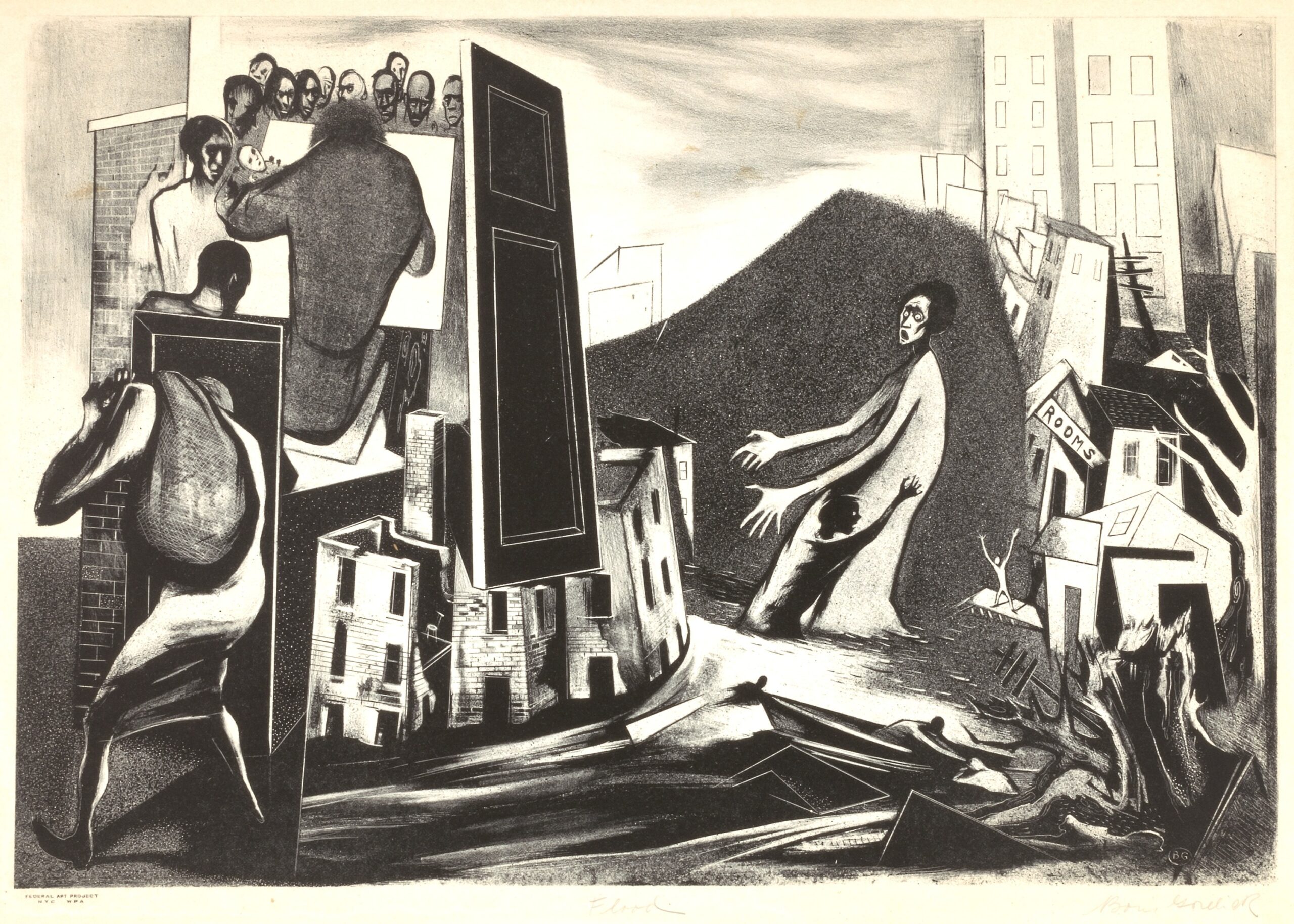
Before the third episode of the Philippines Graphic Literary Workshop (PGLW) concluded on April 18, we knew that we had one more thing that we can offer our bright young fellows: a starting platform for their creative endeavors. Here, we present one of their final outputs from the workshop. We also asked them to provide an artwork that they think best represents their stories. Read on.
A day after the super typhoon, people walked out of their homes into the flood on Quirino Avenue. It wasn’t because the water had gone from four to three feet in just a single night, or that the sunlight shimmered in a way that promised the next typhoon wouldn’t arrive the following day, but perhaps next month. The water was crystal clear, as if the gray concoction of grease and garbage had finally grown sick of the city, packed up its filth, and evacuated before anyone else could, leaving behind its natural translucence.
It was the most breathtaking sight that they had ever seen. For the first time in their lives, they could see through the water—see the pavement, the pedestrian lanes, the tire tracks, the potholes and the canals, the pebbles and the lone leaves that almost made the flood look like a sliver of the sea.
Most of them questioned where all the trash had gone, and if the rats had died deeper down the pipes and could no longer emerge above, for there was no sign of carcasses floating so far, while some of them theorized the success of the city’s improved underground infrastructure, or the second coming of Jesus Christ. But as they took pictures and videos, posting them on social media and realizing that the rest of Metro Manila did not have their clear floodwater, they soon forgot to investigate the cause. It was best to call it a miracle, not a mystery.
It was the street children who first dipped their toes in the water. It was cold and refreshing, and the sweltering heat made it much easier to splash around before they realized they were already diving deeper, seeing each other underwater. Only when their stomachs rumbled did they dry off and take a break, except for those who decided to take a sip from the flood.
It was unlike any water that they had drunk before. Unlike the flat blankness of 20-liter blue jugs or the metallic aftertaste that changed from bottle to bottle, the flood tasted surprisingly sweet, as if the clouds had infused the storm with honey. When the children kept returning to swim and drink—not a single sign of sickness on their delighted young faces—more people began trying it for themselves.
At first, they took meager sips. When no one got sick by the third day, the sips became tumblers and the tumblers became jugs, and by the end of the week, the people of Quirino Avenue were no longer afraid of what the flood was made of—they were afraid of it disappearing. The idea drove them to hoard more of it, knowing they could be paying for clean water at any moment.
A woman boiled it for lugaw and said it tasted better than the water she’d been buying for twenty pesos a jug. A diabetic man drank it plain every morning, swearing his blood sugar had improved, and the mother who mixed it with baby formula attested that her child had never looked so energetic before. Over time, the water only grew clearer and sweeter, even as the entire avenue washed its clothes, its bodies, and its dogs in it.
The barangay tanodsand volunteers, however,didn’t stop warning the residents about cholera, leptospirosis, dengue, and malaria. But by midafternoon, drenched in their own sweat from circling the avenue for any trouble, even they were accepting ice candies from the same family they’d been lecturing.
By the next morning, someone had put up a big sign in red bold letters: DO NOT DRINK. It was torn apart by the palamig vendor beside Quirino Station. He had been sitting behind his cart for weeks with no one stopping by, but the moment he swapped his tap water for the flood and mixed it with his coconut, pineapple, mango, and orange juice, the occasional passerby grew into a beeline of people waiting patiently under the sun just to get a sip, choosing his wooden cart over the air-conditioned convenience store nearby. Even as a new sign was plastered every day, someone else always took it down.
Since the typhoon, not a single resident had purchased a drop of water. But despite the rising tensions between those who chose to stay by the flood day and night and those who visited occasionally, the truth remained: water was free in Quirino Avenue—this beautiful, bountiful water that looked clean and felt nourishing, water that those children had long been swimming in and didn’t appear to have had any problem. They were not lining up at the community faucet with their buckets and pails, hauling home water that reeked of rust and swirled with grit. Not anymore.
One morning, some early hoarders spotted the mayor’s black Rolls-Royce, and everyone hurriedly went back inside their homes. They were going to be questioned, they thought, and when the mayor found out that they had all been ignoring their Maynilad bill, they were going to be penalized, arrested, or worse—banned from drinking the flood.
Still, the palamigvendor was the first one to approach the mayor, jovially handing him a cup of pineapplejuice. The mayor’s eyes widened as he exclaimed how it tasted so much better than the one he bought from Thailand, or was it Trader Joe’s? It’s the flood, sir. The flood? Yes, the flood, the magic flood. Horror twisted the mayor’s face. He quickly made a series of phone calls, then excused himself to pray. By the evening, the people saw the MMDA’s public advisory on social media: Quirino Avenue was closing.
With the police watching over the flood, no one interfered with the researchers from DOST extracting some samples. One neighbor, whose cousin’s wife’s brother-in-law worked at the department, swore there was no need to worry. The water was not contaminated. In fact, it was cleaner than any other body of water in Metro Manila—cleaner than the treated supply running through the city’s own pipes. No one knew exactly why. They only knew what the researchers were already calling it: the world’s first urban sea, borne out of a super typhoon, already teeming with traces of microorganisms no one had ever seen before.
Soon enough, DENR marked it as a protected area, with phytoplankton and cyanobacteria tinting the clear water in subtle shades of green. The protesting residents, now barred from collecting it, had no choice but to return to their filling stations. No one bought from the palamigvendor again.
The children began noticing tiny translucent creatures near the surface—and within weeks, snails and worms and small pale eggs the size of rice grains clustered in the water. This drew people from across the metro and the provinces to see it, many of whom compared Quirino Avenue to Japan’s floodwater, which had only been clear and never produced any life. By then, the road was no longer closed, only lined with more police, limited to public viewing.
It had not yet been a month before the next typhoon arrived. The flood doubled in depth overnight, forcing people out of their homes and trapping those inside the taller buildings, who climbed higher and higher until they had nowhere else to go. As volunteers rescued victims in boats, the mayor surveyed the area from a helicopter. The green tint had subsided, and from above he could see something moving in the water.
It was better than anything he could have imagined. It was fish—dalag, hito, bangus, tilapia—fish of all sorts and sizes swimming vigorously in the flood, and he praised the Lord for the miracle. And when the coral reefs appeared, he prayed for another typhoon.
Evacuees filled covered courts, churches, and schools across Pedro Gil and Vito Cruz—sleeping on banig or folded cardboard, sipping on instant noodles, or bathing with rationed water from plastic drums—and they could only watch through their cellphones the latest updates from home. They saw new viewing platforms built on the rooftops of taller buildings, boat tours priced at one hundred pesos for fifteen minutes (two hundred for the glass boat), and a souvenir stall replacing the palamigvendor’s spot near the station.
No one knew what happened to the vendor until someone spotted him on the side of the road, heading to work at a bottling plant—the one granted the exclusive contract to extract, filter, and bottle the floodwater under the brand Purong Quirino.
When concerns arose over the extraction’s impact on the water, DENR responded by prohibiting anyone from fishing—except for the international canneries that had met the city’s standards. One had already bought out an empty building nearby and began packaging raw bangus meat, which immediately gained global appeal for its more flavorful taste compared to sashimi. The secret? Pure and organic flood.
It wasn’t long before tourists all over the world were flying to the country—not for Boracay or Palawan or Siargao, but for Quirino. Their home, Quirino. Their flood and their fish that had made the country rich and famous, that had opened up discussions on whether or not the avenue was the eighth wonder of the world, the Great Flood of Manila. Others said nothing, only that they wanted to go back. But we have no home. Yes, we do—we have Purong Quirino in our relief packs, so at least we get to keep it in a bottle.
When the third typhoon of the year hit the country, the viewing platforms were reconstructed to the higher floors. After the fourth, the boat tours were permanently suspended and replaced with helicopter rides. The fifth, sixth, and seventh brought so much water that the buildings themselves became part of the reef, and the government stopped calling them buildings altogether—now, they were called natural marine structures.
And by the eighth typhoon, no one lived on Quirino Avenue anymore. The flood had swallowed Metro Manila whole, and everywhere the tourists went, the water was always clear, always sweet, always teeming with life. No one could tell whether the land was sinking or the water was rising. The only thing that mattered was that the fish remained, and they were thriving.
Written by Jaella Magno

Started in 1927, the Philippines Graphic is the longest-running printed magazine of national circulation that provides relevant news and features and promotes Philippine literature.