
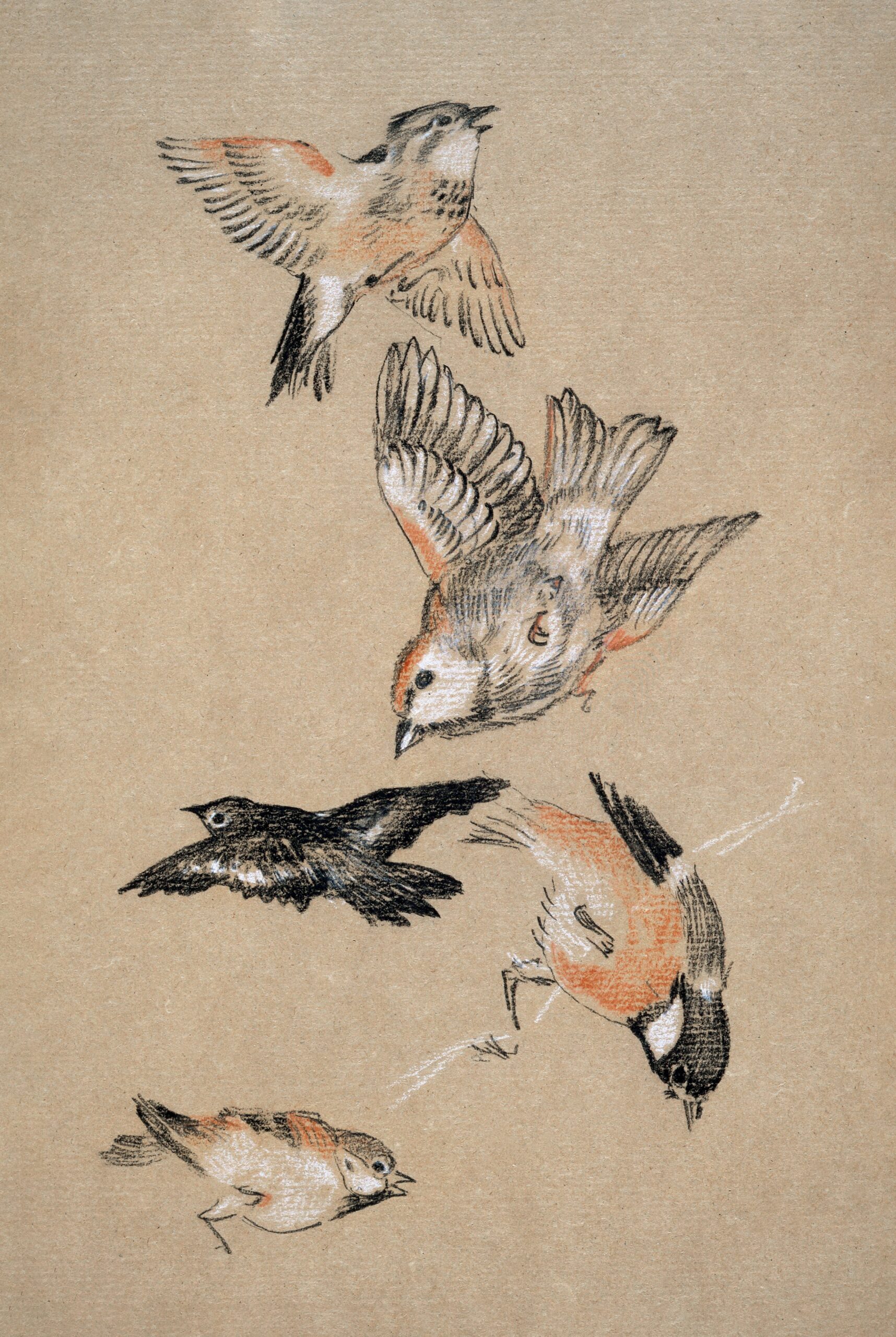
Before the third episode of the Philippines Graphic Literary Workshop (PGLW) concluded on April 18, we knew that we had one more thing that we can offer our bright young fellows: a starting platform for their creative endeavors. Here, we present one of their final outputs from the workshop. We also asked them to provide an artwork that they think best represents their stories. Read on.
Before the bird he caught transformed into a woman, Edwin thought to himself that the day could not get any stranger.
His day began as normally as it should: a steaming cup of freshly brewed black coffee, with his preferred ground barako beans; a small walk through the neighborhood, maybe a quick stop to chat with his ever-so-joyful neighbor who was never short on daily gossip; then a small rest on his patio to soak in the morning rays of the sun. A routine he had perfected over most of his years in his quaint and uneventful—sometimes rather boring—barangay.
That afternoon, just after eating his lunch of stir-fried mixed greens and some leftover stewed pork, he decided to take a stroll through the forest behind his house. Before leaving, he took note of the weather, nodded to himself, then grabbed his airgun from the hook at the back of his door and left. Since it was still early in the year, there was a chance for birds still migrating, and he thought he could hunt some for his dinner. It was quite chilly for February, so he was grateful he had thought to wear his thick jacket before setting off.
The ground was soft under his shoes, not entirely muddy, but not as firm as he had expected. The soil clung to the soles of his trainers as he hurried along the steep path through the woods, avoiding sunken terrain and slippery algae that had crept along the trail. It had been rainy these past few weeks, and it was only at these rare times that the sun finally came out of hiding and bestowed its warmth upon their barangay.
As he jumped over a fallen tree branch, he heard a faint coo nearby. Quickly, he unstrapped his airgun and pointed it toward where the sound came from. At the cusp of two Hawili trees, a speck of color sat on a thin branch, grooming its feathers, its eyes darting from side to side. Just as he pulled the trigger, the bird flew off before the rubber pellet could graze it. The shot rang out in echoes through the woods, startling a flock of resting birds overhead. He cursed, set down his gun, reloaded it, then continued down the pathway.
He reached a cliff overlooking his barangay, a bare platform of smooth stone surrounded by elder trees on either side, where the colorful rooftops below were splayed like dots of hue on an evergreen canvas. He set his gun down and sat on one of the boulders clustered near the edge. He glanced at the sinking sun on the horizon, shivering as a gust of wind blew past him. He stayed there a few more minutes before calling it a day.
Just as he was about to sling his gun over his shoulder, he heard a faint sound close to him. Moving only his gaze, he saw a great black bird perched on a stone just beside him. Its feathers carried a faint sheen in the fading light; its beak was short and smooth, curving slightly at the tip. Edwin wasn’t quite sure he had ever seen such a bird before, but that was a thought for later. He steadily backed away, raised the gun, and pulled the trigger.
The bird fell flat on its back, wings outspread on the ground, a few loose feathers drifting down around it. Smiling to himself, he approached the creature and picked it up by its feet, turning it over a few times before deciding it was dead. He slung it over his shoulder alongside his gun. The sun was now a quarter over the mountain range, its rays deepening with each passing second. A sudden breeze blew past him, ruffling his hair and nipping at his exposed skin. His eyes burned at the wind and he shut them briefly. Behind him, the bird gave a small jerk—but he didn’t seem to notice.
Back home, he filled a kettle with water and set it over the fire. It didn’t take long to boil; it whistled loudly and he quickly pulled it from the hearth. He had set the bird in a plastic tub, ready to be defeathered. He slowly poured the hot water over it, but the moment the water touched its feathers, they began to fall away and multiply in size. They doubled, then doubled again, spilling over the rim of the tub and onto the floor. Feathers of varied shades of black and grey rose faster and faster until they formed a sizable, shifting pile. Startled, Edwin dropped the kettle. Hot water spread across the floor and he barely registered the sting of it soaking through his pants and onto his feet.
The pile of feathers squirmed and wriggled. At the top, they began to part and sink away, revealing a head of long black hair. He pulled back the curtain of feathers to find a woman sitting on the floor, her knees pressed to her chest, her arms wrapped tightly around them. She was stark naked. Still in shock, Edwin cautiously pressed a finger to the top of her head, half-expecting her to dissolve. Her hair was damp to the touch, but soft, like the fine down beneath a bird’s outer coat.
“Well, you’re definitely not a bird,” he muttered. “But a girl.”
The girl twitched, then slowly raised her head and looked up at him. Her eyes were earth brown, like soil just after heavy rain. Her skin was the color of the inside of an oak tree. She studied him for a moment, then her eyes widened. She stood quickly, stepped closer, and brought her face near his to inspect him in the firelight. The glow from the hearth lit the sides of her face like a halo. Edwin stood perfectly still as she cornered him against the kitchen wall, like a predator with its prey. She raised a hand to cup his cheek and tilted her head.
“Arsenio?” she whispered.
“Er—no. My name is Edwin,” he replied.
The girl stumbled backward, dropping her hand, then stared at him in confusion. Edwin, now very aware that she was naked, quickly offered to leave and find her some clothes. She gave a brief nod, and he made his escape, ducking into his room to gather what he could. When he returned and held the clothes out to her, she only looked more confused, staring at them blankly.
“Do you not know what these are?”
“No.”
“Ah. Well, what do you wear?”
“Ginnalit and lamma.”
Edwin looked at her again, bewildered. “Those? People stopped wearing them years ago.” He left the room once more, this time heading to the storage room where his late grandmother’s things were kept. It took some time to find what he was looking for, but he eventually did. He stared at the garments for a moment, feeling the fabric between his fingers. When he returned to the kitchen, the girl had moved herself beside the hearth and was warming herself by the fire.
“Here,” he said, holding out the native attire. “These were my grandmother’s, so they might be a little big on you.”
“It’s alright. Thank you,” she answered.
She put them on quickly, then came and sat beside him near the fire. They both stared at the flames for a while, neither wanting to break the silence.
“So,” he began carefully, “if I may ask, were you turned into a bird, or were you simply born as one?”
She smiled at him amusedly before looking away.
“I was human before. I did something I shouldn’t have, and suddenly I turned into a bird.”
“And that was?”
She was quiet for a long moment, her gaze fixed somewhere deep in the fire.
“I did a ritual,” she answered finally.
“A baki?” Edwin turned to look at her. “But isn’t that forbidden for—”
“For women, yes, I know.”
Edwin said nothing, but his expression shifted.
“My lover was dying. A sickness came without warning that not even the best mumbaki in our village could name it, let alone cure it.” She pulled her knees to her chest again, the same way she had sat in the tub of feathers. “I watched him grow sicker every day. I tried everything I was allowed to try. And then I ran out of allowed things.”
“So…you did the ritual yourself,” Edwin concluded.
She nodded. “I knew it was wrong, but knowing something and obeying it are different when the person you love is dying in front of you and you can do nothing but watch.” Unshed tears pool at the corners of her eyes, glistening in the firelight.
She told him the rest quietly. She had waited until the village was asleep. She had prepared the offerings with hands that wouldn’t stop trembling. For the sacrifice, she had chosen a black bird, not the usual offering, but it was what had come to her, and she had taken it as a sign. She had begun chanting words, uncertain of some, desperation filling in the gaps where knowledge failed her.
She never finished the ritual.
“The mumbaki suddenly arrived,” she said. “He must have felt something wrong in the air. They always say the spirits grow uneasy when something is out of place. I suppose a woman’s voice doing what only a man’s should was disturbance enough.” She almost smiled, but it didn’t reach her eyes. “He found me in the middle of it, and because it was unfinished, it did not do what I intended it to do.”
She looked down at her hands, turning them slowly in the light. “It happened very fast—or was it slow. One moment, I was standing, and the next, I was not. I remember looking at the dead bird, then the stretch and pull of every limb on my body. I remember the feeling of the wind. After that, I remembered very little for a very long time.”
The fire crackled between them. Outside, the evening had settled fully over the barangay, and the night insects had begun their low, steady chorus.
“Until today,” he offered.
“Until today.” She closed her eyes briefly. She opened them again. “I think—I think the bird I sacrificed. Completed its purpose…somehow. Even without the ritual being finished.”
Edwin nodded slowly, not fully understanding but understanding enough. He watched her face as the quiet stretched between them, and he saw the exact moment the weight of it landed on her fully, the clear, inevitable flow of time.
Her brows drew together.
“How long,” she began, then stopped. She looked around the kitchen, at the plastic tub, the tiled floor, the electric light above them, and the modern stove. Her eyes moved slowly, taking inventory of things that did not belong to the world she remembered. “How long has it been?”
Edwin considered his words carefully. “I couldn’t say exactly. But—” He glanced at the room around them too, trying to see it as she did, as something unfamiliar. “Long enough, I think.”
She turned back to the fire. For a moment, her face was very still. Then something in it broke. Her eyes dimmed as she pressed her lips together hard.
“So he’s dead,” she said. Not a question.
Edwin remained silent; there was no answer he could offer that would have helped. After some time had passed, he leaned forward, resting his elbows on his knees.
“I don’t know what I can offer you,” he said honestly. “I’m just a man with a small house and a patio that gets good morning light. But whatever that amounts to, it’s yours, if you need it.” He paused. “You shouldn’t have to figure out whatever comes next alone.”
She looked at him then—really looked at him—and something in her expression shifted, softer and sadder at once.
“You look like him,” she said quietly. “That’s why I said that name. When I first saw your face.” A small, mournful sound escaped her that was almost a laugh. “It frightened me when you answered differently.”
“Arsenio,” Edwin stated.
“Yes.” The name left her mouth like something sacred and grievous. “Arsenio.”
He gave her a moment with the name before he spoke again.
“I never asked yours,” he said gently.
She looked back at the fire one last time, and when she answered, her voice was steadier than he expected.
“Aginaya,” she replied.
Edwin nodded, sealing it into his memory.
“Aginaya,” he repeated. “Then it’s good to meet you. Even if the circumstances were a little weird.”
She looked at him, and this time the almost-smile made it a little further than before.
Juliana Franchesca Ronda
Started in 1927, the Philippines Graphic is the longest-running printed magazine of national circulation that provides relevant news and features and promotes Philippine literature.