
Before the third episode of the Philippines Graphic Literary Workshop (PGLW) concluded on April 18, we knew that we had one more thing that we can offer our bright young fellows: a starting platform for their creative endeavors. Here, we present one of their final outputs from the workshop. We also asked them to provide an artwork that they think best represents their stories. Read on.
She dressed like the way she wrote, every comma was equipped in her wrists, a parenthesis or two at the throat, a glittering ellipsis at the ears. She did not always know how to write, but her readers were somehow convinced she was great and always were. Perhaps no footnotes were visible or in the language they read.
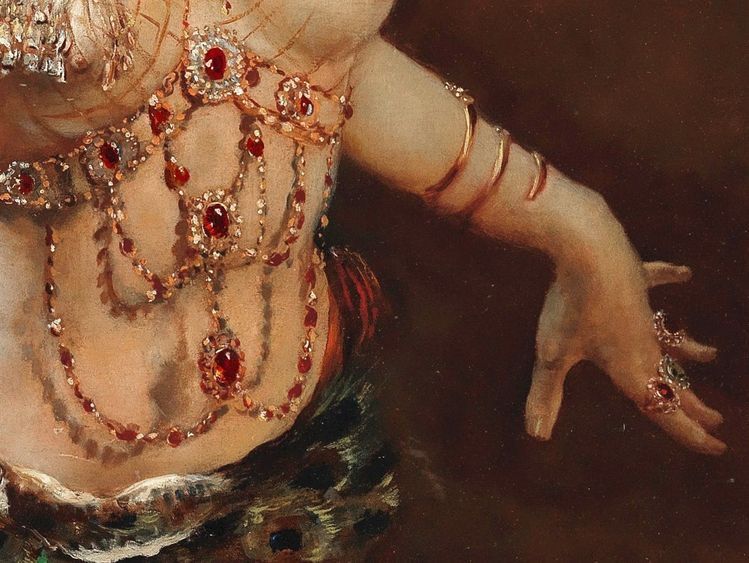
She’d always edit before the final verdict, a ring for the morning she wanted to remember, a bracelet that she saved from breaking, earrings that chimed just enough to interrupt a question, a necklace that drew the eye downward, away from evidence pooling under her own.
But each time she did, she searched for something, not a synonym nor anything neat, but something new yet something familiar. The thing is, she knew, but maybe if the finger hovered just right, the box opened in a certain way, and the light from the window was at a certain degree, the right words would spring out.
Her eyes rest upon the glittering few in the velvet cushion, blinking each time as if she’d looked at it wrong. Each is labeled with a story she could repeat on cue—this one from a trip, this one from a friend, this one from a version of herself that laughed more, drank slower, and slept better. Not those. The remaining ones. They had no substitute or synonym.
Comma, parenthesis, ellipsis, repeat. Comma, parenthesis, ellipsis, repeat. Tell me, do you recall loving the art of mathematics for such patterns?
Comma, parenthesis, ellipsis, repeat. Did the sun rise too far from my house? Did it spawn a second late? Comma, parenthesis, ellipsis, repeat.
“Dear,” she’d laugh—how absurd. Comma, parenthesis, ellipsis, repeat. De…cember?
Comma, parenthesis, ellipsis, repeat. What December has she held dear?
Comma, parenthesis, ellipsis, repeat. A night she could not remember but could not forget. Like tarnished gold, it was dull but real, heard beyond the buildup of frustration.
Him.
She remembered not remembering. A blackout that felt less like darkness and more like erasure. Like someone had taken a red pen to her night and struck through entire paragraphs, thesis, and statements, leaving only a note, you needed this.
Comma, parenthesis, ellipsis, repeat. I didn’t.
Comma, parenthesis, ellipsis, repeat. Each piece, a statement, a heavy period for every inch.
“See how I shine? See how I deflect? Look here, not there. Ask me about this bracelet—I’ll tell you about the market, the sunlight, the way I bargained for it with a stranger who called me “ganda!” and made me feel like I belonged to myself. Ask me about these earrings—I’ll tell you about the friend who gave them to me, how we laughed, how we swore we’d never change. Ask me anything that can be answered with an origin story that isn’t mine.”
No one asked about the rings she didn’t wear. Perhaps they can no longer keep track of what was the usual of the ordinary. No one inquired about the way her eyes were accumulating saline at the margins, threatening to spill but never doing so. No one inquired about the tiny shadows beneath them, the bruised half-moons that no amount of golden palette could completely cover. The jewelry served its purpose: it dazzled, distracted, and drew the eye outward, away from the center, where she refused to look.
Then it happened. With no right consequence, no right input, she lost the box on one of her trips. She had no idea if she had misplaced it during the journey, been robbed during the commute, or simply did not bring it with her–impossible.
Like a pen dried out of its ink, she tried to write, but it dried way before it hit the surface. Without the familiar weight at her throat, nothing to fidget when she’s bored, her collarbones felt too exposed, like open parentheses with nothing inside. Without the earrings, her face seemed louder, her silence more noticeable. Without the bracelet, her hands looked like they belonged to someone who didn’t know what to do with them.
She stood there, a blank piece of paper, staring at its editor begging to be written on, to be edited, to be decorated.
It wasn’t her.
She refused to go out of the bathroom that already knows her now by an hour.
Ellipsis, repeat.
She let out a sound as if vomiting over the outfit she planned to wear her jewelry with.
“Ugh! I give up!…” Slamming her undecorated hands on the marbled sink that reflected her dull skin. She looked up, her eyes darting heavily on what’s now in front of her, as if she had a choice to look away at this point.
Her eyes were red from trying to tint them with lipstick she barely knew how to use. Her hair was disheveled from putting it up, putting it down, tying it, untying it, tying it, clipping it, and brushing it down and up. Her top, ruined from cinching it at places, uncinching it, draping it over with a scarf, decorating it with something else that did not belong there.
THUD, THUD, THUD
Her hands curled into fists, hitting whatever it wished to land on, her lap, the sink, the marbled countertop, the wall, her lap.
THUD, THUD, THUD
“Lilieth?” She flinched. Shit.
The memory of that December night shifted, just enough to let a glitter of truth through.
Not a full recollection—no, she still couldn’t assemble the scene into a coherent narrative. But there was a sensation she had been avoiding, a fragment she had misfiled under irrelevance.
Her eyes scoured the room as if she had been there, darting to every corner of something that she might have seen before, until it comes back into her own hands.
Empty.
She had not been wearing the rings that night.
She had lost them not in the chaos of that night, not in some careless, drunken misplacement, but before it—perfectly before it, at a moment when they would have been useless, obstructive even. She had been without her usual armor when she needed, or was forced into, something else entirely.
Bulneirability.
That night, control had slipped. Or been taken. Or surrendered. She didn’t know which verb to trust.
What she did know, or began to understand, was this: he had seen her without the adornments. Without the curated narratives. Without the distraction of sparkle and story. He had seen her blacked out. Raw. Unpunctuated. A sentence without commas, without pauses, without the luxury of choosing how she was read.
He did not shush her nor stop her but stood quiet, noticing what she’s tracing with her fingers now—the hidden pool of saline in the corner of her eyes, the half-moons that formed under them, the hands so bare, free of carrying the burden she always had. Her exposed clavicle, becoming more prominent by the minute.
He was there…for her.
Not the adorned version. Not the curated exhibit. Her.
And she hated it.
Not him, not exactly. But the fact of it. The way it bypassed her consent to be seen. The way it suggested that there was something beneath all the glitter that might be worth noticing, worth holding, worth—what? knowing?
What did it mean, now, to have nothing to point to?
Ellipsis…
Her hands tremble, reaching for the door. Yet again, void of anything that might make it shine, she realized: She could leave the velvet light, even for a while.
Let her dull skin, essence, and color speak for herself, for they no longer know the difference between her commas, parentheses, and ellipses.
“She’s always looked her best,” they would always say, and still do.
Perhaps they would say it today, too. Because her finger hovered just right, the box was lost through a certain way, and the light from the window was at just the right degree. But no one will ever come to know;
She lost the rings before they could even come to know her name, her skin, and her youth. Comma.
Written by Romina Mae O. Hidalgo
Started in 1927, the Philippines Graphic is the longest-running printed magazine of national circulation that provides relevant news and features and promotes Philippine literature.