

The play delivers a gut-wrenching display of one’s sense of purpose, and the immense hardship required to escape the drab and punishing life overseas
The arid Arabian desert is capable of drying nearly everything to death, with temperatures often reaching up to 55 degrees Celcius; thus, it is not unusual for one to die from dehydration or heat stroke.
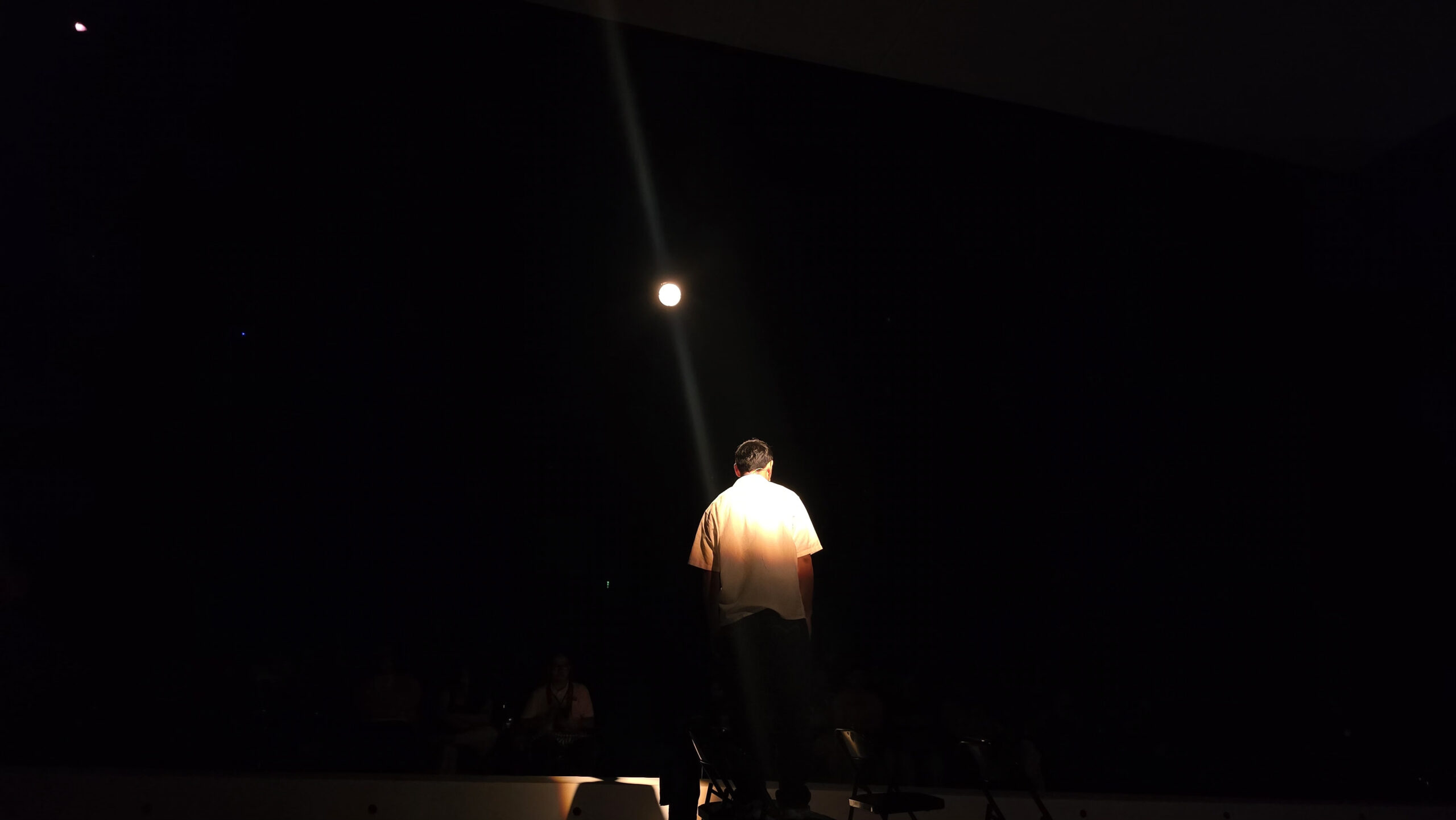
But in the Dulaang Unibersidad ng Pilipinas’ (DUP) staging of award-winning writer Arlo Deguzman’s play Ang Kaliitan ng Kasalukuyan, the desert became not just a site of physical dehydration, but also a force that drains Bulan of his sense of purpose.
In March 2026, DUP held several stagings of the Palanca-awardee’s play, which centers around the life of Bulan (played by Sandino Martin) as an overseas Filipino worker (OFW) in the Kingdom of Saudi Arabia, and his personal struggles as he is torn among competing responsibilities as a son, an employee, a Filipino, and an aspiring writer.
Whatever warmth might have been present when he returns home at the start of the play is quickly drained upon arriving back in KSA. Now thousands of kilometers away, it is in the companionship of his sister who is also working in the kingdom where he comes closest to feeling “home.”
Other than that, the closest he is to being “warmed” is in the sweltering temperatures of the Middle Eastern country, and in inebriation.
SPOT-ON ACTING
The way Ang Kaliitan ng Kasalukuyan captures the OFW experience with remarkable precision, which is not surprising considering Deguzman—its writer-director—was once an OFW himself for nearly two decades across 50 countries, as well as some of the actors who also had their own experiences as migrant workers.
The acting was top-notch. Martin’s portrayal of a son burdened by difficult circumstances is stellar. His personal experience as an overseas worker lends weight even to the smallest facial expressions, such as when he hears his mother (played by Sheryll Ceasico) air out a tone of disappointment upon hearing his desire to go back to the Philippines.
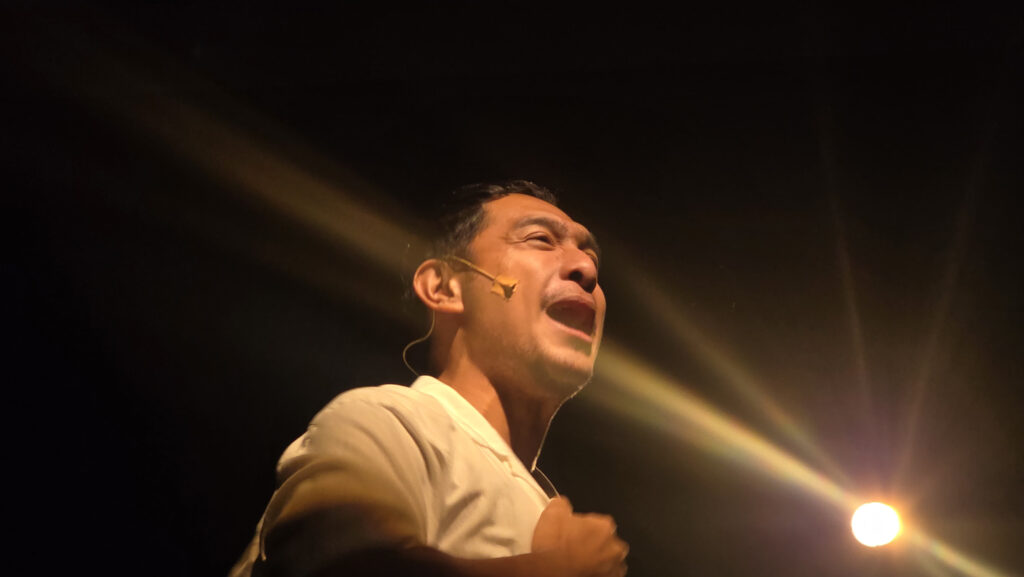
The rest of the cast were no slouches either, delivering nuanced performances that sway from being delicate to bombastic.
ALL TOOLS DEPLOYED
As expected of the award-winning writer, Deguzman successfully condensed the complex OFW experience with great sensitivity and respect. But the last quarter of the script felt half-baked, execution-wise.
Though some foundation had already been established to support Bulan’s downward spiral, it still felt rushed as the end quickly shifted into a more abstract depiction of his battle with his own demons, rather than presenting something closer to a concrete resolution.
Part of the play’s exemplary production is in its use of puppets, which, according to the writer, felt the most appropriate to portray different versions of Bulan.
“Lahat na, dineploy [Everything was deployed] to be able to articulate [the OFW experience], because [it] is a difficult narrative to articulate,” Deguzman said during the play’s press conference. “We need to sort of look at the toolbox.”
There are some things more terrible than exhausting every bit of one’s self, only to end up with a lackluster life, always be at the mercy of a meager salary, and leave behind the comfort of home and family to work somewhere far away.
Ang Kaliitan ng Kasalukuyan captured these struggles most clearly through Martin’s flawless portrayal of Bulan. To feed one’s family requires a lot of will, and often at the expense of one’s happy life. The degree of sacrifice which any OFW makes on any given day can never be perfectly encapsulated by any media, but the DUP play shows us that we do not need an artisticallyperfect encapsulation—we just need something genuine, nuanced, and personal.

Started in 1927, the Philippines Graphic is the longest-running printed magazine of national circulation that provides relevant news and features and promotes Philippine literature.

 staging of award-winning writer Arlo Deguzman’s play Ang Kaliitan ng Kasalukuyan, the desert became not just a site of physical dehydration, but also a force that drains Bulan of his sense of purpose.)