

Mosquitoes such as Aedes aegypti and Aedes albopictus, which are known to transmit diseases like dengue, Zika, and chikungunya, may carry more than just viruses that affect humans. They also host insect-specific viruses that do not infect people, some of which may even inhibit the multiplication of disease-causing viruses. This implies that mosquitoes can serve as valuable tools for detecting both known and emerging viruses that may impact public health.
Irish Coleen Asin, John Michael Egana, and Dr. Ma. Anita Bautista of the University of the Philippines – Diliman College of Science’s National Institute of Molecular Biology and Biotechnology (UPD-CS NIMBB), together with Dr. Richard Paul of Institut Pasteur, Université Paris Cité, collected mosquitoes from three areas in Los Baños, Laguna that differ in topography and land use. Using viral metagenomics—a method that identifies all viruses in a sample—they analyzed the virome inside the mosquitoes.
Their research revealed that the mosquitoes carried viruses from 12 different taxon groups. Most of these were insect-specific viruses (ISVs), which infect mosquitoes but not humans. Both A. aegypti and A. albopictus also shared the majority of the identified viruses.
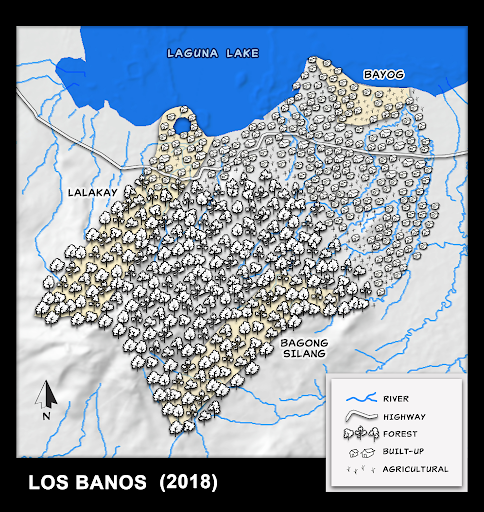
The molecular biologists collected mosquito samples from three barangays in Los Baños, Laguna: Bagong Silang, Lalakay, and Bayog. Bagong Silang is the upstream (mountain) site, located 305–331 meters above sea level (asl), with a rolling landscape. Lalakay is the midstream site—characterized by rolling to slightly uneven terrain. Bayog, the lakeshore site, has a flat landscape.
“Based on the land cover maps, Bagong Silang retained its forest cover in the last 4 decades as of the study date. At the same time, both Lalakay and Bayog underwent conversion from agricultural to built-up areas during that period,” they shared.
The study also showed that more types of viruses were found in areas altered by human activity—such as urban or cleared land, like Barangays Lalakay and Bayog—compared to the forested area of Bagong Silang. “These mosquitoes are usually disturbance-resilient and are more competent hosts for several viral isolates or strains,” the molecular biologists added. Notably, the team did not detect dengue, Zika, or chikungunya viruses in the samples. Interestingly, mosquitoes from two barangays were found to harbor the Cell Fusing Agent Virus (CFAV). CFAV has been thought to inhibit the proliferation of Dengue and Zika viruses.
“The potential risk of emerging and possibly unknown arboviral threats calls for strengthened surveillance programs and advanced research on arboviral diseases—those transmitted by insects like mosquitoes,” they said, emphasizing that arbovirus surveillance programs are vital to public health, as they monitor the activity of both endemic and emerging viruses in real time to help manage outbreaks. Such monitoring can be enhanced through next-generation sequencing techniques, including virome sequencing.
The molecular biologists also noted that mosquitoes may serve as important biological targets for zoonotic and arboviral disease surveillance programs. “Mosquitoes act like biological syringes, feeding on multiple kinds of hosts,” the team pointed out. “Because of this, they can provide valuable insights into viral diversity across space, time, and species.”
Their study, “Virome sequencing and analysis of Aedes aegypti and Aedes albopictus from ecologically different sites in the Philippines,” was published in Parasites & Vectors. This international journal focuses on all aspects of the biology of parasites, parasitic diseases, intermediate hosts, vectors, and vector-borne pathogens. Their work was supported by the Department of Science and Technology—Philippine Council for Health Research and Development (DOST-PCHRD) and the UPD Office of the Vice Chancellor for Research and Development. —Eunice Jean C. Patron

Started in 1927, the Philippines Graphic is the longest-running printed magazine of national circulation that provides relevant news and features and promotes Philippine literature.