


It was probably the most unsettling and shocking piece of news that broke during that second week of October.
After eating his share of hotdog and marshmallow-on-a-stick, a boy, aged 3, uses the stick to stab the heart of his four-year-old girl playmate. The girl dies, but lives long enough to tell her mother: “Mama, nag-away kami. Sinaksak niya ako. [Mother, we quarreled. He stabbed me].”
The news of the child’s death made the rounds of the evening, and eventually, landed in YouTube https://www.youtube.com/watch?v=ob256AW4WY4, where it enjoyed more than 2,500 views in a month’s time.
At the end of the radio-TV report that lasted for almost five minutes, the dead girl’s young mother made a public appeal: “Pumunta po kayo dito, para makita po siya [Come over so you can see her]. To this, the reporter covering the story announced that the mother was seeking help to bury her daughter, eldest of two children. He added the bereaved parents will not press charges because the boy who stabbed their child was too young.
LEGISLATIVE ACTION
Stories of minors caught in criminality have pushed some lawmakers to work for the amendment of the Juvenile Justice and Welfare Act (RA 9344), a law passed in 2006 that mandated the setting up of a comprehensive juvenile justice and welfare system in the Philippines.
RA 9344 created the Juvenile Justice and Welfare Council (JJWC) under the Department of Justice (DOJ). An undersecretary of the Department of Social Welfare and Development (DSWD) chairs the JJWC.
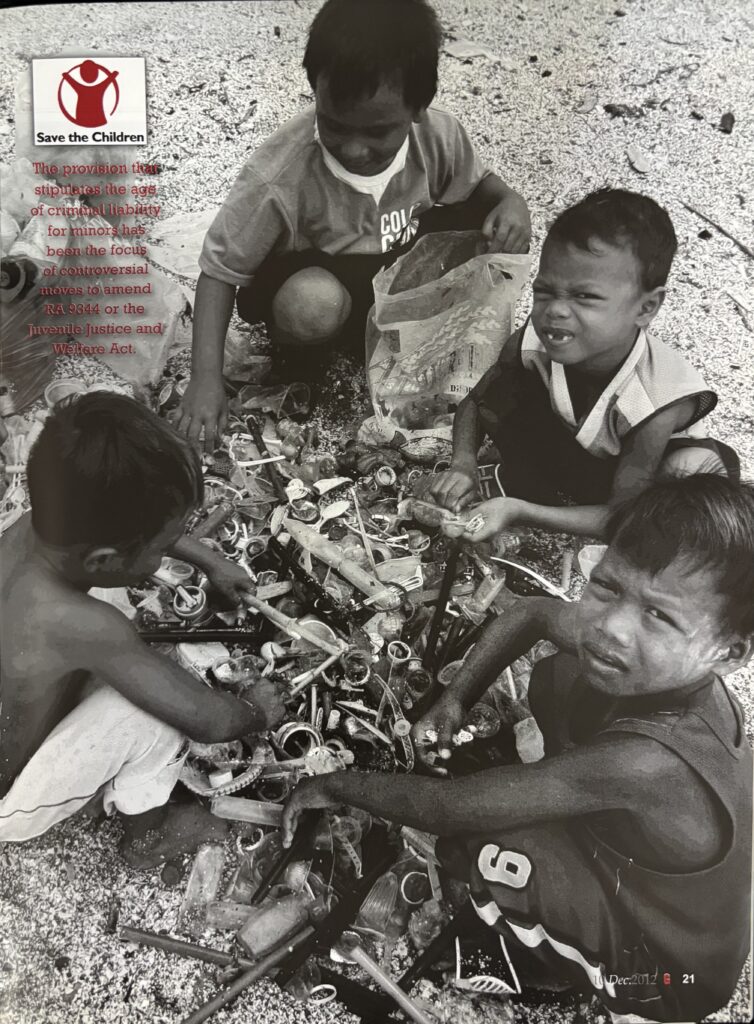
The law likewise stipulated that, “a child 15 years of age or under at the time of the commission of the offense shall be exempt from criminal liability. However, the child shall be subjected to an intervention program.”
The provision that stipulates the age of criminal liability for minors has been the focus of controversial moves to amend RA 9344.
According to the JJWC, numerous House Bills have been proposed to lower the Minimum Age of Criminal Responsibility (MACR), from 15 years old to 9 years old.
These bills include those filed by the late Rep. Salvador Escudero and Rep. Cinchona Cruz-Gonzales (HB 467), Rep. Mitzi Cajayon and Rep. Roberto Puno (HB No. 2611), Rep. Pablo Garcia and Rep. Pablo John F. Garcia Jr. (HB No. 2894), and Rep. Anthony Rolando T. Golez Jr. and Rep. Romeo M. Acop (HB No. 3423).
House Bill no. 6052 consolidated all four proposals and proposed further amendments to RA 9344, which included the raising of the MACR from 9 to age 12. The consolidated bill has passed the third reader at the Lower House, the JJWC said.
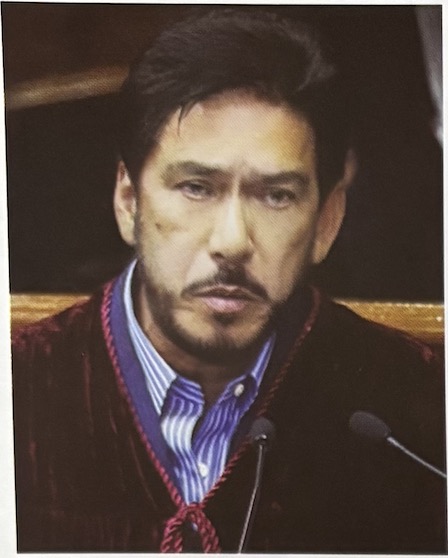
At the Senate, the consolidated measure faces challenge from Sen. Vicente “Tito” Sotto III, author of SB no. 43, which proposed the MACR set at age 11. Filed in July 2010, Sotto’s explanatory note to SB 43 stated: “This is a bill which proposes to lower the age of exemption from criminal liability to properly commensurate the degree of liability of a teenager who still lacks the discernment, with the degree of awareness and understanding of a teenager. The State must be protected from physically and mentally mature youth who are hiding from penal liability merely due to their age.”


NO CORRELATION
Child-based non-government organizations and even the JJWC are against the lowering of the minimum age of criminal responsibility.
There is no established correlation between lowering the age of criminality and crime prevention, the international NGO Save the Children said.
From 2002 to 2006, Save the Children-UK commissioned three exhaustive studies on Children in Conflict with the Law (CICL) in the Philippines — with Metro Manila in Luzon, Cebu City in Visayas, and Davao City in Mindanao as primary areas of study.
In reviewing previous studies on CICLs, Rowena Cordero, program director of the study Breaking the Rules: Children in Conflict with the Law (CICL) and the Juvenile Justice Process — The Philippine Experience, said: “Although several studies have been done on children’s justice, most of these had very little quantitative data. Statistics usually focused on children in prisons, while other studies used secondary data.
The consolidated study also indicated that the Juvenile Justice and Welfare Act has not been properly implemented in the Philippines, owing to lack of funding and resources support from the national and local governments.
NO BUDGET
Alma O. Acera, advocacy officer of Tambayan Center for Children’s Rights in Davao City, said that laws on child protection that pre-dated RA 9344 had called for the creation of youth detention homes. But this has not come to fruition “Noong 1974 pa dapat may youth detention home na, pero wala sa priority.”
SocialWatch, a political and economic think tank, in its assessment of the DSWD budget, said: “Changes in DSWD’s budget show that even though its funds ballooned from P6 billion to P49 billion, only the Conditional Cash Transfer (CCT) program consistently benefited from the dramatic increase. Other programs enjoyed very minimal increases and even experienced budget decreases in succeeding years.”
The Juvenile Justice Act got 0.6% of the total DSWD budget in 2010. In 2012, 91% (P39.4B) of the DSWD budget went to CCT while all the other programs shared 9% (P4 billion) of the budget, the SocialWatch said.
NOT COST EFFECTIVE
In its policy paper presented to the Senate, the JJWC said: “The proposal to lower the minimum age of criminal responsibility will require the establishment of more detention facilities. It will only demand the infusion of substantial amounts of public expenditure into a punitive system that is not cost-effective. In the Philippine setting, this consideration raises significant policy considerations, where the reality of scant resources for programs and services for all children, and not just for children-in-conflict-with-the-law and children-at-risj, quickly keeps us grounded.”
Citing guidelines established by DSWD, the JJWC said that the cost of caring for a child in an institution in the Philippines is P224.09 per child. “A child in conflict with the law could spend an average of 1,196 days or 3.28 years in institutional care. This average covers the period from the time that they are arrested, placed in youth detention homes pending trial, and through the completion of their rehabilitation and reintegration. This amounts to a total of P268, 011.64 per child.”
JJWC said that some barangays can handle as many as 89 CICLs. “For 89 children, a daily expense of P19,944.01 or a total of P23,853,036.00 for the entire cycle from apprehension to rehabilitation would have been spent for their institutionalization. Prior to the enactment of RA 9344, when the MACR was still set at nine (9) years old, within a ten-month period between January to October 2004, a total of 2,121 were arrested and placed under detention by the BJMP. The cost of institutional care for 2,121 detained children amounts to a staggering amount of P173,482,630.00 for one year alone. The Philippine experience proves that incarceration is more expensive. We have yet to see whether it is, indeed, more effective.”
ANTI-POOR
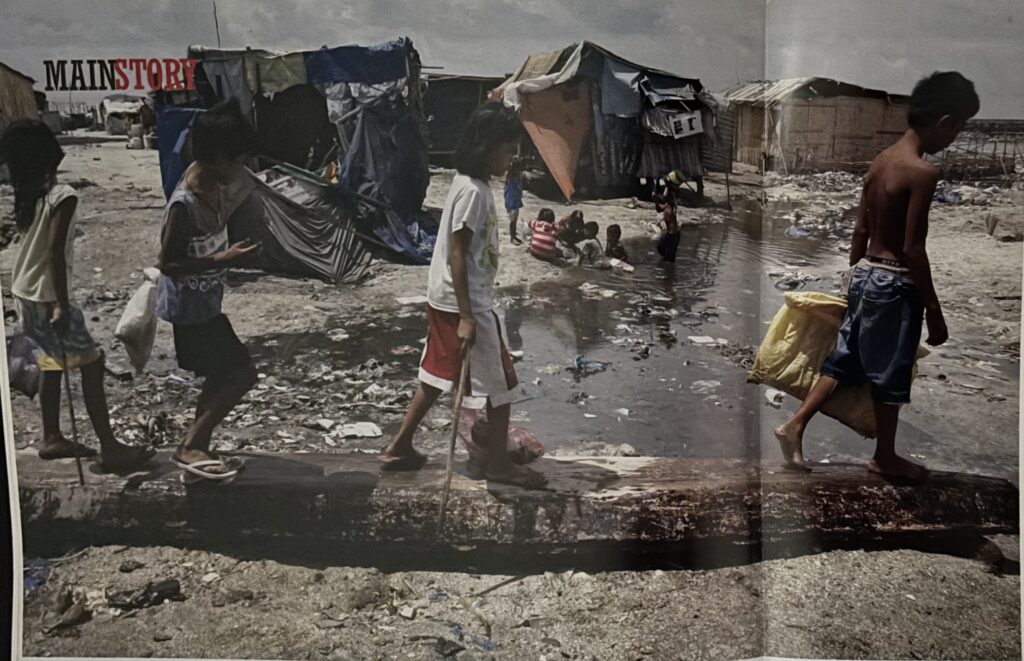
“Most CICL come from the poor, distressed and low-income families. This was the alarming empirical finding by social workers, institutional managers, and government rehabilitation center heads. In the Philippines, almost half of the reported crimes where children are involved comprised petty crimes of theft, robbery and other crimes against property. Taken against the backdrop of extreme poverty in the country, these children are most likely motivated by a desire to survive, or were forced into activities that they would not normally engage it. The Public Attorney’s Office (PAO) observes that most of their clients are illiterate, oppressed and unable to secure competent legal representation. As a result, more of these underprivileged youth languish in jails, and stay incarcerated for longer periods of time,” the JJWC policy paper stated.
It likewise said that lowering the age of criminal responsibility does not address the root causes of juvenile offending. The law will punish the children of the poor, while remaining oblivious to the root causes of youth offending and vulnerabilities arising from illiteracy, oppression, extreme hunger and destitution.
The JJWC policy paper also stressed that lowering the MACR violates international treaties, standards and principles. These instruments, it added, constituted legally binding obligations and are self-evidence foundations of a just and humane society that cares for its children.
“In the Philippines, a minor’s act produces no juridical effect in contracts, marriage, employment and elections. Filipino children cannot bind themselves in contractual and marital relations; they cannot work; they cannot vote and be voted for, unless they are at least 15 years of age in the Sangguniang Kabataan elections at the Barangay level. They are incapable of doing all of these legal acts. The philosophical and legislative justification for all of these has always been to afford legal protection for children. In sharp contrast, the proposal to lower the MACR is founded upon the principle of providing protection from children.”
Children will now be made to bear the full criminal consequences of their acts, including detention, incarceration and criminal litigation. Lowering the age of criminal responsibility, opens the door for more, and a lot younger, children to be brought into the adult justice system, for processing into prisons and detention centers, the policy paper stated.
Last October, child-focused non-government organizations led by the Davao City-based Tambayan Center for Children’s Rights Inc., CFSFI-Baguio, and Children’s Legal Bureau, among others, held a media forum in Quezon City together with the JJWC to ventilate concern for congressional moves to lower the minimum age of criminal responsibility from 15 years to 12 or 11 years.
“We keep telling people that we should crack the whip on adults using children. No child was born a criminal,” said lawyer Triccia Oco, executive director, JJWC.
Interviewed by the Philippines Graphic, Oco said that the JJWC is working closely with the Senate to clear points concerning the lowering of the MACR.
“We are against the lowering of the MACR,” Oco said, adding that, fortunately, some Senators “are open to dialogue.” — December 10, 2012

Graphic Archive
The Graphic Archive contains the articles and literature published in the Philippines Graphic since it was first established in 1927.

, a law passed in 2006 that mandated the setting up of a comprehensive juvenile justice and welfare system in the Philippines.)