

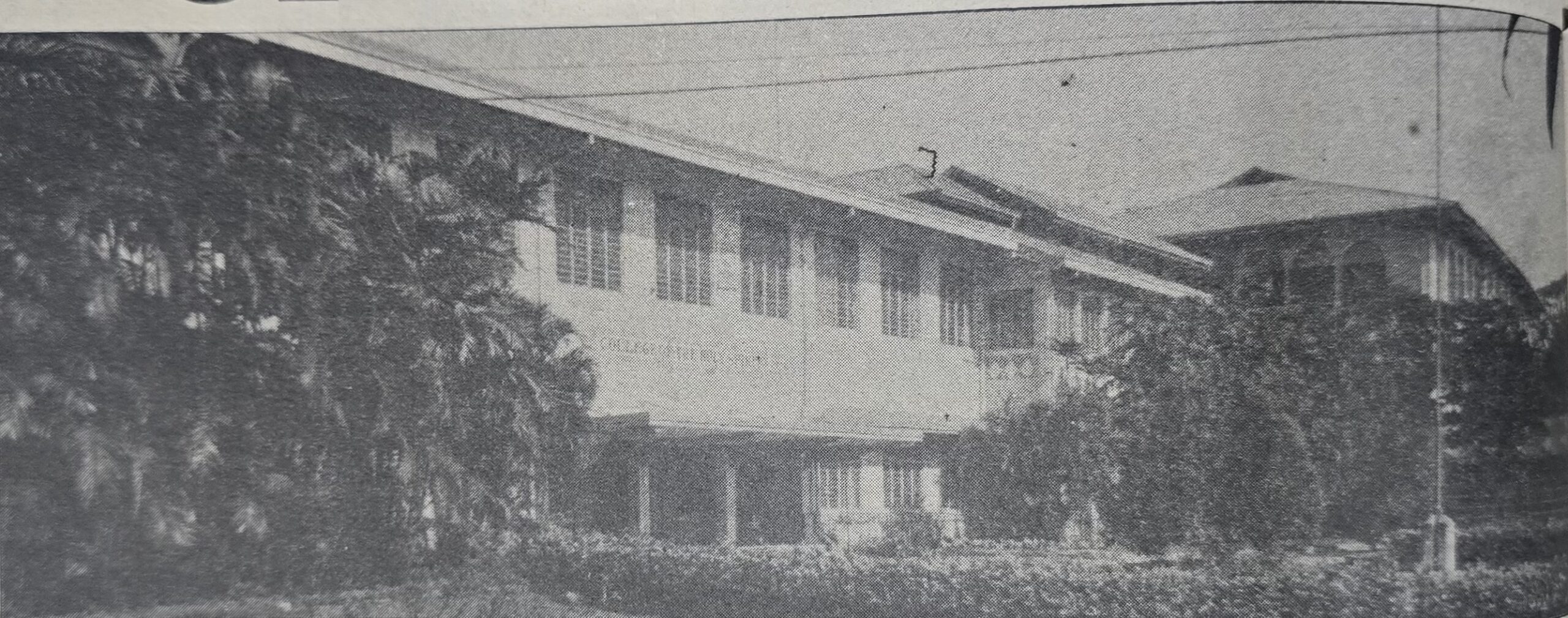
U-Belt means Manila’s collegiate zone, an area extending from Calle Arlegui in Quiapo to Governor Forbes in Sampaloc, bounded in the west by Quezon Boulevard and in the east by Dr. Jose P. Laurel Street. In the university belt are three boroughs: Quiapo, San Miguel and Sampaloc.
Hub of this campuslandia is the east end of Recto. Here and on the streets off it are the shops, eateries and cinemas that cater to the studentry, not to mention the crummy dorms where provincial scholars dingily lodge. For them the U-Belt is mainly the Recto-Morayta junction, which indeed seems a campus itself, ever milling with young folk sweating lessons and book-laden.
It’s not Recto, however, but the brief stretch of Mendiola that can claim to have been the starting point of the U-Belt. Before it became a frontier, all this Mendiola area was swampland, empty and desolate. What’s now the borough of San Miguel was originally an island cut out by the Pasig and the Estero de San Miguel. Of this island only the riverside was occupied: by summer villas lining the lone street called La Calzada de Malacañan. The rest of the island was bog and bush.
As they did with other Manila quagmires (Malate and Ermita especially), the Americans, fearing the miasma of swamps, had the San Miguel terrain filled up by turning it into a dump. By the early 1990s the Mendiola area was becoming terra firme. There was however still no Calle Mendiola, no Mendiola Bridge—in fact, no streets at all yet. And you would have been thought crazy if you had predicted campuses here.
The credit for turning this ex-bogland into a beginning of a U-Belt belongs to five schools: San Beda and La Consolacion, both founded in 1901; Centro Escolar de Señoritas, founded in 1907; Holy Ghost College, founded in 1913; and Mapa High School, which opened as the East High School in 1923. All five had started elsewhere before converging on Mendiola.
In 1900 the Papal Delegate to Manila, Placide Louis Chapelle, decreed that two big houses owned by the Archdiocese of Manila on Calle San Sebastian (now R. Hidalgo) be turned over temporarily to an order of nuns known as the Augustinian Tertiaries. These Augustinian Sisters remodelled the buildings into a schoolhouse which, in June 1901, they inaugurated as the Colegio de la Consolacion. Its first claim to fame, say the Sisters, is that it was the first school in the land to teach English. This was made possible by a Sister who had studied English in Hongkong just before the outbreak of the Spanish-American war. Though established by the Spanish nuns sent to the Philippines in the 19th century to help in a cholera epidemic, the congregation was now purely a Philippine sisterhood.
The Colegio de la Consolacion prospered but the Sisters worried about occupying a building only lent to them. Their great dream was to have a place of their own with room enough for their expanding school. To this end they saved and saved and lived frugally, cooking only the cheapest pinakbets and sinigangs for themselves.
In 1903 they had saved enough to buy a lot measuring 8,000 square meters on the corner of Calle Arlegui and San Rafael. Right behind the property was the wasteland of Mendiola. In those days, lots in this area were selling for as little as two pesos a square meter! The Sisters of La Consolacion now had land, but had to save some more to be able to build on their lot.
In 1909 Christmas merriment was followed by horror and grief. The Colegio de la Consolacion on Calle San Sebastian burned down on December 27. The Sisters were unable to save anything from their pioneer English school. They rented a neighboring building and reopened classes on January 10, 1910—quite a show of resilience! And they decided to go ahead and start building on their Mendiola property.
This first campus on Mendiola had its cornerstone laid on July 17, 1910, with great solemnity. Work on one wing proceeded at once on what savings the Sisters had, but the money quickly ran out. They had to scrounge for more funds. But on May 1, 1911, they knew the bliss of moving to a place of their own, the Mendiola location, henceforth La Consolacion the Motherhouse. In 1912 they bought the adjoining lot of 20,650 square meters. This purchase turned La Consolacion into a large estate covering an area bounded by Tuberias, Arlegui, San Rafael and Mendiola.
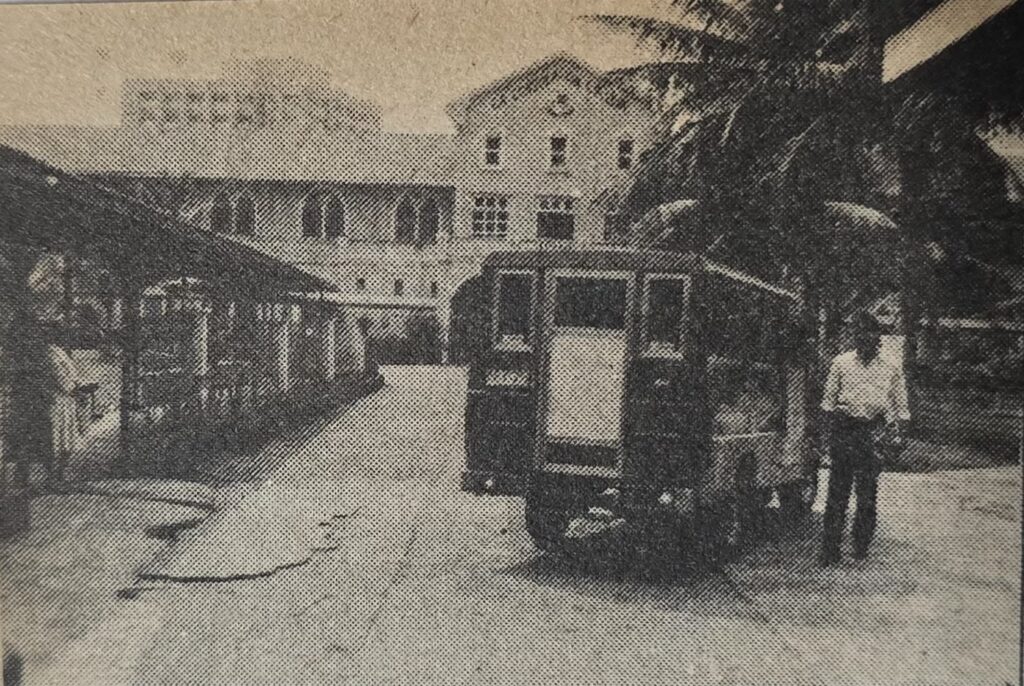
In contrast to the Holy Ghost girls, whom prewar Manila knew as “the only colegialas who don’t speak Spanish,” the niñas of La Consolacion were noted for their fluent Spanish, as was to be expected of a school famous for its veladas. These veladas were cultural variety shows featuring oratory, poetry readings, dance numbers, musical selections, and drama. The plays the niñas presented included such spectacles in Spanish as La esclava de Faviola, Maria Estuardo, and La hija de Baltazar. The readings were of Spanish poems by Recto, Bernabé and Balmori.
The Augustinian Tertiaries say that La Consolacion was not only the first local school to teach English: it was also the first to be lighted up with electricity, at a time when only streets and plazas and the tranvia (or trolleycars) had electric lights. The school that opened on Calle San Sebastian in 1901 with a dazzle of electricity had city folk marveling how “modern” were these Augustinian Sisters, with their classes in the idioma Gringo and their bombillas de luz electrica.
On what’s the Mendiola brookside area was a large block of marsh extending from the banks of the estero to the huge exposed waterpipes hogging the alley called Tuberias (now C. Aguila). This mudland, owned by the Estrella del Norte, the luxury store on the Escolta, was used to grow zacate, the fodder of calesa nags.
In 1919 the Benedictine monks acquired this fodder land as the new site for their boys’ school. Since it opened in 1901 the Colegio de San Beda had occupied a small lot at the corner of Arlegui and Tanduay in Quiapo, and this location had become too small for the fast-growing boarding-school.
The Mendiola property the Benedictines bought in 1919 for ten pesos a square meter extended from the north bend of the estero all the way down to San Rafael Street. Had this lot been kept intact, San Beda would have had a campus double in size to what it has now. Even when the opening of Calle Mendiola divided the property in two, the split could have been used to make academic sense, with the northern half (the present San Beda) occupied exclusively by the prep school, and the southern half developing into a university campus. And San Beda would have entirely occupied all this west half the Mendiola area. But it was not to be. In the 1920s, needing money to set up a printing press, the monks sold the southern half of the property to Centro Escolar, which built an annex on that site and would later transfer its entire campus to Mendiola, abandoning the old original motherhouse on Azcarraga.
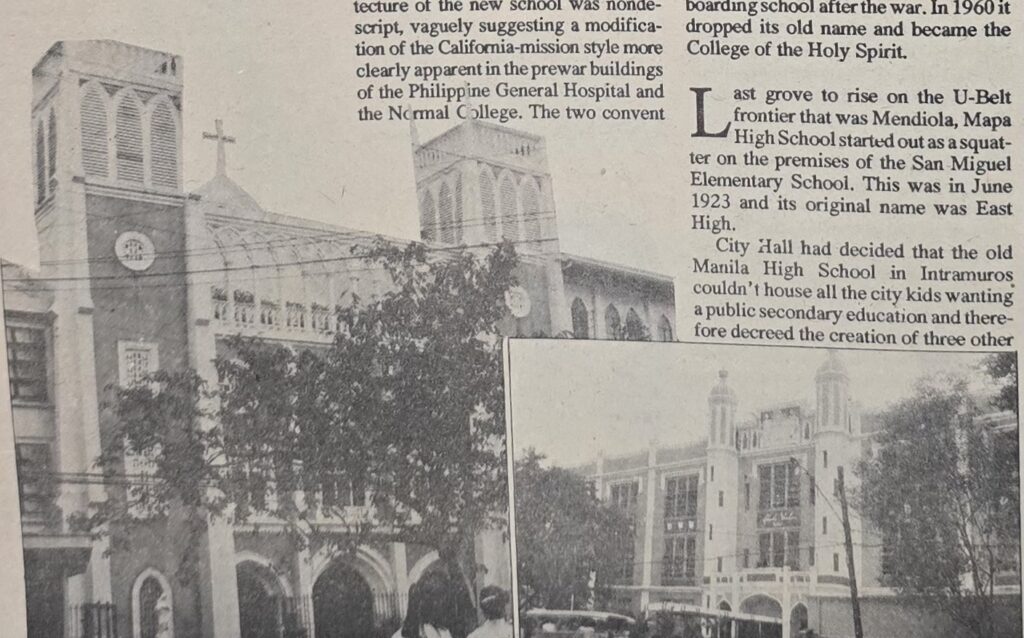
Not till 1925 did the Benedictine monks begin building on Mendiola, and what they set up was an architectural rarity: for the abbey school of San Beda is one of the few gothic structures in the Philippines. The abbey chapel was completed first, on January 12, 1926. The schoolbuilding that rose to the right of it was three stories high, with 14 classrooms and polished hardwood floors.
As late as 1928, the backyard of San Beda was still weedy swamp, but that year saw the removal of this last vestige of the ancient bog. Mud from the estero was carted into San Beda to fill up its campus, with the monks paying a peso for each cubic meter of silt. Some 15,000 cubic meters of these filling materials were brought in by two wagons drawn by carabaos. On the reclaimed land the monks built a football field and a pair of swimming pools that cost P44,000. No other school then boasted a swimming pool, and San Beda became renowned for its champion swimmers. Also worth its cost was the football field: San Beda swept all the football championships in 1928, 1929 and 1930. It had won its first NCAA cage championship in 1927.
In prewar days the home of the Red Lions was, for Mañilenos, one of the dearest prides on the landscape. Visitors were taken to view the handsome gothic edifice and could be expected to gape on entering the chapel and seeing the great golden altar and the ceilingful of gorgeous frescos.
When San Beda got a neighbor across the street–Centro Escolar–the skyline of Mendiola became almost complete, but the rest of the prewar era brought more changes there. The giant waterpipes were buried at last; Tuberias (now renamed Çoncepcion Aguila) was opened to traffic; and the area behind San Beda was turned into a subdivision and quickly filled up with houses. Thus was the old bog transformed into a new suburb that’s now part and parcel of the U-Belt, being mostly a dorm jungle.
When there was yet no Mendiola Bridge, the east stretch of Azcarraga (now Recto) ended in a tiny square called La Plaza de Santa Ana, alongside the Estero de San Miguel. This was then a stream so clear you could see the pebbles at the bottom–but it’s now so black and stinking it’s one of the most repulsive sights in the city.
Azcarraga was then a lovely street shaded by giant acacias and rivaling R. Hidalgo in the splendor of its mansions. Here stood the houses of such patrician families as the Carmelos, the De los Reyeses, the Padillas and the Arces. At the corner of Azcarraga and Gastambide was the Club Carambola, where the young blades played billiards in the front rooms, card games in the back rooms. Beside it was the old Centro Escolar de Señoritas, whose girls were famous for their good looks, their brains, and the elegance of their Spanish. The original Centro was a squat three-story building laced with fire escapes–and so many Lotharios tried to climb those fire escapes Doña Librada Avelino, the foundress, had to ask for a special police derail to guard her internas from naughty swains.
An alumna of that original Centro Escolar is Sarah Kabigting, who was enrolled there in 1916, at age eight, as a boarding student.
“The street where stood centro was still called Azcarraga and was not yet joined to any bridge across the estero. Across the estero was a vast swampy expanse of mud and garbage dump, execrated as a health hazard because it bred mosquitoes. No constructions there yet–no Calle Mendiola, no Holy Ghost College, no Centro Escolar annex. Just mud, mud, mud, and the piles of garbage.”
The brook there was variously known as Estero de San Miguel and Estero de Tanduay, but Sarah Kabigting says that in her time it was called Estero de la Santa Cruz.
“It was not until 1920 that the city decided to do something about that estero, whose overflowings kept such a large tract of land unusable. The estero was embanked, a bridge was built over it, and the area we now know as Mendiola was developed as a subdivision. At that time the popularity of the Centro Escolar was peaking: it was considered a top choice by parents who didn’t want a very strict convent-school education for their daughters, like that available at the Assumption Convent, but still wanted as tony a finishing school.”
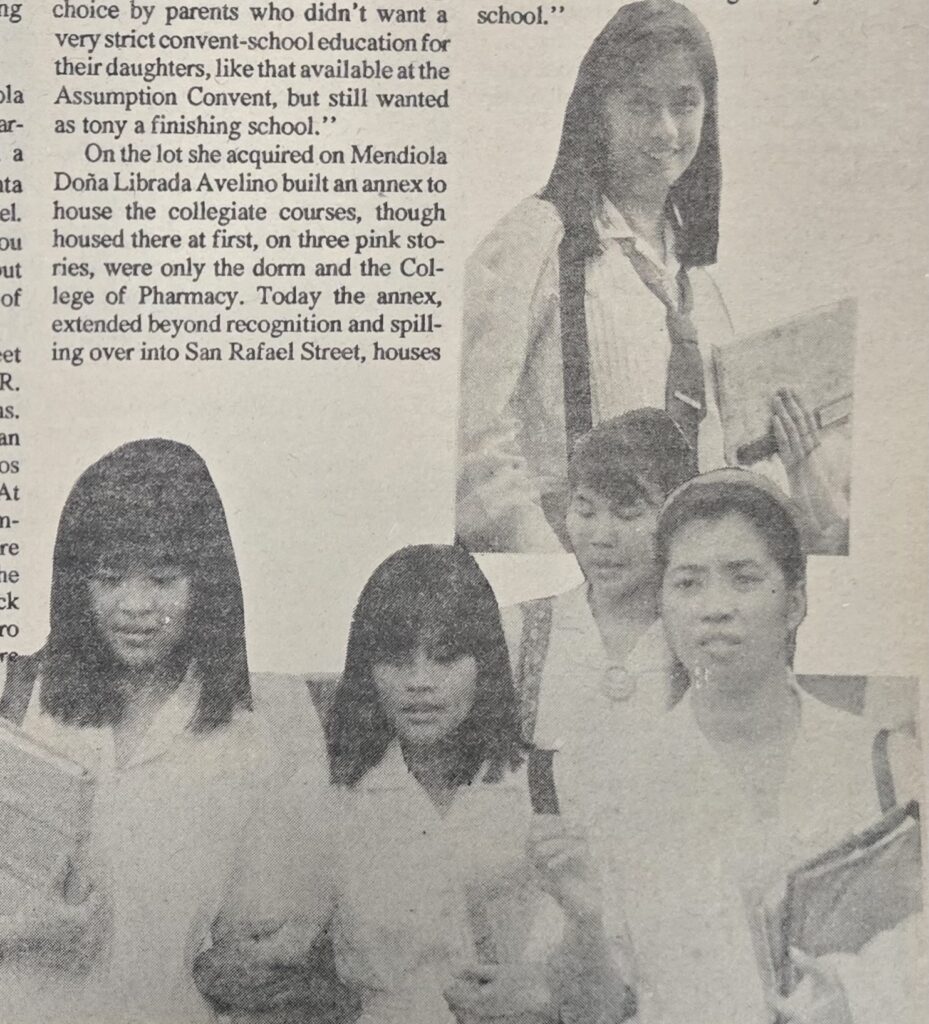
On the lot she acquired on Mendiola Doña Librada Avelino built an annex to house the collegiate courses, though housed there first, on three pink stories, were only the dorm and the College of Pharmacy. Today the annex, extended beyond recognition and spilling over into San Rafael Street, houses all the colleges of the university.
Besides that annex, Doña Librada also acquired a mansion in the heart of genteel old San Miguel, as a dorm for “internas especiales,” or deluxe boarders. Doña Librada was nothing if not perceptive and she saw that in the 1920s the Philippine middle class was rich enough to splurge. So, for high school, the young Sarah Kabigting found herself an “interna especial” at that luxury dorm.
“My father was not wealthy but he earned a fairly good salary as provincial treasurer; and my mother had many profitable sidelines. Besides, we were only two sisters in the family. So my father thought we would give me a break by putting me in the especiales group after years of being just a regular Centro Escolar interna.”
She liked the grandeur and the speciality. The dorm used to be the Roxas-Gargollo mansion.
“It was done in the Moorish style: carved doors, beautiful wide stairs of polished narra, a vast azotea where we spent our hours of recreo. The perfume of jasmine filled the air. I spent the four years of high school in that magnificent building where we were treated like little princesses. We did not have to rise for chapel at five in the morning because we had our own little chapel just beneath us. Our clothes were laid out for us in the morning and there was an agraciada, or charity student, for every four of us, to help us get ready for school.”
Ah, them were the days! A Moorish palace for a dorm! In the present U-Belt you’d be lucky to get bed space wide enough to breathe in. And don’t you expect any perfume of jasmine in the air–not with all those toilets that don’t flush!
Almost a decade had La Consolacion been on the scene before Mendiola got its second colegio. In 1920 the College of the Holy Ghost opened its doors on that shady tree-lined corner where Mendiola was cut off by Calle Aviles. This new colegio put the stress on English and not on Spanish because it was run, not by Spanish or Filipino Sisters, but by Teutonic members of a congregation called the Servants of the Holy Ghost, more familiarly known as the German Sisters, though many of them were Dutch.
They were red of face and busty of bosom, and wore white habits and stiff oval headdresses. Their English was guttural–“Holy Marrrry, Motherrr of Gawd”–and the blue of their gaze was arctic; but under the capacious bodices beat a heart of gold, as their “Old Girls” now aver with a sigh.
Those girls wore beige uniforms with twin pleats in front and behind, and white marinero collars. Grade-schoolers wore black shoes and white socks. High-schoolers wore black shoes and long white cotton stockings. They shocked the German Sisters when, going home in the afternoon, they rolled down their stockings. That, said the Sisters, was equivalent to taking off your panties in public!
Another taboo was the school gates during the school day: no girl might step past those gates until classes were dismissed. During recess the girls were supposed to snack on what was available at the canteen. But growing girls have a fickle appetite and it was all too easy to weary of German fudge, German buttered bread, German cookies and German sweets. So, many a reb would sneak to the taboo gates, climb them to their grilled tops, and from there wave to the ice-cream vendor outside on the sidewalk. You risked expulsion for a stick of popsicle.
The German Sisters who founded Holy Ghost arrived in Manila in 1913, in Maytime. They had come at the urging of Manila Archbishop Harty, who saw the need for a girls’ school not identifiable with the old convent schools of the Spanish era. The Sisters were lodged at 663 Calle Legarda, a private residence the archbishop had rented for them. There, on June 17, 1913, the Sisters opened the school dedicated to the Paraclete. They had a hard start, being without funds. When Archbishop Harty visited them he found them using wooden boxes for chairs because they could not afford furniture! But their school was such a zoomer they were presently buying the 12,000 square meters of rich mud on Mendiola, comprising the entire block from Concepcion Aguila to Aviles. The new Holy Ghost College that rose on Mendiola was a concrete three-story edifice that, curiously enough, showed no touch of German style nor yet of the neo-classic the Americans were then popularizing in the Philippines. The architecture of the new school was nondescript, vaguely suggesting a modification of the California-mission style more clearly apparent in the prewar buildings of the Philippine General Hospital and the Normal College. The two convent schools across from each other on Mendiola–La Consolacion and the Holy Ghost–are both modest of architecture; their loveliness lies in the lawns and gardens they coaxed out of primeval mud.
Recalls Maria Luz Itturalde, who was at the Holy Ghost when it was just beginning:
“The Sisters early brought us to an awareness of and reverence for the beauty of nature–the unfolding splendor of grass and flower glistening with morning dew. How we gloried in the riot of color that were the flowers lining the tennis court. As we toured the garden we touched the soft surface of violets on the vine and watched the changing patterns on the ground wrought by the shadows of leaves stirred by a breeze. As we lay on Mother Earth we enjoyed the sigh of birds on the wing outlined against the azure sky. Sometimes we listened to the steady patter of rain on the rooftop and dreamed as we took the afternoon nap decreed by the Sister in charge. Those were childhood’s golden days; recalling them brings pain at the thought of the transience of time.”
When Holy Ghost celebrated its golden anniversary in 1963, it had a student body of over 3,000, a faculty of close to 200, complete college courses in chemistry, education, commerce, pharmacy, home economics, music, the fine arts and the liberal arts. Classes were conducted in five buildings; and there were libraries, study halls, canteens, playgrounds, an auditorium and a chapel. But long vanished were the dorms and refectories for the internas. Holy Ghost ceased to be a boarding school after the war. In 1960 it dropped its old name and became the College of the Holy Spirit.
Last grove to rise on the U-Belt frontier that was Mendiola, Mapa High School started out as a squatter on the premises of the San Miguel Elementary School. This was in June 1923 and its original name was East High.
City Hall had decided that the old Manila High School in Intramuros couldn’t house all the city kids wanting a public secondary education and therefore decreed the creation of three other high schools: North High (in Santa Cruz), West High (in Tondo), and East High (in San Miguel). The old Manila High in Intramuros became South High.
In August of 1923 East High moved to its own premises: the lot running from Mendiola to San Rafael, next door to La Consolacion. Utterly inadequate as academe were the two wooden buildings that were the original East High. There were hardly any tables, only a few desks, and a scarcity of blackboards, but the principal was an American: John J. Carl, one of the Thomasites. Students came to school in what would now be termed formal wear: the girls in long white dresses that had to be hemmed below the knee; the boys in white drill suits with tie. Manila must have had a cooler climate then or how could those boys have withstood an all-day education in coat and tie? Mercifully, the day was past when female teachers were required to wear the baro’t saya in school, although on gala days (like their birthdays) the ma’ams appeared in class garbed in a terno. The sirs were, of course, always in a suit with tie.
East High was without a schoolyard: its “campus” was Calle San Rafael. But in the 1920s the high-schoolers had another lolling place: the enormous waterpipes running right beside the school and which could be walked, straddled, lain down on, and used as a table for reading, writing or eating.
School year 1930-31 brought the school a new name and a new head. City Hall renamed the four public high schools of Manila after eminent chief justices, and East High became the Mapa High School. Mr. John J. Carl died in office in 1929 and was succeeded in 1930 by Mrs. Sarah England. Mrs. England would herself become an institution, a familiar figure on the streets of San Miguel until 1951, when she retired after some 16 years of Philippine service. She it was who founded the Mapazette, the school paper remarkable for its brilliant English. Indeed, under Mrs. England, Mapa the proletarian school rivaled in prestige the lordier halls of San Beda.
A time would, in fact, come when Mapa High would make all its academic neighbors on Mendiola look like chickenfeed. In the later 1950s it had seven annex buildings, an enrollment of over 11,000, a faculty 500 strong, and a yearly budget of over a million pesos when the peso was hard coin. Mapa had become “the biggest high school in the world.”
To wind up this report on the making of the U-Belt: one should cite the role of two small bridges–the ones on Arlegui and Mendiola–which opened up this academic frontier and may be said to have been the avenues through which that frontier spread forth, overrunning and overthrowing such old havens of gentility as Calle R. Hidalgo, Legarda, Azcarraga, Lepanto and Morayta.
Anyway, you now know where the U-Belt came from: it sprang from a bog. —Written by Quijano de Manila. Published in the Philippine Graphic on July 9, 1990.

Graphic Archive
The Graphic Archive contains the articles and literature published in the Philippines Graphic since it was first established in 1927.