By 4 p.m. the clouds had dispersed and the sun shone over Manila Bay. This looked like a good omen on the historic birth of the Republic 67 years ago.
THE town of Kawit in Cavite Province assumed a festive air that Sunday morning of June 12, 1898. Local bands had been promenading around the streets since sunrise playing a medley of gay tunes, some Spanish, others Mexican, mixed with kundimans and native airs. The blue smoke from a thousand breakfast fires curled lazily upward from as many nipa homes in what promised to be another damp and sultry day, for the dry season had come to an end and the torrential rains had already begun.
By noon several hundred visitors had entered the town on foot and aboard carretelas headed for Calle Real where stood the big house of the erstwhile capitan municipal and now dictator, General Emilio Aguinaldo. The majority of the newcomers were military personnel: the soldiers barefoot with white blouses and red trousers, wearing wide-brimmed straw hats, and carrying a Remington or a Mauser rifle captured from the enemy, with the inevitable sharp bolo hanging from their waist; while the officers, with white tunics and trousers tucked into boots and mounted on native horses, wore caps on their heads and a sword and holstered revolver at their sides. The score of civilian visitors who rode in horse-drawn carts wore ties and dark coats befitting the solemn occasion — for that day had been set for the proclamation of the independence of the Philippines.
The central figure at the Aguinaldo mansion was the general himself: a slight figure of medium Filipino height, in grayish uniform but without any sidearms or decorations, busily engaged in receiving visitors and chatting with each and everyone briefly to make them feel at home. His wife, Doña Hilaria, and mother, Doña Trinidad Famy, shared with him the duties of host. In another room, around a large table, a middle-aged portly man was seated scanning foolscaps of paper that he intermittently read to the earnest group around the table, making deletions, additions and corrections; and then turning them over to an amanuensis, a professional scribe, whose fine penmanship made every word legible for all future generations to read. The man was Don Ambrosio Rianzares Bautista, an eminent lawyer who had been imprisoned at Fort Santiago shortly after the outbreak of the revolution in August of 1896, and whose patriotism and devotion to the rebel cause was beyond question.
Lunch was served, and the visitors trooped to the dining room where a large variety of dishes were piled on large platters and tureens. The inevitable lechon or roast pig, tinola or chicken broth, chicken and pork adobo, leche flan or custard, and a dozen other viands were scattered around the table, while fleetfooted servants kept the dishes continually replenished. Down below, in the extensive gardens of the house, visitors who did not rate either in the military or civil hierarchy sat on long bamboo benches and tables and helped themselves with fingers on food piled in heaps on fresh banana leaves.
A feeling of optimism permeated the gathering. At long last their cherished desire for independence was about to be realized. For nearly a year and a half, they had fought the Spanish troops, from August of 1896 to December of 1897, and accepted the truce of Biyak-na-Bato because the war had reached a stalemate, with neither side making much of a headway against the other. Then, like lightning on a clear summer day, war had broken out between Spain and the United States of America on April 26, 1898. It seemed to the Filipinos that Divine Providence had taken a favorable hand in their struggle for independence.
EVENTS IN HONGKONG
Commodore George Dewey, anchored at Mirs Bay off Kowloon in the British colony of Hongkong, had sent an emissary, a Jewish businessman, to sound out Aguinaldo, who was then in voluntary exile with a score of his followers on that island. But after being served with papers of a lawsuit brought by his former secretary of the interior, Isabelo Artacho, who claimed half of the ₱400,000 that the rebels had received from the Spanish government under Governor General Fernando Primo de Rivera, General Aguinaldo had precipitately fled to Singapore, and missed the Battle of Manila Bay on May 1, when the remnants of the once invisible Spanish Armada met their tragic end.
The Hongkong Junta had sent General Jose Alejandrino to accompany Commodore Dewey to Manila in an attempt to arouse popular support for the rebel cause and thus weaken Spanish power; for, although Dewey controlled the sea, he had no troops to engage the Spaniards on land. But the tall and lanky Pampango general, who had been chosen mainly because of his knowledge of the English language and thus could deal directly with the Americans, failed to generate enthusiasm among the rebels in Central and Southern Luzon.
Not until Emilio Aguinaldo in person landed in Cavite on May 19 aboard the cutter McCullough did the inhabitants of the surrounding countryside rally feverishly to their cause. A series of local uprisings in a dozen towns in Cavite province was successful. Then Dewey turned over 2000 rifles and the corresponding ammunition to Aguinaldo for the use of the rebels. These rifles were bought through the American consul in Hongkong, ROunseville Wildman, with part of the money paid by Primo de Rivera, and transported to Manila aboard one of the American gunboats.
The general order for an uprising on May 24 had brought encouraging results. Filipino troops under the flag of Castile, a great number of whom were mustered to meet the American threat, joined the ranks of the insurgents; whereas Spanish detachments, demoralized by the defeat of their navy and the appearance of American power, offered only token resistance against the insurgents. Dewey had refrained from committing himself or his country to the rebel cause since the Battle of Manila Bay, but the Filipinos wanted to believe that the great republic of North America would side with them in their aspirations to be free. Earlier hints by the American consul general in Singapore, Spenser Pratt, and subsequent conversations held by Dewey with Aguinaldo led the Filipino chieftains to believe that the Yankees would give them the same measure of self-government as the inhabitants of Cuba.
DEWEY DIDN’T ATTEND
Thus, the decree calling for the proclamation of independence on that day, issued a week earlier, invited the leading American representatives to attend the celebration; Dewey, however, alleged that as it was “mail day” he would be busy inditing dispatches for Washington and would not be able to be present. Nevertheless, a certain Col. L. M. Johnson of the artillery corps not only was present but affixed his signature to the document of the proclamation. Was he a spy sent by Dewey, or did he attend on a personal basis to satisfy their curiosity?
Black clouds had covered over the countryside from late morning, and shortly after lunch time a torrential downpour fell. This dampened the spirits of the crowd; but by 4 o’clock in the afternoon the clouds had dispersed and the sun shone above Corregidor Island at the mouth of Manila Bay. It seemed like a good omen, and the spirits of the crowd brightened considerably.
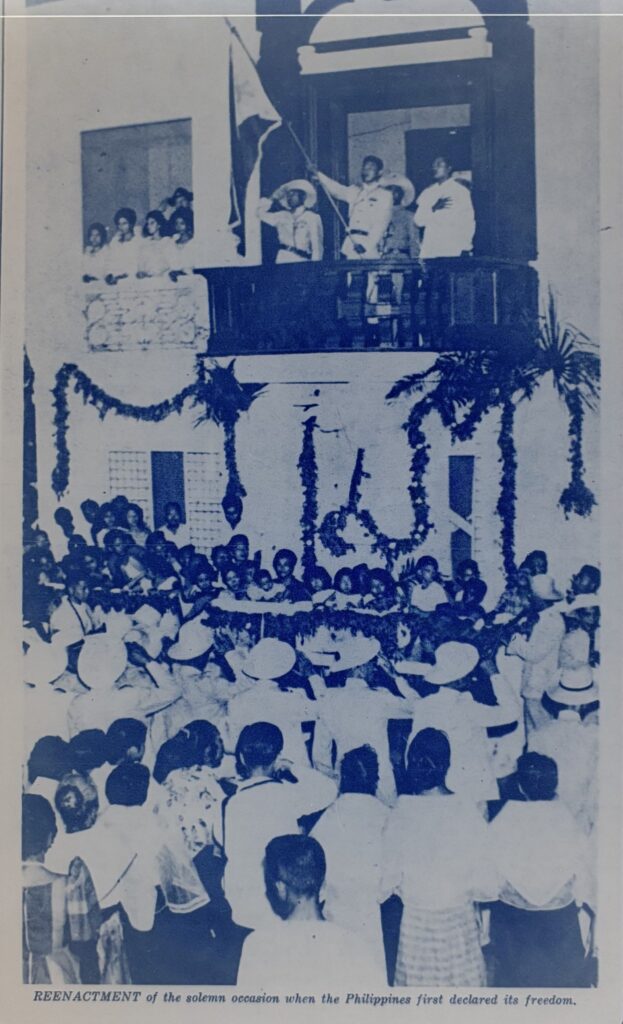
A gaily decked carretela carrying the new flag of the Philippines, sewn meticulously by hand in Hongkong some weeks earlier by Doña Marcela de Agoncillo, wife of Don Felipe, leader of the Hongkong Junta, arrived in front of the Aguinaldo house, carried by an officer with his escort. For the last few days, ever since its arrival from Hongkong, this flag had been zealously guarded at the residence of the late Maximo Inocencio in Imus, about half an hour’s drive by horsecart to Kawit, or Cavite Viejo as the Spaniards called it. Maximo Inocencio, an elderly patriot who had been executed by the Spaniards in September of 1896 for the uprising in Cavite, was highly respected throughout the province for his integrity and republican principles. Aguinaldo could find no greater tribute to the fallen hero than by depositing the new flag at his residence in Imus. The flag was then brought up the stairs to the small balcony facing the street.
PROCLAMATION READ
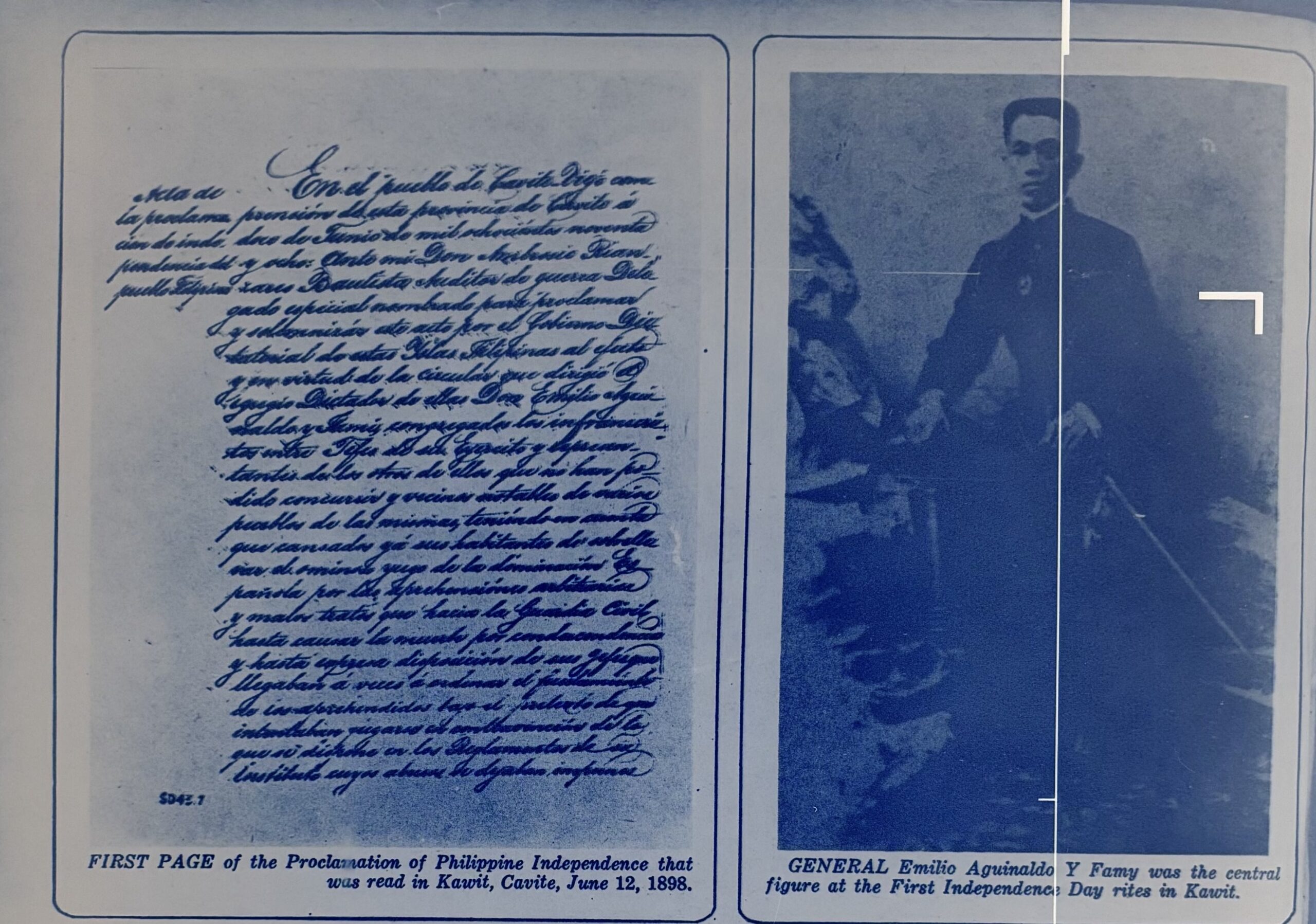
The gray-haired Ambrosio Rianzares Bautista stepped forward on the balcony, with foolscap in his hands, and after addressing the guests and the people began to read in a sonorous voice the proclamation that he had so laboriously worked over in the other room.
“We proclaim and solemnly declare,” he said in part in impeccable Castilian, “in the name and by the authority of the inhabitants of all these Philippine Islands, that they are and have a right to be free and independent; that they are released from all obedience to the crown of Spain; that every political tie between the two is and must be completely severed and annulled; and that like all free and independent states, they have complete authority to make war, conclude peace, establish treaties of commerce, enter into alliances, regulate commerce, and execute all other acts and things that independent states have the right to do so. Reposing confidence in the protection of Divine Providence, we mutually pledge for the support of this declaration of our lives, our fortunes, and our most sacred possession — which is our honor!”
The entire proclamation of twelve pages was rather long to read because it traced the desire of the Filipinos to be free and nullified the claim of Spain to occupy legally and morally the archipelago. But the crowd of several thousands listened attentively to every word, and broke out periodically in feverish applause and huzzas to show their approval.
Then General Aguinaldo solemnly proclaimed the independence of the Philippines, and the crowd went wild as they gave vent to their emotion. General Artemio Ricarte, known as Vibora or Viper, followed with an explanation of the meaning of the flag, which was quickly unfurled. The sun, the stars, and the colors of the new flag were described by the doughty Ricarte in Tagalog. Aguinaldo took the flag from the bearer and began waving it from the balcony to the onlookers below amidst thunderous applause and shouts of “Mabuhay ang Kalayaan ng Pilipinas!” (Long live Philippine Independence), “Mabuhay ang Republika Pilipina!” (Long live the Philippine Republic), and “Mabuhay si Heneral Aguinaldo!” (Long live General Aguinaldo).
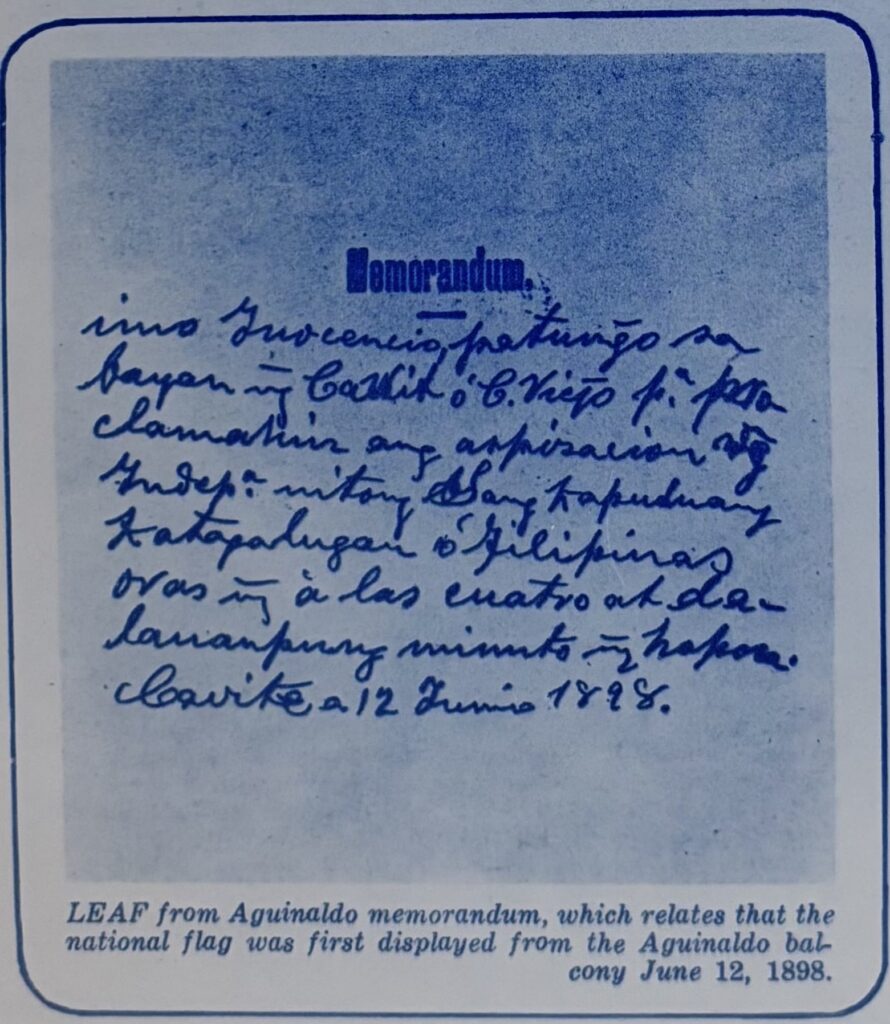
In the calendar-almanac for that year, published by Roman Ongpin, owner of “El 82,” wellknown distributor of office and art supplies, Aguinaldo later meticulously noted in Tagalog: “Ipinanaog ang Bandera nacional dito sa bahay ng nasirang Don Maximo Inocencio, patungo sa bayan ng Cawit o C. Viejo pa. proclamahin ang aspiracion ng Indepa, nitong Sang. Kapuluang Katagalugan o Filipinas, oras ng a las cuatro at dalauanpung minuto ng hapon. Cavite a 12 Junio 1898.” (The national flag was carried down from the house of the late Don Maximo Inocencio and was brought to the town of Kawit or Cavite Viejo for the proclamation of independence aspired by the Tagalog archipelago or Philippines, at 4:20 in the afternoon. Cavite, June 12, 1898.)
The band from San Francisco de Malabon, which was stationed below the balcony, now broke out into a solemn but stirring tune. This was the national hymn, but which at that time was called the Marcha Filipina Magdalo, composed by Julian Felipe, a musician from Cavite who had been commissioned by Aguinaldo a week earlier to write a tune for the occasion. The general had brought with him a composition from Hongkong, but was not satisfied with it, and asked his provincemate to do so. A day earlier Felipe showed a draft of the hymn to Aguinaldo and his staff, playing it on the piano. The latter immediately adopted it as the national hymn of the Philippines, and Julian Felipe was kept busy until that afternoon transcribing the tune for the band and then holding practise sessions until he felt satisfied with the performance of the musicians. (See also Hymn Of The Republic, page 14.)
The crowd, who had never heard the tune before, did not know how to react at first; but when they saw Aguinaldo and the leading revolutionary officers salute while Rianzares Bautista and other ranking civilians stand stiffly at attention, they realized they were hearing the national anthem played for the first time in public, and likewise saluted or stood at attention.
About that time, a group of newcomers arrived at the Aguinaldo residence carrying with them a bamboo hammock a paralytic lawyer who had been specially fetched by the general from Bay in Laguna across back-wood roads. He was Apolinario Mabini, who had been highly recommended by Agoncillo to act as the political adviser to Aguinaldo. He had written political tracts on the present situation in the islands, and his penetrating comments had attracted the attention of the rebel intelligentsia. When apprised of what had just taken place that afternoon in Kawit, he stared aghast, for the United States had not officially given any indication of recognizing the independence of their country. To proclaim the country’s independence would have been premature, he believed, for it would be revealing the stand of the Filipinos before knowing what action the Americans would take.
But he kept his views to himself for the time being, for nothing could diminish the joy of the people or rob the glory of that day when the independence of the Philippines was first proclaimed on the 12th day of June in 1898. —#
Written by Carlos Quirino. Published in the Weekly Graphic. June 9, 1965.
The republishing of this article was made with the help of the Philippines Graphic‘s historical researcher, Carlos Concepcion.
Graphic Archive
The Graphic Archive contains the articles and literature published in the Philippines Graphic since it was first established in 1927.