

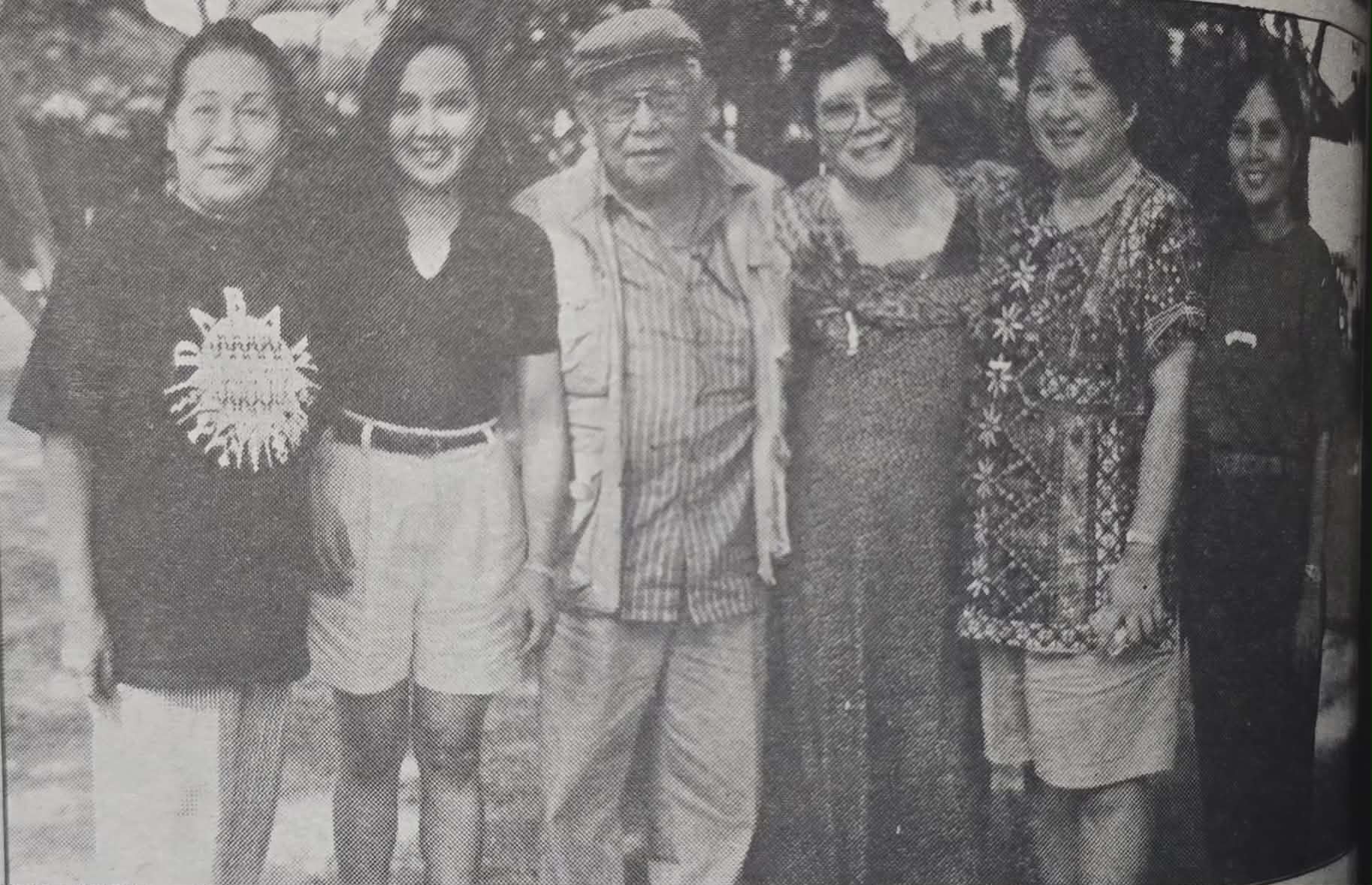
On Samal they are reminded by N.V.M Gonzalez that the country’s finest writers belong to the provinces.
It was the provinces, according to novelist N.V.M Gonzalez, that literally filled your imagination, that fired your heart and spirit, that made you the writer you have become. And for the 18 writers and eight panelists—all big names in Philippine contemporary literature—the recently-concluded 25th UP National Creative Writers’ Workshop at a scenic beach resort on Samal Island, in Davao Gulf, was indeed just the place to fire their minds, spirits and imaginations for a whole week last October.
The little huts on the white coral sand, with their cogon roofs, sawali walls, bamboo-slat flooring and porches affording a sweeping view of mountains, made the writers and panelists feel as if they were in a tribal mountain village beside the sea. The place they forget, it’s a place called Samal Island Beach Park owned by Pedro and Susan Durano, well-known in these parts for their coco-charcoal export venture.
Writing fellows came from all over Mindanao: from Jolo, Basilan, Zamboanga, South Cotabato, Lanao; from Davao and Cagayan de Oro cities. Five flew in from Manila with the UP Panelists led by Professor Jose Dalisay. It was a well-represented group of fellows for the first UP National Writers’ Workshop ever to be held in Mindanao. Traditionally, UP writing workshops had always been held in UP Diliman or in Baguio. Last year, there had been one in UP-Iloilo before the one in Davao, which was organized by the newly-established UP Mindanao.
“Often, in Manila,” N.V.M Gonzalez told some 200 literature teachers and writers during a lecture forum in the Davao Chamber building, “we forget the provinces: we forget that some of the country’s best writers belong to the provinces.” But National Artist and GRAPHIC editor-in-chief Nick Joaquin who spoke before Gonzalez, admitted that he had no other obsession but to capture the sounds and sights of old Manila when he first began writing fiction. In the 1930’s he was aware enough of his milieu, he said, to know that it was missing from Philippine writing in English. “The Manila I had been born into and had grown up in had yet to appear in our English fiction, although that fiction was mostly written in Manila and about Manila” stressed Joaquin. “The place-names were familiar enough but they conjured up no city to trigger a shock of recognition in those who knew Manila.”
To the Mindanao audience of literature lovers, it was a treat to see and listen to the Nick Joaquin in the flesh, still reeking of beer during that morning lecture which preceded the weeklong writers’ workshop on Samal Island. This was the great Filipino writer materializing, as it were, from the pages of classic novels and short stories revered by students of literature.
But Gonzalez maintained that it was really the provinces that “fired your heart and spirit and made you the writer you’ve become.” It is in Manila, maybe, where they get to be known as writers, he told his captivated audience during that lively three-hour lecture-forum. “In Manila, you get to be published and you win awards and bring home prizes—only to remember that it was really the province that had filled your imagination.”
And what brings them over to the provinces these days? “Stories are what have brought us over,” said Gonzalez. “And what are stories? They are dreams transformed into a string of imaginary events, a necklace of pearls that is ours to keep and pass on, from one generation to the next.”
It was really actually Gonzalez’s second time to come to this beautiful island in the South. He fell in love with this island resort of the Duranos probably because it reminded him of his hometown in Romblon, or Mindoro, where he grew up. He was invited for the first time to Davao by fictionist-educator Aida Rivera-Ford for the Second Mindanao Creative Writers’ Workshop early in 1994 as a guest panelist, and had his first encounter with the exotic beach park when one of the writers’ works was taken up during the last day’s session. Gonzalez occupied one of the quaint tribal huts with his wife Narita.
Said Gonzalez: “We have come again, I like to think, for good reason—here the air is pure, the sky more blue, the sea more clean and cool to the skin. Best of all, here richly laden with folklore and history are kith and kin, kindred spirits with passion, we hope, to transform our reality into strands of living truth.”
Contemporary Philippine literature is ready for new creative directions, according to Gonzalez. He remarked that Davao writers are tapping their folklore and current history more than do their counterparts elsewhere in the country. There is a sense of experiment, he said, in the use of Cebuano and its mix with Filipino and vice-versa. “We probably will be multi-lingual here, if creativity of expression were to be hugely encouraged; we would have more poetry straight from the soil, rather than a derivative one, which is the bane of too urbanized imaginations. And I like to think, because of this presentness, the grappling with the here and now of becoming Davaoeño, of belonging to Mindanao and its heritage and legacies, this literary generation will be informed by vitality for generations.”
Gonzalez cited the poetry of Davao poetess Dr. Eva Elaine Aranas as earthy, coming straight from the soil, and the Cebuana stories of Davao writer Satur Apoyon and Basilan writer Papias Apoyon as all reflective of the richness of our contemporary literature and provincial culture—the sights, sounds, idioms, passions, textures, color, etc., of some unheard of villages in the jungles and mountains of Mindanao. UP Professor Jose Dalisay also cited Apoyon’s fiction in Cebuano titled “Gutom” as one of the most “amazingly powerful” stories he had ever encountered in all the UP workshops. The theme of hunger in this story, according to Dalisay, is so universal that one can feel its power in any language the story is written.
The other Cebuano story titled “Kainit Sa Udtong Tutok,” by the other Apoyon brother from Basilan, threw workshop participants into fits of laughter, as Iligan MSU panelist Professor Jaime An-Lim translated the story into both English and Tagalog for the benefit of the Manila-based panelists and fellows. The other panelists aside from Gonzalez, Dalisay and An-Lim, were Professors Gemino Abad, Cristina Hidalgo, Ricardo Ungria, Antonio Enriquez, and Aida Rivera-Ford who also represented the Mindanao Foundation for Culture and Arts, which assisted the UP-Mindanao in organizing the first-ever UP writers’ workshop in Davao City.
This group of panelists, according to Davao fiction writer Josefina Tejada who had attended four early workshops as a fellow, was one of the most formidable put ever put together. Davao poetess Tita Ayala could only agree, adding that such panelists must mean “a really bloody workshop.” It was “bloody” all right, noted Davao Writer Margarita Marfori, whose two short stories, published in the Graphic were “massacred” during the workshop. But most fellows admitted that, though it was painful for their works to be so “murdered,” they became better writers after the workshop—and for that, they were grateful that they had been selected as fellows.
For Gonzalez, the “Papa Hemingway” of Philippine literature, he simply just couldn’t let go of his memories and involvement in Davao, “in a way that is private but archetypal and this is much more so now, given the writing and teaching on one hand and on the other hand the strengthened sense of community that you’re planting in our hearts, through your welcome and unbounded hospitality. Perhaps we have more here at stake than what the gods have been used to setting up for the likes of us. It is their way of letting us in on the future waiting to be lived.”
Written by Aurelio A. Peña. Published in the Philippine Graphic on March 18, 1996.

Graphic Archive
The Graphic Archive contains the articles and literature published in the Philippines Graphic since it was first established in 1927.