
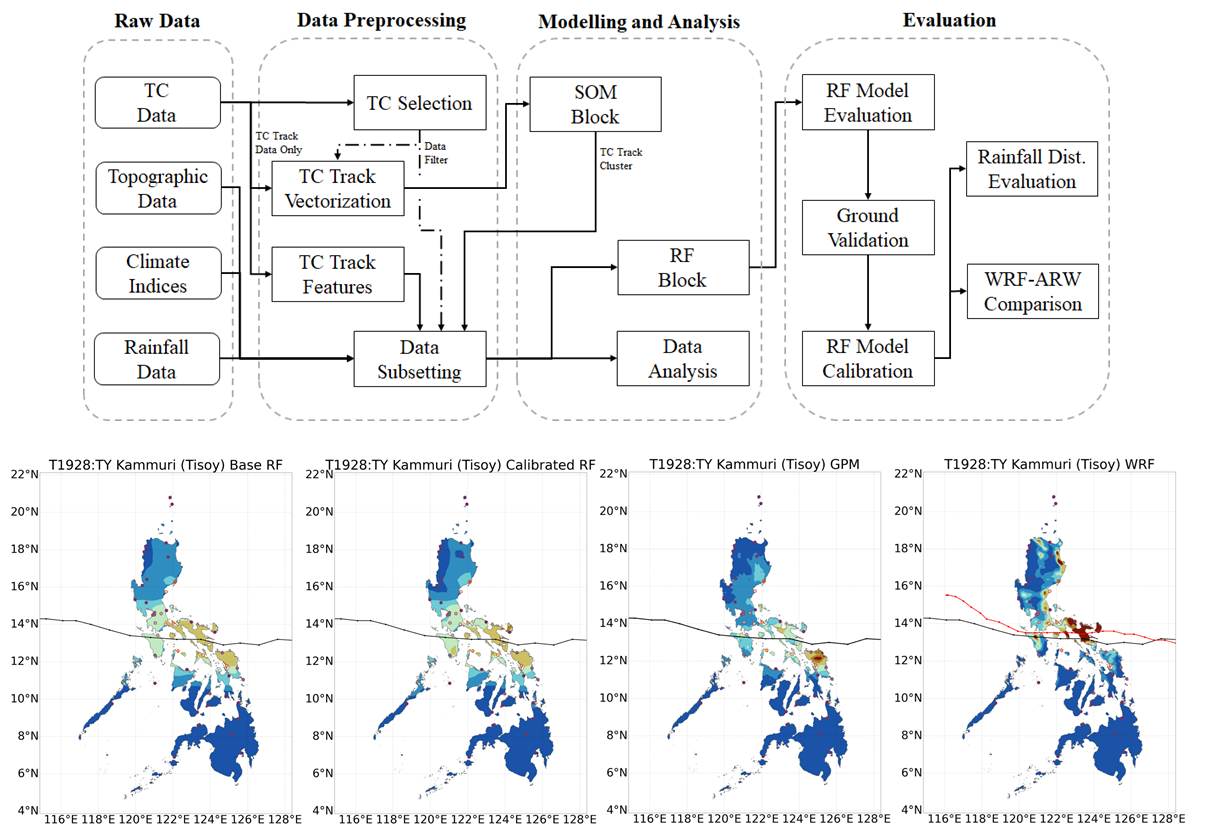
The Philippines is often hit by tropical cyclones (TCs), which bring heavy rainfall that can cause floods and landslides. More often than not, the patterns of TCs repeat. For instance, if a typhoon with a certain amount of rainfall passes through Central Luzon, a similar typhoon that will pass through Central Luzon again in the future is likely to have the same amount and distribution of rainfall.
This piqued the interest of Cris Gino Mesias and Dr. Gerry Bagtasa of the University of the Philippines Diliman College of Science’s Institute of Environmental Science and Meteorology (UPD-CS IESM), who developed an AI model that links past TC tracks to recorded rainfall. The AI model still uses the same information about Philippine typhoons, but can spot patterns more quickly and efficiently.
“Most predictions of TC rainfall rely on dynamic models, which are very difficult to run as they take a lot of computational resources and require high-performance computing,” Dr. Bagtasa shared.
Compared to previous models, the AI model developed by the UP scientists can run within minutes on a laptop. “When we assessed the AI model, its predictive skill was comparable to a dynamic model that we regularly use. The AI model had better skills for extreme rainfall from tropical cyclones,” he added.
Dr. Bagtasa explained that the distance of the TC and its duration are the parameters that most influenced the AI model’s rainfall predictions, and these mainly determine who will be affected by heavy rains and how much rain the country will experience. For instance, a typhoon near Batanes would not be expected to cause heavy rains in Mindanao. Slow-moving TCs that spend more time over land also tend to bring more rainfall overall.
“This AI model, admittedly, is not perfect. But it can add to the suite of rainfall forecast models available to equip our disaster managers with more information on impending hazards,” he said. The model can also be updated with fresh data, allowing it to relearn and improve its accuracy.
The AI model developed by Mesias and Dr. Bagtasa is different from AI models like ChatGPT and Gemini, which are known as large language models (LLMs). Dr. Bagtasa emphasized that not all AI systems are the same, making AI literacy an absolute necessity. “Some AI models, such as those for weather forecasting, can be useful and more efficient than conventional methods. But there are also some, like LLMs, that consume so much energy, leading to environmental impacts that are harmful to the planet,” he cautioned.
The study, titled “AI-Based Tropical Cyclone Rainfall Forecasting in the Philippines Using Machine Learning,” is published in Meteorological Applications. The research was also supported by the Department of Science and Technology–Accelerated Science and Technology Human Resource Development Program (DOST-ASTHRDP) and the DOST-Philippine Council for Industry, Energy, and Emerging Technology Research and Development (DOST-PCIEERD). — By Eunice Jean C. Patron
For interview requests and other concerns, please contact media@science.upd.edu.ph.
References:
Mesias, C. G., & Bagtasa, G. (2025). AI‐based tropical cyclone rainfall forecasting in the Philippines using machine learning. Meteorological Applications, 32(4). https://doi.org/10.1002/met.70083
Started in 1927, the Philippines Graphic is the longest-running printed magazine of national circulation that provides relevant news and features and promotes Philippine literature.

, which bring heavy rainfall that can cause floods and landslides. More often than not, the patterns of TCs repeat. For instance, if a typhoon with a certain amount of rainfall passes through Central Luzon, a similar typhoon that will pass through Central Luzon again in the future is likely to have the same amount and distribution of rainfall.)