
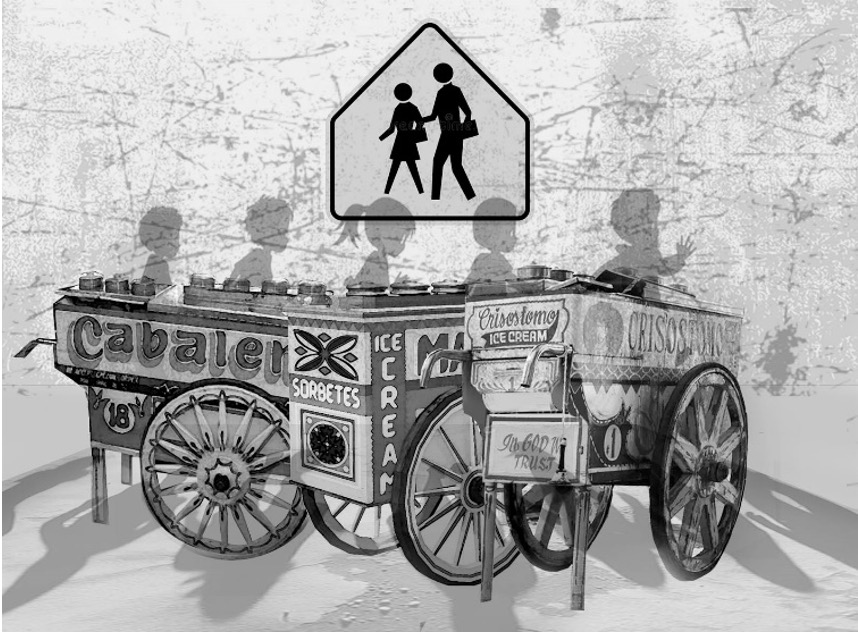
Sophia followed the sound of the steady tinkling of a handbell coming from the gate of the kindergarten grounds. She peered through the gate’s wire mesh for a good view of the happy commotion around the sorbetes cart. Outside, the schoolchildren scrambled for a serving of “dirty ice cream” just as their fetchers arrived. They returned to the school premises beaming with childhood wonder, eyes fixed on their wafer or sugar cones heaped with scoops of sorbetes. They couldn’t care less about the ice cream stains that soiled their pastel-colored uniforms.
The dirty ice cream vendormade sure to stop by at about the same time every day, just before dismissal. He was popular, especially among the kindergarten students, and so was his bright yellow cart whose colorful umbrella provided adequate shade from the searing heat or when it rained. When the weather permitted, the kindergarten children flocked to him, angling for attention and a quick cold serve, their nannies at their heels trying to keep them in their line of vision and within close range.
No matter the weather, the sorbetero’s visits were always happy times, but not for Sophia who had to contend with watching the other children while she controlled her craving from a safe distance. Her mother forbade her from having any food that was sold in the streets. She said Sophia didn’t have the constitution for it. The truth was that Sophia would’ve gone straight to the doctor’s clinic for a case of tonsillitis, if she ever ate anything cold or sweet, and a sore throat and fever would’ve kept her at home for days.
There were days when Sophia made an exception, like her best friend Margaux’s birthday, when she had her first taste of ice cream cake.
Margaux’s mother brought the fancy frozen dessert to school for her class, that day, along with spaghetti and buckets of fried chicken. The food was served on the long tables of the school cafeteria, where they sat on slatted benches tied with colorful balloons they could take home with their candy-filled goody bags. The schoolchildren gasped when Margaux’s mother brought out a birthday cake: a decadent chocolate ice cream cake, topped with chocolate frosting, Oreos and colored sprinkles, lollipops and other candy decor around a merry–go–round. Everyone got a slice of the frozen treat after singing the birthday song and Margaux blew her birthday candles.
Sophia sat plaintively as she watched Margaux and the other children enjoy spoonfuls of the chocolate-flavored ice cream. With a mix of childhood anticipation and regret, Sophia patiently waited for her ice cream slice to turn into a pool of gooey chocolate sludge. It was the only way she could have her serving. Some of her classmates stared, but Margaux didn’t mind knowing Sophia’s food restrictions. Margaux had been warned that Sophia couldn’t eat ice cream that wasn’t bought from a store.
Sophia’s mother insisted that no one knew how street food – not even the tempting sorbetes – was made. The dirty ice cream came in popular flavors and was likely hand-churned: cheese and chocolate or avocado, ube, and mango—depending on the fruits in season. Sophia’s mother insisted it was “dirty” because there was no telling how it was made or with what, enough reason for Sophia to stay away from it, even if the look of satisfaction on the other children’s faces convinced her that the cold, delicious treat was anything but that. In the hands of other school children, the frozen mounds of dirty ice cream were mouthwatering treats.
On some days, the nannies themselves would give in and help themselves to a serving of dirty ice cream outside the school grounds,and so would the school staff who happened to be similarly inclined.
Mr. Melencio, the school custodian, was one of the regular faces around the ice cream cart. He liked to squat and pretend to be one of the children falling in line. Sometimes, when he was in a joking mood, he would announce that the sorbetes had run out and that the children should come back the next day. At other times, he would tell the children that he was treating them to ice cream before calling his own bluff. The children would let out a collective sigh; the girls would giggle, the boys would push and shove, much to Mr. Melencio’s amusement. He was old enough to have children of his own; it was hard to tell if he did, but he was clearly fond of children.
This could very well have been the reason why Mr. Melencio didn’t think twice about letting Sophia and Margaux into the school garage the day they wandered beyond the kindergarten grounds.
The girls had sauntered past the kindergarten playground and the kalachuchi trees, then peered through a window of the small mausoleum–– a monument for the school’s missionary founders. The path took them beyond the dividing fence that led to an unvisited part of the school grounds. The school garage that doubled as a stockroom was situated at the end of the school driveway that led back to the main gate. It was a familiar sight on campus but was easy to miss as the school buses shuttled students to and from school, picking them up in the same designated stops where they were dropped off. No one knew how the school garage, which was off limits to children, looked.
The garage door creaked open as Sophia and Margaux looked in. Mr. Melencio was alone, checking the metal fittings under the pickup.
Alerted by the creaking door, he looked up from under the vehicle to see his surprise visitors: “Can I help you, girls? Shouldn’t you both be in class?”
“We’ve been dismissed, but our rides aren’t here yet,” Sophia replied. “What are you doing?”
“I’m just making sure this old vehicle is in good shape,” Mr. Melencio said, helping himself up from the roller platform.
The pickup was an efficient and dependable vehicle. It was the same one that they had seen Mr. Melencio drive around the campus to transport school supplies.
“You girls shouldn’t be staying out in the sun,” he said, wiping his grease-soiled hands on a rag as he walked towards the open garage door. “It’s hot out there. Come on in,” he said, quickly glancing behind the garage door, before ushering the girls inside the garage and pushing the door closed. “Feel free to look around. You may stay. Just don’t touch anything,” he cautioned. He ambled towards his desk and picked up his tumbler for a drink of water.
Sophia and Margaux squinted upon entering the premises, allowing their eyes to adjust to the milder light inside the room from the blinding glare outside. There were no windows; only air vents. The air was stale with the musty smell of newspaper, stacks of which were arranged in rows and lined up against the wall alongside cardboard boxes and sacks filled with soda bottles. Boxes of school supplies were neatly arranged on a long slotted metal rack on one side of the room. They were carefully labeled as if by someone who had a lot of time in their hands. Tires were piled on top of each other behind the pickup, much like those that were alternately placed in rows for the makeshift obstacle course in the kindergarten playground; the school garage might very well have been Mr. Melencio’s own.
The girls scanned the labeled boxes on the metal rack of the school garage. The boxes read: stationery, notebooks, music pads, pencils and pens, crayons, pencil cases, bags. Some of the items were marked with the school logo; all of them were sold at the school bookstore. The girls stopped when their eyes came upon a small clump of blond hair in one corner of the lower rack. It reminded them of a cat’s tail but this one didn’t move. Sophia reached back and pulled out a doll the size of her arm. She gave Margaux a bewildered look. What was a doll doing in the school garage? It would have made more sense to see it in the playground or sandbox, left in a frantic rush by a harried child.
“Hay, naku…I told you not to touch anything…” Mr. Melencio said disapprovingly.
Stunned, as if upon the sudden discovery of a well–kept secret, Sophia and Margaux held their breath and tossed the doll back on the rack.
“Were you looking for this?” Mr. Melencio asked.
The girls cautiously turned to see the look on the custodian’s face. Instead of a scowl, he had Groucho glasses on – a one-piece disguise with a plastic nose, brows and spectacles – and his palms were turned up in dramatic flourish. “Ta-dah!”
The girls let out a sigh of relief and burst into nervous laughter.
It was not unlike Mr. Melencio to fool around. The first time Sophia and Margaux saw him outside the school garage, he had one foot on the roller platform, riding it like a skateboard, the other foot kicking against the cement road, and flailing his arms in the air with wild abandon. They had watched him disappear into that same garage many times before, while pushing a cart loaded with newspapers or packages or following a heated argument with a co-worker who couldn’t follow instructions. He didn’t seem particularly friendly with people his age.
That noon, they had seen no one else in the garage.
“Who cares for ice cream?!” Mr. Melencio asked excitedly.
Margaux’s eyes widened and she turned to Sophia with an inquiring smile.
Sophia shrugged her shoulders then smiled back reassuringly at her friend.
Mr. Melencio watched the two girls exchange glances, and paused to give Margaux a lingering look. “You’re a pretty one, aren’t you,” Mr. Melencio said, grinning. There was a lilt in his voice, the kind that happy people have.
It was normal for people to stare at Margaux. Her wispy lashes drew attention to her mesmerizing eyes. With her light brown hair glistening under the sun, her light complexion and delicate features, she would’ve stood out in a crowd. This was probably why Margaux’s parents preferred to have her stay at home.
“I think there’s still some ice cream in the freezer. I always have some. You never know who’s coming around. Stay here. I’ll be right back,” Mr. Melencio said, before disappearing behind an office door.
“It’s time for lunch,” Sophia whispered to Margaux. “We should be going.”
“It’s just ice cream,” Margaux replied. “We won’t be long.”
“But we’re not supposed to take food from strangers,” Sophia reminded her friend.
“Mr. Melencio isn’t a stranger,” Margaux quipped.
Mr. Melencio was a familiar face on campus. If he wasn’t dropping off school supplies at the main building, or driving out for some, he would be walking around campus, handling minor repairs in the school buildings. Sometimes, he would saunter by the playground, furtively watching the schoolchildren as they navigate the obstacle course, balancing themselves on the seesaw or clambering up and down the monkey bars, captivated by the shouts and shrieks of the schoolchildren competing with the squeaking swing.
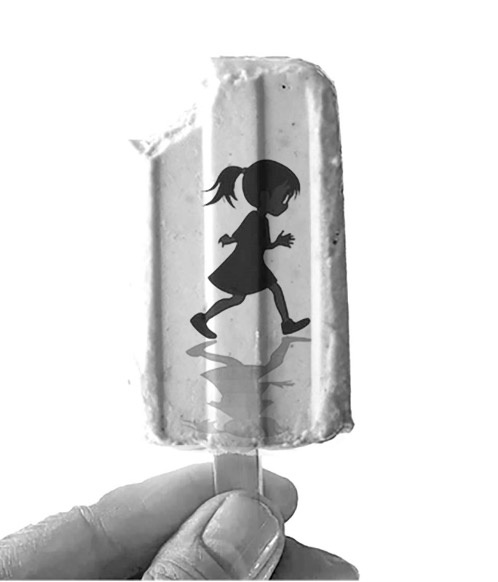
When Mr. Melencio returned to the room, he was holding chocolate twin popsies. He looked at the two girls and broke the frozen treat in half before handing them out.
Sophia looked at him and waved off her half, “I can’t take anything cold.”
“That’s too bad,” Mr. Melencio said, turning to Margaux. “Would you want one?” There was a glint in his eye. “Wait, what kind of host am I,” he said, pausing momentarily before bringing the popsicle to his lips. He bit off the wrapper with his teeth, and sent it drifting to the floor. “Here. Let me hold it for you,” he said, offering the frozen treat to Margaux.
The initial excitement had gone from Margaux’s face giving way to a pale expression. She looked up quizzically at Mr. Melencio and shook her head.
“Come on. Don’t be shy,” Mr. Melencio prodded, his gaze cold. “Take it.”
Margaux turned her head away and stepped back.
Mr. Melencio grinned before biting into the rejected popsicle, sending a portion of it dribbling down his chin.
Margaux’s lips quivered, like she was about to cry. It was like that time when one of her classmates surreptitiously pinched her thigh in class for refusing to lend out the new toy she had taken to school – a small wind-up plush puppy that popped-up on its front legs and scurried across the floor. The teacher didn’t see the student’s unwelcome gesture or Margaux squirm, but Sophia did.
Seeing Margaux close to tears again, Sophia sensed that something was wrong. Her mother’s reminder against taking treats from strangers nagged at her. She had grown up following stories about the Evil Queen offering Snow White a poisoned apple and the snake tempting Adam and Eve to eat the fruit of knowledge in the biblical story of the Garden of Eden.
“We better head back,” she told Margaux, nudging her friend towards the garage door.
“Leaving already?” Mr. Melencio asked. “But you just got here.”
Sophia and Margaux ignored him and headed for the exit. The garage door creaked as they pulled it open, before stepping out into the blaring heat.
“Come and see me again soon!” Mr. Melencio yelled after them, his voice hissing.
From a few meters away, Sophia turned around to see Mr. Melencio keenly watching them from the garage door. He had finished the first popsicle and was biting into the untouched one, his gaze still fixed on Margaux. Sophia and Margaux knew that their fetchers would be looking for them by now. They didn’t want them worrying. They raced with each other back towards the kindergarten grounds, as fast as their legs could carry them — past the dividing fence, the small mausoleum, the kalachuchi trees, and back to where their vehicles were waiting to safely bring them home. The sorbetero’s handbell rang urgently, as if calling them back to the school gate and the familiar comforts of the kindergarten playground.

Caroline J. Howard
Caroline J. Howard is a freelance writer and former broadcast journalist. “Tinnitus’ is her first short story since taking a hiatus from writing fiction. She dabbles in writing free verse poetry and recently discovered an inclination towards painting with acrylic on canvas.