
Bad news spread like bad news does: fast, as fast as chat groups and social media could deliver it, which meant immediately. Lauro Jocson, Jr. was dead.
He suffered a stroke on the 13th hole of his home golf course in Cavite, and had slipped into a coma. His playing partners said he was practicing swings in the tee box with his brand-new driver, half-joking about hitting his ball into the flight ahead because “They’re so slow! They’re so fuc…” when he just keeled over, collapsed like a marionette whose wires had been suddenly cut. In the hot sun his golf mates tried desperately to revive him, but when blood started oozing out of Lauro’s ears and nose they hauled him onto a golf cart and raced back to the clubhouse.
After three days in the hospital ICU, the doctors said they could do nothing for his brain’s internal bleeding, that the inevitable must be accepted, and so his family decided to cease life support and let Lauro pass.
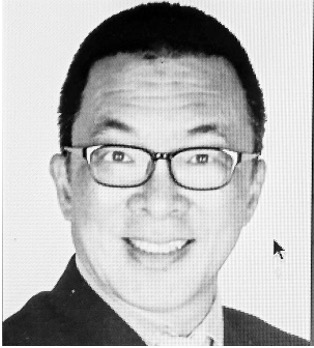
“Lauro’s wake will be from Dec 16 to 20, 2019, at the Archangel Michael Room, Angel’s Gate Columbarium, Santa Gloria Avenue, Taguig City. We invite all of his friends and associates to pay their respects,” read the official message from the Jocson family. “Cremation and inurnment will follow immediately after.” It was accompanied by a formal portrait of a smiling Lauro in a black suit and red tie, taken just a few months prior to a younger relative’s wedding, appropriately retouched to remove background distractions and his facial blemishes. “Lauro Tee Jocson, Jr., August 27, 1960 to December 12, 2019” it read underneath in a stylized script font. He was 59 years old.
Lauro and his family, devout Roman Catholics, regular Mass attendees not only on Sundays but even on First Fridays, and avid participants of Bible study groups, did not lack for sympathy. The condolences from his fellow congregants flooded in. The priests of Santa Barbara Parish sent long messages of consolation and condolences to their group chats, blessing Lauro’s soul with all that God in Heaven could offer, thanking him and his family for the years of service and donations to their church.
Equally profuse in their condolences were Lauro’s middle-aged peers, now slow in physical movement, and with time’s passage, slowing down even more. They poured their digital sympathies into the internet like a monsoon. They were his former classmates and club mates, his friends and fraternity brothers, his business associates. They were those he drank, ate, traveled, and stayed out late with, those he knew from elementary, high school, and university. They were his teammates from basketball, then tennis, then golf, their choice of sport reflecting how the passage of years had moderated their physical decline, their inexorable descent down life’s mountain slopes, accentuated by their increased body aches and pains.
When these peers trooped to Angel’s Gate on the evening of December 16, it struck them just how quickly Lauro had gone on ahead of them. He was the first of their primary cast of major characters to have stumbled and rolled down to the foot of the mountain. They thought they would all gently descend together; that this did not turn out so, shook them to their core. Lauro’s friends worried over themselves, starkly reminded them that the foot of the mountain was within sight and not too far off for any of them. What would they leave behind? What have they done with their lives? As one, they felt both sad and fearful, with more than a touch of desperation, their dwindling time and legacies weighing on their minds.
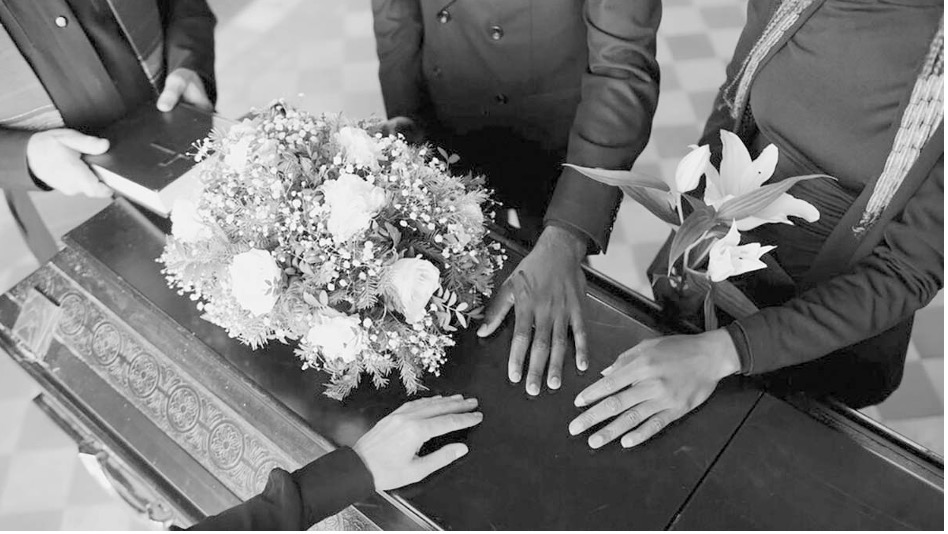
Lauro’s wake was held inside the Columbarium’s largest room–named after the Archangel Michael—which was already curtained from wall to wall with multiple tall and expensive decorative flower settings from many well-wishers. His friends stepped to the front to pray as well as to study Lauro lying in his coffin, as repaired as the mortician could make his countenance seem, but looking far, far worse than his portrait. It occurred to them that their friend must have suffered dreadfully from his stroke.
His expression was far from peaceful. Despite all efforts, his lips grimaced menacingly and his brow furrowed in anger. Lauro looked cruel and devilish. A number of his classmates complained about this to the Columbarium staff standing nearby, but the staff said it was the best that could be done; the stroke was like an explosion in Lauro’s head, and his face muscles had frozen solid into what they saw now. The family had allowed the open casket, besides, with the widow, Rosanna, even saying, “If nothing can be done about it, then so be it.”
After their short prayers, Lauro’s family—Rosanna, the two young adult sons and one teen daughter—met with Lauro’s friends in the middle aisle between the rows of pews. They stood there, awkwardly, speaking in disjointed conversation, offering their face-to-face condolences hesitantly. Lauro’s friends were not close to her or the children, not the way some friends become close with each other’s families. Rosanna greeted them as a group, not individually, even if she knew all their names and who they were. How could she not? His friends were one of the topics Lauro talked about constantly when he was still alive.
They asked how she was, and she answered that she was fine, though her face and voice betrayed some fatigue. She invited them to sit with quick gestures of her arms and hands towards some empty pews, as if pushing them to sit already so that she could put the niceties behind her and excuse herself. One of them dared to ask how the rest of the family was coping.
“We are…okay,” she answered after a pause, as if the realization had just dawned on her. “We are doing all right. Coping well, quite well. Much, much better.” She took a deep breath.
“It’s not like he was in the house a lot. He was always busy, always out. At the office, or the golf course, mostly, meeting people here and there, and then, with you guys, very often. For dinner, for drinks, for concerts, for trips abroad, and even for just hanging out. You just had a week-long trip to Nagoya last month, right? How was your trip?”
Up to that moment, it was the most she had said in one go to any of them at any time, and the more astute of Lauro’s friends looked at her, then away, then back at her again, but sideways and no longer into her eyes. But the most gregarious among them–Jeremy Lee was his name—heard her words for conversation and not for what was being said. He chuckled and then answered, “The trip was great! Fun! Lauro cracked jokes and laughed a lot, like he always does. He was the life of our group! We are so blessed he spent his time with us. He was a true friend. We really appreciate him. We’re going to miss him.”
Rosanna held Jeremy’s gaze through the beats of several silent moments until his smile stiffened in confusion while his companions stood by, shuffling.
“Please, sit,” she finally said, releasing them and the tension, gesturing once more with her hands, but now with a deep sigh that she didn’t care to hide. This time, they did as instructed, clambering awkwardly, tightly, into two pews. She called for someone to serve them juice and snacks, then shortly excused herself to attend to other guests.
Lauro’s friends took in the rest of the Archangel Michael silently. The room slowly filled, mostly with relatives, as the Jocson’s were a large clan, and Rosanna herself had four siblings, all of whom were milling about, helping her and her children as best as they could. They knew Lauro, too, had siblings, a younger brother and a sister, but they could not find them in the throng.
Lauro’s friends clasped their hands between their thighs and whispered to each other about their own health issues—diabetes, prostates, knees, hypertension, gout—a gamut of the middle-aged maladies they were suffering, brought forth into the light by Lauro’s unexpected stroke. They began to feel more comfortable as the minutes passed with no one minding them except each other, and their talk swerved slowly to their natural light banter.
The priest arrived. He walked in through the swinging double doors and they knew him from his Roman collar, the worn, black satchel of Mass accoutrements he carried, and his plastered, toothy smile. The people parted, and he easily made his way through the middle aisle to the altar where Rosanna met him. The priest shook her hand, and that of her children, before he set his satchel down and began to get ready. Rosanna’s daughter fiddled with two wireless microphones to test if they were working. The thumps her fingers made reverberated over the speakers; she left one on the altar and took the other to hand over to her brother, who was to be the lector and who waited on one side.
Someone in the front row stood up as she passed. A short man in an ill-fitting, discolored shirt and too-loose slacks held out his hand to her and asked firmly for the microphone. Confused, Rosanna’s daughter hesitated, and this was enough for the man to reach out and take the microphone from her.
“My name,” he said, his high-pitched voice carrying over the speakers, “is Warrenson James Fernandez!”
Warrenson! The name meant nothing to most of those in the Archangel Michael, but it made Lauro’s friends gape. Warrenson! That was a name they hadn’t heard for years…decades! It was one of their classmate’s names, and this man was him, standing before them! Warrenson! There was no one else in their batch who owned that name, and in their long years after graduation they had met no one else who was named the same. The man in front was the one and only Warrenson Lee Fernandez!
“It’s Warrenson!” Jeremy said. “It’s really him! My God, he looks terrible!”
“He never looked good to begin with,” one of his friends retorted.
“He looks worse than ever!” someone else said.
Although they were all supposed to be of the same age, Warrenson looked two generations older than his classmates. Scraggly but with a bulbous paunch, stringy and thinning white hair on an egg-shaped head perched on a scrawny, skin-shriveled neck, Warrenson seemed ready to join Lauro at any time in death. He was saved only by his energy, reflected in the passion in his voice, and the intensity of his wet, rheumy eyes squinting through very old-model eyeglasses. Yes, there was no mistaking that this was, indeed, Warrenson, their former classmate, appearing out of nowhere like a ghost.
“Lauro Jocson, Jr. was my classmate, my seatmate!” Warrenson continued.
Memory could be strange; it only took an image, a bit of music, a voice or a setting, a sound or a story, to dredge up what was long forgotten. Where minutes before, no one among the friends had given a thought to their time as elementary and high school students. Yet in that instant Warrenson stood and spoke before them, they became students once more, remembering their school, the sights and the sounds of their classrooms, their teachers, their energetic youth.
And Warrenson was a part of it, especially early on school mornings. He was always the first to arrive, not long after followed by Lauro. By virtue of the alphabetical seating arrangement, their tables were just one row apart, just an arm’s length away from each other, to Lauro’s glee and Warrenson’s misfortune.
“I’m telling everyone now that he was a goddamn fucking bully and I hope he suffered! I hope he died in a lot of pain!” Warrenson shouted.
The Archangel Michael gasped as one, and Lauro’s friends remembered more, remembered everything.
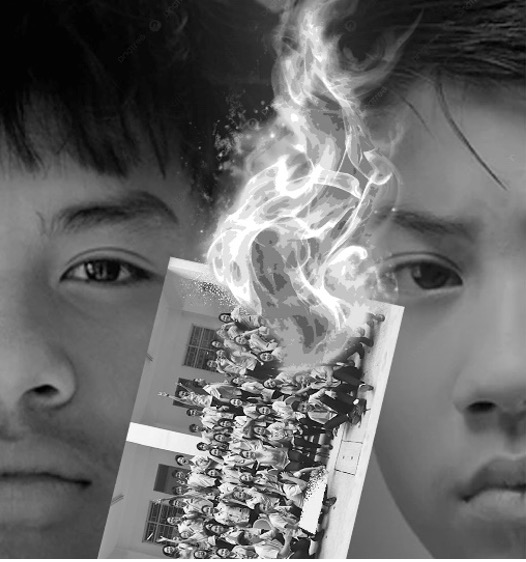
Every morning during their senior high school year, Lauro would walk into the classroom and Warrenson would be there ahead of him, waiting, cowering, small. Lauro wouldn’t start his devilment right away; he loved an audience, and he waited for all of his friends to arrive before he started, and he always began with Warrenson’s smell.
“You really stink!” he’d say. “Don’t you ever take a bath?” The sad truth of it was Warrenson did stink, and he looked the part in his unwashed, yellowing uniforms and his old, worn shoes. He couldn’t shower regularly because he had a serious case of psoriasis, so soap badly affected his skin, and his arms were covered in reddish, angry flakes that looked like snake’s scales; occasional pustules would form there, especially in summer; and when he shook his head, his hair snowed dandruff.
Warrenson had been brave enough to answer back the first time he was attacked with a simple “Shut up, Lauro,” but he was short and weak. The heavyset Lauro found it simple enough to lift him bodily out of his chair and to deliver a swift punch to his stomach.
“Say that again,” Lauro said with menace, but Warrenson didn’t, couldn’t, not through the pain.
“I got my hands dirty touching you, you shit,” Lauro said, pushing Warrenson to the floor. “I had to get near your stink, and look! I’ve got your skin all over me, aaagh!” Lauro gathered his saliva and spat it into Warrenson’s face. “This had better not be infectious, fucker! Next time, I’m gonna use a stick to beat you!”
Warrenson never answered back after that, but mornings became a ritual of hurtful insults that Lauro wholeheartedly enjoyed hurling at him. The laughter of his friends spurred him on, and they joined in, being led, as they were, without questioning whether they were taking the right path or not. It was a show, Lauro’s show, an almost daily roasting of his favorite target. Out of fear, the other class members chose to keep their distance. What few friends Warrenson had disappeared. If someone else was being targeted, if someone else was being hurt, then that meant that they were not, and that was good enough, as long as they were safe.
It was a good few months before someone anonymously wrote to a teacher of what was happening. A short investigation ensued, and the authorities’ goal was to return the situation to normalcy as soon as possible. Lauro was given detention for three days, but nothing more; Warrenson was moved to a different class, but by that time, the damage had been done. He had become a pariah, shunned and ignored, and when he graduated, eking out just good-enough grades to pass, he disappeared from everyone’s knowledge and was forgotten.
Until Lauro’s wake.
What pain he carried over the years, bottled up and fermenting silently within him like a mixture turned toxic, sour, and foul, he released it all that evening, telling the Archangel Michael the story of what Lauro and his friends had done to him. He told the people everything, punctuating his tale with all the curses and insults he could muster.
“He did this to me! He deserves no respect!” Warrenson gestured to the open casket. “I hope he suffers in hell forever!” he shouted at the still-shocked audience, “And I hope you follow him there! Because you did this to me, too!” he ended, pointing at Lauro’s friends.
Whereupon they burst out of their seats in anger and would have reached Warrenson if not for the tightly-packed crowd. They reached out for him, and Warrenson flinched only a bit but held his ground.
“He’s already dead!” Jeremy shouted back. “Why talk about him that way? What for? He’s dead! Dead!”
“I don’t care if he’s dead, and I don’t care what you do to me now!” Warrenson said. “You’ve already done your worst! You should be in hell with him for what you did to me!”
“How dare you say these things about Lauro!” the priest said hotly, interjecting himself, using his scolding, sermon-voice, grabbing at the microphone in Warrenson’s hands. “He was a good Catholic! He attended my Masses, my recollections! This is his wake! We are praying! Respect the dead! You should be ashamed of yourself!” The two engaged in a brief tug-of-war for the microphone.
“Stop!”
A word from the widow halted the ruckus. Rosanna had picked up the other microphone from the altar and barked her order with authority. In the ensuing silence, she spoke her next words slowly.
“I am sorry,” she said, gazing deeply into Warrenson’s eyes, and she meant it from her heart. “I am so sorry,” she repeated, and the way she said it made Warrenson release his microphone to the priest, who snatched it away.
Rosanna saw in him her own victimhood, and though not in the same manner, she had suffered for far longer than he. She hoped that for all the festering Warrenson had undergone, that he was not too far lost, and that like a reflection, he could also see his own victimhood in her.
“You’ve said what you needed to say,” she said, and envied him for that. “You may go now.”
“Let him go,” she said to Lauro’s friends. Everyone felt–or feared–the widow’s power, and as one they backed down. A very few of them, those who were less taken up by what had happened, hung their heads, trying not to seem a part of their group anymore. For a short moment, Warrenson took in Rosanna’s words before he walked down the middle aisle, stiffly, resolutely, with energy—no shuffling off, no bowed head, not from him, not this time, never again—and no one saw his lower lip trembling as he did so.
Shameful, shameful, shameful, the crowd murmured after him. He’s already dead, dead, dead, they whispered. So shameful.
“Disgraceful,” the priest said.
Rosanna asked for a fifteen-minute break, for everyone to settle down, and told the priest to start his Mass right after. She put the microphone back on the altar and faded to the back of the Archangel Michael, headed for the exit. Everyone assumed she was retreating briefly to the bathroom to compose herself, but no one saw her take a bottle of water and a packed meal with her as she left.
Rosanna chased after Warrenson through the almost blindingly lit corridors. Despite his small frame, he had walked fast and far ahead. She caught up to him standing by the front driveway, his cellphone in hand.
“Here,” she said, and handed him the meal and the bottle.
Warrenson, taken by surprise, accepted the offer meekly, his earlier bluster exhausted.
“It was not enough,” he said to her.
“Nothing will ever be enough,” she said.
They regarded each other, fragile acceptance and resignation hanging between them. Lauro’s unexpected death had dealt the classmate and the wife a final blow: unattempted and unfinished resolution. Warrenson had expressed himself, but dead men cannot hear. Rosanna had been biding her time, waiting for all her children to reach adulthood before…before what? Even she wasn’t sure what would have come next, but time had run out suddenly, the way it always did. Learning to live with pain had taken both of them down similar paths, although both had treated the journey differently, one with stoicism and the other with bottled rage.
The two were acutely aware of what had been stolen from them. When peace was torn away and shredded, when balance could not be restored and the unfairness lingered like undissipated stench, the aftermath was dealt with from within, often alone. No one emerged the same, rarely for the better, certainly not these two. How to carry burdens—and how to release them—were learned skills, and not all people were good students.
The ride Warrenson had called for with his cellphone arrived, tires crunching as it rolled up the driveway and stopped in front of him. He stepped into the sedan and rode away face-first into the night, into the poorly-lit city streets, never looking back, vanishing just as quickly as he had done before.
Inside the Archangel Michael, Lauro Jocson, Jr. lay dead. He could do no more. He lay in his casket with his face frozen in that hateful mask which even took the priest aback when he finally found some time to view it. Too busy to say anything about it, the priest set up for Mass, and while doing so, he thought of Warrenson’s story and how impossible it sounded. Slander and calumny, he thought, of one of his most devoted parishioners. Such a disgraceful and insulting act.
The friends sat in their pews, awkwardly at first, but many of them still felt the heat of what had transpired. So what if Warrenson’s story was true? So what if all that he said really happened? So what if they had been a part of it? This was not the place. There were other places for him to complain, but not here. This was a wake. This was a time to pray for the deceased.
If they could have seen themselves, they would have noticed that their grimaces and their furrowed brows mimicked Lauro’s own death mask. They might have then worried about whether their own visages, upon their deaths, would be the same as Lauro’s. But no one held up a mirror to them, and they were too caught up in themselves to point this out to each other. And if there were others in the crowd who would have eventually talked to them, who would have tried to get to know Lauro’s friends, these people felt no urgency to do so anymore.
While waiting for the priest to begin Mass, the crowd continued to whisper among themselves: about Warrenson; about Lauro and his friends, all while giving them sidelong glances; about the children, and Rosanna, his wife. Poor, poor Rosanna.
Rosanna waited for Warrenson’s car to disappear from sight before returning into overly bright Angel’s Columbarium, rushing back to her guests and her responsibilities. But halfway to the Archangel Michael, she found herself slowing down, almost stopping, as if her strength was being sapped and her body had taken on extra weight. She found herself asking why, what for, had the effort ever been worth it?
Then she thought of her three children. They had no other choice but to cope, and she remembered that they were, indeed, coping. They were okay; she had said so herself earlier, so that was something to keep in mind. A small measure of relief filled her, and maybe that was all anyone could ask for. She resumed her brisk walk back to the Archangel Michael, to whatever awaited her, awaited them.
Kenneth Yu
Kenneth Yu is a writer and editor residing in Metro Manila, Philippines. His short fiction has been published here and abroad such as Malaysia, Taiwan, Canada, and the U.S.A. He is the publisher and editor of Philippine Genre Stories, which first started as a full-print digest that published genre tales by Filipino authors, and is now an online e-zine atwww.philippinegenrestories.com. He is the author of two short fiction collections: Mouths to Speak, Voices to Sing: Stories by Kenneth Yu (Penguin Random House SEA, 2024), and The Greatest Fight of Sunny Granada and Other Stories (Anvil Publishing, 2025).