

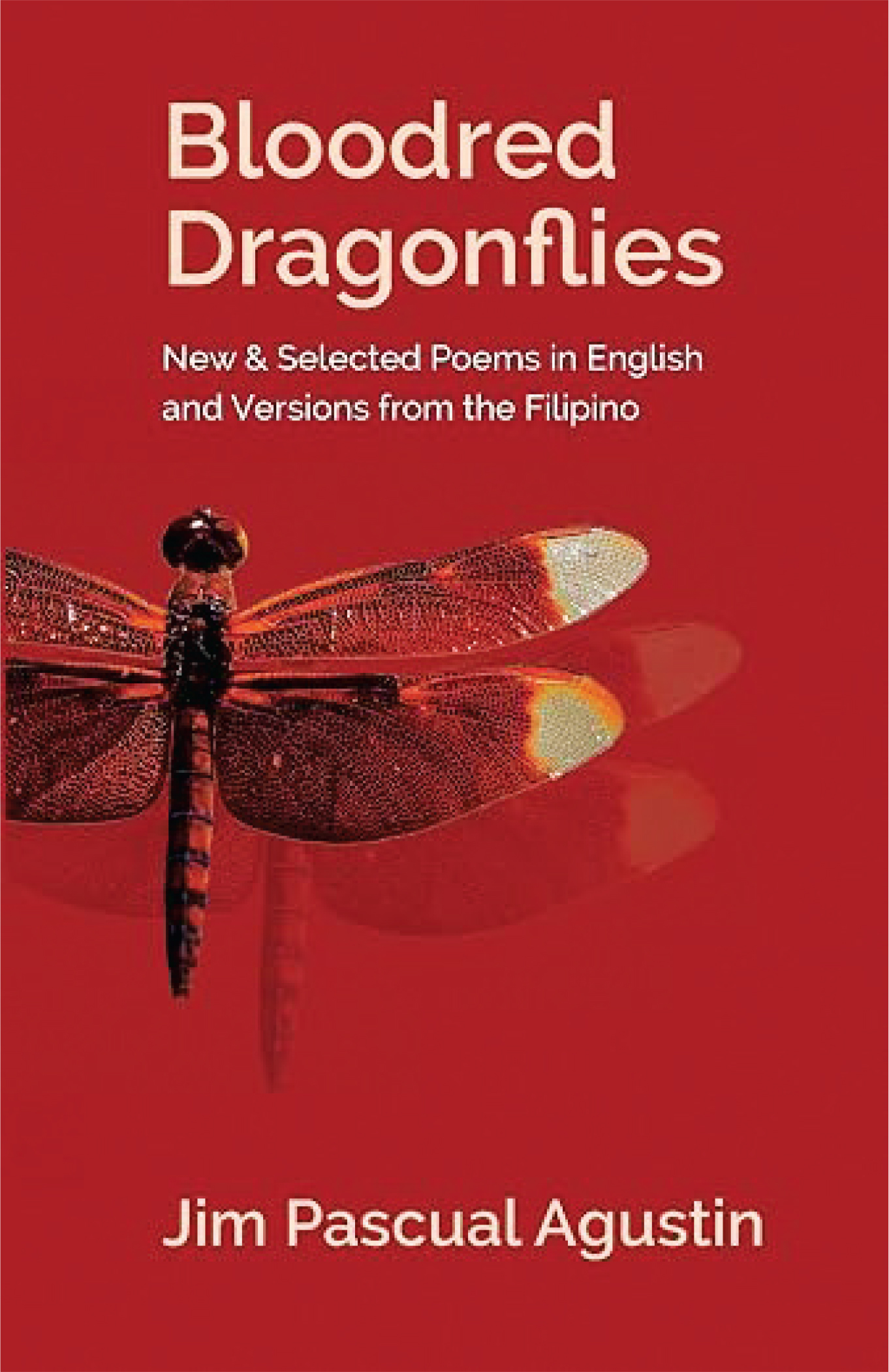
It’s a four-year-old book of poetry—a slim book, all of 90 pages, with 55 poems published in 2022, ready to be read and absorbed.
And for English-proficient third-millennium Filipinos—whether aspiring for comfort or already living in ease—the images spun by 16 of the 55 poems hark back to a time beyond their consciousness.
That is why Jim Pascual Agustin’s Bloodred Dragonflies can be the metaphorical blood transfusion required to pump poignant, visual, and painful cells of old memory into the veins of the unconcerned and unaware.
SEEING IN THE DARK
In “Seeing in the Dark,” a woman gives a glimmer of the future: you will leave your country/stare loneliness in the eye/bury the dead among the living/and resurrect them unwillingly/because your hands are your way/of seeing in the dark She foretold the future and yet, the lines reveal: the future, the past, the present. The timeline doesn’t matter because the image is always true. The Filipino diaspora limp through the centuries, gripping loneliness and isolation with both hands.
DRAGONFLIES
A fragile childhood is picked up and smashed on the incline of memory in the book’s title poem, “Dragonflies.” Bloodred dragonflies are a rare sight to many who people cities of concrete indifference and unknowing. They are just like Agustin’s poems-rare, beautiful, but cutting. It isn’t possible to find the old house/ where you taught me how to take/my very first steps, Mother./ The government didn’t just tear down/ its foundations. They buried it/ under twenty feet of soil.
Over that, they stretched tar/ in the name of the dictator,/built a bridge that tore the shoulders/ of the river.
Then they carved out the hill/ that was almost a mountain.
It is almost cinematic, an ode to all the houses demolished to give way to government development projects. And then the picture widens to include a dictator, the skein of brutality stretches and palpates with the intensity of destruction unfurled.
LINES TOO LATE TO UTTER
From the social, Agustin shows he can touch the personal— a fallen experience, a failed relationship. It is raw, the images strong and painful.
Look for me on the edges of shadows/ at dusk, away from streetlights/and neons, beyond the urban sprawl/ where people are boxed meals. Listen to my whisper between/a dog’s fading howl/ and the snapping of a cat’s claw as it runs up a wall/ with graffiti skin.
There is regret crumpled between a final goodbye and a recognition of love despite.
Forget what I wrote you years ago./ Those promises have found/their boundaries. Go, take flight,/my love.
WHO IS JIM PASCUAL AGUSTIN?
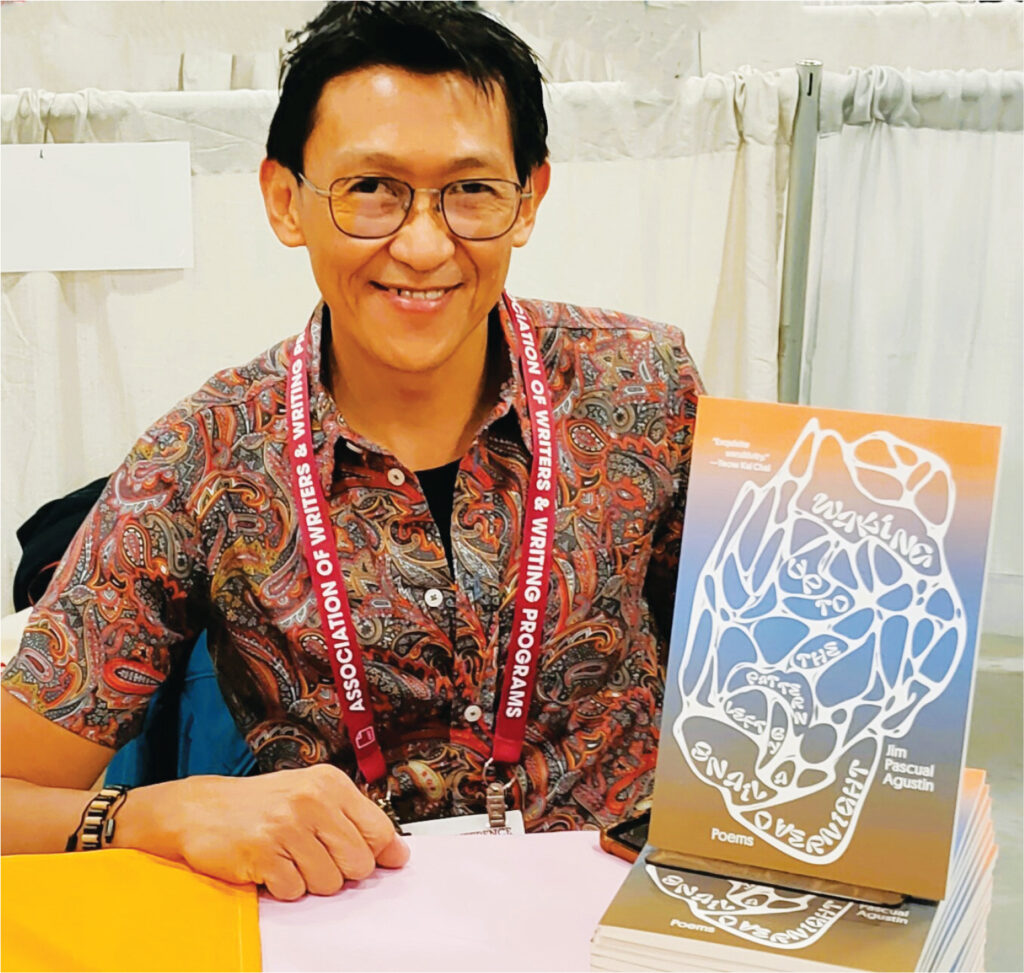
Jim Pascual Agustin is a Filipino poet, Marikina-born and Ateneo de Manila University-bred. He has been living in South Africa for 32 years with his Canadian-South African wife and twin children.
While many Filipinos chose to migrate to the United States in search of posh jobs and a higher standard of living, Agustin opted to go to faraway South Africa to live the life of happily married poet.
Interviewed online by the Philippines Graphic, Agustin said, “I left Manila in October 1994 to follow the woman I had met the year before while travelling in the Mountain Province.” Not only did Agustin follow the woman from the Mountain Province to South Africa, he also ended up marrying her.
Agustin finds many similarities between the Philippines and South Africa, “Both countries share a long colonial history, with many different groups of people who have their own local languages. There are 12 official languages in South Africa, including sign language.”
He added: “There is a common warmth and openness among the people of both countries. There are mineral riches and magnificent places.
But South Africa has many nature reserves. One would have to live here to get a better idea of the place and its people.”
One wonders how someone who seems to have enjoyed a life of relative comfort can nurse in his chest the deep wounds that—if statistics governed—more commonly reside among the poor and disadvantaged in our midst?
The answer to the wondering may be psychological, sociological, and could even be deeply religious. But one thing is definite, Jim Pascual Agustin’s poetry makes you see bloodred dragonflies. —Psyche Roxas-Mendoza