

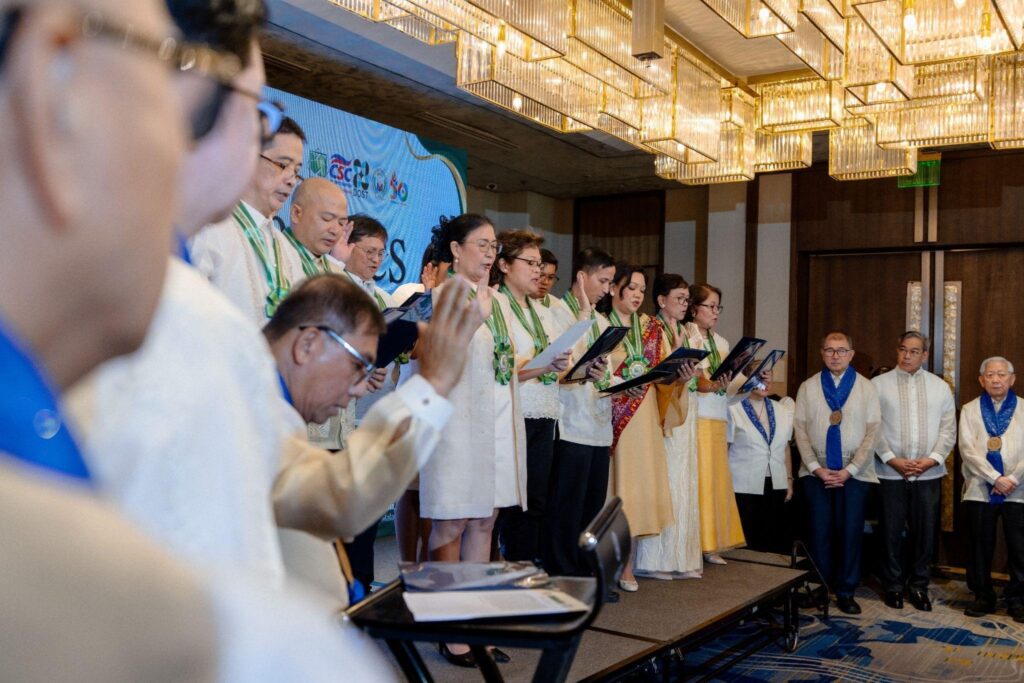
VIA GRAPHIC PLUS — Eleven government researchers and scientific experts were officially named as new Career Scientists and two upgraded Career Scientists this year, the Scientific Career System (SCS) recognized, Admiral Hotel, Manila, Sept. 21.
The SCS, alongside the Department of Science and Technology – National Academy of Science and Technology (DOST-NAST PHL) and the Civil Service Commission (CSC), conferred the title on scientists from various government agencies.
The ceremony served as a formal recognition of government scientists who have demonstrated sustained excellence, professional competence, and significant contributions to research, development, and innovation in the public sector.
“Today, we celebrate the years of dedication, perseverance, curiosity, and hard work that brought our scientists to this important milestone,” said Ms. Luningning E. Samarita-Domingo, Director of the National Academy of Science and Technology, Philippines (NAST PHL) and Executive Secretary of the Scientific Career Council (SCC), in her welcome message.
Newly Conferred Career Scientists
Focusing on health, food, and nutrition sciences, two experts, Dr. Mildred O. Guirindola and Idelia G. Glorioso, from the DOST-Food and Nutrition Research Institute (FNRI) were honored as Career Scientist I.
Dr. Guirindola led the National Nutrition Survey (NNS) and other food system projects, while Glorioso focused on technology-driven nutrition education, such as the Nutrition Educator’s Kit (NEK), to help guide national health policies, interventions, and legislative efforts for public nutrition.
For social sciences, Dr. Eric P. Palacpac was conferred for his efforts to champion effective technology adoption among livestock farmers through extension services and digital tools.
National Museum of the Philippines’ Dr. Danilo N. Tandang is conferred for biological sciences for discovering and describing 40 new flowering plant species across the Philippines, further enriching the national herbarium.
DA-PhilRice’s Imeldalyn G. Pacada, on the other hand, patented an AI-based breeding tool to develop pest- and disease-resistant rice varieties and other methods to protect national rice security.
Supporting sustainable microenterprises and agricultural pest management, Dr. Irene M. Adion of DA Regional Field Office III established incubation centers and tissue culture labs to improve propagation of crops such as sweet potatoes and mushrooms.
Expanding plant conservation, Maria Lea H. Villavicencio of the University of the Philippines Los Baños – Institute of Plant Breeding, curated plant genetic resources through community genebanks specifically for taro and other medicinal plants.
In addition, Dr. Mary-nia M. Santos of DA-NFRDI was also conferred under the Scientific Career System for Agricultural Sciences apart from Dr. Pacada and Dr. Villavicencio.
Milestone
This year’s edition marked a milestone for the SCS as it conferred Career Scientists from the DOST-Philippine Institute of Volcanology and Seismology (PHIVOLCS) for the first time.
Of these, three Career Scientists I are recognized under engineering & technology and mathematical & physical sciences, namely Jeffrey S. Perez, Dr. Rhommel N. Grutas, and Dr. Arturo S. Daag.
Perez is known as the “fault finder” as he leads the mapping of the key segments of the Philippine Fault, one of the longest and most active fault systems in the world, alongside the Valley Fault System, which is widely associated with “The Big One.”
Dr. Grutas, on the other hand, who specializes in seismic hazard assessment, risk reduction, and resilient infrastructure design, spearheaded the Seismic Hazard Assessment for Design Earthquake of the Philippines (SHADE) Project.
The SHADE contributed to the updating of the country’s Maximum Considered Earthquake (MCE) Maps, National Structural Code, and seismic hazard atlas, tackling improved building safety against seismic risks.
Similarly, Dr. Daag is recognized for his work in geological hazard assessment and landslide investigations, among others—hence his contribution to the Dynaslope Project, a community-driven early warning system for deep-seated landslides.
He also directs satellite imagery collection and interpretation through international collaborations such as Sentinel Asia and the European Space Agency-CoPhil Project, enabling real-time maps for efficient disaster response.
Rank Advancement
Two experts were also conferred as Career Scientist II, recognizing their advancement in rank within the SCS.
DOST-Philippine Nuclear Research Institute’s (PNRI) Dr. Angel T. Bautista VII was decorated for his expertise in nuclear and isotopic methods to address environmental radioactivity.
He leads national initiatives for nuclear fuel cycle research and the establishment of the National Isotope Center to advance stewardship, policy, and scientific capabilities related to nuclear technologies.
Dr. Ester B. Flores of DA-PCC developed modern genomic breeding frameworks, improving quality and genotype technologies for Philippine dairy buffaloes.
She introduced structured breeding initiatives for riverine and swamp buffaloes, developed models for genetic evaluation and genomic selection to enhance buffalo herd quality and livestock livelihoods.
As part of the program, the SCS also paid tribute to former members of the Scientific Career Council and the Special Technical Committees (STCs) for their dedicated service and valuable contributions to the implementation of the Scientific Career System. Their expertise and commitment have helped uphold the integrity and rigor of the evaluation process for the conferment and advancement of government scientists.
The following former SCC and STC members were recognized:
- Dr. Ma. Louise Antonette N. De las Peñas – Past SCC Member
- Acd. Edward H.M. Wang – Past STC-HSD Chair
- Acd. Cristina J. Montiel – Past STC-SSD Member
Meanwhile, DOST Secretary Renato U. Solidum Jr., in his keynote, affirmed that being conferred as a Career Scientist underscores public service through scientific pursuits.
“Our knowledge, our expertise, and our daily toil contribute to something far greater than ourselves. This is most evident in the scientists we honor today,” he said.
Further, he urged them to share their learning and mentor young researchers, “not only on the methodologies but also on the patience, integrity, persistence, and pursuit of truth.”
“The ultimate measure of a scientist’s legacy is not only what they discover, but what they empower others to discover, build, and achieve long after they are gone,” he reminded.
In his closing message, Academician Jaime C. Montoya, President of NAST PHL and member of the SCC, reminded the awardees and aspiring government researchers of the broader purpose of scientific work in the public sector.
“Never lose sight of why we do science in public service,” he said, as he encouraged scientists and researchers to remain committed to continuous learning, professional growth, and the pursuit of scientific excellence in service to the Filipino people.
The 2026 Oath-Taking Ceremony reaffirmed the commitment of the Scientific Career System to strengthening the scientific workforce in government by recognizing excellence, promoting professional advancement, and providing a structured career path for highly qualified researchers and scientists in public service.
Through the continued implementation of the SCS, the government seeks to cultivate and retain a strong corps of scientists whose expertise and innovations contribute to evidence-based policymaking, national development, and improved public welfare.
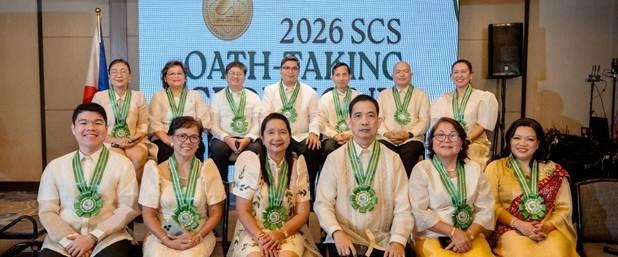
The conferment of career scientists is one of the initiatives of the Department of Science and Technology (DOST) aimed at providing science-based, innovative, and inclusive solutions across four strategic pillars: human well-being, wealth creation, wealth protection, and sustainability. These pillars embody the mantra OneDOST4U: Solutions and Opportunities for All.