

By: Eunice Jean C. Patron
Human-built environments, such as the spaces we live in, can influence our health through microbiomes—communities of microbes like bacteria and viruses. People have long been unconsciously influencing microbes through the way we design our built environments. With the right knowledge, we can intentionally shape these microbial communities to support better health—an idea currently explored by Filipino researchers in a recent study.
Pursuing interdisciplinary collaborations
Ma. Beatrice Villoria of De La Salle – College of Saint Benilde, also the owner of the thesis that started this research, collaborated with Vina Argayosa of the University of the Philippines – Diliman College of Science’s Natural Sciences Research Institute (UPD-CS NSRI), Angelo Rosalinas of Ove Arup & Partners Hong Kong Limited – Philippines Branch, Daniel Nichol Valerio of De La Salle University, Christian Lyle La Madrid of LLUID, and Michael Xavier Ticzon of Fundamental Design Experts—who come from diverse fields of expertise—to create a conceptual framework for translating microbial research into design tools for the urban built environment.
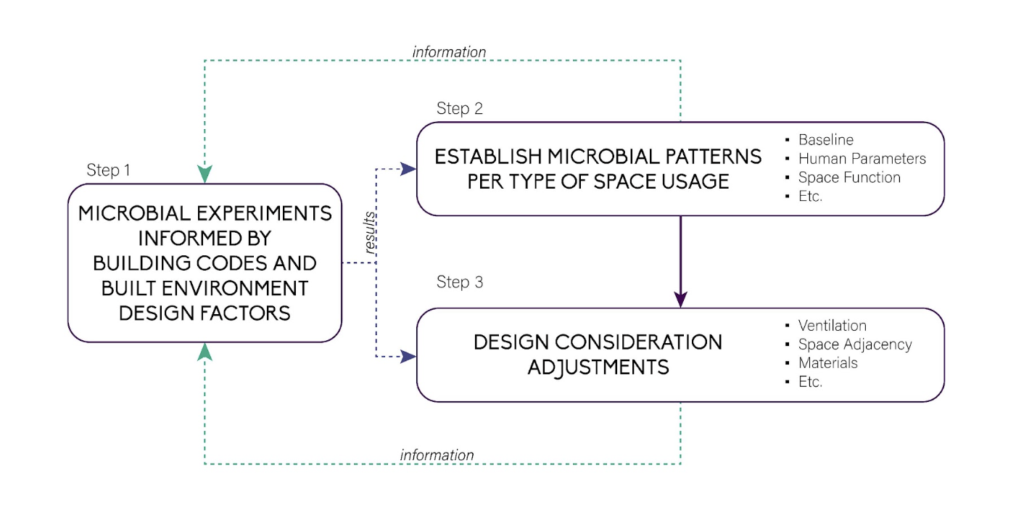
The study found that ventilation and the number of people in a space have a huge impact on the amount of indoor bacteria. A framework showing how microbial research can be done to produce data usable by architects and other designers for building design – similar to the experiments in the study- was developed by a team of architects, a microbiologist, and engineers led by Villoria, an architecture graduate.
“It started in my thesis, I looked for a microbiologist [Argayosa] who was willing to work on this idea, and the effort paid off,” Villoria shared. “Having different fields working together is a big help in our evolving society. So far, I’ve collaborated with people from the fields of architecture, microbiology, and engineering. For sure, there are other disciplines we need to work with to further develop the study.”
Application to existing building code
Building codes, such as the National Building Code of the Philippines, set standards for design and construction within a country. These standards typically take the local climate, site conditions, anthropometry, and many more into account. However, the impact of building design set by building codes on microbial presence has yet to be explored.
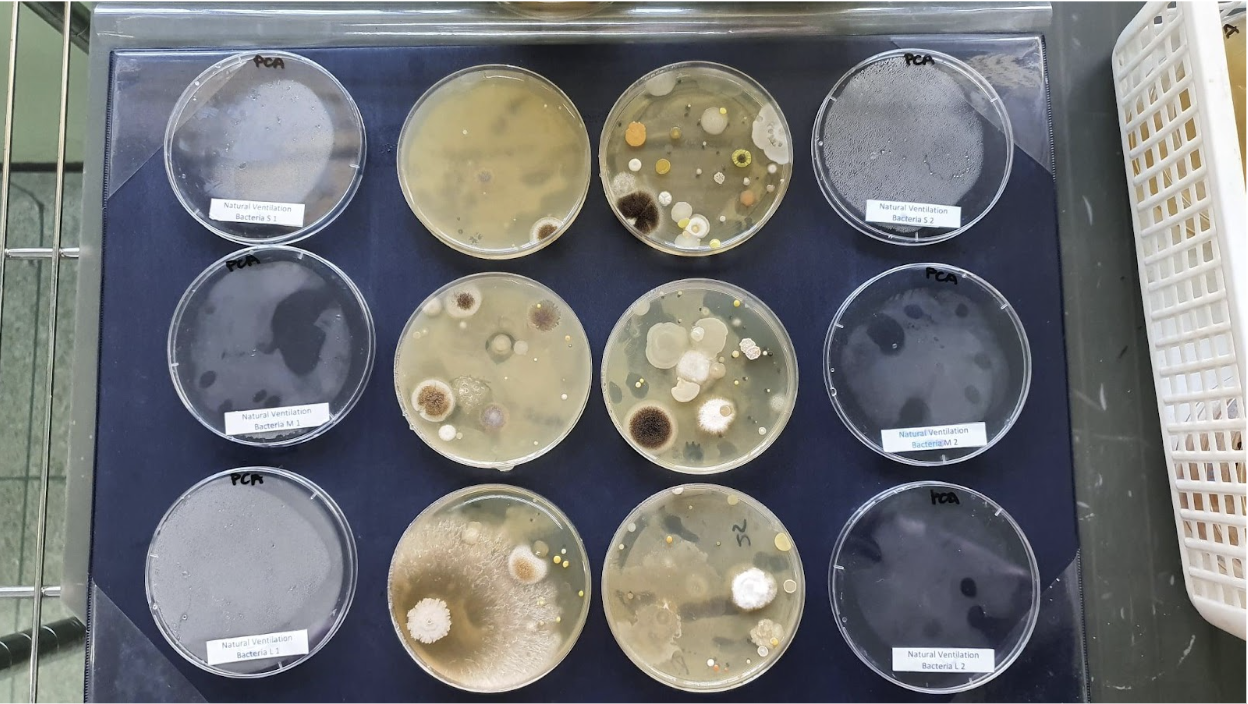
The researchers used the National Building Code of the Philippines, particularly its guidelines on the minimum habitable room, as the basis for their study. Three experiments were conducted in Metro Manila using passive air sampling—a method for collecting airborne bacteria and fungi—to measure bacterial and fungal counts under different conditions: ventilation, window size, and human presence. The findings were used to conceptually design an indoor space that considers microbial presence.
“How do we measure a healthy amount of microbes in a built environment? It would actually be good to define that. Hospitals and manufacturing sites follow certain standards based on the acceptable levels of microbes they should have. Now, it’s like we’re examining our daily lives with a more studied approach—especially as things become more urbanized,” Argayosa said.
Global relevance from a local study
Although the research was conducted in the Philippines, the methodology can be applied in other parts of the world. Since each country follows its own building codes and regulations, the framework can be adapted to different contexts—considering factors such as the country’s temperature and humidity. “Other countries have their own design standards that fit the needs of their country. In our case for example, our tropical climate has a different effect on humidity, temperature, which influences the types of microbes that grow here in our country,” Villoria added, saying that their team hopes that the findings of their study can serve as a reference point for international efforts to improve overall indoor environmental health.
Ongoing refinement of the framework
The work doesn’t stop at using the conceptual framework for a minimum habitable room; rather, the team encourages researchers from various fields to build on their data by including other types of room or space usage. “If people understood patterns between the built environment and microbes better, they can make more informed interventions later on,” Villoria explained. “We’ll need to start small—like on a micro level—so we can build up the data and form patterns. This conceptual framework can still be updated and then used on a much bigger scale like the zoning of cities which affect a bigger number of people.”
“We don’t realize it, but we’re actually surrounded by microbes. Our bodies have a lot of microbes, and so does everything around us. Just being aware that these microbes are in our surroundings is already a big deal,” Argayosa expounded. That’s why this study asks: is there something we can do in how we design our buildings, and what kind of impact would that have?”
The study, titled “Integrating building code to microbial count studies in urban built spaces with ventilation and human presence: a model,” is published in Frontiers in Built Environment, a journal that focuses on the development of sustainable methodologies for the design and management of resilient buildings and infrastructure.
For interview requests and other concerns, please contact media@science.upd.edu.ph.
References:
Villoria, M. B., Argayosa, V. B., Rosalinas, A. D., Valerio, D. N., La Madrid, C. L., & Ticzon, M. X. (2025). Integrating building code to microbial count studies in urban built spaces with ventilation and human presence: A model. Frontiers in Built Environment, 10. https://doi.org/10.3389/fbuil.2024.1517638

Started in 1927, the Philippines Graphic is the longest-running printed magazine of national circulation that provides relevant news and features and promotes Philippine literature.