

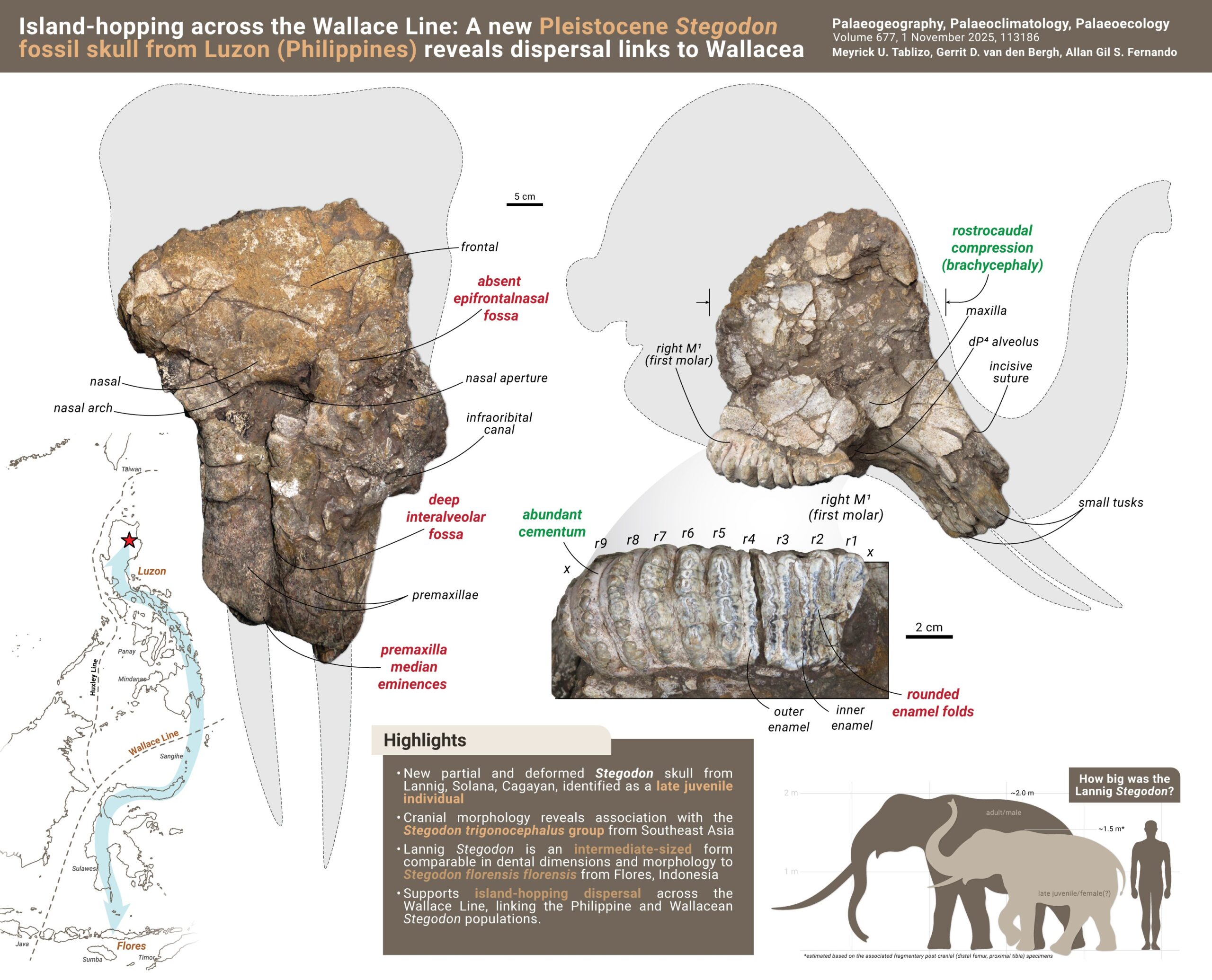
The first-ever fossil skull of a Stegodon—an extinct relative of modern elephants—in the Philippines was discovered by a local in Solana, Cagayan (northern Luzon) and described by paleontologists from the UP Diliman College of Science (UPD-CS) and the University of Wollongong in New South Wales, Australia.
Meyrick U. Tablizo and Dr. Allan Gil S. Fernando of the UPD-CS National Institute of Geological Sciences (NIGS), and Dr. Gerrit D. van den Bergh from the University of Wollongong have recently published a study describing the million-year-old Stegodon skull.
The paleontologists believe that the Stegodon was likely a “teenager”, possibly slightly taller than the average Filipino. A fully grown Stegodon from this population may have been slightly smaller than the living Asian elephant. “Its features match those of Stegodon from Indonesian islands like Sangihe, Sulawesi, and Flores,” shared Tablizo. “This means that these ancient elephants were strong swimmers, able to cross open seas and island-hop, as there were no land bridges connecting these islands.”
Finding a Stegodon skull is extremely rare. Large animal fossils are generally much harder to find than small ones, and among these, sturdy parts like teeth and tusks survive far more often than fragile skulls. “Skulls are large, hollow, and easily broken before or during fossilization, so they almost never make it through thousands to millions of years intact,” he explained. “That’s why most Stegodon fossils from the Philippines are just isolated teeth or tusk fragments, with occasional bone fragments.”
The uncovered Stegodon skull is one of a kind—despite being crushed and deformed, it still preserves a complete tooth and two small tusks. Tablizo said that while there were old reports of Stegodon skulls in Luzon, none were ever properly studied or kept in museums, making this find not only rare but also the first formally described Stegodon skull from the Philippines.
This discovery gives us a clearer picture of the ancient wildlife of the Philippines. “We’ve known about Stegodon being here since the late 1800s, but until now, only teeth and tusk fragments had been studied sparsely,” added Tablizo. “A skull is much more informative because it helps us determine which other Stegodon populations this animal was related to and how it might have reached the Philippine islands.”
Their findings suggest that Luzon may have hosted at least three different forms of Stegodon: a large-bodied type, a smaller “dwarfed” type, and the new intermediate form—indicating that the Philippines had a richer and more complex history of these ancient elephants than previously thought.
Tablizo emphasized that apart from the fossil itself, its context—where it was found, what layer it came from, and what other remains were nearby—is just as important. With few paleontologists in the country, chance discoveries by locals are especially valuable. “If someone happens to encounter a fossil, the best step is to contact the Nannoworks Laboratory, the Paleontological Society of the Philippines, or the National Museum of the Philippines. This ensures the find is properly studied and preserved, and it might even become a key piece in understanding our natural history,” he concluded.
Their research paper, titled “Island-hopping across the Wallace Line: A new Pleistocene Stegodon fossil skull from Luzon (Philippines) reveals dispersal links to Wallacea,” was published in Palaeogeography, Palaeoclimatology, Palaeoecology, a journal that features high-quality studies in the field of palaeoenvironmental geoscience. — By Eunice Jean C. Patron
For interview requests and other concerns, please contact media@science.upd.edu.ph.
References:
Tablizo, M. U., Van den Bergh, G. D., & Fernando, A. G. (2025). Island-hopping across the Wallace Line: A new Pleistocene stegodon fossil skull from Luzon (Philippines) reveals dispersal links to Wallacea. Palaeogeography, Palaeoclimatology, Palaeoecology, 677, 113186. https://doi.org/10.1016/j.palaeo.2025.113186

Started in 1927, the Philippines Graphic is the longest-running printed magazine of national circulation that provides relevant news and features and promotes Philippine literature.

 and described by paleontologists from the UP Diliman College of Science (UPD-CS) and the University of Wollongong in New South Wales, Australia.)