

There is a famous story of a wager between the Roman politician Mark Antony and the Egyptian queen Cleopatra. The condition was simple: to host the most expensive feast.
As the story goes, Cleopatra won by dropping a rare pearl from her earring into vinegar, dissolving it, and then drinking it.
This is what I imagine whenever I would come across news of our marine life—our oceans and seas— being damaged by human activity: the “pearl” dissolving, and the once great seas of the Philippine islands slowly becoming unworthy of its historical sobriquet.
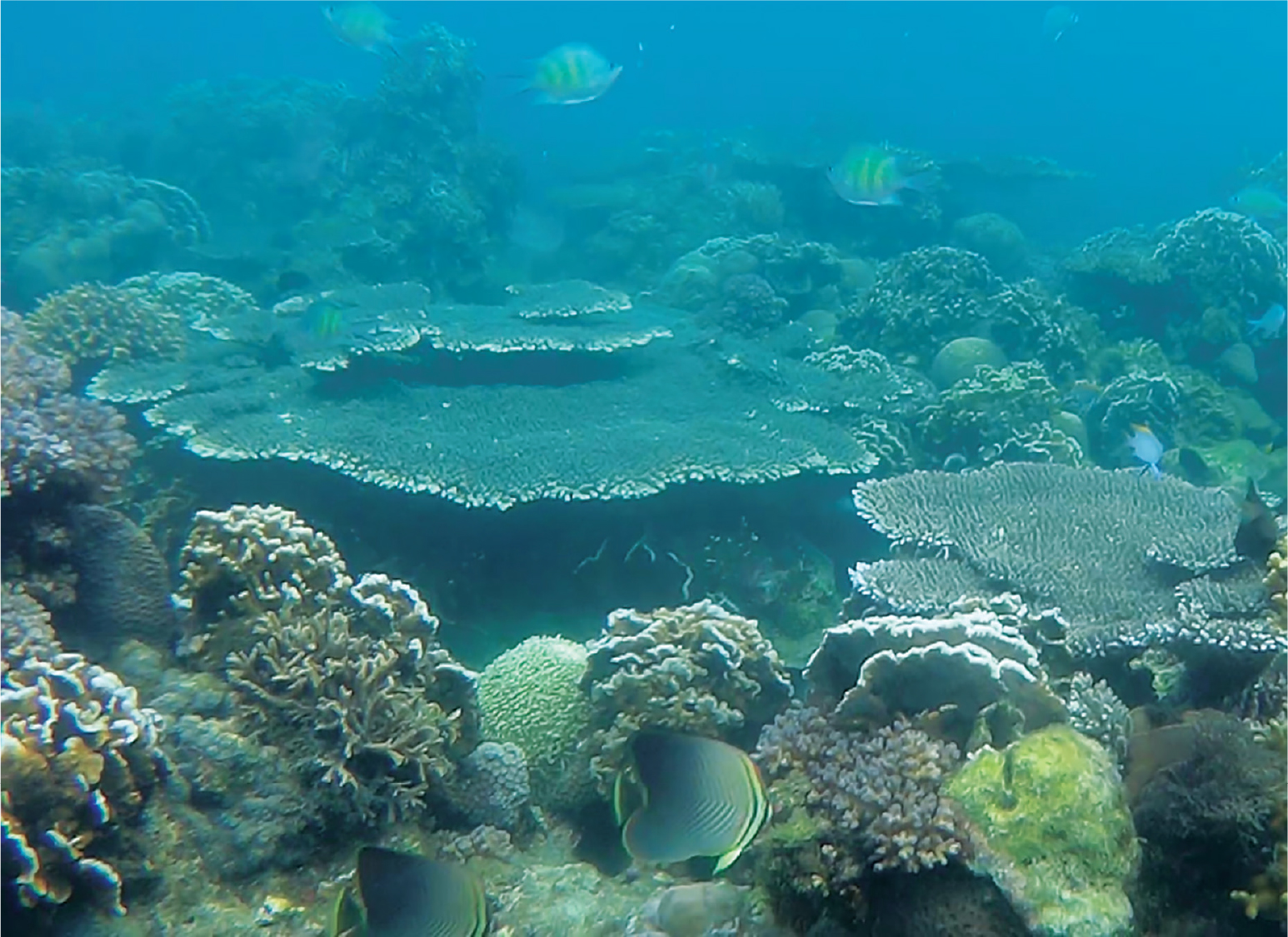
This writer recently revisited a Philippine Graphic article by Ben A. Abogadie Jr. published on November 9, 1992, titled “Save Our Coral Reefs!” There, he wrote about the importance of coral reefs in sustaining the country’s rich marine biodiversity.
“The Philippine archipelago, with a coastline much longer than that of the United States, has some of the world’s richest and most diverse coral reefs,” began Abogadie in his article.
He continued: “Of the 500 known species in the world, 400 are found in the country’s 7,100 islands—a fantastic collection even greater than that of the Great Barrier Reef of Australia.”
HOUSE OF LIFE
It is easy to admire coral reefs: their vibrant colors, the way sunlight filters through water, and the schools of fish they attract. One could surmise that the corals are nature’s most remarkable displays.
But coral reefs are more than just underwater attractions. According to Abogadie, marine biologists consider our coral reefs as one of “the most productive marine ecosystems in the world.”
“As one of the essential ecological processes and life-support systems, coral reefs serve not only as shelters but also as spawning, feeding, and nursery grounds for fish and other marine creatures,” Abogadie wrote. They also serve as crucial barriers protecting the shoreline from erosion.
Coral reefs are among the most productive ecosystems on Earth. Acclaimed Filipino environmentalist Ramon Binamira says that a hectare of healthy coral reef is capable of producing around 30 metric tons of fish every year.
But even back in 1992, when Abogadie wrote the piece, the Philippines’ precious coral reefs constantly faced danger.
‘VINEGAR’ TO THE ‘PEARL’
Despite what the coral reefs bring to the country—whether in tourism or livelihood—their destruction has loomed for decades.
A report produced by Newsweek in June 1992 found that “dynamiting, polluting and collecting have killed 90 percent” of the Philippines’ coral reefs, with more than half of it already “in advanced states of destruction.” About 25% were in good condition, and only 5% of our country’s live coral cover is in excellent condition.
Abogadie wrote: “Sizable areas of reef flats and reef crests at Tubbahata and nearby seamounts, for instance, have been reduced to rubble, apparently by dynamite blasts and other forms of destructive fishing. Marine biologist Angel Alcala notes that dead hard corals indicate the effect of sodium cyanide poisoning to stun the fish. Corals have also been broken by muro-ami fishing and boat anchors cast indiscriminately at the marine park.”
Aside from fish stunning, cyanide fishing, Binamira pointed out, causes “the slow death of reefs, as well as poisoning the people eating poisoned fish.”
Illegal fishing is trading quick gains at the expense of the future generations. It is akin to shooting oneself in the foot—destroying livelihood in the process. As a noted environmentalist, Binamira mourned this, especially how corals could take around half a century—sometimes more—to grow, “only to be destroyed by dynamite fishermen in less than a second.”
Humanity, which has the greatest capacity to protect marine life, has instead become the “vinegar” to the “pearl”—eroding it over time.
The worst part? It never stopped in 1992, or 1993. In fact, this man- made catastrophe has yet to stop.
DESTRUCTION CONTINUES
Over the past decade, coral reefs have appeared in the news more often for damage than recovery. Foreign fishermen have usually been in the headlines for destroying swaths near or within our maritime territory, such as the time they were harvesting giant clams from Scarborough Shoal in June 2018.
Authorities and environmental groups held their breaths when news first broke out of an overseas- registered oil tanker running aground near Bolinao in Pangasinan in December 2019, when officials and environmental groups hoped for as little damage as possible to the reef area where it was stuck.
In June 2025, a maritime militia vessel ran aground near Pag-asa Island, causing P11.1 million worth of coral damage.
But the damage done to our country’s coral reefs couldn’t be attributed solely to foreign actors. Filipinos also had a hand in the reefs’ worsening state.
One of the worst incidents was the 2023 sinking of MT Princess Empress —a Philippine tanker vessel carrying 800,000 liters of industrial fuel oil. Some of the content spilled to the water and spread over 24 square kilometers. According to scientists from the University of the Philippines’ Marine Science Institute, around 20,000 hectares of coral reef were affected by the oil spill, apart from the almost 10,000 hectares of mangroves and 6,000 hectares of seagrass.
STILL A ‘PEARL’?
Binamira said that corals might “take around 50 years or more to grow into fish sanctuaries.” Only 35 years have passed since Ben Abogadie wrote his article for the Graphic—yet the state of things has yet to improve.
This suggests that the coral damage when the latter wrote his article has yet to recover, on top of the many more harm it has faced since then.
The best course of action is to protect these ecosystems, even as ocean pollution persists. Increased use of plastic materials over the years only resulted in more damage.
Could we still call our country “Pearl of the Orient Seas,” or should we start thinking of other names to replace our historical sobriquet?
This article appeared in the April 2026 issue of the Philippines Graphic.
RELATED ARTICLE:

Von Zyron Alimorong
Von Zyron Alimorong is a writer and social media point person for the Philippines Graphic. He is based in Makati. His works often dissect human nature, infusing narratives with introspection and existentialist thought. He studied Literature at the University of Santo Tomas and served as a Literary writer for The Flame. He is also the rhythm guitarist for the band COALESCENCE.